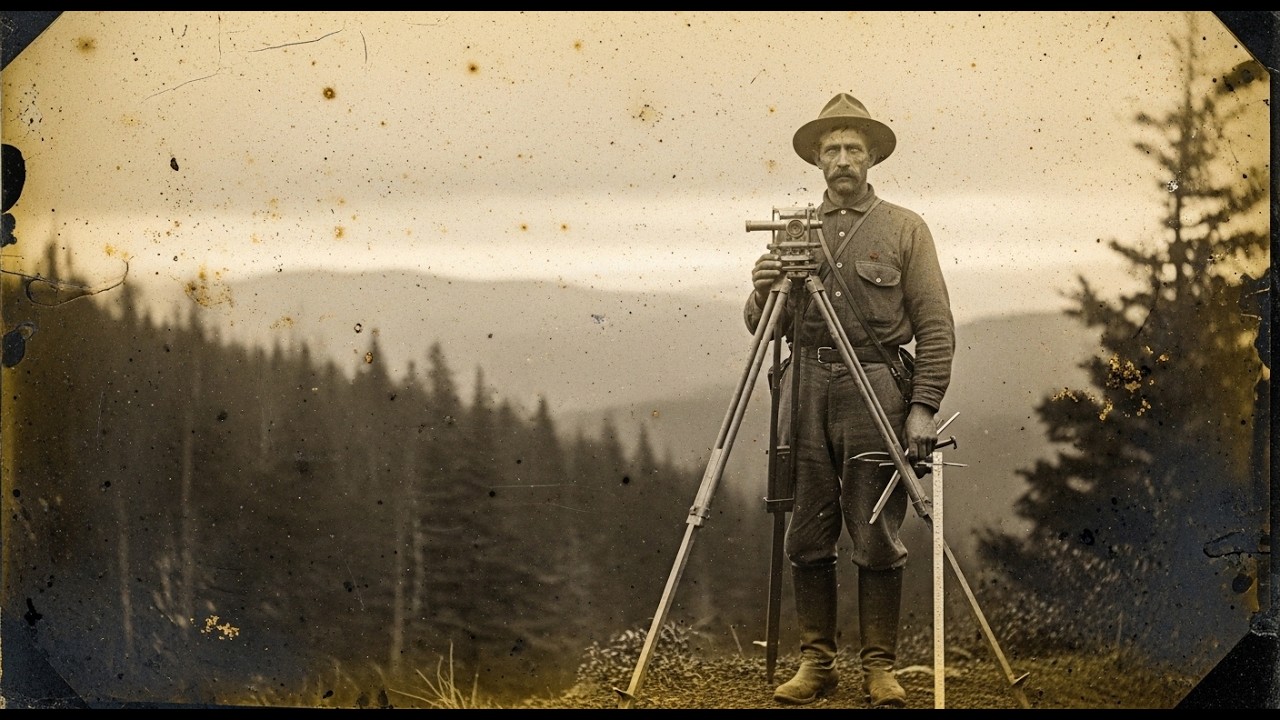
In the autumn of 1891, a geological surveyor named Vernon Ashcroft arrived in the high country of eastern Kentucky. He was 34 years old, a practical man of science employed by a mining company out of Pittsburgh. His assignment was to spend six weeks mapping coal and mineral deposits in a remote stretch of mountains the locals called the Shrouded Ridges.
Ashcroft was accustomed to solitude. He had spent months alone in the wilderness of West Virginia, worked through brutal winters in the Alleghenies, and once mapped a canyon system in Tennessee so remote he didn't see another human being for 47 days. He preferred the company of rocks and trees to people.
The company arranged for him to stay at a small settlement called Millrice, about 15 miles from his work area. The town was little more than eight or nine buildings clustered around an old gristmill. He took a room at a boardinghouse run by a widow named Cora Whitfield, who warned him not to be late for supper.
That first evening, Ashcroft mentioned where he would be working. The conversation among the other boarders died instantly. A young timberman named Gareth Price asked if he was going into the Shrouded Ridges. When Ashcroft confirmed it, Price said he didn't know anyone who went up there regularly anymore.
An older timberman named Luther Crown added that people didn't like it up there. He said the area had a feeling to it, especially past a place called Deadman's Gap. When Ashcroft asked what kind of feeling, the man just shook his head and went back to his meal.
Ashcroft dismissed the warnings as mountain superstition. He had heard similar stories in other remote places and had never seen anything that couldn't be explained by natural causes.
He set out before dawn the next morning with a pack mule named Sadie. The trail was clear at first, climbing steadily through thick forest. By late afternoon, he reached Deadman's Gap, a narrow cut through a ridge of dark gray stone hemmed in by sheer rock faces.
The gap was silent in a way that felt wrong. No birds called. No wind stirred. Even the sound of the mule's hooves seemed muffled. Ashcroft felt a wrongness, like he had stepped into a place that didn't follow the same rules as everywhere else. He shook it off and kept moving.
On the other side, the forest changed. The trees were older, thicker, with trunks so massive three men couldn't have linked arms around them. The light had a different quality, filtered through the dense canopy in a way that made everything look gray and faded.
Ashcroft set up a base camp beside a stream and settled into a routine. The work was methodical. By the third day, he found promising coal seams exposed in a cliff face about two miles northeast of camp. He spent most of a week mapping the extent of the deposit.
But something was bothering him. He would catch movement in his peripheral vision, only to find nothing when he turned. He would hear what sounded like footsteps on the trail behind him, but the sound would vanish when he stopped to listen.
On the eighth day, Ashcroft found marks carved into the bark of a massive oak tree. They formed a symbol he didn't recognize, a series of angular lines arranged in a pattern almost like a sunburst. He found more symbols over the next few hours, always on the uphill side of the trunks, always facing deeper into the mountains.
That night, he sat by his fire studying the symbols he had copied into his field book. A branch cracked somewhere in the darkness. He grabbed his rifle and called out. No answer came.
He didn't sleep well. He kept waking, convinced he had heard something. The third time he woke, it was the darkest stretch before dawn. He lay in his tent and realized what had been bothering him for days. It was too quiet. An absolute silence pressed against his tent like something physical.
Then he heard footsteps. Slow and deliberate, moving around the perimeter of his camp. The rhythm didn't sound right. It sounded like boots on the ground.
Ashcroft grabbed his rifle and threw open the tent flap. The fire had burned down to coals. He called out again and heard a response. Not words, but a low vocalization that could have been a voice, pitched too deep and too resonant to come from a human throat.
He stood there in the cold, rifle raised, staring into darkness so complete it felt like staring into the earth itself. The sound didn't come again. He lit a lantern and searched the camp. There were no tracks, no sign anyone had been there. But he knew what he had heard.
He didn't sleep again that night. He sat with his back against a tree, rifle across his lap, watching the darkness until dawn.
The next day, Ashcroft stayed close to camp, telling himself he needed to organize his samples. He kept expecting someone to walk into camp and explain the sounds. No one came. By late afternoon, he had talked himself into believing he had imagined the whole thing.
He decided to push further into the mountains the next day to survey a ridgeline running northeast. It was the edge of his survey area. Once he mapped it, he could start thinking about heading back.
The next morning dawned clear and cold. Ashcroft loaded the mule and headed northeast. By midmorning, he reached the ridge and set up his theodolite. He was about two miles along the ridge when he found the structure.
At first, he thought it was a natural rock formation. But as he got closer, he realized the rocks had been stacked deliberately to form a crude shelter, open on one side and facing back the way he had come.
The interior was dark and smelled of rot and something acrid. The walls were covered with the same symbols he had found carved into the trees, but here they were scratched into the stone. Hundreds of them. In the center was a pile of ash and charred wood. Scattered around it were bits of bone, feathers tied with sinew, and bundles of dried herbs.
In the very back, partially hidden behind a rock, was a skull. It was human, or at least mostly human. But the bones had an odd quality to them, darker than they should be. The jaw was too long. The eye sockets were too large. The whole thing looked caught between two forms.
Ashcroft backed out quickly, his skin crawling. He told himself it was old, probably Native American. Mineral deposits could cause discoloration and distortion. But he knew he was lying to himself.
He left the ridgeline quickly and headed back down the slope. Sadie seemed nervous, pulling at her lead and trying to move faster than he wanted.
When Ashcroft reached camp in late afternoon, he immediately knew something was wrong. His tent flap was hanging open when he was certain he had secured it. His equipment had been rearranged, placed in patterns he couldn't interpret. His field books were open, the pages ruffled like someone had been reading them.
He felt cold anger rising, pushing aside his fear. He called out, said he knew someone was there. No response came. Nothing had been stolen. Nothing damaged beyond the violation of having his camp rifled through.
As darkness fell, he loaded his rifle and sat with his back to a large boulder, facing his tent. Tonight, he decided, he would get answers.
The hours crawled past. The night was perfectly still. Sometime after midnight, he heard it again. That low vocalization that was almost, but not quite, a voice. This time it came from multiple directions, as if two things were calling back and forth to each other.
The sounds overlapped in a way human voices shouldn't be able to, creating a resonance Ashcroft could feel in his chest. He stood up, raised his rifle, and shouted at the darkness.
The sound stopped immediately. Then, at the very edge of his firelight, he saw them. Figures standing just beyond where the light turned everything into indistinct shadow. Tall figures, unnaturally so, at least seven feet. They stood perfectly still.

Ashcroft could feel their eyes on him, the weight of their attention like pressure against his skin. He sighted on the nearest figure and called out one more time. The figures didn't move.
His finger tightened on the trigger. But something stopped him. Some instinct deeper than fear told him that if he pulled that trigger, he would not survive the night. That whatever unspoken agreement was keeping those figures at bay would be broken beyond repair.
Then, as if released by some silent signal, the figures turned and walked away. They moved with an odd gliding gait, too smooth to be natural, and made no sound at all as they disappeared into the darkness.
Ashcroft stood there for a long time, rifle still raised. Eventually, he lowered the weapon. He stood by that fire for the rest of the night, feeding it constantly, and didn't take his hand off the rifle until the sun came up.
When dawn broke, he made a decision. He wasn't abandoning his job, but he wasn't staying out here alone. He packed up what he could carry, cached the rest, and headed back toward Millrice. He planned to hire someone to come back with him.
The trip down was uneventful at first. But the trail seemed longer than he remembered. Landmarks didn't appear where he expected them. By late afternoon, he realized he was off course. He consulted his compass and found he had been heading west instead of south, away from Millrice.
He turned around and tried to retrace his steps, but the forest all looked the same. After half an hour, he had to admit he was lost.
He found a small clearing beside a stream and set up a minimal camp. As soon as full dark fell, the sound started again. That low vocalization, now seeming to come from all around him. He heard things moving in the darkness, not trying to be quiet. Branches broke. Stones clattered. Once, he was certain he heard breathing just beyond his fire's light.
He didn't fire his rifle. He remembered the feeling from the night before, that sense that violence would break some unspoken agreement. So he sat there, shaking with fear and exhaustion, feeding his fire, waiting for dawn.
At one point, he must have dozed off. He jerked awake to find his fire had burned down to coals, and something was standing over him. A shape darker than the darkness around it, absolutely silent.
Ashcroft scrambled backward, grabbed a branch, and thrust it into the coals until it caught fire. He waved it at the figure. By the flaring light, he caught a glimpse of something he would never be able to adequately describe.
A face that was almost human, but stretched wrong. Features elongated and distorted. Eyes that reflected the firelight like an animal's, but which held an intelligence far too knowing. Hands with fingers that were too long and seemed to bend in too many places.
The figure stepped back, retreating into the shadows. Ashcroft heard that vocalization again, but now it sounded different. Almost like laughter. Mocking and cruel.
Then it was gone.
Dawn came eventually. Ashcroft didn't waste time. He kicked apart his fire, grabbed his pack and rifle, and started walking. He didn't trust his compass. He just picked a direction that felt like it was going downhill and started moving.
It was mid-morning when he heard voices. Real human voices. He crashed through the brush toward the sound and emerged onto a wide, clear trail. Two timber workers stopped in surprise when he stumbled out of the forest.

He must have looked wild. His clothes were torn, his face scratched and dirty, his eyes hollow from lack of sleep. He tried to explain what had happened, but the words came out confused and disjointed.
The timber workers listened with expressions that were hard to read. Concern mixed with something else. Something that might have been recognition. One of them, a man named Jasper Crane, said they could take him back to their camp.
The timber camp was about two miles down the trail. There were maybe a dozen men working there. They gave him coffee and food, let him wash up and rest. He slept for most of the afternoon.
That evening, he sat by the cook fire and told them everything. He could see by their expressions that they believed him. These were hard men who made their living in the wilderness. But they knew about the Shrouded Ridges.
An older fellow named Rutherford Beck, who had been working timber in these mountains for 30 years, told Ashcroft he was lucky to have made it out. He said there were places in those mountains where the old world was still close to the surface, where things lived that were there before anyone, before the Indians even. Things that didn't take kindly to being disturbed.
"You went into one of those places," Rutherford said. "Most who do don't come out."
Ashcroft stayed with the timber camp for two days. Then Jasper Crane guided him back to Millrice. They made the trip in one long day.
Ashcroft spent a week in Millrice writing his report for the company. He documented the coal deposits, provided his measurements and samples, made his recommendations. But he also wrote a separate confidential letter to the head of the surveying division.
In it, he explained what had happened as clearly and rationally as he could. He recommended that the company abandon any plans to mine in the Shrouded Ridges. Not because the coal wasn't there, but because the cost would be too high. Not in money, but in lives and sanity.
"Some places," Vernon wrote, "should be left alone."
He never went back for the equipment he had cached. The company accepted his report and his recommendation. They didn't send anyone else up there, and as far as Ashcroft could determine, no mining operation was ever established in the Shrouded Ridges.
Ashcroft continued working as a surveyor for another 15 years, but he never took another job in Eastern Kentucky. When other surveyors asked why, he would just shake his head and say it wasn't worth it. He never told the story again.
He retired in 1921 and bought a small house in Pittsburgh. He spent his last years tending a garden and reading books and trying not to think about the mountains. But sometimes, on quiet nights, he would lie awake and remember.
Vernon Ashcroft died in 1933 at the age of 76. His widow, going through his effects, found his old field books. Among them was a journal from that autumn in 1891, filled with measurements and sketches and notes. But the last several pages had been torn out, removed so cleanly that only the ragged edges remained.
Whatever Vernon had written about his final days in the Shrouded Ridges, he had chosen to destroy rather than let anyone else read.
The Shrouded Ridges are still there, as remote and isolated as they were in Vernon's time. The forest has reclaimed everything. But if you were to hike up there now, if you were to pass through Deadman's Gap and venture into those high country forests, you would probably find the ruins of Vernon's camp, gradually being absorbed back into the earth.
You would find other things, too. Those symbols carved into trees, weathered but still visible. That stone shelter on the ridge, its interior still marked with scratches and stains.
And if you stayed after dark, if you built a fire and sat by it as the night deepened, you might hear sounds that have no explanation. You might see movement at the edge of your light. Figures that watch without approaching.
You might feel that same wrongness that Vernon felt. That sense of being in a place where you don't belong, where your presence is tolerated but not welcomed.