The bucket came up empty for the third time, and that was when my brother said the rope had stopped catching water and started catching stone.
We had been draining that well for two straight days. It was an old hand-dug well on a homestead high in the mountains of Western North Carolina, a piece of land my family had held since before anyone alive could put a date to it. The water had gone bad years back, gone brown and sour and wrong, and we finally wanted to know why.
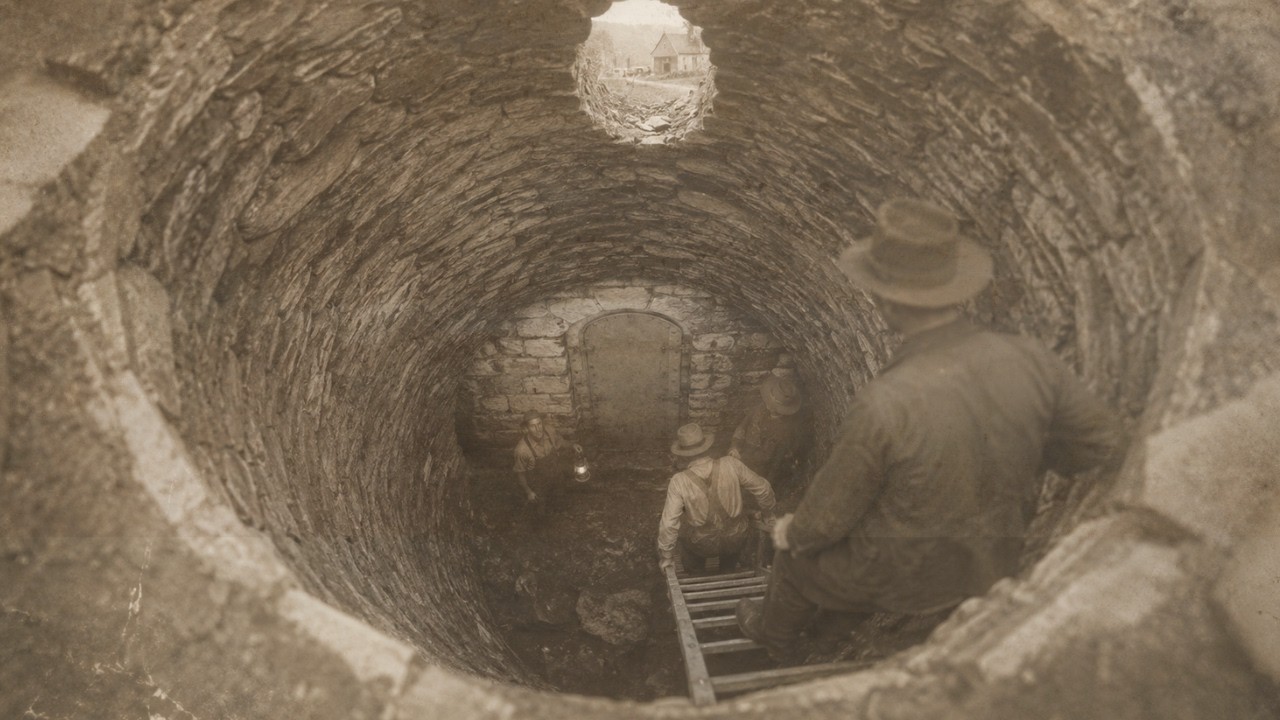
So, we ran the pumps. We watched the level drop lower than any well on that ridge had any right to go. Forty feet down, then 50, and still the shaft kept dropping away beneath us, dry and straight and far too smooth for something a farmer supposedly clawed out of the ground with a pick and a prayer.
Then the beam from my headlamp caught something at the bottom that had no business being there. Not a rock, not the black muck you brace yourself for, but a flat face of dressed stone cut clean. Set into that stone, framed on every side, was an outline, a shape my eyes refused to name for a full 10 seconds.
It was a door. Sealed shut. Waiting.
Sixty feet under a mountain that every history book swears was empty wilderness until the 1700s, and the longer we stared, the more certain we both became of one thing. Whoever built that door had not been trying to keep something out. They had been trying to keep something in.
The Homestead
The homestead sits at the end of a gravel road that the county stopped maintaining sometime in the 1960s. You climb for the better part of an hour past nothing but laurel and hemlock and the rusted skeletons of fences nobody has mended in a lifetime.
My great-grandmother was the last person to live there full-time. She died when I was a boy, so most of what I know about the place came to me in pieces, in the half-remembered warnings older relatives handed down without ever quite explaining.
The cabin still stands. The barn has mostly gone back to the earth. Behind both of them, ringed by a low wall of stacked fieldstone, sits the well.
Here is the thing about that well that never sat right with me, even as a child. It was too good. Everything else on that homestead was rough work, honest mountain carpentry, logs notched by hand and chinked with clay. But the well was different.
The stones lining its mouth were cut square and fitted so tightly you could not slide a knife blade between them. No mortar, none. Just stone locked against stone with a precision that did not match a single other thing for 40 miles in any direction.
As a boy, I never thought to ask why. You do not question the things that have always been there. It is only when you come back as an adult with adult eyes that the questions start to itch.
The Stories
The old people had stories about the well. Of course they did. Every mountain family has its stories, and you learn early to fold them away as superstition.
My great-grandmother would not let anyone draw from that well after dark. She said the water tasted different at night, said it came up colder and heavier, and she would rather go thirsty than lower a bucket past sundown.
There was another thing she used to say, and I only really turned it over years later. She said the well was older than the house, older than the family. She said her own grandmother told her that the people who first cleared that land did not dig the well at all.
They found it. They found it already there, already cut, already deep, capped over with a slab of stone that took four men to move. When they moved it, they found water. So, they built their home around it, and never spoke of who had cut the shaft in the first place.
We are taught that these mountains were untouched wilderness before European settlers arrived. Empty, forested, home to native peoples who left no cut stone behind. And yet here was a well on a nothing homestead that the settlers themselves admitted they did not build.
Draining the Well
We started draining on a Thursday morning, cold and bright. The pump coughed and caught, and the hose bucked in my brother's hands as the first water came up.
That water, I will never forget the smell of it. Not sewage, not rot, but something mineral and metallic, like a mouthful of pennies and cold iron. A smell that got into the back of your throat and stayed there.
We pumped for 6 hours that first day, and the level barely seemed to move. We told ourselves the well was just deep. We told ourselves a lot of things that first day because the truth was already whispering at the edges, and neither of us wanted to hear it yet.
By the end of that first day, the water level had dropped maybe 15 feet. My brother lowered a headlamp on a string to see how much further we had to go. What came back up on his phone screen made us both go quiet.
The walls of the well below the old water line were not rough stone anymore. They were dressed, cut, the same tight mortarless masonry as the mouth up top, but cleaner, sharper, as if the deeper you went, the more careful the builders had been.
About 30 feet down, worked into one of the blocks, was a mark. A single carved symbol, a kind of looping spiral wrapped around a straight vertical line, cut deep and deliberate into the face of the stone. A mason's mark maybe, except no mason from these mountains ever signed his work.
Day Two
Day two started before dawn. Neither of us had slept much. We ran the pump hard, and by mid-morning the level had dropped past the mark on the stone, past 30 feet, past 40. The smell coming up out of that shaft had changed.
The metallic tang was still there. But underneath it now was something dry and ancient, the smell of a sealed room that has not breathed in a very long time.
That is when we knew we were close to the bottom, and that is when the water finally cleared.
My brother was on the rope, lowered to about 55 feet with the headlamp strapped to his chest. I was at the top working the pulley. He had gone quiet, which was not like him. Then his voice came up the shaft, thin and strange, and all he said was, "Come look."
So I tied him off, and I went down.
The door was set into the north wall of the shaft, where the round well suddenly squared off into a flat, deliberate face of stone. The frame was perhaps 7 feet tall and just over 3 feet wide, carved from a single piece of dark rock that did not match the granite of the mountain around it.
This stone was almost black, fine-grained, and cold to the touch in a way that went past the chill of the water. In the center of the frame sat the door itself. It was not wood, and it was not the same black stone.
It was metal. A dull greenish-gray metal that had not rusted, had not corroded, had not surrendered a single flake to 60 feet of standing water and untold years of dark.
I put my hand flat against it, and it did not feel like anything I had touched before. It was smooth as glass, and there was the faintest hum under my palm, so faint I told myself I imagined it. I have never fully convinced myself of that.
Across the surface of that metal door ran lines. Not decoration, not the scrollwork you would expect from a tomb or a vault. These were straight, and they were curved, and they intersected in patterns that felt less like art and more like a diagram.
At the very center, where a handle should have been, was that same symbol from up the shaft. The spiral wrapped around the vertical line, larger here, deeper, and ringed around it were seven smaller marks I had never seen before and cannot draw for you even now.
We did not speak for a long time. There is a particular silence that comes over you when the ground you have stood on your whole life quietly tells you it has been lying.
The Records
We climbed out of that shaft near dark, and neither of us wanted to spend the night on the property. We drove down the mountain to the little town at the foot of it.
Over coffee that neither of us drank, we made a decision. Before we touched that door again, we were going to find out everything we could about who had lived on that land before us. Not the family stories, but the paper. The deeds, the surveys, the county records.
The next morning, we were at the county records office when it opened. The clerk there, an older woman who had worked that office for the better part of 40 years, went a little pale when we told her which property we were asking about. She pulled the file, laid it on the counter, and stepped back from it.
The deed history went back further than we expected. Most mountain parcels have a clean chain of ownership that peters out in the 1800s. Ours did not peter out. The oldest document in that file was not a deed at all. It was a survey.
The survey was dated the summer of 1891, drawn by a man whose name I will not give here because his descendants still live in that county. His field notes were attached, folded into the back of the file, brittle and brown.
In those notes, buried among the ordinary business of measuring a mountain parcel, the surveyor had written a passage that made the coffee go cold in my stomach. He wrote that the well on the property was, in his professional judgment, not a well.
He wrote that the shaft was too regular, too deep, and lined with worked stone of a quality he had seen nowhere else in the county. He wrote that the family living there refused to let him lower his line past a certain depth.
Then he wrote one sentence, underlined twice. He wrote: "The people here say the bottom is a door and that it must not be opened for it was closed for a reason, and the reason has not gone away."
1891. A working surveyor, a man of measurements and property lines and hard facts, had written down the same word we had found 60 feet under the mountain more than a century later. Door.
There was a second document in the file. Much older, so old the paper had gone the color of tea. It was a fragment of a letter, written in English, but an old and formal English, signed with only a set of initials.
It spoke of the mountains and of a company of men who had come up into them looking for something. It spoke of a shaft and a seal. It called the thing at the bottom of the shaft "the last door of the old world," and it warned that the men who sealed it had done so at the cost of their lives, and that no living soul should undo what they had died to finish.
The Mechanism
We spent the next 3 days back on the property. We rigged a real platform at the bottom of the shaft. We brought lights, cameras, tools, and we studied that door the way you would study a puzzle that might kill you if you solved it wrong.
The first thing we understood was that there was no handle, no hinge, no visible mechanism of any kind on our side. The metal met the black stone frame in a seam so tight that water had not seeped through it into whatever lay behind.
The second thing we understood was the seam itself. Running the whole way around the door, where the metal met the stone, was a band of a different material entirely. A reddish, almost coppery line, perfectly even, perfectly continuous.
When my brother touched a multimeter to it, the needle jumped. There was a current in it. A faint, steady current in a seam of metal 60 feet underground with no power source anyone could imagine, still running after who knows how long.
That is when the hair stood up on the back of my neck for real. A current means a circuit, and a circuit means the door was not just closed. It was watched.
We should have stopped there. Every rational instinct I had was screaming at me to climb the rope and never come back down.
But we had found the mark. In studying it, my brother had noticed something the rest of us had missed. The spiral wrapped around the vertical line was not carved flush with the metal. It was raised, just slightly. It sat proud of the surface by no more than the thickness of a coin.
And it moved. When he pressed it gently, testing, it gave. The way a button gives, the way a lock gives when the right key finds it.
We argued for the better part of an hour about whether to press it. My brother wanted to. I did not. In the end, what decided it was the current in the seam. I told him that a live circuit, after all this time, meant something was still maintaining that door, and that the only thing more dangerous than opening it might be leaving it to whatever had been holding it shut.
He looked at me for a long moment in the lamplight, 60 feet down in the cold, and he said the thing that we both knew was true. He said, "If we cover this back up and walk away, we will spend the rest of our lives wondering."
And then he pressed the mark.
For a moment, nothing. And in that moment, I felt a wild, drowning relief.
Then the hum I had felt under my palm rose up out of the metal and filled the whole shaft. The coppery seam around the door flared, just for an instant, with a dull red light. And then, with a grinding of stone on stone that shook grit down on our heads from 40 feet up, the door sank backward into the frame and slid to one side and opened.
The Corridor
What came out first was the air. I have been in caves, in mines, in old sealed cellars, and I know the smell of trapped air. This was not that.
The air that came out of that doorway was not stale. It was not dead. It was cold and dry and clean. Cleaner than the air on the mountain above us. It carried on it a scent I can only describe as the smell of a winter morning in a place with no seasons.
Beyond the doorway was not a chamber. It was a passage. A corridor of the same black fine-grained stone running level and straight into the heart of the mountain farther than our lights could reach.
The floor of it was smooth and slightly dished in the center, worn as if by the passage of feet, though feet had not walked there in a span of time I did not want to calculate.

Along both walls, at a steady interval, set into the stone at the height of a man's head, were the marks. The spiral and the line. Over and over receding into the dark, each one faintly, impossibly, aglow with the same cold light that had brightened our lantern.
A corridor lit from within its own walls, waiting, patient, exactly as it had been left.
We had not found a door. We had found a road. And it led down into the mountain, into the buried world, away from every safe and simple thing we thought we knew.
The Hall
The corridor ran level for what felt like a hundred yards. The cold light in the walls kept pace with us, brightening a few feet ahead and dimming a few feet behind.
About halfway down, my brother stopped and laid his hand flat against the wall over one of the glowing marks. He held it there a long moment, and then he pulled it back fast, like a man who has touched a hot stove.
I asked him what was wrong. He said the wall was warm. Not hot, warm. The way a living thing is warm, the way a chest is warm when you lay your head against it.
Stone does not stay warm. Stone takes the temperature of the ground around it, and the ground around it was cold. Something in that corridor was making that heat. Something was still running.
And then the corridor ended, and the walls fell away on every side. We had walked into a space so large that the ceiling and the far walls were lost in blackness above and beyond us.
It was a hall. An enormous underground hall. My brother swept his flashlight across it, and the beam did not reach the other side.
What it did reach were columns. Rows of them marching away into the dark, each one carved from the same black stone, each one fluted and precise and topped with a capital of interlocking geometric shapes that no frontier hand had ever dreamed of.
This was not a mine. This was not a natural cavern that someone had improved. This was architecture. Grand, deliberate, monumental architecture.
And the columns were only the beginning. As our eyes adjusted, we began to make out the shapes between the columns. Long, low forms arranged in careful rows across the floor of the hall.
At first, I thought they were tables. Then I thought they were tombs. And then my brother's light steadied on the nearest one, and we both saw what they truly were, and my legs nearly gave out beneath me.
They were beds. Row upon row of stone beds, hundreds of them, filling that vast hall from wall to distant wall. And on each one lay a figure, wrapped from head to foot in a pale, unrotted cloth, arms folded, still, in the posture of someone who has laid down to sleep and expects, one day, to wake.
It was a shelter. Not a tomb, because a tomb is where you put the dead and forget them. This was built by people who did not intend to be forgotten.
At the head of each bed, set into the stone, was a small niche. In each niche rested a handful of objects. A comb, a small metal cup, a folded piece of that pale cloth, a ring. In one, a child's toy, a little carved animal of some kind, worn smooth by a small hand that had held it before the world was buried.
These were not the treasures of kings laid down to impress the afterlife. These were the keepsakes of families, the things you grab when you have minutes to decide what matters, and the earth is coming up to swallow everything you have ever known.
Whoever these people were, they had not been conquered and entombed. They had fled. They had come down into the mountain, into a shelter their own hands had built, and they had lain down together with the small treasures of their lives beside them.
And they had sealed the door from the outside, which meant some of them had stayed behind to do the sealing. Some of them had chosen to be shut out so that the rest could be shut safely in.
The Wall
There was a wall at the far end of the hall. We almost did not reach it, but something drew us on, deeper between the rows of sleeping figures.
On that wall was a carving. Not marks this time, not the spiral and the line, but a picture cut into the black stone in relief, running the whole width of the wall and higher than our lights could climb. It told a story the way the walls of old temples tell stories in panels, left to right.
The first panel showed a city. Towers and domes and great arched halls, the architecture of the drowned world spread out beneath a sky with what looked like two lights in it, one large and one small. It was a city at its height, crowded with tiny figures going about their lives.
The second panel showed the sky changing, the two lights drawing close. Lines of what might have been fire or water or earth streaming down.
The third panel showed the flood. The wave of earth and water rising up over the city, swallowing the towers to their shoulders, drowning the domes, burying the great halls to their arches. And the tiny figures were running down into the dark, into shelters cut in the rock.
The fourth panel showed the ceiling. Figures standing at a door, this door, our door. Some passing through into a corridor lined with light, and others standing outside, hands raised to the metal, closing it, sealing their own families in.
And the fifth panel, the last panel, the one I have tried to forget and cannot, did not show the past. It showed the door again, closed, buried, with a shaft rising up out of the earth above it. And at the top of that shaft, small, unmistakable, were two figures.
Two men. One at a rope, one at a pulley, standing at the mouth of a well, looking down.
The carving was old, older than the settlers, older than the surveyor, older than the letter with the initials, and it showed us. It showed the two of us at the top of that shaft on the night we drained it dry.
Whoever cut that wall had known we were coming. Had known that one day someone would come and open what they had died to close.
And in the corner of that final panel, beneath the two small figures, was carved a single word in the old formal hand of that faded letter. The word was run.
The Escape
We ran. There is no dignity in the way we left that hall, and I will not pretend there was. We ran back down the corridor of glowing marks with our lights swinging wild across the walls, past the door, onto the platform.
We went up that rope faster than either of us had any right to at our age. And as we climbed, the hum came back. That deep pressure in the teeth and the bones.

Under it, or inside it, I heard something else. It sounded like the grinding of the door. It sounded like the door was closing again on its own.
And it sounded, very faintly, from somewhere far back in that hall of sleeping figures, like the shifting of cloth. Like something, on one of those hundreds of stone beds, had begun, very slowly, to sit up.
We reached the top. We hauled the rope up after us so fast it burned our hands.
And then we did the only sane thing we had done in 3 days. We took the capstone, the great slab that four men were once said to be needed to move, and by God the two of us moved it that night. We dragged it over the mouth of the well, and we sealed it shut.
We piled every stone from the old ring wall on top of it that we could lift, and we did not stop until the sun came up. When the sun came up, the mountain was just a mountain again. Quiet, green, ordinary, as if it had never held anything at all.
Afterward
We never told the family what we found. We told them the well was beyond saving, that it had to be capped and abandoned, and that no one should ever try to open it again.
The sale went through. The land belongs to someone else now. I lie awake some nights wondering if the new owners have children, and whether those children play near an old sealed well with a ring of stones piled over its mouth, and whether they have ever pressed their ears to the cap and heard anything humming underneath.
My brother was never the same. He was the one who wanted to press the mark, and I do not think a day has passed since that he has not wondered anyway, only about a different thing. He stopped drinking from taps for a while. He would only drink water he had watched come out of a sealed bottle.
He moved to a flat place after that, Kansas, then West Texas, somewhere the land lies open and level for a hundred miles, and there is nothing beneath your feet but more of the same honest dirt. No mountains, no ridges, nowhere for a buried well to hide.
I stayed in the mountains because a part of me needs to keep an eye on them.
The symbol found me again. Once you have seen the spiral wrapped around the vertical line, you start to see it everywhere. It is carved into the keystone of a courthouse three counties over. It is worked into the ironwork of an old train station. It is stamped, small and worn, into the cornerstone of a church whose congregation has no memory of putting it there.
The same mark on the buildings we are told were thrown up in a hurry by frontier towns that could barely feed themselves. As if whoever really built them signed their work quietly in a language they knew we would forget how to read.
The Questions
I never learned who wrote the letter with the initials. I chased those two letters through the census records of that county, through church rolls and grave markers. I found men whose names those initials might have fit, but never one I could point to and say, "This is the hand that wrote 'the last door of the old world.'"
Whoever he was, he knew about the shaft. He knew about the seal. He wrote about a company of men who came up into the mountains looking for something, and he wrote that the ones who sealed it had done so at the cost of their lives.
The door had been opened before. The door had been closed before. We were not the first. We were only the latest.
I never went back into the hall, so I never learned how far it ran. Our lights did not reach the far walls. The rows of beds marched off into a darkness we did not have the courage to cross. Hundreds, I said, and I stand by hundreds, but the truth is it could have been thousands.
Everything past that wall is still down there, unseen, unopened, exactly as it was left.
And I never learned the most important thing of all. Were they waiting to be saved, or waiting to be stopped? Did those families lie down as refugees trusting that the door would open onto a healed world, or did they lie down as something else? Something the closers came back to bury a second time at the cost of their lives.
I put my hand on that door. I felt the hum. And I still do not know whether I was standing at the threshold of a lifeboat or the lid of a cage.
The Toy
There is one more thing. It is small, and it is the detail that stays with me longer than the door or the hall or the wall or the word carved under our two small figures.
It is the toy. The little carved animal in one of the niches, worn smooth by a child's hand before the world was buried.
I think about that child more than I think about anything else down there. I think about a mother or a father in the last hours of a dying world pressing that small worn thing into a small hand and telling the child that they were only going to sleep for a little while. That when they woke, the sky would be right again and the water would be sweet again and the ending would be over.
I think about that promise made in good faith in the dark at the bottom of a mountain. And I think about the fact that the little hand is still folded around empty air on a stone bed in a hall I ran away from.
That is the part I cannot make into a monster. That is the part that is just grief. And it is down there still in the dark, waiting with a toy.
The Warning
There was a world here before ours. It was buried all at once, and then it was written out of the record so completely that we built our homes and our towns and our whole idea of history directly on top of it and never felt the hollow underneath.
The buried buildings are real. The wells the settlers did not dig are real. The impossible cathedrals in the little towns are real.
On the night we sealed that well and piled the stones back over its mouth and watched the sun come up over a mountain that had gone quiet and green and ordinary again, I told myself it was finished. I told myself the door was shut, the current was holding, the sleepers were sealed, and the world could go back to not knowing.
But a door that has been opened once has been taught that it can open. A lock that has been pressed once knows the shape of the hand that pressed it.
And somewhere under the green, in the dark we let the light into, on the far side of a wall we never had the courage to cross, a hall full of families who lay down to survive the ending of one world is waking, slowly, into the beginning of ours.
We drained a well. We found a door. And I am no longer sure we were the ones who opened it, or the ones it was opened for.
Keep your eyes on the old buildings. Keep your ears off the caps of old wells. And whatever you do, if you ever find yourself at the bottom of a shaft that should not be that deep, staring at an outline in the stone that your eyes refuse to name, do the one thing my brother and I could not make ourselves do.
Climb back up. Leave it closed. And let the old world sleep.