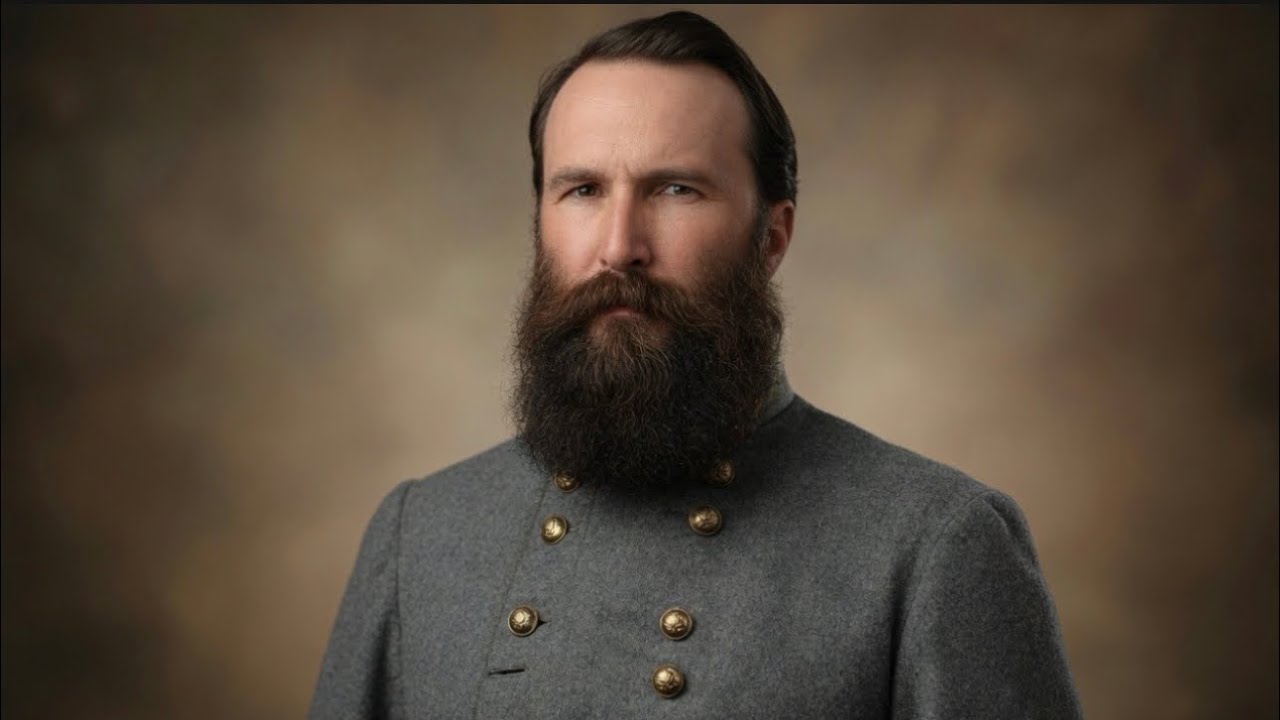
In the winter of 1904, an 83-year-old man sat for a portrait in Gainesville, Georgia. He was half-blind in one eye and still carried a Union bullet near his throat from a wound suffered decades earlier. Within months, he would be gone, buried not as a celebrated commander but as one of the most hated men in the former Confederacy.
His name was James Longstreet. He was arguably the finest tactical mind in the Confederate Army, and he became its most convenient scapegoat.
Longstreet did not fight like the men around him. The Confederate officer corps in 1861 was steeped in a military tradition that worshipped Napoleon. Massed infantry, dramatic charges, and the glory of the offensive defined the era. Robert E. Lee believed in it. Stonewall Jackson believed in it.
Longstreet believed in something quieter and far more modern. He believed in ground. He believed that a well-placed, dug-in defensive line could shred an attacking force before it ever got close. He believed the general who forced his enemy to attack held the real advantage.
This was not cowardice. It was arithmetic. He had watched massed rifle fire cut down advancing men at Fredericksburg, where Union soldiers were slaughtered against a Confederate position on high ground. He drew a conclusion most of his peers refused to accept: the era of the glorious frontal assault was already over.
That thinking made Gettysburg far more complicated than the textbook version suggests. On July 2, 1863, Longstreet studied the Union position on Cemetery Ridge and concluded it was nearly unbreakable by direct assault. He proposed a wide flanking maneuver around the Union left, forcing George Meade’s army to abandon its high ground or fight on terrain the Confederates chose.
Lee said no. He wanted to attack directly. Longstreet obeyed reluctantly. The assault that afternoon cost the Confederacy dearly without breaking the line.
Then came July 3. Lee wanted to send roughly 12,000 men across nearly a mile of open field into the center of the Union position. The assault would become known as Pickett’s Charge.
Longstreet told Lee plainly that it would fail. He said no 15,000 men arranged for battle could take that position. Lee overruled him. Longstreet, by his own account, could not even bring himself to speak the order aloud. He simply nodded.
What followed was one of the bloodiest, most futile assaults in American military history. It was one of the only times Lee’s instincts failed him so completely. Longstreet had been right.
For the rest of his life, that fact would be twisted into evidence that he was somehow to blame.
After the war, Lee died in 1870. A movement immediately began to rebuild him as a flawless commander undone only by forces beyond his control. The mythology needed an explanation for Gettysburg. It could not be Lee’s own decision-making, so it had to be someone else’s fault.
Longstreet was the perfect target. He had hesitated. He had disagreed. He had been slow to attack on July 2. And worst of all, he had lived to tell his own version of events.
Former Confederate General Jubal Early became the loudest voice accusing Longstreet of losing the battle through delay and insubordination. Early was not a neutral historian. He was a bitter defender of the Confederacy with every incentive to protect Lee’s image at any cost.
But the military criticism was fueled by something else entirely. Longstreet committed what much of the post-war South considered an unforgivable betrayal. He became a Republican. He supported Ulysses S. Grant for president. He accepted federal appointments. He spoke openly about the need for the South to accept the outcome of the war and support reconstruction.
In the political climate of the 1870s, that made him a traitor to the lost cause itself. The military criticism and political resentment fed each other. It became easier to destroy Longstreet’s reputation as a soldier once he had already made himself a villain as a citizen.
Modern historians have found the military case against Longstreet to be remarkably thin. The supposed delay on July 2 was far less significant than Early and his allies claimed. Longstreet’s judgment about the impossibility of the Confederate position was vindicated by the outcome. His objection to Pickett’s Charge was the clearest piece of tactical foresight offered on that field that day.
There is a deeper irony in all of this. The tactics Longstreet favored, entrenchment, defensive positioning, forcing the enemy to come to you, became the defining tactics of modern warfare within a single generation. By World War I, armies had built their entire doctrine around the principle Longstreet had argued decades earlier.

He was not fighting the Napoleonic war his peers wanted to fight. He was fighting the next war, one that had not been invented yet. He saw the future of combat half a century before most military minds caught up to him.
Instead of being remembered as a visionary, he was remembered as a saboteur.
This was a man Lee himself had called his old warhorse. Longstreet fought at First Manassas, the Peninsula Campaign, Second Manassas, Antietam, Fredericksburg, and Chickamauga, where his aggressive breakthrough produced one of the Confederacy’s few decisive victories in the later years of the war. He was severely wounded in the Wilderness in 1864, shot through the throat and shoulder by his own men.
He was not lacking in courage or commitment. Yet within a decade of the war’s end, his former comrades were rewriting him into the villain of their favorite story.
Longstreet tried to defend himself. He wrote a memoir laying out his version of events with detail meant to counter the accusations directly. But the myth had a decades-long head start, woven into monuments, textbooks, and veterans reunions. A single memoir from an unpopular old man could not compete with that machinery.
He died in 1904, largely estranged from the veneration men like Lee and Jackson received. His name was spoken in southern communities more often with contempt than gratitude.
His real offense was never a battlefield decision. It was refusing to keep playing his assigned role in the post-war South’s fantasy of noble, unblemished defeat. He looked at the war honestly, accepted that it was over, and tried to move forward. For that honesty, he was punished more severely than almost any other Confederate general.
Before the war, Longstreet gave little hint of the tactical mind he would become known for. He graduated from West Point in the lower half of his class. He served competently in the Mexican-American War as a steady, reliable officer. Nothing predicted that within 15 years he would be running the largest, most effective infantry corps in the Confederate Army.
What changed was that the Civil War created conditions where his particular instincts mattered. He was a general built for a kind of warfare that had not fully arrived yet, dropped into a conflict that was only beginning to reveal what modern combat would look like.

His performance at Chickamauga complicates the simple narrative of Longstreet as purely defensive. Sent west to reinforce the Army of Tennessee, he identified a gap in the Union line and drove his men through it with a violent, decisive breakthrough. It remains one of the only clear-cut tactical victories the Confederacy achieved in the war’s second half.
His caution at Gettysburg was not timidity. He was entirely capable of aggressive offense when the terrain and odds favored it. What set him apart was a refusal to attack blindly. He understood that battlefield success was about reading the specific conditions in front of you and matching your tactics to them.
That kind of flexible, situational thinking is exactly what modern military theory prizes. It was dismissed as inconsistency or disloyalty by critics who needed a simpler story.
After the war, Longstreet moved to New Orleans and went into business. In an 1867 letter that provoked outrage across the South, he argued that the Confederacy had lost fairly, that resistance to reconstruction was pointless, and that former Confederates should accept the new political reality.
To many in the post-war South, that read as capitulation. He compounded it by accepting positions under reconstruction governance and federal appointments under the Grant administration. Each choice was the act of a man trying to rebuild a life and a country. Each one was treated as further proof that he could not be trusted.
He watched in real time as men he had commanded turned the machinery of memory against him. He kept making the same choices anyway. That stubbornness, holding to a conclusion because the evidence supports it rather than because it is popular, is the same trait that made him tell Lee the truth about Pickett’s Charge.
Military historians today routinely point to Longstreet’s read of Gettysburg as one of the most accurate tactical judgments made by any commander on either side during those three days. His instinct for defensive warfare is now taught as an early glimpse of the industrialized combat that would define the 20th century.
The qualities that got him branded a coward and a traitor, caution, foresight, a willingness to tell a superior an uncomfortable truth, are now identified as the marks of exceptional command.
His statue was not added to the Gettysburg battlefield until 1998, more than 130 years after the battle. It stands lower than the others, not on a raised pedestal. A small, almost accidental symbol of how long it took to give him even the barest acknowledgement other Confederate generals received without question.
James Longstreet spent his final years as a man out of place in his own history. Too honest for the myth his side wanted to build. Too skilled to be dismissed entirely. Too politically inconvenient to be forgiven.
He fought differently than any general in American history, not because he lacked courage, but because he saw the war for what it actually was. A contest of industrial power and modern weaponry dressed up in old ideas of glory. He tried again and again to fight it with clear eyes instead of comforting illusions.
It cost him nearly everything he had left after the war ended. It is only now, generations later, that the record is finally starting to catch up with what he understood all along.