On December 19, 2017, Meghan Markle attended a private Christmas lunch at Buckingham Palace hosted by Queen Elizabeth II, gathering with extended royal family members just weeks after announcing her engagement to Prince Harry. Among the guests was Princess Michael of Kent, who wore an antique blackamoor brooch—a decorative motif depicting a stylized figure of an African person in a subservient pose, an object rooted in European colonial history. Within hours, photographs of the brooch circulated widely, and by the following morning, accusations of racism trended alongside Princess Michael’s name. Her spokesperson issued a statement saying she was “very sorry and distressed” that the brooch had caused offense.
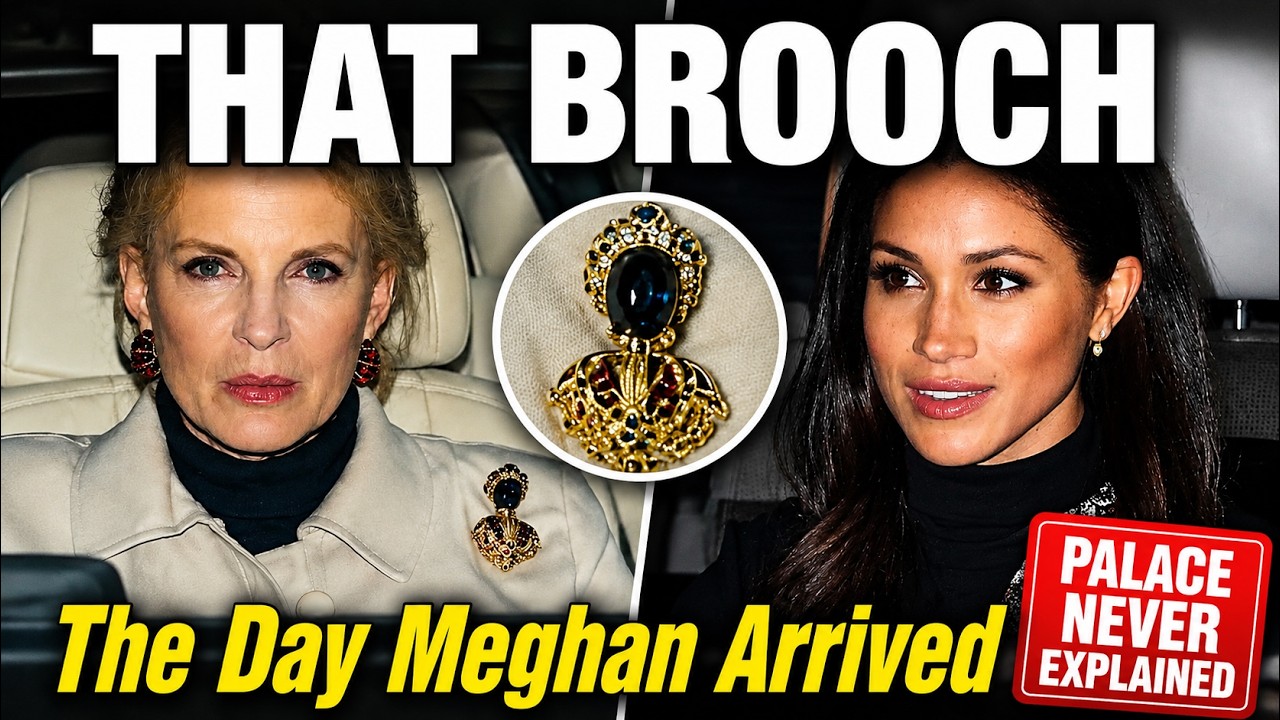
But the incident raised a question that did not fade: was this an accidental misstep or a deliberate signal? Princess Michael, born Baroness Marie Christine von Reibnitz in Czechoslovakia in 1945, married Prince Michael of Kent, a first cousin of the Queen, in 1978. She was not a working royal and held no formal duties, but the British press had long nicknamed her “Princess Pushy” for her perceived eagerness to claim proximity to the throne. This was not her first racial controversy.
In 2004, multiple accounts reported that she made a remark telling black diners at a New York restaurant to “go back to the colonies. ” Her spokesperson denied racist intent, but the story generated significant coverage. She apologized, and because she held no formal royal role, the matter was filed away—but not forgotten by journalists or the communities it reached. For 13 years, the 2004 incident sat in the archive.
Then Meghan Markle became engaged to Prince Harry, and the history of everyone connected to the extended royal circle acquired new relevance. The engagement, announced November 27, 2017, had been framed as a modern fairytale—a historic moment for diversity and openness, with the Queen releasing a warm statement and Charles expressing delight. The Christmas lunch came just 22 days after the engagement announcement. In that window, the British tabloid machinery had already generated a notable volume of negative coverage about Meghan—her character, her ambition, her past relationships, her family—in sharp contrast to coverage given to Harry’s previous long-term partner, who is white.
This pattern had been documented and noted publicly at the time, and the palace had not moved to interrupt it. The palace had three weeks to prepare for the lunch. It had the guest list for a high-profile event where Meghan, already receiving international coverage as the first black woman to enter the direct line of royal succession, would be present. It had access to Princess Michael’s documented history, including the 2004 story that had run in major British newspapers.
It had communications staff whose stated function includes managing reputational exposure. Apparently, no one connected those three things to prevent the brooch from being worn. The absence of intervention became, for many observers, more significant than the brooch itself. What might have been read as an individual’s carelessness became a structural question about the institution’s priorities.
The palace had publicly welcomed Meghan while privately failing to ensure even basic situational awareness for her first meeting with the extended family. Princess Michael’s apology acknowledged impact but remained silent on history. The 2004 incident was not mentioned. The pattern was not acknowledged.
The British press divided along familiar fault lines: some outlets ran the apology as the story, others dug into the archive, and a smaller number asked whether the moment revealed something about the palace that had allowed it to happen in the first place. The 2004 story reentered circulation on a scale not seen in over a decade. Screenshots of original news reports were shared widely. People encountering the restaurant incident for the first time saw it alongside the brooch photographs as a set—a portrait of an institution that had absorbed one person’s specific history for 13 years without requiring change, and was now asking Meghan to absorb the consequences.
In the years that followed, the brooch became one of the most cited moments in the public debate about Meghan and the royal family, cited by opposing camps to support incompatible conclusions. For Meghan’s supporters, it was evidence—the first documented signal in a sequence that would eventually include the March 2021 Oprah Winfrey interview, in which Harry and Meghan described an unnamed royal raising concerns about the possible skin color of their unborn child. For the palace’s defenders, the brooch story was evidence of a media culture unable to distinguish between deliberate prejudice and the unavoidable presence of historical objects in an institution built on centuries of history. The disagreement was not about a piece of jewelry.
It was about who gets to decide when an offense has been adequately addressed, and what an institution owes the people it claims to welcome. Lost in the argument was the figure at the center: Meghan Markle was a woman at her first royal family gathering, navigating a room full of strangers in an institutionally pressured setting. Whatever she thought when she saw the brooch has never been fully described in her own words in the context of that specific day. The palace chose who was protected in the aftermath.
Princess Michael retained her invitations. The spokesperson statement closed the formal record. The institution’s preferred narrative—miscalculation, not symptom—was the one adopted and kept. More than seven years later, Princess Michael of Kent still carries her title.
The blackamoor brooch has not been photographed in public since. Meghan Markle left the working royal family in January 2020, moving with Harry to California. They gave the Oprah interview, built their own company, and told their version of their royal experience across multiple formats, received by the world with the same division that had applied to the brooch story from the beginning. The Christmas lunch of 2017 clarified something about the institution’s relationship to accountability: the royal family was capable of absorbing a person with a documented racial history, granting continued access, treating a forced apology as sufficient resolution, and making no structural adjustments—even when the person most affected had no platform, no advocate inside the machine, and no mechanism to say “This is not enough.
” Meghan eventually built a platform of her own, but that voice required her to leave the institution to use it. The brooch is presumably still in a drawer somewhere, a piece of colonial-era craftsmanship that its owner described herself as “very sorry and distressed” to have worn to one specific event. The question it left behind—what the institution actually believed between its public statements and its private decisions about who belonged, who was protected, and what a newcomer was expected to absorb—remains unanswered.