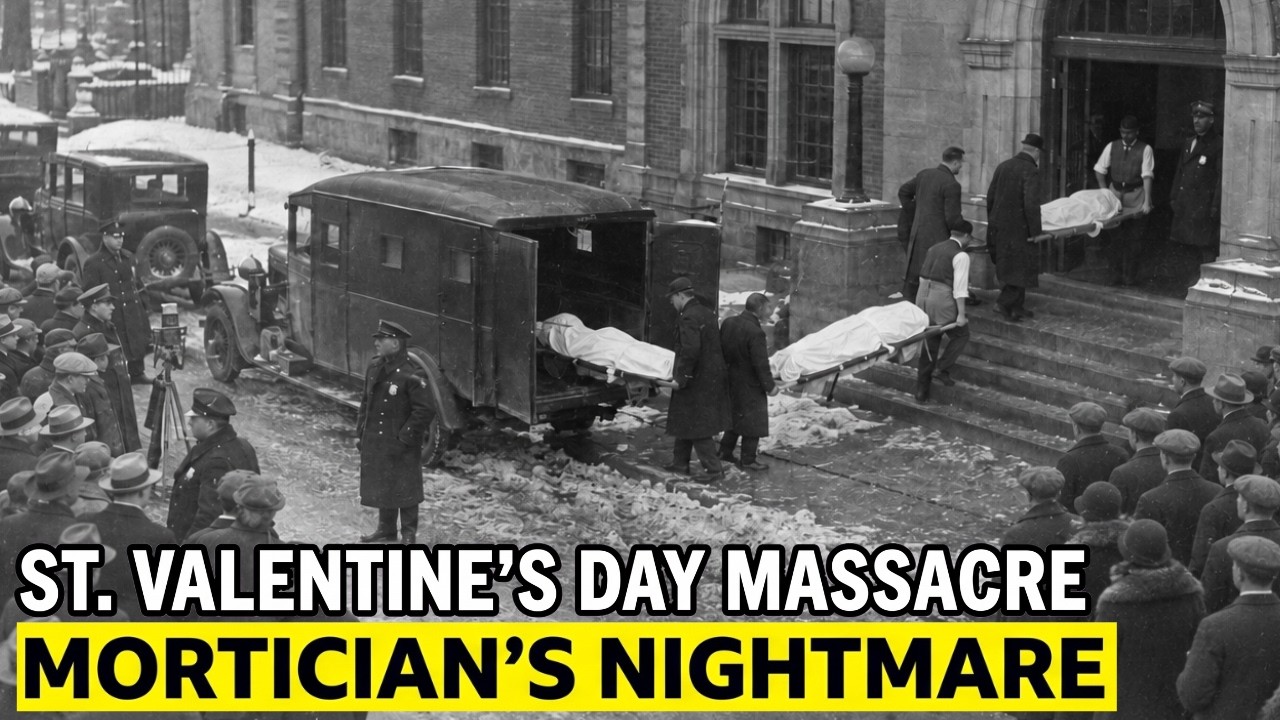
The seven men who died in the 1929 Saint Valentine’s Day Massacre were not just crime scene photographs. They were bodies that had to be prepared for open-casket funerals, and the person tasked with that work faced a task that Hollywood has never shown.
The mortician’s job began with a fundamental problem. Embalming relies on a closed system. The embalmer opens a major artery near the collarbone and pumps preservative fluid through the body, following the same paths the blood once took. The entire process depends on one rule: the system must hold pressure. Nothing can leak.
But these bodies were full of holes. John May, a mechanic who kept the gang’s cars running, had been shot ten times. Each bullet wound was a hole in the network of vessels. When the embalmer opened the artery and started pumping, the fluid did not complete its journey. It found the nearest exit and flowed back onto the table.
When a body cannot hold pressure, the embalmer has to abandon the single-system approach. He breaks the work into a dozen smaller systems, tying off vessels and closing wounds one section at a time. It is like trying to plug the holes in a boat with only two hands.
The most difficult cases were the faces. Two of the seven men barely had faces left. John May had part of his face torn away by gunfire. Frank Gusenberg lived for about three hours in a hospital bed and died without giving police a single name. Witnesses described him as the most disfigured of the seven. His head had been nearly destroyed by bullets.
The families wanted a final look. In 1929, an open casket was the entire point of the funeral. It was the proof and the display. Someone had to rebuild a face for a man who no longer had one. This was a slow, delicate craft. The embalmer did not pump fluid into this part. He rearranged shattered bone to form an arch. Missing pieces were packed with funeral wax and cotton from the inside. Then he used thread and a small hook to pull relaxed features back into place. A thick layer of cosmetics finished the work. From six feet away in a dim room, the brother looked like himself again.

Before the bodies even reached the embalmer, other men had already cut into them. A doctor named Calvin Goddard needed the bullets for ballistics testing. His work on this case directly led to the creation of the first independent crime lab in the country. The bodies were cut open, the bullets were extracted, and each one was placed in a small paper envelope marked with the name of the man it came from. Two bullets came from John May’s body. Another was taken from Adam Heyer’s leg. The embalmer did not start with clean wounds. Someone else had already been allowed to dig deep before he arrived.
The bodies did not arrive in order either. The men bled out on a cold garage floor while police and press photographers worked the scene. The Cook County coroner’s office processed all seven at once. Then the bodies were put on display while half the city filed past to stare. Only after all of that did the bodies reach the embalmer.
The personal details were strange and unavoidable. When they examined Peter Gusenberg, he was wearing a large diamond ring and carrying $447 in cash. The embalmer had to remove the ring from a stiff finger, count the money, and hand it over to someone. The good suit was torn by gunfire and soaked in blood. It had to be cut off before the work could even begin. Then a new suit had to be put on, with a tie tied properly, so the man looked like he was going somewhere respectable instead of to the grave.

The cold came first. The real cold room was not dramatic. It was a workplace in Chicago in February, kept freezing on purpose because a warm body begins to decompose quickly. There were seven bodies and no way to reach them all in the first few hours. Some had to wait. Rigor mortis set in, making the bodies hard as concrete. The men stiffened in the same positions the machine guns had left them in, lying on a hard floor for hours. Before the embalmer could lay a man out peacefully with his hands folded, he had to break that stiffness. He had to move the arms and bend them against the rigidity until the joints loosened. It was not gentle work, and it did not make the sound you would want to hear.
The small details made the difference between death and sleep. Eyes do not stay closed on their own. They dry out and sink. Small caps were placed under the eyelids to keep their shape and keep them shut. The jaw does not stay closed either. It hangs open, so it had to be wired or sewn from the inside. Fingernails had to be cleaned, because a man who bled out on a garage floor does not have clean hands, and those hands would be folded in front where everyone could see them.
The drainage was the honest core of the profession. For fluid to go in, the blood had to come out first. It ran through a tube and down a drain in the floor. With a natural death, this was quiet and orderly. With these men, it was never that. They had bled to death on the garage floor, been cut open for bullets, and only then reached the table. The smell soaked into the embalmer’s clothes and followed him home on the streetcar.
The seven men did not all come from the same gang or the same neighborhood. Peter Gusenberg and his brother Frank were enforcers for Bugs Moran’s North Side gang. Adam Heyer ran the business side of the operation. Albert Weinshank was there too, along with a man known as James Clark. John May was the mechanic, not really a gangster, just a man who fixed cars and needed money. Reinhart Schwimmer was an optometrist who liked to hang around gangsters and brag that he could kill any man if he wanted to. The man believed to have sent the shooters was Machine Gun Jack McGurn, Al Capone’s top enforcer and the suspected mastermind of the entire massacre. He was never convicted.
The seven men were spread across different funeral homes and undertakers. More than one person opened that door and realized the next days of their lives had just been claimed. And despite everything, the men left in absolute style. Gangster funerals in the 1920s were spectacles. Flower arrangements the size of a door were carried in one after another. At the Gusenberg brothers’ funeral, there was a large heart made of flowers that people believed Bugs Moran himself had sent. Moran was the man the entire massacre had been designed to kill. The rooms were packed wall to wall, and crowds passed by the shiny caskets just to get a look. Everyone who leaned over whispered that he looked peaceful, that he looked like himself again. They were all looking at the work of a man they would never meet. He had spent the entire week soaked in those bodies, just so a small, kind lie could hold up for a single day.