Under the common law inherited from England, a married woman’s legal identity was suspended and absorbed into her husband’s. The doctrine of coverture held that husband and wife were one person in law—and that person was the husband. A wife generally could not own property outright, make a contract, or keep her own wages. New York began dismantling those rules in 1848, and other states followed through the second half of the century.
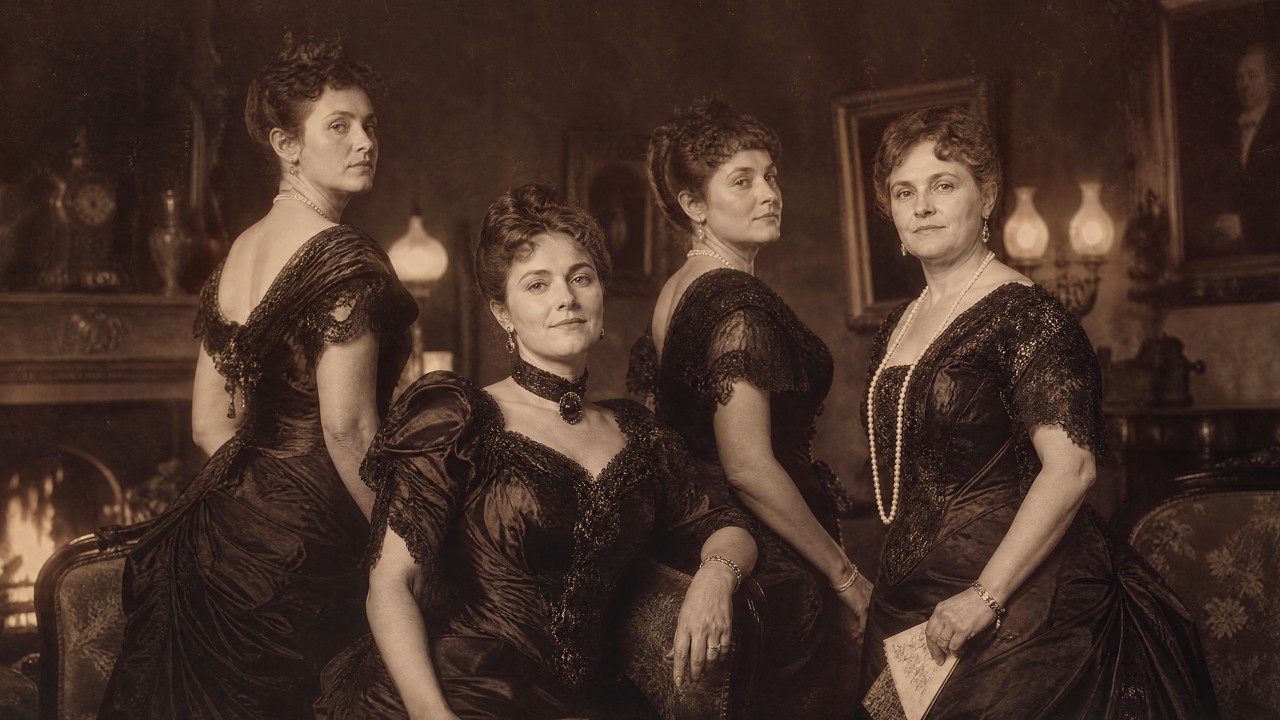
But the law moved ahead of social practice. A woman could own property on paper long before a bank, broker, or husband would behave as though she could. Four women of that era exploited the gap between legal capacity and social reality. None knew each other.
They arrived separately at the same discovery: a self nobody is looking for is a self nobody will find. In San Francisco, a young wife wrote a scandalous novel in secret and published it under the name of a demon. In the Netherlands, a saloonkeeper’s daughter married a baron while a warrant for her arrest was still open in California. In Boston, a fortune teller built a bank for unmarried women on the fiction of a nonexistent charity.
In New York, a woman already married to one man married another, faked a pregnancy, and bought newborns until one was pale enough to pass as a Hamilton. Gertrude Franklin Horn was born in San Francisco in October 1857. Her parents separated when she was two. Raised largely by her grandfather, a devout Presbyterian relative of Benjamin Franklin, she was educated and well-read, but had no fortune and no permanent home.
In 1876, at 18, she eloped with George Atherton, heir to a Chile trade fortune. The family estate on the San Francisco Peninsula, Fair Oaks, was vast—her mother-in-law’s garden later became the town of Atherton, now one of the wealthiest addresses in the United States. George had no profession and lived under his mother Dominga’s roof and rules. Gertrude was expected to fill her days with calls, meals, and the management of servants.
In 1882, her young son died. That same year, she sat down and wrote a novel in secret, reportedly in about three months. The Argonaut, San Francisco’s most widely read weekly, began serializing it in March 1882. She signed it “Asmodeus”—the demon from the Book of Tobit whose office is the destruction of domestic happiness.
The novel, The Randolphs of Redwood, took its plot barely disguised from the collapse of a real local family, and contained a candor about drink and sex that respectable women were not supposed to possess. The city spent weeks guessing the author’s identity. Gertrude sat in drawing rooms pouring tea while the subject was raised and speculated about. She kept the money the serial paid, hidden from a household that funded her leisure.
When she told her husband’s family she was the author, they stopped speaking to her. Publication by a woman of the family was considered an obscenity. The marriage continued as a facade. In 1887, George died on a voyage to Chile.
According to the account her biographers tell and she told herself, his body was preserved in a cask of rum and shipped home. Decades later, she admitted in print to having wished him dead. A widow had legal standing a wife lacked. She left for New York in 1888, then London and Paris, where a publisher took her first two books.
She met Oscar Wilde and a young Winston Churchill. Back in California, her mother-in-law raised her daughter and left the inheritance that would have gone to George to the granddaughter. Gertrude Atherton became famous—The Conqueror, a best-selling novel about Alexander Hamilton, appeared in 1902; Black Oxen in 1923; a gold medal from the International Academy of Letters and Sciences of Italy; the Legion of Honor in 1925; election to the American Academy of Arts and Letters in 1938. She died in San Francisco in 1948, at 90, under her own name.
May Dugas was born in Chicago in 1869 to French Canadian immigrants. After her father, a saloonkeeper in Muskegon, Michigan, died, her mother moved the family to Menominee, a lumber town on the Wisconsin line. In 1887, at 18, she left for Chicago and took up residence at Carrie Watson’s, the most celebrated house in the city. While living there, she enrolled in university courses in psychology, French, and business law.
A wealthy young man proposed. His father hired a Pinkerton detective named Edwards, who discovered her background. Dugas did not run or deny it. She named her price—$20,000 for the details not to be divulged.
He paid. She had learned that the most valuable commodity she possessed was other people’s need for silence. She left Chicago for Portland, then San Francisco, where in 1890 she and a companion, Fanny Lyell, were arrested for larceny. It was clumsy and apparently her only serious operational failure.
She escaped custody and left the country, named as a fugitive in San Francisco municipal reports for 1892. She traveled to Shanghai, then Hong Kong, where she obtained $25,000 from a British mining executive. In Tokyo, an affair with a man named John Kilpatrick ended with his suicide after he returned to New York—a death downstream of her, with no evidence she wanted it. In London, she met Baron Rudolph de Palant, master of hounds to the princess of Wales.
They married at his castle in the Netherlands in November 1892. She was 23. He knew nothing of her past—not the saloon, not Carrie Watson’s, not the larceny charge, not the fact that she was still a fugitive. A title, she understood, was not a forgery.
It was true, entered in a Dutch register, and would survive any investigation. It also reversed the direction of shame—a wealthy man asked for money by a baroness could not easily go to the police without explaining who he had been seen with. She kept working. Documented aliases ran alongside the title for the rest of her life: Pauline Davidson, Pauline Townsend, Maud Jackson, Mrs.
Applebee. The estimate of what she accumulated across decades is around $2 million—none of it held under her own legal name. The baron signed a deed of separation in 1899, agreeing to pay £6,000. She kept his title for the remaining 38 years of her life and inherited a small fortune from him when he died.
The exposure came from a woman. Frank Gay Shaver, an attorney, met Dugas around 1901. They became friends. Shaver lent money to Dugas’s family, and by the end was asking for repayment of approximately $100,000.
Dugas maintained Shaver had signed a release absolving her—business law, the lesson from the Chicago classroom, put to work. Shaver sued, alleging extortion. The trial was held in Menominee, Michigan, in 1917. A courtroom required Dugas to state who she was on the record, in public, in the town where she had gone to high school.
The settlement required her to repay $13,515. The money was never what she lost in that room. The same year, at 47 or 48, she adopted an infant boy. She named him John Andrew Van Erp.
He went to Harvard, became a professor of romance languages, and during the Second World War interpreted Italian prisoner mail for Allied intelligence. He died in 2006. Dugas died of cancer in New York City in March 1937. Her death certificate identified her as May de Palant Van Erp.
The newspaper notice described her as Marie, beloved wife of Edward Alan Morrissey. Two documents, same week, same dead woman, each unaware of the other. Sarah How was born around 1826, though the sources spread across seven years. The Boston Herald said she came from Providence; nobody has established it.
She had a reported early marriage to James Solomon, possibly annulled under a miscegenation law—the state declared the wedding had never existed. A second husband died. In 1852, she married Florimond Howe. After the Civil War, she came to Boston and became a fortune teller.
For 15 years, women came to her privately and paid her to tell them what their futures held. She learned what they were frightened of: whether the money would last, whether there would be a husband, whether an unmarried woman with no prospects would end in the poorhouse. In 1875, she was jailed for several weeks over loans taken out against identical collateral. The conviction was overturned on appeal.
The mechanism was a rehearsal for what came next. The Ladies Deposit Company was open for business by April 1879. It accepted deposits only from unmarried women. It paid 2% a week, later restated as 8% a month.
Depositors were told the returns were underwritten by a Quaker charitable fund endowed by a wealthy benefactor. There was no fund. There had never been a fund. It never advertised.
It grew entirely by referral, woman to woman. It took in approximately $500,000 from about 1,200 depositors in Boston, Chicago, and Washington. New deposits paid the old interest—the scheme now known by the name of Charles Ponzi, who ran it four decades later. She deliberately chose impossible returns.
More importantly, she recruited 1,200 women to hold the secret with her by making silence a condition of membership. Depositors were told to tell no one—heard not as suspicious, but as consistent with discreet charity. The rule that made them feel chosen kept them from comparing notes. In September 1880, the Boston Daily Advertiser printed what the company actually was.
The run began within days. The women came to the door, each discovering simultaneously that she was not the only one. Most were not going to get their money back—the earliest depositors had been paid from the savings of those standing in line. How was convicted on multiple counts of fraud and served three years.
She came out in 1884 and did it again. The second institution, the Women’s Bank, used the same model with the rate lowered from 8% to 7%. It took in an estimated $50,000. It was exposed in April 1887, and she left Boston before the indictment.
She tried again in Chicago under the name Ladies Provident Aid. In December 1888 she was arrested in Boston and released in March 1889 because the victims refused to prosecute. Some still would not tell anyone—the shame and the fear of being known as a woman who could not manage money outlived the scheme. She died in January 1892, about 66 years old.
The $5 burial fee at Forest Hills Cemetery was paid by a stranger. Eva Hamilton’s origins are essentially unrecoverable. Her name before any of it was Evangeline Steele, born around 1858, from Elmira in upstate New York. By the mid-1880s she was living in the New York boarding house world, married to Joshua Mann, called Josh or Doy.
His mother, Anna Swinton, lived with them. On a Manhattan sidewalk sometime in the mid-1880s, she met Robert Ray Hamilton. He was the great-grandson of Alexander Hamilton, a Columbia-educated lawyer, a Republican in the New York State Assembly, and the recipient of an income of approximately $40,000 a year from his maternal grandfather. She told him she wanted to take Josh Mann for company, and he said it was all right.
For five years, Hamilton paid her expenses in a boarding house at 208 East 14th Street—where her husband lived as a relative, eating on his money. Hamilton never investigated. A man of his class did not investigate the domestic arrangements of a woman he was keeping. After about three years, she told him she was pregnant.
She had never been pregnant. She left for Elmira, telling him she had gone to stay with a brother, Mr. Steele. The brother did not exist.
Hamilton sent her funds in lumps of $500 to $1,500 on the strength of the pregnancy. Four infants were born across those months, and every one of them was for sale. There was in late-1880s New York a functioning market in newborns—baby farming, as the period called it. Reporter Nellie Bly proved it by buying an infant for $10.
The first child was bought in December 1888 for $10. It died, reportedly of starvation, because a woman who has never been pregnant cannot nurse. The death certificate recorded the child as Alice Mann, daughter of George and Alice Mann. Every name on it was false.
Hamilton was never told the child had died. For weeks he was sending money and making plans for a baby already buried under a false name. The second child also died. Hamilton never saw it.
The third was brought to the house, looked at, and declined—too dark-complexioned and black-eyed. It would not pass as the daughter of Robert Ray Hamilton. It was handed back. A living child failed an audition.
The fourth was a girl. She cost $10. She was kept alive with Anna Swinton’s help. They named her Beatrice Ray Hamilton.
Eva presented her to Hamilton at the boarding house. A day or two later, on January 7, 1889, in Paterson, New Jersey, he married her. Before the wedding, he agreed to give her $6,000 a year for pin money. It had cost $10 to convert a boarding house arrangement into a claim on one of the largest private fortunes in New York.
For seven months it held. In August 1889, at a summer cottage in Atlantic City, the marriage ended in an argument about the allowance. Hamilton had refused to discharge the nurse, Maryanne Donnelly. Eva stabbed Donnelly with a knife.
Hamilton was cut twice trying to get between them. Donnelly survived. Eva was tried for atrocious assault and battery at Mays Landing in September 1889 and sentenced to two years in the state prison at Trenton. The bigamy, the purchased children, the false identity—none of it was in the indictment.
The arrest opened the file. For eight weeks, the newspapers took the architecture apart: that she was already married, that the brother was the husband, that there had been no pregnancy, that the daughter of a Hamilton had been acquired for $10 from strangers. In October 1889, Robert Ray Hamilton sued to have the marriage declared void. He did not disown the child publicly.
Whatever he thought of the woman, the girl had been his daughter for seven months. He left New York in May 1890 and bought a ranch near Jackson Lake, on the road into Yellowstone. On August 23, 1890, he was found drowned in the Snake River. Investigators who later disinterred the body found it forced into a wooden crate too small for it.
His partner, John Dudley Sargeant, was accused of murder, found legally insane, and never prosecuted. Nothing was ever proved. His will left $10,000 for an ornamental fountain to be erected in New York City. Evangeline received a $10,000 settlement from the estate.
The estate valued them identically. She was released from prison about three months after his death. Her original husband, Joshua Mann, sued her for divorce in 1893. She appeared for a while on a stage in a theatrical production called The Hamiltons, selling her own scandal by the ticket.
After that, she disappears from the record. One account has her dying penniless at St. Vincent’s Hospital in 1904, buried in a common plot. Other sources say her death was never established at all.
There is a clear pattern in how all four were finally caught. Not one was betrayed by someone close. Atherton was exposed because she told the family herself. Dugas was exposed because a friend went to law.
Howe was exposed because a newspaper printed an analysis of her interest rate. Eva Hamilton was exposed because a police blotter generated a court case. The institutional machinery that had been too indifferent to check any of them was perfectly capable of taking them apart once it had a reason to look. The more of a person these women manufactured, the less of one they were left holding.
A counterfeit that conceals a capability can be absorbed into a life—when discovered, what is discovered is a woman who could do something. A counterfeit that conceals a theft cannot: when it is discovered, what is discovered is that there was never anybody there. Atherton counterfeited one signature and got out. The others counterfeited whole lives and lost them.
Beatrice Ray Hamilton was born to a woman whose name nobody recorded. She was sold for $10, kept alive by a woman called grandmother, presented to a man who was not her father, and given the surname of Alexander Hamilton. She was a few months old for all of it.
She outlived them all, and carried that name for the rest of whatever life she had.