In June 1864, Ulysses S. Grant faced a brutal reality. He had spent six weeks bleeding his army dry in Virginia. The frontal assault at Cold Harbor on June 3rd had been a catastrophe, with 7,000 Union soldiers falling in less than 30 minutes. Grant later wrote that he always regretted ordering that attack. He knew he could not break Robert E. Lee’s lines by charging them head-on.
Lee, meanwhile, had every reason for confidence. He had been beating Union commanders for three years. But his body was failing, plagued by heart disease and chronic pain. He often commanded from a camp chair when he could not mount his horse. Still, his Army of Northern Virginia, though hungry and depleted, had just proven itself nearly unbreakable behind earthworks.
Grant needed a different kind of victory. Lincoln faced re-election in November, and a stalled war could mean a negotiated peace with the Confederacy. Grant needed a move so bold that Lee would not believe it even as it happened. His plan was to make his entire army vanish.
On the night of June 12th, 1864, the Army of the Potomac rose from its trenches at Cold Harbor. More than 115,000 men began walking south into the darkness. They left behind burning cooking fires and knapsacks propped against logs to create the illusion of an army still in place. Regimental bands played Yankee Doodle at intervals, not in celebration, but to mask the creak of wagon wheels and the clatter of canteens.
The march was a nightmare. The route stretched 35 miles through swamps like White Oak Swamp, where mud could swallow a man to the knee. The column of men, horses, cannons, and wagons stretched back 50 miles. It was the longest continuous marching column in American military history. If lined up single file, the men alone would have stretched 65 miles.
Grant’s destination was the James River at Weyanoke Point, a crossing 2,100 feet wide with tidal currents running two to four knots. There was no bridge within 50 miles. His engineers would have to build one, in secret, in enemy territory. Grant called the operation hazardous. In his memoirs, he described the problem plainly: more than 50 miles intervened between him and Butler, with both the James and the Chickahominy unbridged to cross.
The deception was layered. Sheridan’s cavalry was already on a raid toward Trevilian Station, pulling Confederate cavalry away. Butler’s forces launched probing attacks. And at Dutch Gap, Union engineers noisily cut a canal through a bend in the James River. The canal was militarily pointless, but it seized Lee’s attention completely.
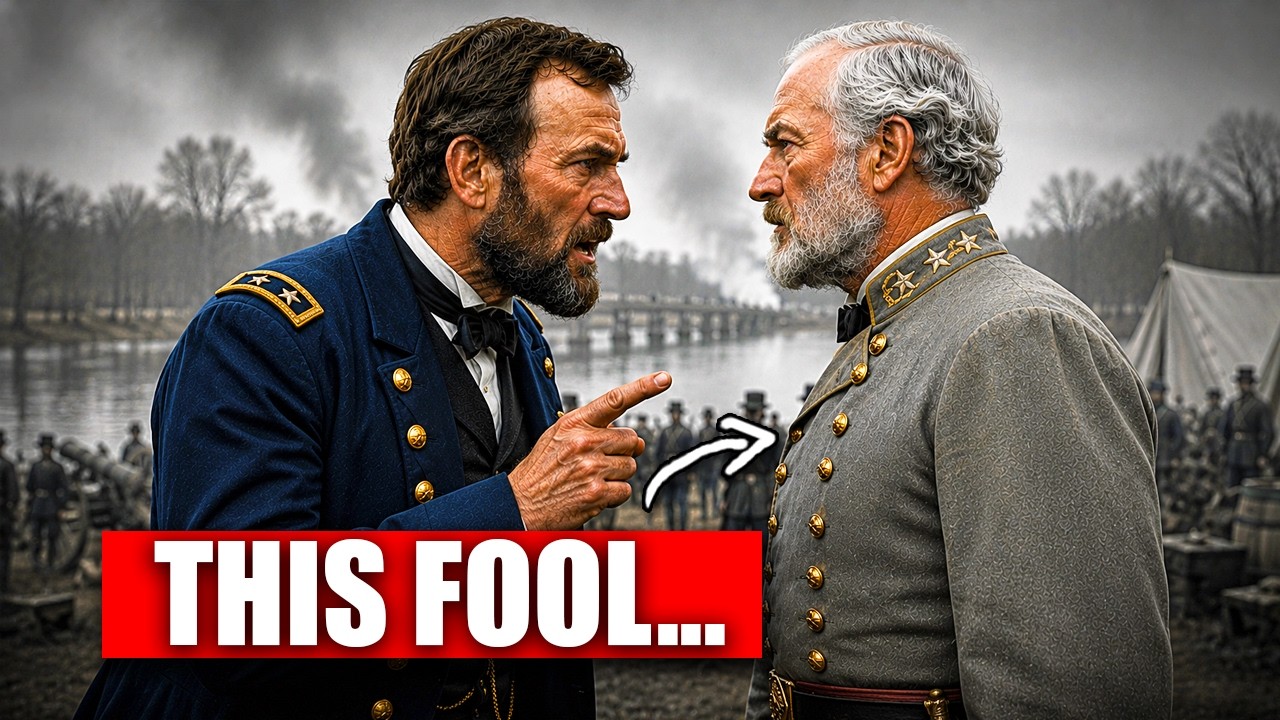
On June 11th, the day before the march began, Lee personally visited Dutch Gap to assess the canal work. He stood on the bank of the James and stared at Union engineers digging in the dirt. He believed this was Grant’s plan. He was looking at a distraction. The real operation was about to happen 50 miles away.
The men marched through the night in complete darkness. Soldiers held the coat of the man ahead to keep formation. Torchlight was forbidden near the front. Orders passed in whispers. Grant was not sleeping. His aide, Colonel Horace Porter, wrote that Grant was consumed, wrought up to an intensity of thought and action he seldom displayed. The man famous for calm under fire was pacing and chain-smoking, waiting for reports that his army had not been discovered.
By dawn on June 13th, Confederate scouts approached the Cold Harbor trenches and found nothing. The positions that had held 100,000 Union soldiers were empty. The Army of the Potomac had vanished in the night.
Lee received the report and made his assessment. He concluded Grant was flanking toward Richmond, using the Chickahominy as cover. It was the logical move, the move every Union commander before Grant had attempted. It was completely wrong. Lee wrote urgently to General Richard Ewell, telling him to discover what the enemy was doing. He was not panicking yet. He believed he understood the situation.
Lee shifted his forces to block the roads to Richmond. A.P. Hill’s corps marched south. Anderson’s corps moved to cover White Oak Swamp. That same day, Lee wrote to Jefferson Davis with confidence, referring to the canal at Dutch Gap. He believed Grant’s main effort was a canal. The truth was 35 miles to the east, and 115,000 men were already halfway to the James.
On the Confederate side, confusion filtered down to every level. Private William Fletcher of the 8th Texas Cavalry captured the mood perfectly. He wrote that they were shifted hither and yon, not knowing Grant’s game. His unit marched in brutal heat, eating parched corn and sleeping without tents. Rumors ran through the column. Grant was headed for Richmond. Grant was retreating. Grant was dead. None of it was true.
By the evening of June 13th, the lead elements of Grant’s army were approaching the James River. The engineering challenge ahead was unprecedented. On June 14th at 4:00 in the afternoon, Union engineers began building a pontoon bridge across the 2,100-foot river. They swung flat-bottomed pontoon boats into the current and anchored them with cables, laying planking across them. The bridge grew foot by foot, fighting the current with every new section.

The bridge was completed by midnight. It was over 2,000 feet long, built in eight to ten hours in tidal current strong enough to capsize a small boat. Sergeant Rice C. Bull of the 123rd Pennsylvania was among the first to cross. He wrote that the bridge swayed and trembled under the weight of thousands of men, horses, and artillery pieces. It was like walking the deck of a ship in a storm, except the ship was half a mile long and there was no railing.
Butler had taken a precaution that showed the depth of planning. Two vessels loaded with stone had been pre-sunk upstream of the crossing point, positioned to block Confederate ironclads from steaming down and destroying the bridge. The Confederate James River squadron was neutralized before it could act.
On June 15th, the crossing reached its peak. Hancock’s 2nd Corps, 30,000 men, began crossing. Horses balked at the swaying planks and had to be blindfolded and led. Behind the infantry came the logistical tail: 5,500 wagons and 28,000 horses and mules. The column stretching back from the bridge extended 50 miles. A single unbroken river of men and material flowing south.
The crossing proceeded for four full days without detection. More than 100,000 Union soldiers stood on the south bank of the James by the evening of June 15th. Petersburg, the rail junction that supplied Lee’s entire army, lay just 10 miles to the south. Its garrison numbered fewer than 5,000 men.
Lee, 35 miles north, was fighting shadows. His scouts brought contradictory reports. His cavalry was scattered. He knew Grant had moved, but where? On June 13th, he shifted forces toward Richmond. Wrong. On June 14th, he received no new intelligence that contradicted his assumption. Still wrong. On June 15th, scouts reported Union activity near the James, but the reports were fragmentary. Lee did not commit forces south.
On June 16th, reports finally reached Lee that confirmed a massive Union presence south of the James. The crossing was not a feint. It was the entire Army of the Potomac. Lee understood too late that Grant had stolen a march of four days and 35 miles. Petersburg was under immediate threat. He began rushing forces south, but he was 48 hours behind.
So what did Lee actually say when he realized what had happened? His surviving correspondence tells the story in stages. On June 13th, still confident, he wrote about the canal at Dutch Gap. On June 14th, his tone shifted. He wrote to Ewell, telling him to discover what the enemy was doing, adding that if they could not arrest his work, they could not in other ways counteract his operations. The language reveals uncertainty where there should have been certainty.

By June 16th and 17th, when the full picture emerged, Lee’s communications became urgent. He ordered immediate movement south. He demanded cavalry reconnaissance. He was, for perhaps the first time in the war, reacting rather than acting. The great defensive genius of the Confederacy had been reduced to chasing Grant’s shadow, four days and 35 miles too late.
Grant had hidden 115,000 men through a combination of night marches, diversionary raids, and operational security so tight that even many Union corps commanders did not know the full plan. Lee was not incompetent. He was human, and Grant had planned for exactly that humanity.
The vanguard of Grant’s army began probing Petersburg’s defenses on June 16th. What should have been a quick Union victory dissolved into confusion and missed opportunities. But the operational maneuver was complete. The strategic result was irreversible. Lee was now pinned at Petersburg. The siege would last nine months.
The crossing of the James led directly to the siege of Petersburg, nine months of trench warfare that presaged the Western Front of 1914. Lee’s army bled out slowly through attrition, desertion, and starvation. When the lines finally broke on April 2nd, 1865, Lee had fewer than 35,000 men. A week later, at Appomattox Courthouse, he surrendered to Grant.
Grant’s crossing has been called the most brilliant operation of the war by historians from Bruce Catton to James McPherson. The crossing was undetected, but the exploitation was botched. The initial attacks on Petersburg, which should have captured the city on June 15th and 16th, failed through miscommunication and timidity. Grant delivered his army to the enemy’s doorstep with a four-day head start, and his subordinates squandered it.
Lee was not simply fooled. He partially fooled himself. His personal visit to Dutch Gap, intended to gather intelligence, actually reinforced his misunderstanding. The general who rode out to see the truth saw only what he expected. His own diligence became the instrument of his deception.
On the night of June 12th, 1864, an army vanished from its trenches at Cold Harbor. By the time Robert E. Lee understood what had happened, 115,000 men stood on the south bank of the James, and the war was already decided. Grant solved the problem not with romantic brilliance, but with logistics, planning, and engineers driving pontoon boats into tidal currents at 4:00 in the morning. Sometimes the greatest victory is the one no one sees.