On October 20, 1968, in a small chapel on the private Greek island of Scorpios, Jacqueline Kennedy married Aristotle Onassis. The world saw a fairy tale: a widow rescued, a wedding in the rain, a yacht offshore. But the marriage was negotiated like a merger, and the man she married had already planned for its end.
The chapel, called Panagitza, held perhaps a dozen people. Onassis owned the island outright, having bought it in the early 1960s for a reported $110,000. He had planted its slopes with cypresses and olives and built a summer world around it. The bride wore an ivory chiffon dress by Valentino. Her children, Caroline and John, were with her. The reception was held on the Christina O, Onassis’s famous yacht with its whale-skin bar stools and hydraulic dance floor.
The wedding came four months after the assassination of Robert Kennedy. Jackie had been physically unwell for days after his death and told friends she feared for her own children’s safety in America. She wanted out. Onassis offered distance, money, and a private island.
But the price was steep. By marrying Onassis, Jackie lost her Secret Service protection and her federal widow’s pension. Both terminated on remarriage. The agents who had guarded her since her first husband’s death went home. The annuity of $10,000 a year stopped. She traded her country’s protection for a husband’s fortune.
Onassis was more than 20 years her senior. He had been involved with her sister Lee Radziwill years earlier and was entangled with opera singer Maria Callas, the woman his own secretary later said he never stopped seeing. He married Jackie, according to biographers, as an acquisition. He had spent 40 years buying ships. He wanted the most famous woman in the world as the last item on the list.
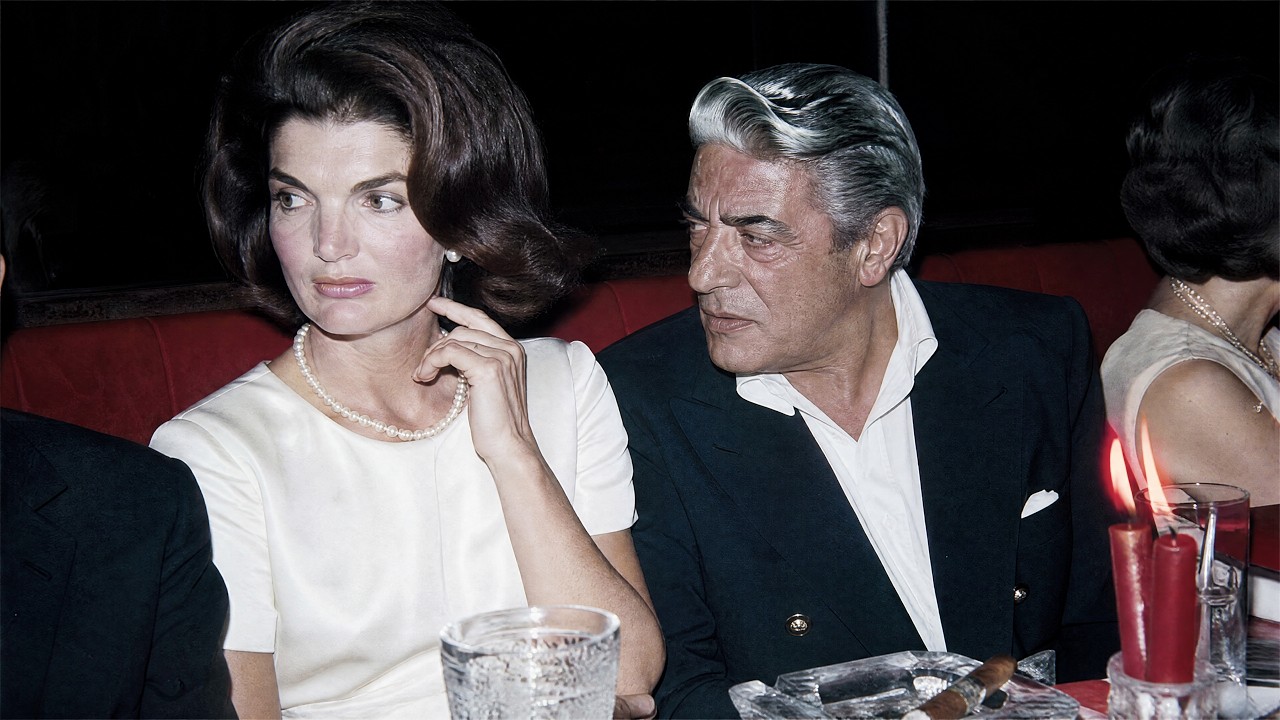
Before the wedding, Senator Edward Kennedy flew to Greece to negotiate the financial terms. The marriage was governed by a detailed contract, though the famous 170-clause prenuptial agreement described in a 1970 book has been discredited. What is documented is that a financial agreement existed and that a senator was in the room while it was negotiated.
Onassis also worked through political contacts to press for adjustments to Greek inheritance law, limiting what a foreign spouse could claim from a Greek estate. He was trying to reduce what his new wife could take from him if the marriage failed.
Within months of the wedding, Onassis was dining in Paris with Callas. She kept an apartment on Avenue George Mandel. He kept one on Avenue Foch. The two streets were a short walk apart. Paparazzi worked the corner between them because the traffic went both ways.
For most of the marriage, the couple lived on different continents. During American school terms, Jackie was in New York with her children. Onassis moved among Paris, Athens, Scorpios, and Monte Carlo. When he was in New York, he stayed at his suite at the Pierre Hotel, six blocks from her apartment.
The marriage was largely conducted by telephone. The couple was rarely in the same country for more than a week at a time. The one place the marriage held was Scorpios in the summer, where the family assembled for about six weeks a year.

In her first year of marriage, Jackie reportedly spent $1.5 million on personal expenses. Onassis, who had bought an airline and an island without flinching, took the bills for his wife’s dresses very badly. He complained about her spending to his lawyers, his sister, and his children. His daughter Christina already disliked her stepmother and now had more reason to see her as a threat.
On January 22, 1973, Onassis’s only son, Alexander, died in a plane crash at Athens airport. He was 24. The aircraft lost control seconds after takeoff. Alexander suffered massive head injuries and died the next day. Onassis never accepted the official finding of mechanical failure. He believed his son had been murdered.
The grief broke him. He was diagnosed with myasthenia gravis, a disease that left his eyelids drooping until he had to have them taped open to read. He began to speak of Jackie as bad luck, a jinx, a curse he had married into his family. He blamed her for his son’s death and for the misfortunes that followed.
At Alexander’s funeral on Scorpios, Jackie stood composed. Christina did not forgive her stepmother’s composure at the graveside. Onassis, according to household witnesses, began to plan against his wife from that day forward.
In the last year of his life, Onassis instructed a lawyer to prepare divorce papers and hired a private detective to follow Jackie in New York. The investigator’s brief was to identify men she was meeting and produce evidence of adultery. The divorce was never filed. Onassis was too ill to survive the proceedings.

He collapsed in early February 1975 and was operated on for gallbladder inflammation at the American Hospital in Paris. He remained on a respirator for five weeks. He died on March 15, 1975. Jackie was in New York. Christina was at the hospital.
His will left roughly 55 percent of his estate to Christina and the rest to a foundation in Alexander’s memory. Jackie was left an annuity of around $250,000 a year for life and $150,000 a year for each of her children. She received no share of the physical fortune she had lived among for seven years.
The will was a deliberate message from the deathbed. Onassis had not been able to divorce her. He had done the next best thing.
Christina fought the settlement. Jackie’s lawyers argued she was entitled to about one-eighth of the estate under Greek forced heirship law. The case was settled in 1977 for a reported $26 million, an amount worth roughly $100 million in today’s money. It made Jackie independently wealthy.
At 47, she took a job at Viking Press as a consulting editor at $200 a week. She later moved to Doubleday, where she worked as a senior editor until her death. She published memoirs, brought Nagib Mahfouz into English, and championed books on dance and architecture.
In the mid-1970s, she began a relationship with Maurice Tempelsman, a Belgian-born diamond merchant. They never married, but he moved into her Fifth Avenue apartment in 1982. He managed her settlement into a private fortune reported at her death at between $100 and $200 million.
She died on May 19, 1994, of non-Hodgkin lymphoma. She was 64. She was buried at Arlington National Cemetery next to John F. Kennedy, beside the graves of their two lost children. She was not buried beside Aristotle Onassis on Scorpios. That was her final statement on which marriage had been hers.
The wedding on Scorpios was sold to the world as a rescue. It was, in fact, an acquisition. The marriage was a contract, a cage, and a plan for its own destruction, stopped only by the death of the man who had built it. Behind the sunglasses, the most photographed woman in the world spent seven years learning what she had signed for and the rest of her life building the one she should have had from the start.