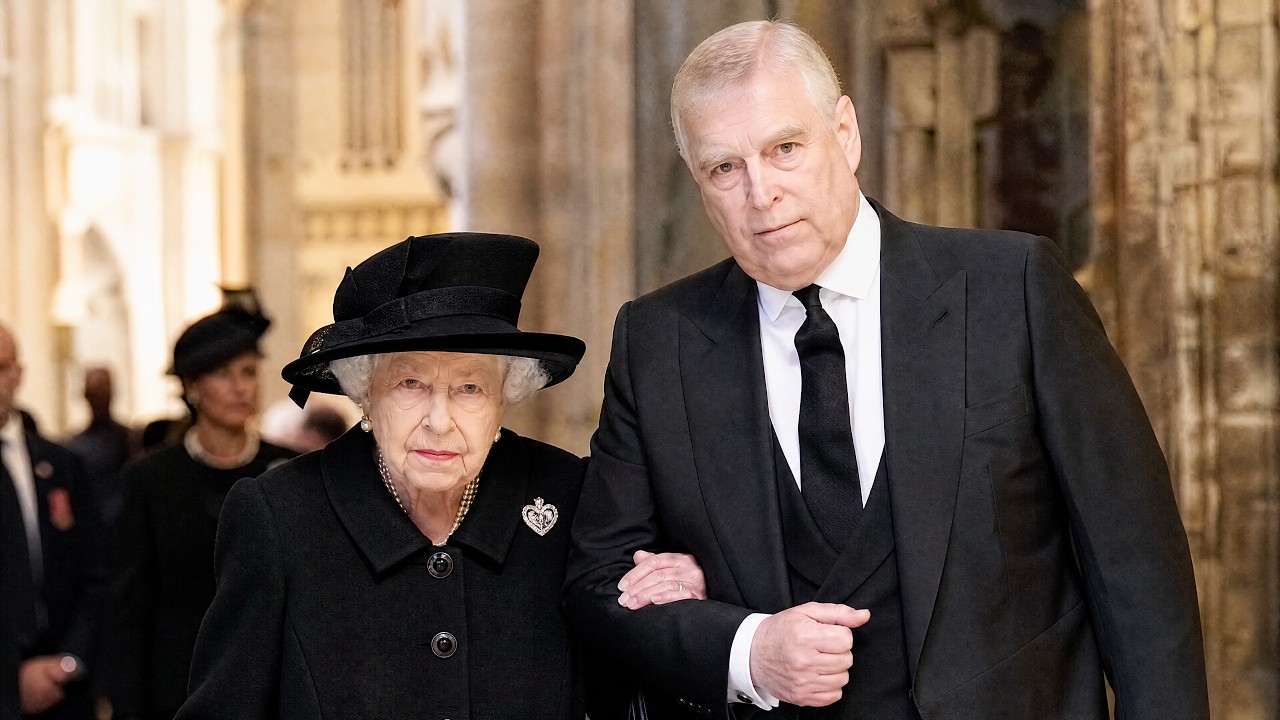
In the spring of 2022, inside Westminster Abbey, the longest-reigning monarch in British history entered leaning on the arm of a man the rest of the country had turned away from. She was 95 years old and could barely walk. In front of every camera in the hall, she chose to lean on Prince Andrew.
Throughout her life, his arm had been her refuge. She kept him close at Balmoral during the worst of times. She was said to have helped settle the case that brought him disgrace. She allowed him to support her when she could have walked in alone. In that gesture, she told a watching country that her son still belonged to the royal family.
Then, in September of that same year, she died. Within three years, his brother took the positions, the money, the guard at the gate, and eventually the name itself.
What is a royal blessing really worth after the one who gave it is gone?
The son the Queen could not refuse was the first child born to a reigning British monarch in over a hundred years. From the moment of his birth in February 1960, he was treated accordingly. No queen had given birth while on the throne for 103 years. His mother had taken the throne young, exhausted by duty. Here, finally, was a child she could hold without the weight of state pressing down on her.
He was second in line to the throne on the day he was born. Biographers returned again and again to one idea: a mother who was more affectionate with this son than with any other. Warmer, quicker to forgive, happier with him.
The favored son is a conclusion drawn by outsiders who studied the family closely. The picture they painted is remarkably consistent. While the eldest son was raised as a project, a future king to be shaped and worried over, the second son was simply enjoyed.
A child who is never refused learns something early about the nature of the world. He learns that walls move when he leans on them. He learns that problems are carried away quietly by others before they reach him.
The choices a man makes at 50 are rooted in the small daily lessons of whether the word no truly applies to him.
The order of succession carried part of the story. Andrew was second in line at birth, closer to the throne than almost anyone. As nieces and nephews and grandchildren arrived over the decades, he slipped to eighth. That slow decline is entirely normal. What was not normal was the scale of the machinery that continued to surround him regardless.
Proximity to the throne is technical. Favor is something else entirely. Favor is a choice made about you, repeatedly, in private. Throughout his mother's reign, her choice about Andrew was to keep him in her warm embrace. That choice was hers alone, and hers alone to change.
It is easy to underestimate the standing of a monarch within a family. She was not just his mother. She was the source of the titles the family carried, the owner or custodian of the houses they lived in, the head of the entire institution that formed their lives. In an ordinary home, a mother's love is private. In this house, it was also a public instrument.
For sixty years, that instrument was pointed toward Andrew. It shaped what he believed he could survive. He built a life on a single foundation: one woman decided he belonged to her, and would keep deciding that no matter what he did.
A man who has relied on his mother's favor for half a century does not spend his mornings imagining the ground giving way. Why would he? She had always been there. Every door he leaned on opened at his touch. The idea that the entire structure rested on one heartbeat was not something that occurred to him.
Yet his life rested on exactly that. Everything he had was given to him, and the giver was mortal.
In 1982, while the country watched the fate of a group of islands most people could not place on a map, the Queen's second son was flying helicopters into the line of fire. Before he was a scandal, Andrew was, for a real and dangerous period of months, something close to a national hero.
He joined the Royal Navy and trained as a helicopter pilot. When Argentina seized the Falkland Islands and Britain sent a task force to reclaim them, he went with it. He flew Sea King helicopters from the carrier HMS Invincible. His duties included acting as a decoy, flying his aircraft on paths designed to draw enemy missiles away from the ships, making himself the more tempting target.
The danger was real. When he came home, he came home in triumph. He was the brave one, the fighting prince. His public standing in the months after the Falklands War reached a level he would never reach again, before or after.
Four years later, he married. On his wedding day in 1986, he was created Duke of York, along with the subsidiary titles Earl of Inverness and Baron Killyleagh. The dukedom sits at the top of the peerage, and the title Duke of York carries particular weight. It is traditionally given to the second son of the monarch. It has a long history of returning to the Crown when its holder dies without an heir or ascends the throne himself.
Andrew's own grandfather was Duke of York before he became King George VI. The title was not truly his. It was a loan from the Crown.
He had two daughters, born in 1988 and 1990. The marriage itself did not survive. It collapsed in 1992, and the divorce was finalized in 1996. Yet he and his former wife remained close, far closer than most divorced couples. They continued to live together for decades.
This instinct to hold on deserves quiet attention, because it forms the core of the story. In the 1980s and 1990s, it looked like loyalty. A man who keeps his former wife under his roof for thirty years does not give up belonging easily. The same instinct, turned decades later toward a title and a position, looked very different.
At that moment, he was at the height of his powers. Duke, decorated warrior, father, son basking in his mother's approval. He had reached the limit of what a second son could reach. Everything that comes after this point in the story is decline.
There is a particular danger in reaching the peak early. The affection of a nation, when given, feels like permanent possession. It is, in fact, a loan. Public feeling is like a weather system, not a foundation. It shifts, it cools, and it can turn into its exact opposite. The public that adored the warrior prince would eventually turn on the aging prince with a coldness that stunned even those who had long predicted his troubles.
The decline began with a wedding gift. The title given in 1986, the borrowed title accustomed to returning to the Crown, is the same one his brother would one day reclaim. He had nearly forty years to enjoy it before the reckoning came.
Imagine the house that came with the Crown. Royal Lodge sits in Windsor Great Park, a short drive from the Castle. Since 2004, Andrew lived there, a listed mansion of around 30 rooms set in its own grounds. The terms of the arrangement tell you almost everything about how royal privilege works.
He held it under a lease reported to run for 75 years. He reportedly paid around one million pounds initially, then spent roughly 7.5 million pounds of his own money on renovations in exchange for a peppercorn rent. These figures come from press reports rather than any official account. But the shape of the arrangement is clear. He lived on royal land in royal luxury on terms the outside world could not dream of.
From 2001 to 2011, he served as the United Kingdom's Special Representative for International Trade and Investment, known simply as the trade envoy. He drew no salary, but it was not free. He had the support of state resources, travel, access, and the standing of the Crown, opening doors around the world for British companies. For a decade, he moved among the wealthy and powerful, drawing on the authority of his mother's throne.
Around all of this was the machinery. Almost nothing a working member of the royal family owns is theirs as an ordinary individual. Income is institutional. There is the Sovereign Grant that funds official royal work, ultimately paid from public money. There is the private wealth of the great royal estates, the Duchy of Lancaster supporting the monarch, the Duchy of Cornwall supporting the heir.
A minor royal does not earn a salary. His wealth comes from a share of an institutional fund, granted at the discretion of the most senior person. Protection rests on the same basis. The armed officers who guard a senior royal are provided by the state and paid for by taxpayers. They are assigned based on role and risk and decision. The prince does not employ his own guards. They are assigned to him, and they can be withdrawn by the same authority that granted them.
The same applies to titles and honors. Patronage is a privilege granted to status. Honorary military appointments are gifts from the monarch. Even the highest titles, the dukedom and the style of Royal Highness, sit within the control of the Crown and state.
All of this meant the entire comfortable system was changeable. Every detail of Prince Andrew's life was granted, not owned. Remove the single factor holding the arrangement together, the will of the most senior person to grant it, and there was nothing that was truly his.
For decades, none of this mattered, because the will of the senior person never wavered. His mother kept granting, and the machinery kept working. Andrew lived a life that felt, from the inside, entirely his own. Privilege at this scale does not feel like privilege from within. It feels like ordinary life, because it is the only life the person living it has ever known.
The car is simply there in the morning. The house is just shelter. The staff at the edge of the day are furniture of existence. A man raised inside this world has no reference point for comparison. The completeness of the shelter becomes a kind of blindness. He cannot see the walls because he has never stood outside them.
Then one day, someone reaches out and begins, quietly, to switch it off piece by piece.
Some friendships cost nothing at all until the day they cost everything. For most of Andrew's public life, his associations were treated as his own private business. The nickname that followed him through the tabloids in the 1980s and beyond. The sense of a royal who enjoyed the good life. None of it was scandal in the sense that would later surround him.
Then came Jeffrey Epstein. The American financier is the name that changed everything. Epstein was a wealthy and influential financier, convicted of a sex crime in 2008. Andrew knew him. The two men moved in overlapping circles of money and society, and the friendship did not end after the conviction.
The beginning of the association is disputed. By Andrew's own account, he met Epstein through Ghislaine Maxwell, the British woman at the center of Epstein's world. In another account attributed to Maxwell herself in 2025, the introduction came through Andrew's former wife. The two accounts do not agree, and no outside observer can say which is correct. What is undisputed is the existence of the friendship, and its continuation into a period when any wise adviser would have told him to let it go.
The single thing that became symbolic of the entire affair was a photograph. In December 2010, after Epstein's conviction and sentence, Andrew was photographed with him in New York's Central Park, walking together in the bitter winter cold. That photograph did more damage over the following decade than any amount of written reporting. A photograph offers no argument. It simply shows two men side by side at a moment when, by any reasonable judgment, one of them should not have been near the other.
Andrew has stated that he ended the friendship in 2011, the same year his trade envoy role ended. He has consistently denied any wrongdoing. He denied the allegations made against him. No court has ever ruled against him on those allegations. The settlement that eventually ended the civil case involved no admission of liability and made no factual findings.
For a long time, the family succeeded in managing things, because that is what the institution existed for. A difficult friendship, an awkward photograph, an uncomfortable story in a Sunday newspaper. These were the ordinary conditions of public life. The institution had centuries of experience.
But not all problems can be made to disappear. Managing a rumor is one thing. Managing a photograph that will not fade, a set of allegations that will not quiet, a former friend whose crimes get worse year after year, is quite another. The story did not shrink with time. It grew. A photograph, once taken, belongs to everyone except its subject.
Andrew could deny, explain, contextualize. He did all of that over the years. But the photograph did not need his words. It simply continued, reprinted on front pages and broadcasts and screens without number.
There is a psychological dimension to how Andrew handled all of this, and it goes straight back to the boy in the first chapter. A man who has never been refused does not easily believe that a problem will fail to resolve itself in his favor. He spent his life watching walls move when he leaned on them. Part of him no doubt expected this wall to move too.
The instinct of the protected man facing a threat is not to flee but to wait, confident that the system will work as it always has. That confidence was about to lead him directly into the one arena where the old methods do not work. He decided, against all counsel, to sit and explain himself on camera. The camera, unlike a courtier, conceals nothing.
On an evening in November 2019, inside Buckingham Palace, Prince Andrew sat down to explain himself on camera and made everything worse. The interview was recorded for the current affairs program Newsnight and broadcast on November 16. It lasted nearly an hour. By the end, a problem the palace had spent years managing in private had become the most discussed thing about the monarchy.
The idea was presumably to draw a line under the matter once and for all. The prince would face the questions bravely and show the country it was less serious than the headlines claimed. It was the instinct of a confident man, the belief that if he could only explain himself in his own words, face to face, the misunderstanding would dissolve.
The wall did not move. The interview was, by near-unanimous consensus, a disaster. Critics reached for the same phrase again and again. They called it a car crash. His manner, his explanations, the strange and specific details he offered in his own defense, none of it worked. Instead of closing the story, it attached the story to him.
His denial was categorical. He said simply that the allegation against him had not happened. He denied knowing his accuser. He offered accounts of his movements, even of his own body, in an attempt to clear himself, and each detail became a subject of obvious skepticism.
The problem was not only what he said. It was the impression that emanated from every moment. The impression of a man who did not realize how he looked. A man who had lived so long inside favor that he had lost the ability to see himself as the world saw him.
The reaction was immediate and swift. Within days, the public roles that had filled his life began to fall away. Honorary positions and patronages dropped off in succession. On November 20, four days after the broadcast, Buckingham Palace announced that Andrew would step back from public duties for the foreseeable future.
Those last words carry real weight. Not forever. Not a resignation. Just for the foreseeable future. The precise language of an institution that deliberately left a door ajar, hoping the storm would pass and the arrangement could one day be quietly reversed.
The scale of the retreat was real. He stepped back from a vast number of public roles, patronages, and charitable positions, a number said to reach around 230. Think for a moment about what that number means in a human life. For decades, his days were shaped by these roles. Cutting ribbons, attending dinners, supporting causes that carried his name. In a matter of days, almost all of it vanished.
Yet the private protection did not move an inch. That gap is what makes this a story about a mother, not merely a fall. Losing the patronages meant losing the job. It did not mean losing the house, the income, the personal protection, or the standing within the family. Those things were never owned by the charities or universities or companies now dropping his name. Those things were crowns granted, which in practice meant they belonged to his mother.
And his mother did not move.
The phrase itself deserves careful reading. The foreseeable future is not the language of an ending. It is the language of silence, of a door left ajar in the hope that circumstances would change. An institution that wanted to be rid of a man forever does not reach for such words. The palace in November 2019 was not yet ready to say it plainly, because the person at its head was not ready to let him go.
So the wording left a path back, a narrow one, an implicit promise that the matter would be revisited once the storm had passed. That promise is the essential difference between the institution's position and his mother's. The institution was managing a crisis and keeping its options open. His mother was not managing anything. She had simply made her decision, as she had for sixty years.
Even as the institution distanced itself in public, her private warmth remained fixed. The country made up its mind about the interview within hours. The family, or at least its head, did not. The man who had just made himself hated in the public eye went home, not to exile, but to shelter.
To understand what happened to Andrew, you have to hold on to one harsh fact about royal life. Almost nothing a royal owns is actually theirs. When people say a prince has been stripped of something, they imagine a dramatic scene, an announcement read aloud, a public humiliation. The truth is quieter and, in a way, crueler. Most of what a royal has is simply not renewed.
The first real dismantling came on January 13, 2022. On that day, the Queen stripped Andrew of all his remaining military affiliations and royal patronages. It was confirmed that he would not use the style of His Royal Highness in any official capacity. The palace made clear that Andrew would now defend the civil case against him as a private citizen, not as a working member of the family.
But look closely at what actually changed that month and what remained. The military titles went. The patronages went. The official use of the HRH style went. These were the institutional honors, the public furniture of the royal role. His home did not change. His place within the family did not change. And as the following months would demonstrate in the clearest possible way, his mother's personal willingness to stand by him did not waver.
What happened in January was the institution protecting itself. At the same time, a mother was protecting her child. Two different things running side by side, in opposite directions.
There is the Crown as a machine, an institution deeply concerned with its own survival, perfectly capable of discarding honors and roles to protect its image. And there is the person wearing the Crown. In this case, a mother with deep feelings for her son. As long as Elizabeth lived, these two things pulled hard against each other.
The institution began to withdraw. She did not. And in the spring of 2022, while the country watched for any sign of the family's true position, she was about to answer the question with a single movement.
In February 2022, the case that had pursued him for years came to an end. Not in a courtroom, but in a signed agreement. The civil lawsuit brought by Virginia Giuffre against Andrew was settled out of court. Because every part of this subject demands precision, here is exactly what that means. And equally important, what it does not mean.
A civil settlement is an agreement to end a lawsuit. The amount agreed upon was not disclosed. The agreement contained no admission of liability. It contained no factual findings. No court evaluated evidence and reached a verdict. No judge declared anything proven. No jury ever sat. Two parties agreed to end a lawsuit on terms they largely kept secret. That is all that is publicly known about it.
Settling a civil case is not a conviction of anything. It is not a judicial ruling. It is a closing of a door, chosen for reasons that may include, simply, the desire to end the matter.
Giuffre alleged abuse. Andrew denied it and continues to deny it. The matter is real, involving real people and real suffering. The fact that matters here is limited. The lawsuit ended in February 2022 by agreement, without admission or conviction, and its end removed the most serious legal threat hanging over the family for years.
One further thread is worth noting here, and it must be handled with great care because it is merely a report, not a confirmed fact. In the aftermath, reports circulated that the Queen herself helped Andrew cover the costs of the settlement. The figures varied from account to account, and no official source confirmed the amount or the mechanism of payment. It can only be included as a reported claim, not as established fact.
If true, it would represent the clearest concrete example of the refuge this entire story is about. A mother drawing on her own resources to ease a heavy burden from her son.
What can be stated plainly is what happened next, because it required no leak and no anonymous source. It happened in public, on camera, and it answered the question of the Queen's position more completely than any settlement.
For weeks, the country watched the institution distance itself from Andrew. The honors were stripped in January, the case settled in February, and the prince vanished from public view almost entirely. The obvious interpretation was that the family was closing ranks against him. The Queen was about to show, with one silent gesture, that at least one member of that family was not.
Consider her position that spring. She was 95 years old. She had not fully recovered from the illness that had swept the world and left her, by all accounts, weak and struggling to walk. Every public appearance cost her something in a currency of which she had little left. She had every reasonable reason to conserve her remaining strength for unavoidable duties.
She did the exact opposite. She chose, deliberately and with full awareness, to spend some of her scarce and dwindling public strength on a gesture that carried only one meaning: support.

A private word to her son, a quiet reassurance behind closed doors, would have cost her nothing and revealed nothing to the public. Instead, what she did was public and unmistakable.
On March 29, 2022, the Queen settled the question definitively. There was no announcement of a decision, no statement of support, no briefing to a friendly newspaper. None was needed. She let the country watch her enter Westminster Abbey, and she let the country see who was supporting her.
The occasion was a service of thanksgiving for her late husband, Prince Philip, who had died the previous year. It was a great formal occasion, the abbey filled with family, visiting royals, and the full apparatus of national mourning. Every important camera in the country was inside that building. It was the most anticipated royal gathering of the year.
The Queen knew this perfectly well as she decided how to enter. She was 95, still not recovered from the virus that had swept the world. Reports at the time said she was struggling to walk. Her public engagements were carefully rationed. For a woman in her condition, simply being there was a real effort.
The original plan, as understood, was for her to enter alone, to arrive and take her place with the minimum of effort and fuss. She changed that plan. Instead of entering alone or with a courtier or beside one of the senior working royals, she arrived and left in a car with Prince Andrew. And Andrew was the one who walked her down that long aisle to her seat in the front row.
Of all the people in that church, every son and grandson and official whose arm would have passed without comment, she chose the one whose presence beside her was itself a statement. It was Andrew's first public appearance since the settlement of the civil case weeks earlier. He had been entirely marginalized from public life. He had lost his military titles and patronages in January. The institution had spent the entire winter carefully distancing the family from its most problematic member.
Here, in the most visible position the year could offer, the Queen herself reached across all of that distance and pulled him close, physically, in front of everyone watching, which was nearly everyone.
Observers grasped the meaning immediately. Commentators noted that Andrew's prominent position at the service, and the Queen's clear public gesture of support, quickly overshadowed the details of the day itself. That was the story that came out of the church. Not the music, not the tributes to the late husband, but the sight of a mother in her final weakness choosing her rejected son to support her.
It was a visible shield, raised at a time and place where no one could ignore it. This was not political calculation. Political calculation would have taken the opposite course, keeping Andrew out of sight, protecting the institution's image at the man's expense. The machine of the Crown wanted exactly that, and she overruled it publicly with her failing body, because for her this was never about the institution. It was about her son.
During the worst of times, she was said to have kept Andrew close at Balmoral, that private Scottish refuge where the family was most itself and least observed. She was photographed driving him to church there. A simple, ordinary act of a mother taking her son to service, given significance only by its timing. These reports must be treated as reports, not established facts. But they form a single coherent picture. Wherever the institution was, she was with him.
It is difficult to overstate the value of that protection to a man in his position. And what it rested on was the entire tragedy in miniature. It rested on nothing but her. Not his innocence, on which this account makes no judgment. Not the rules the institution was diligently applying to him. Not public opinion, which had turned cold and hard. It rested entirely on the will of one woman who decided, and would keep deciding until her last moment, that her son was still her son.
That was the only refuge. One person choosing him again. It was the greatest public protection of his life. It was also, though no one knew it then, about to be the last. The woman who sheltered him in that abbey was 95 years old and failing. The shield was real and warm, and it had a lifespan now measured in months.
On September 8, 2022, at Balmoral, a 70-year reign ended, and with it went the only guarantee Andrew ever truly had. The Queen died in her Scottish home, the private house that was the heart of the family. The nation mourned a monarch it had known its entire history. Andrew mourned his mother. But in that same moment, he was losing something no one else in the family was losing.
He was losing his protector. There would be no other.
For the country, her death marked the end of an era. For Andrew, it was more precise and more dangerous. Everything in this story, the house, the income, the guard, the standing at the heart of the family, even the use of his titles, rested on one foundation. Not law, not constitution, not his place in the succession, where he had long since fallen to eighth. It rested on his mother's will to keep granting it, morning after morning, year after year.
That will left the world forever. Nothing about Andrew changed on September 8. He was the same man, with the same past, the same denials, the same friendships, the same photograph in the winter cold. What changed was who held the power. The person doing the accounting had changed. And so, inevitably, would the accounts.
Favor, as we said at the beginning, is a choice someone makes about you. It is not fully yours. It is a permission that someone else renews. For 60 years, the person renewing Andrew's permission was his mother, who could not refuse him anything. Now the decision would fall to the brother.
The brother is not the mother. This brother grew up beside him, not above him. He carries his own long history of family troubles, his own memories of the burdens the institution carried over the years. And above all, this brother was now the decision-maker. He would not treat Andrew the way the mother treated her son. He would treat him the way a king treats a liability.
This distinction is not cruelty. The story would be badly distorted if told as a tale of a wicked brother. Charles spent his entire adult life preparing to be king, preparing for a particular kind of monarchy. He had long favored the idea of a smaller monarchy, a slimmed-down royal family of working members, fewer people drawing on public money, a more efficient and defensible institution for a more skeptical age.
Within that vision, there was no comfortable place for a brother who had become the most damaging figure the family had carried. His mother could carry Andrew because a mother's love does not count the cost to herself against her child. It simply loves and pays whatever that love requires. A king cannot think that way about an institution he has inherited and must one day hand on intact.
Where Elizabeth saw a son to protect, Charles would be forced, from the day he outlived her, to see a problem to be solved. Both were looking at the same man, but through different eyes because they were performing different functions. Only one of those functions could accommodate unconditional love.
For a brief period immediately after the death, the change was covered by the usual rituals of transition and mourning. The family gathered. The great funeral took place and the world watched. Andrew, still the son of the late Queen, still a prince by birth, sat among the mourners. The refuge did not vanish overnight, because nothing in a great institution vanishes overnight. But its source was gone.
The hand that had been feeding his entire existence was now under the control of another hand. That hand belonged to a man who had spent his life planning for a monarchy with fewer people.
It is worth pausing to appreciate how strange this kind of loss is, because it has no parallel in ordinary life. Most people who lose a parent lose love and memory and a voice on the phone. Andrew lost all of that too. But he also lost what no ordinary person loses in their grief: the guarantee that underwrote his material existence, his roof, his income, his guard, his standing.
For him, grief and loss arrived at the same time, wearing the same face. The man weeping for his mother does not immediately register the effect of her death on his security. That realization comes later, coldly, when life returns to normal and he discovers that the hand steadying everything is gone.
The country was not expecting the reckoning. It is doubtful Andrew was expecting it either. The protected man does not easily grasp that the protection had a single point of failure, and that the point had just collapsed.
Charles did not hate his brother. He was cost-effective. That simple distinction is the key to everything that followed. The dismantling of Andrew's royal life over the next three years was not an act of malice or revenge or old grievance. It was, from the new king's perspective, an accounting. A cold and necessary accounting for an institution that could no longer carry the burden his mother had chosen, out of love, to bear alone.
The accounting did not come as a single blow. It was a gradual, patient withdrawal, piece by piece, of everything this story has described as taken for granted. The public roles, already emptied after the interview, were quietly left unrenewed. There would be no gentle rehabilitation. No gradual return to the balcony and the schedule of engagements that the phrase for the foreseeable future had left open as a possibility. Under Charles, the door his mother's institution had deliberately left ajar was closed, slowly and without fanfare.
Then came the money. The funding that supported Andrew's lifestyle came, as we have seen, through institutional channels controlled at the highest level. Under the new king, that support was withdrawn. A man who had never thought about how his bills were paid found that the flow, which had always simply been there, had been cut off at its source. This was not a court judgment. It was a head of household and head of institution deciding to stop paying, a decision entirely within his rights, because the money had never been Andrew's to begin with.
Hardest of all, and most symbolic, was security. The taxpayer-funded protection, the ring of officers that had surrounded Andrew his entire adult life as a prominent member of the royal family, was withdrawn. It is hard to overstate what that means in purely human terms. All his adult life, he had lived inside a state-provided bubble of safety. Now he would think about his front door the way ordinary people think about theirs, every night.
There is hardly a crueler way for an institution to say someone is no longer one of us than to remove the people whose job was to keep him alive. The guard at the gate, that daily, tangible symbol of belonging, was simply moved away and sent elsewhere.
The ongoing pressure on the palace overshadowed all of that. Royal Lodge, the grand house in Windsor Great Park, became the entire battleground. Charles wanted, by all accounts, his brother gone. He wanted the slimmed-down monarchy to look slimmed down. A disgraced prince living in luxury on royal land, a short drive from the Castle, was the opposite of that image.
Andrew did not want to leave. And here his lifelong instinct, the same instinct that had kept his former wife under his roof for 30 years, turned into something like a last stand. Andrew held a real card, and the palace alone could not take it from him. He held a long lease, a legal document with real terms, and he was said to have spent millions of his own money on the property over the years. Whatever else had been granted to him, and could be revoked with a word, the lease was a contract.
For a time, the lease was the wall he hid behind. It was the only part of his royal life that was not merely a revocable benefit, the one place he could claim a right rather than a permission. So he held on and stayed. And for a while, the pressure met an object it could not simply move.
The psychology of the two brothers explains why the ending was never really in doubt. Andrew was fighting the way a man fights who never learned that some things cannot be kept simply by refusing to let go. He treated the house as if holding on tightly enough might transform it into something he truly owned. Charles moved the way a man moves who has decided something must happen, and who has time and patience and the full weight of the institution behind him.
One brother was defending a position out of instinct and need. The other was executing a plan out of duty. Instinct versus accounting is not a fair contest, and it never ends in instinct's favor.
The word that best describes what Charles did is stewardship. A steward inherits something he did not make, must hand it on to those who come after, and owes his first duty not to any individual family member but to the thing itself, the estate, the institution, the Crown. Measured against that duty, a brother living in disgrace on royal land, drawing on royal money, guarded by public protection, was not a personal sorrow to be borne in silence. He was a line item in a ledger the steward was bound to balance.

This is what made the outcome so harsh and so hard to resist. There was no injustice to exploit, no cruelty to condemn. Just the patient performance of a duty Charles had spent his entire life preparing to carry out. His mother had been free to abandon that duty for her son, because a mother answers to her heart before she answers to an institution. A king does not have that freedom.
By then, the withdrawal was nearly complete. The patronages were gone. The money was gone. The guard was gone. What remained were the deepest things of all. The ones his mother had never allowed anyone to touch. The titles. The name. The house he was still clinging to with both hands.
For a time, the lease held. The last wall of a shrinking fortress. The last thing that could be argued was his by right rather than by grant. But a wall is only as strong as the ground beneath it. And the ground had shifted on the day his mother died. In time, even the wall would fall. And when it fell, the name would fall with it.
In mid-October 2025, Andrew surrendered his fight over his name. After three years of holding on, after clinging to the house and the lease and the last of his identity, he issued a personal statement and effectively conceded. It is a strangely quiet way for a story with so much noise to reach its peak. A man simply announcing that he will stop using the titles he had carried for nearly 40 years.
On October 17, 2025, Andrew announced he would stop using his titles, including the title Duke of York. In his statement, he framed it as his personal decision, saying the continuing allegations against him were distracting the King and the royal family, and so he had chosen to relinquish the titles. Those were, in essence, his words. A man does not usually give up the core of his identity simply for the comfort of others. But whatever the hidden pressures, the public act was his. On that day, the Duke of York, in daily practice, ceased to be the Duke of York.
Less than two weeks later, the Crown made the relinquishment official, going beyond what Andrew himself had said. On October 30, 2025, Buckingham Palace announced that the King had begun formal proceedings to remove his brother's title, styles, and honors. From that point, he would be known as Andrew Mountbatten-Windsor, the official family name, stripped of all royal trappings. The same announcement formally stated he would give up the lease on Royal Lodge and move instead to a private residence at Sandringham, a move the King himself was said to have funded from his own pocket.
Precision here is essential. What the King did was begin formal proceedings. He did not, and cannot constitutionally, abolish a dukedom by royal decree over breakfast. The full legal abolition of a peerage lies beyond the monarch's power alone. Historically, it requires an Act of Parliament.
The honest account of the October outcome is this: Andrew stopped using his titles. The King began the formal removal of his style, titles, and honors, and set that machinery in motion. In daily usage, he became known as Andrew Mountbatten-Windsor. What was removed was the use and the standing, backed by formal proceedings, not a sudden abolition of a centuries-old dukedom within hours.
There was one thing even this process could not reach, and it should be stated for accuracy. Andrew remains, by birth, a son of the late Queen. That is a matter of lineage, not grant, and no process any palace runs can erase it. He was born a prince because of his mother's bloodline, and that origin is fixed forever. But the use of the title, the practical reality of being addressed and treated as His Royal Highness the Duke of York, was always a permission. That permission had now been withdrawn.
The palace statement revealed something else worth noting, something that showed how completely the institution had shifted. The statement did not focus on the fallen prince. It focused on the people he was accused of harming. The statement said Their Majesties wished to emphasize that their thoughts and deep sympathy were and would remain with victims and survivors of all forms of abuse. The statement noted that this step was taken despite Andrew's continuing denial of the allegations against him.
Taken together, the meaning was unmistakable. The royal institution was no longer protecting him, even slightly, with his denial. It was publicly and deliberately placing him outside its sympathy. The statement also contained a reference to the future, reported rather than officially announced, and so it must be treated as a report rather than a fact. Word circulated that the heir to the throne, Prince William, had taken a harder line, wanting his uncle's exclusion to be permanent with no path back once the throne passed to him.
If accurate, it means the accounting was not just one king's act in one autumn. It was a shared position across two generations: the man who had been protected for sixty years would not be allowed back into that warmth.
And so the name went, or would go, wrapped in the language of precise formal proceedings. The house went. The last wall fell. The man who began life as the favored son of a reigning queen, second in line to the throne, was now Andrew Mountbatten-Windsor, preparing to leave the mansion he had fought so hard to keep. His titles were set aside. His standing was systematically dismantled by the brother wearing the crown.
At the end of October 2025, the story appeared to have reached its end. It had not. There was one final turn in the road. This time, it would not be the palace at the door. It would be the police.
On February 19, 2026, more than six years after the television interview that began his public collapse, the police came to arrest Andrew Mountbatten-Windsor. It is a sentence that would have seemed almost impossible a decade earlier. A son of the late Queen taken into custody by his country's police.
It must be told with the greatest care, because this is the point where the difference between allegation and established fact matters more than ever. Here is what is known, set down plainly. On that day, Thames Valley Police arrested Andrew Mountbatten-Windsor on suspicion of misconduct in public office. Misconduct in public office is a serious matter under British law, an offense that can carry a significant penalty. He was arrested on suspicion of that offense, questioned, and police searched properties linked to him in Norfolk and Berkshire. As of this writing, he has not been charged with anything at all.
Every part of that deserves its proper weight. An arrest on suspicion means a person is detained while police investigate. It is not a charge. It is not a trial. It is not a conviction. No court has examined any evidence. No jury has reached any verdict. Nothing has been proven against him. The man arrested on suspicion is presumed innocent. That presumption is not a formality to be waved aside in the rush to a conclusion. It is the foundation of everything.
Andrew has denied any wrongdoing throughout this long saga. This arrest changes nothing about his denial, or about the fact that, at this stage, it remains an allegation under investigation and nothing more.
What has been reported about the investigation brings the end of the story back to its middle, to a thread we were asked to hold on to long ago. The suspected misconduct is reported to relate to his years as trade envoy, the decade from 2001 to 2011, when he moved around the world drawing authority from the Crown. Reports said it concerns alleged correspondence suggesting the exchange of sensitive material connected to that public role with Jeffrey Epstein.
That is the substance of the suspicion, and nothing more. It is an allegation of misuse of a public position. It is unproven, and it must be described as such every time it is mentioned. The arrest did not come from nowhere. It followed the release of a vast amount of Epstein-related material, the kind of disclosure that reopens questions thought to have been settled long ago.
The officer in charge of the case spoke in careful, measured language, the language of an ongoing investigation, saying that following a thorough assessment, an investigation had been opened, and stressing the need to protect the integrity of the process. This is the language of a beginning, not an ending.
Whatever the courts ultimately decide, and they may decide much or nothing at all, notice what this arrest reveals about how far the man has fallen. In the past, a threat of this magnitude would have been met with the full apparatus of royal protection: courtiers, lawyers, careful management, even a mother drawing on her own resources to ease the burden. Now all of that was gone. He faced the police as Andrew Mountbatten-Windsor, a private citizen in a house on his brother's estate, stripped of the status and protection that had surrounded him his entire life.
The institution did not rally around him. There was no shield to raise. That is the real meaning of the moment, something harder and stranger than conviction or acquittal. The fall was complete before the police arrived. The man arrested in February 2026 was not a protected working prince. He was a private citizen, stripped of everything and rehoused, facing the law the way any citizen faces it, entirely alone.
The refuge that had been the core of his existence was gone, and its absence was the loudest fact of all, louder than any charge that may or may not ever be brought against him.
It is easy to recite the principle of presumption of innocence. It is harder to hold to it when a story gathers its own momentum. By February 2026, the public had watched a decade of Andrew's decline. A decade of decline generates a desire for an ending, a desire for the story to reach a final, conclusive result. The arrest can feel, to viewers primed by everything that came before, like a confirmation of everything long suspected.
It is not. An arrest is the start of an investigation, not its conclusion. The distance between the two is the distance the law exists to protect. A fair account must resist the pull of narrative desire and hold the line the law draws: a man who has been arrested and not charged, against whom no court has found anything, remains innocent until that changes.
What can be said is only what is known. What is known, as of this telling, is an arrest on suspicion, searches, a denial, and an investigation still in progress. Whatever the courts decide later, the story this account set out to tell was already over when the police knocked on the door. The indulged son had become a man with no titles, no royal house, no guard, no protector, answering questions alone.
Let us return one final time to the abbey, to the arm, to the 95-year-old woman who chose her son in front of the world. Compare that image with the other one. A private citizen in a house on his brother's estate, answering the knock of the police, with no one standing between him and the door.
Two images of the same man, separated by only a few years. Everything this story means lies in the distance between them. The man himself did not change between the images. His past is the same in both. The allegations he denied are the same. The photograph, the friendship, the interview, all of it remained constant.
What changed was who held the power, and therefore who decided whether he belonged. In the abbey, the decision belonged to the mother, and she made it with the last of her strength, in her son's favor. At the door, the decision belonged to the brother and the institution, and they made it, coldly and deliberately, against him.
The same man. Two opposite judgments. The only thing that differed between them was which relative wore the power.
Royal favor is not ownership. It is permission. It is something one person gives to another, and can take away, and it lasts exactly as long as the giver wishes to maintain it, not one moment longer. Andrew never owned his standing. He borrowed it from a mother who could not refuse him anything while she lived. He thought the loan was his, the way a man thinks a warm room is his when he has never been asked to leave it. When the lender died, the loan was called in. There was nothing underneath that was truly his.
There is a deeper wound in all of this, going back to the boy in the first chapter. The son who was never refused. The very thing that made his rise easy is what left him, in the end, with nothing of his own. The child given everything never has to build anything for himself. The man protected all his life never learns to stand without shelter. Because the shelter was always there, holding him up before he even knew he was leaning.
Andrew had a title given to him. A house on borrowed land. An income drawn from an institutional fund. Protection provided by the state. A guaranteed place secured by his mother's love. None of it was of his making. So when the support stopped, there was no foundation of his own to save him. The indulged child, given everything, was left in the end with nothing he had built himself.
The institution, in the end, made its position unmistakable. It did so by placing the people at the other end of the story at its center, not the fallen prince. Whatever else that statement achieved, it refused to make the fallen man the object of sympathy. It directed the Crown's sympathy toward those who may have been harmed. And it left Andrew standing outside the warmth for the first time in his life.
The refuge closed. The mother who kept the door open for 60 years was gone. The brother who inherited the Crown chose not to keep it open any longer. The titles, the house, the guard, the standing, all of it fell away in succession until only one thing remained that no one could take from him: the fact of his birth. And even that no longer carried any protection with it.
He was the son the Queen could not refuse. He became the man his King did not wish to keep. Imagine the abbey again, and imagine that old woman, frail beyond her years, choosing in front of every camera in the country to lean on the arm of her son, the one the world had turned away from. It was the truest statement she ever made about him. And she made it without saying a word. It was also the last time it would be true.
Because that arm was never his to keep. It was hers. And the love that extended it. When she was gone, there was no one left in that great family to offer it to him again.