On the morning of December 24, 1992, Thomas and Rosemarie Uva left their Queens apartment for a short Christmas shopping trip. They never made it past a red light near 103rd Avenue and 91st Street in Ozone Park.
A gunman approached their maroon Mercury Topaz and opened fire through the windshield. Thomas Uva was hit three times in the head. Rosemarie Uva was also shot three times. Both died in their seats, but the car kept moving.
The Mercury rolled east through several blocks before crashing into another vehicle near Woodhaven Boulevard. Inside were a young couple, some holiday purchases, and the end of one of the most reckless crime sprees New York's underworld had ever seen.
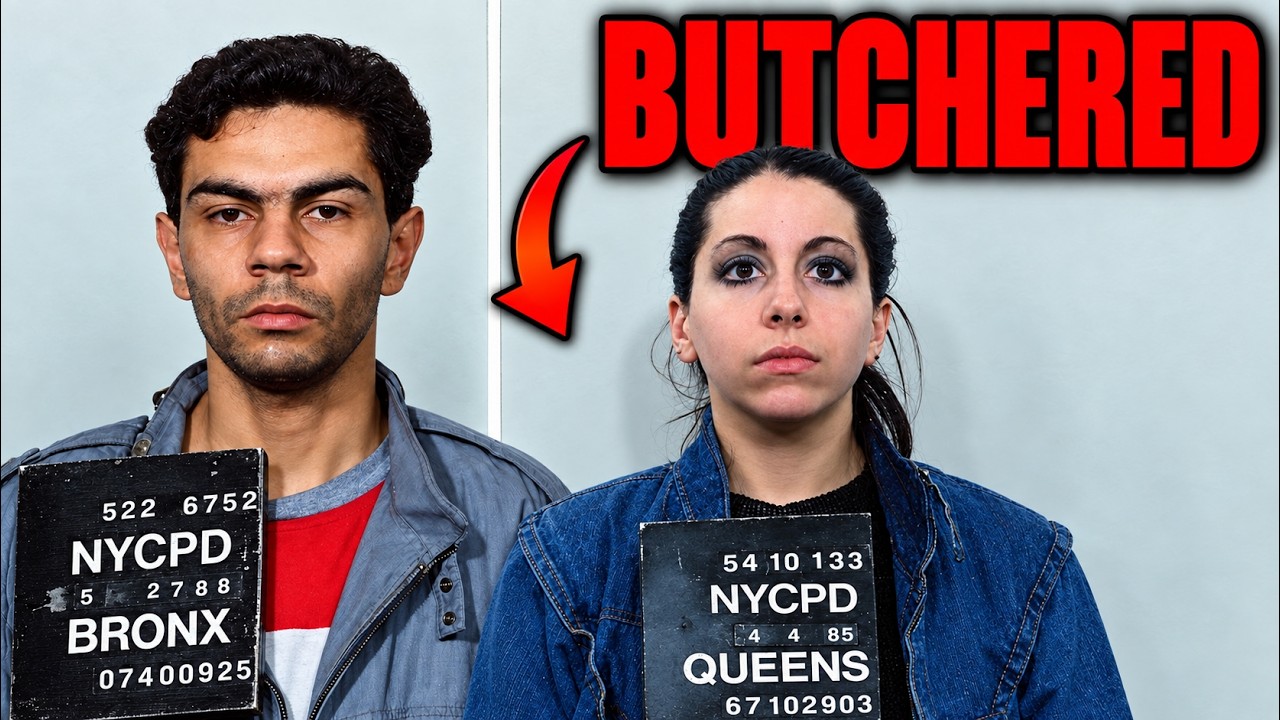
For months, Thomas and Rosemarie had been robbing mafia social clubs at gunpoint. They stole cash and jewelry from men tied to some of the city's most feared criminal organizations. They entered rooms that were supposed to be safe. They humiliated the people inside, and they did it again and again.
By Christmas Eve, it was said that more than one mafia family wanted them dead.
A mafia social club was never just a bar. It was a headquarters disguised as a neighborhood room. Members and associates gathered there to play cards, exchange messages, settle disputes, and collect money. The names on the doors might have seemed harmless, but the men inside often represented a captain, a crew, or a larger family.
These clubs ran on reputation. A stranger was not supposed to walk in and take over. The people inside were supposed to be protected by the fear attached to their names. Police were rarely welcome, and any robbery created a problem. Reporting a theft could invite questions about the club, its members, and the money on the tables.
Silence protected the club from law enforcement. But it also protected the thieves.
Rosemarie Uva was born in 1961. She had already served time in prison after a robbery conviction in the 1980s. Thomas Uva, born in 1964, also had a criminal record. He had been imprisoned after a burglary conviction and was released on parole in May 1992.
The couple married in 1987 after Rosemarie left prison. For a time, they tried regular jobs. Rosemarie found work at a collection agency in Manhattan and helped Thomas get a job there. Both were let go in November 1992.
By then, investigators believed the robbery spree had already begun.
During the summer and fall, the couple allegedly targeted at least four mafia social clubs. Some accounts put the number as high as ten. Thomas was described as the one who walked in, sometimes carrying a compact submachine gun. Rosemarie waited in the getaway car.
Thomas demanded money and jewelry, but taking valuables was only part of the performance. According to accounts that later reached investigators, he sometimes ordered the men to pull down their pants. In one reported incident, he deliberately ruined an elderly mobster's carefully styled hair.
The goal seemed to go beyond profit. It was domination.
Money could be replaced. Humiliation could spread. Every man ordered to lie on the floor or strip became proof of his crew's failure. Every story repeated in another club weakened the image that protected mafia business.
The Uvas were not just stealing from organized crime. They were making organized crime look powerless inside its own strongholds.
In the early 1990s, John Gotti's public image had made the Gambino family famous beyond traditional mafia neighborhoods. His expensive suits, courtroom appearances, and apparent ability to beat prosecutions made him a symbol of criminal confidence. His conviction in April 1992 did not erase that image immediately.
For remaining Gambino members on the street, any public challenge carried extra risk. If people could rob clubs tied to prominent leaders again and again, the Gotti name no longer guaranteed fear.
The Uvas had stumbled into a conflict between appearance and reality. The reality was that a social club could be penetrated. The appearance was that entering such a place without permission was unthinkable. Every successful robbery widened the gap between those two ideas.
Other criminals might hear that the clubs could be hit. Neighborhood residents might hear that feared men had surrendered their valuables. Associates might begin to wonder if their leader could protect them.
The loss of a few thousand dollars at a card table was a minor expense compared to the damage of that rumor.
Once the couple's car and address were known, the families could make them an example. The response would restore the deterrence that locks, guards, and police reports never provided.
The targets spanned multiple families. One was the Hawaiian Moonlighters club on Mulberry Street in Manhattan, tied to Joseph Corrao of the Gambino family. Another was the Veterans and Friends Club on 86th Street in Bensonhurst, tied to Gambino leader James Failla. The couple was also said to have targeted a Bath Avenue club connected to Gambino member George DeCicco.
Then there was the Liberty Cafe in Ozone Park, a club tied to Gambino captain Dominick Pizzonia. Investigators believed the couple robbed it twice. They were also linked to a Brooklyn club tied to Bonanno family figure Anthony Spero. Other reports indicated that Colombo family members were victims as well.
Reconstructing every reported robbery with certainty is difficult. Those clubs kept no public records of being robbed. The people inside had strong reasons to stay silent. But by late 1992, the couple's names, faces, and methods were circulating in the same underworld they had been robbing.
At the Liberty Cafe, their luck may have begun to run out. During one robbery, men reportedly chased the getaway car and managed to record its license plate number. The advantage that had protected the Uvas was fading. The clubs might not call the police, but they had their own networks.
Thomas Uva seemed aware of the danger but indifferent to it. An informant later reported that when someone warned him the mafia would kill him, Thomas replied that everyone dies. That phrase became famous after his death, but it must be treated with caution. It was not recorded, and it did not come from Thomas himself in a courtroom. It survived as an underworld account passed to investigators.
What can be established is that the warnings did not stop the robberies.
The response was not limited to one angry club owner. Investigators later concluded that murder contracts were being discussed among the Gambino, Bonanno, and Colombo families. The same rival organizations that fought over money and influence now shared a single target. Each had members who wanted to find the Uvas.
According to later testimony, the crews were actually racing to reach the couple first.
That competition helps explain why two local thieves mattered enough for prominent figures to discuss them. Inside the Gambino family, Dominick Pizzonia had a strong personal motive. The Liberty Cafe was within his territory, and it had allegedly been robbed twice. Known as "Dom the Thin," Pizzonia was a captain operating in Queens.
Years later, prosecutors accused him of participating in the plot to kill the Uvas and helping the Gambino family claim responsibility.
The chain of command, according to government witness Michael DiLeonardo, went above Pizzonia. DiLeonardo was a made member of the Gambino family and a longtime Gotti loyalist before he began cooperating with federal prosecutors. At Pizzonia's trial, DiLeonardo described discussions inside the family after the club robberies.
His testimony connected the response to Peter Gotti, John Gotti Jr., and ultimately John Gotti himself.
John Gotti was not free when the Uvas were killed. He had been convicted in April 1992 and was serving a life sentence. He could not stand on a Queens street, track their car, or personally oversee an attack. But prison did not erase the power his name carried inside the Gambino family.
According to DiLeonardo, approval for the murder reached the imprisoned boss.

DiLeonardo also testified that Gotti later wanted people to know that Gambino family members had killed the couple. The goal was not just revenge. It was owning that revenge. That distinction mattered because rival families reportedly wanted the same credit.
Another cooperating witness, former Bonanno underboss Salvatore Vitale, described a dispute over who actually carried out the killings. The question became serious enough for prominent figures to discuss at a private meeting. In mafia culture, claiming credit for another family's work could create new conflict.
The Uvas had embarrassed several groups, but only one crew could claim to have found them first.
The official underworld credit, according to later testimony, went to Pizzonia and the Gambino family.
That does not mean a jury concluded John Gotti ordered the killings. It did not. The claim about his approval came from cooperating witnesses years after the murders. No written contract with his signature exists. No one was convicted of murder for firing through the windshield.
The evidence describes a decision moving through conversations, loyalties, and family hierarchy. It also shows why the most dramatic version of the story must be treated with precision.
The murders happened on Christmas Eve, but there is no reliable evidence that Gotti chose that date or waited for it deliberately. Perhaps the date was chosen because the couple had been located by then. Perhaps it offered an expected routine. Perhaps it was coincidence.
What is documented is that the Uvas left their apartment that morning and drove into a neighborhood where people tied to the clubs were looking for them. They did not get far. Near 103rd Avenue and 91st Street, their car stopped at a red light.
The attacker approached and fired rapidly through the glass. Thomas and Rosemarie had no time to escape. The same windshield that protected them from the cold became the surface the bullets pierced.
The car's final movement created confusion about the location for years afterward. Some official summaries placed the shooting at Woodhaven Boulevard and 103rd Avenue, where the Mercury finally stopped. More precise reconstructions placed the shooting several blocks west near 91st Street. The vehicle then rolled without a conscious driver, struck another car, and settled near Woodhaven Boulevard.
That rolling car was the first public sign that the chase was over.
At home, Rosemarie's mother Maria DeToma was preparing fish for the family's Christmas Eve dinner. Her son Anthony, a police officer, arrived with the news. The family had expected Thomas and Rosemarie to return from shopping. Instead, the couple became the subject of a double murder investigation that immediately faced the silence surrounding mafia clubs.
Investigators had victims with criminal records, a stunning motive, and an unusually large number of possible enemies. What they did not have was a group of cooperative witnesses. The robbery victims had avoided police when the clubs were attacked. Admitting what happened would have exposed their own relationships and increased their humiliation.
Even people who knew about the murder contracts had reason to stay quiet.
Investigators began hearing information from informants, but intelligence was not enough as courtroom evidence. The case remained unsolved for more than a decade.
Then, in September 2005, federal prosecutors charged Dominick Pizzonia in a racketeering case that included the Uva murders. Ronald Trucchio, known as "Ronnie One-Arm," was named as an unindicted co-conspirator. Prosecutors alleged that Pizzonia was involved in both the planning and the killings themselves.
The trial began in 2007. By then, the government could call former insiders who had crossed the line no one expected the Uvas to cross. DiLeonardo testified about the Gambino family's reaction and the alleged approval from John Gotti. Vitale described what he learned from the Bonanno side and the later dispute over credit.
The defense attacked the cooperators' credibility and presented an alibi. Anna Biello testified that Pizzonia spent Christmas Eve at her home cooking fish. It was a striking parallel. While Rosemarie's mother prepared the traditional fish dinner and waited for her daughter, the man accused of helping kill her was said to be cooking fish elsewhere.

The jury's verdict was narrower than the prosecution's charge. Pizzonia was not convicted of murdering Thomas and Rosemarie Uva. Jurors acquitted him of the murder counts. However, they did convict him of racketeering conspiracy tied to planning the killings.
In September 2007, he was sentenced to 15 years in federal prison.
That outcome is essential to the truth of the story. A federal jury accepted that Pizzonia was part of a racketeering conspiracy involving plans to kill the Uvas, but it did not find enough evidence to prove he carried out the murder. Another defendant, Alfred Congiulo, was acquitted. No one was convicted of pulling the trigger.
The case ends with two kinds of certainty.
The first is historical. Thomas and Rosemarie Uva robbed mafia social clubs. Their actions provoked outrage across several families. They were hunted, and on Christmas Eve they were shot dead in their car. Federal testimony placed the Gambino family inside the conspiracy and claimed John Gotti approved the contract from prison.
The second is legal. The trial did not resolve every role. It did not identify a convicted shooter. It did not prove Gotti chose Christmas Eve, and it did not turn every story repeated by informants into established fact.
But the unanswered details do not weaken the central lesson. They reveal how the clubs protected the very people who targeted the Uvas.
The couple chose victims who could not comfortably call the police. That gave them temporary freedom. It also guaranteed that revenge would develop outside normal channels, through leaders, crews, prison conversations, and rival families racing to retaliate.
Thomas and Rosemarie Uva found a weakness in mafia social clubs. They mistook that weakness for safety.
The money they stole was never the greatest offense. The deeper insult was forcing feared men to submit, then allowing that story to spread. Every successful robbery made the next one seem possible. Every humiliation threatened the reputation the clubs depended on.
By the time a license plate linked the thieves to a real couple in Ozone Park, the underworld question was no longer whether they would be punished. It was which family would reach them first.
On the morning of December 24, the answer came at a red light. Their Mercury kept moving after the couple was gone. It traveled the last blocks without them, carrying Christmas purchases toward a dinner they would never attend.
Behind it was a shattered window. Ahead was Woodhaven Boulevard, where the car finally stopped and the public story began.
For 13 years, no one was charged. Even after the federal trial, no one was convicted of the shooting. The imprisoned boss mentioned in testimony never faced a verdict for approving this crime. Christmas Eve was the haunting date, but no proven explanation exists for why that morning was chosen.
What remains is the reason the hunt was so intense. Thomas and Rosemarie Uva entered places built on fear and discovered the men inside could be robbed. Then they added mockery to the theft. They thought silence would protect them because their victims could not admit what happened.
But silence protected the mafia instead. It hid the search, obscured the chain of command, and kept the shooter's identity beyond the reach of a murder conviction.
The couple robbed the clubs in public humiliation. The response came through private conversations. And when their car moved through Queens on Christmas Eve, the people who wanted them dead had reclaimed the one thing the robberies had taken from them.
Their reputation.