The Battle of Fort Stedman began as one of the most audacious and complicated assaults of the American Civil War, but it ended as Robert E. Lee’s last desperate gamble to break the Union stranglehold on Petersburg. In early March 1865, Lee summoned his youngest corps commander, 32-year-old Major General John B. Gordon, and asked him to identify the weakest point in the Union line.
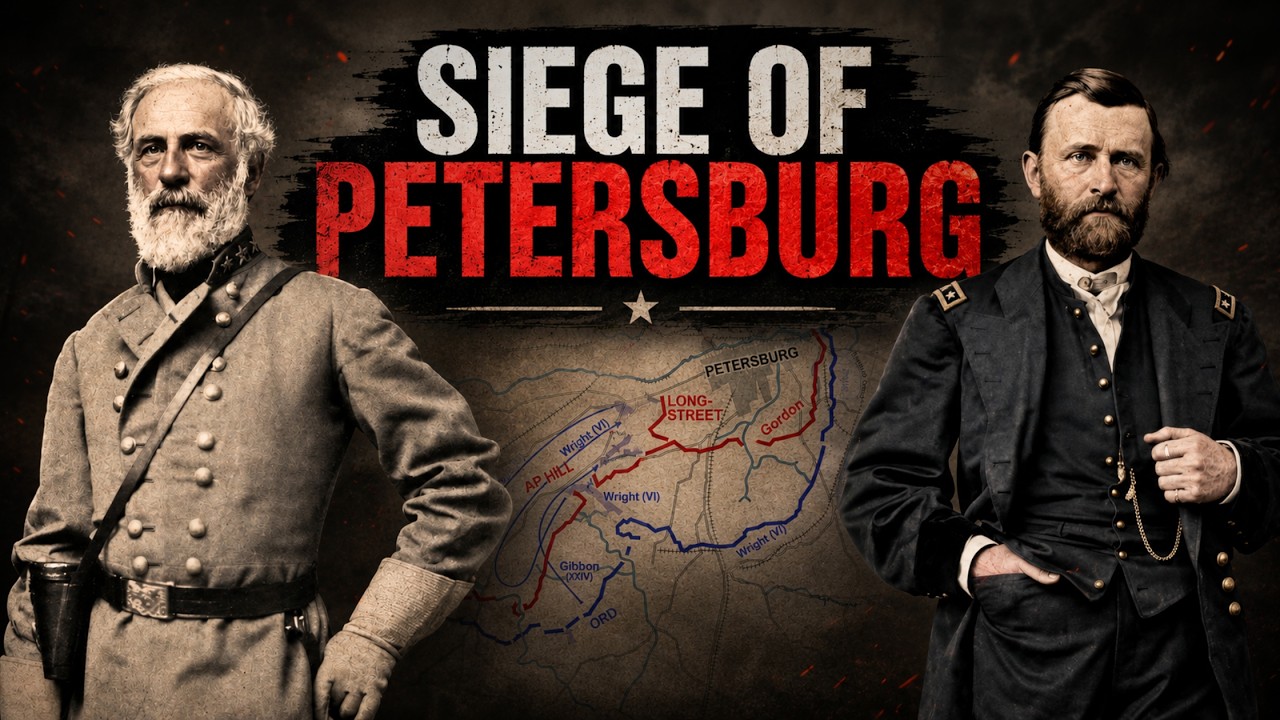
Lee knew his army was starving and shrinking, and he believed he had to strike or face a slow death in the trenches. Three weeks later, Gordon returned with a plan to attack Fort Stedman, a Union bastion east of Petersburg where the two opposing lines were only 150 yards apart. The fort bristled with cannon and was protected by breast-high fraises, angled rows of sharpened logs reinforced with telegraph wire. Gordon’s plan required his men to clear obstacles in the dark, overwhelm Union pickets silently, and send fifty axemen ahead to chop through the federal defenses.
Three detachments of one hundred men were assigned to neutralize the redoubts behind the fort that commanded its position. Confederate cavalry was then to slash through to the federal rear. Lee gave Gordon four and a half divisions, nearly half of the entire Confederate force in front of Petersburg. The attack was set for 4:00 a.
m. on Saturday, March 25, 1865. The assault’s early success exceeded expectations. Confederate troops tore through the federal line just north of the fort, bayonets and clubbed muskets were used in close fighting, and artillery poured enfilading fire into Union positions.
But confusion quickly set in. The maze of federal trenches made it impossible for the attackers to maintain formation or determine their positions. The three infantry detachments never found their assigned redoubts. Confederate cavalry never advanced.
And starving Southern soldiers stopped to fill their pockets with Union rations instead of pressing the attack. As daylight arrived, Union artillery and infantry converged from all directions. By 8:00 a. m.
, four hours after the attack began, Lee ordered a withdrawal. Many Confederates were cut down crossing the fire-swept ground between the lines, and nearly 1,900 were taken prisoner. Lee’s army lost about 1,600 men killed or wounded. Union losses were approximately 1,000, including about 500 captured.
Despite the surprise, the federal response was so measured that a divisional review originally scheduled for that morning was simply postponed until the afternoon. The defeat at Fort Stedman was devastating. The very next day, Lee informed President Jefferson Davis that both Richmond and Petersburg were doomed. He knew he had to move his army, break away from Grant’s grip, and attempt to join General Joseph Johnston’s forces in North Carolina.
Grant, who sensed Lee’s intentions, had already begun positioning forces for a final maneuver. His plan centered on a rectangle of ground southwest of Petersburg bounded by the Southside Railroad, the Weldon Railroad, the Vaughn Road, and a crossroads known as Five Forks. Grant wanted to lure Confederate infantry out of their trenches and set the stage for Major General Philip Sheridan’s cavalry to strike behind Confederate lines. On March 29, Lee correctly interpreted Grant’s movements.
He pulled Major General George Pickett’s 5,000-man infantry division out of the line and sent it to bolster his right flank. To counter Sheridan’s roughly 11,000 troopers, Lee could spare only about 5,000 Confederate cavalry under his nephew, Major General Fitzhugh Lee. The skies opened that day, and the rain fell in sheets. Grant briefly called off operations, but Sheridan rode seven miles through the downpour to confront his commander.
He insisted he was ready to strike the next morning. Grant relented. On the morning of Friday, March 31, Confederate forces launched a flank attack against Sheridan’s cavalry and the Union Fifth Corps under Major General Gouverneur Warren. One Union brigade was led by Brigadier General Joshua Lawrence Chamberlain, the hero of Little Round Top who had been wounded at Petersburg nine months earlier.
He was hit again that day when a Confederate bullet passed through his horse’s neck, tore through his left sleeve, and slammed into his chest, where it was deflected by a leather case and mirror in his breast pocket. He briefly lost consciousness, but returned to the fight, hatless and blood-smeared, and helped rally his brigade. That evening, Warren realized that Pickett’s force was vulnerable, stretched so far west that it could be cut off from the rest of Lee’s army. He proposed moving his entire corps to attack the Confederate flank while Sheridan struck the other side.
Grant approved the plan, but delays meant Warren’s men did not reach their positions until the next morning. At daybreak on April 1, 1865, Pickett realized his danger and began falling back toward Five Forks. Sheridan pursued, determined to prevent his escape. That afternoon, Pickett and Fitzhugh Lee made a disastrous decision.
Despite earlier orders from Lee to hold Five Forks at all hazards, the two officers accepted an invitation from Major General Thomas Rosser to attend a shad bake at his headquarters. They left no one in command and told no one where they were going. At 4:15 p. m.
, Federal troops stepped out in full view of the Confederate left flank. The attack initially went badly, with the Confederate line positioned farther west than expected, and Union formations had to wheel to adjust. But elements of the Fifth Corps marched unopposed and found themselves completely behind Pickett’s force. Sheridan, who had been furious over the delays, led from the front, waving a flag and cursing, encouraging and threatening his men.
One officer described him as the incarnation of battle. Pickett, unaware of the fighting because of an acoustic shadow that muffled the sound of the guns, was still at the shad bake. When he finally dispatched messengers, he watched one of his couriers being captured by Union soldiers. Pickett was cut off from his men.
By 6:45 p. m. , Confederate resistance collapsed. More than 5,000 Confederates were captured, along with thirteen battle flags and six guns.
One Confederate cavalry officer later called Five Forks the Waterloo of the Confederacy. Robert E. Lee’s right flank had been smashed. That evening, Sheridan removed Warren from command of the Fifth Corps, citing what he considered tardiness and a lack of aggressiveness.
Warren asked Sheridan to reconsider. Sheridan’s reply was blunt and dismissive. Warren, humiliated, reported to Grant and was assigned to command garrison troops. He immediately requested a court of inquiry.
The wait would last fourteen years. His name and honor were cleared only three months after he died of heart failure on August 8, 1882. Victory at Five Forks reached Grant that night. While others celebrated, Grant immediately ordered attacks for the next morning at 4:00 a.
m. across the entire Confederate line stretching from Petersburg to Richmond. The bombardment that opened the assault on Sunday, April 2, 1865, was the greatest of the nine-month siege. As one Union sergeant described it, hundreds of cannons, field guns, and mortars produced a stream of living fire.
The signal gun intended to launch the infantry advance was drowned out by the barrage, and some units moved forward nearly half an hour late. Pioneers with axes chopped through the Confederate obstacles. Soldiers carried loaded muskets with the caps removed to prevent accidental firing. Canteens and haversacks were left behind to reduce noise.
It was the Ninth Corps under Major General John Parke that first reached the Confederate line at Fort Mahone. Federal soldiers fell under Confederate volleys and double-shotted canister, but they pressed on. Major General Horatio Wright’s Sixth Corps broke through the Confederate line in several places and reached the Southside Railroad a mile beyond. The 24th Corps under Major General John Gibbon then turned toward Petersburg itself.
Confederate Lieutenant General A. P. Hill was unaware of the breakthrough at first. The previous evening, he had inspected his line and retired concerned about his ability to withstand an attack.
Just before sunrise, he rode to Lee’s headquarters. Lee was weary and ill, lying in bed partially clothed, listening to the guns. Hill and James Longstreet joined him there. An officer then reported that Hill’s lines had been pierced and that federal skirmishers were approaching.
The officer was wrong on one point. Those were not skirmishers but the main Union body. Hill mounted his horse and rode toward the breakthrough with Colonel Charles Venable and two couriers. They encountered Union soldiers who had become separated from their units, and Hill’s party captured two prisoners.
Hill turned to his courier, Sergeant G. W. Tucker, and told him that if anything happened, he must go back and report it to General Lee. Moments later, Hill spotted two Federals in the trees ahead.
Drawing his revolver, he rode forward. Corporal John Mock and Private Daniel Wolford of the 138th Pennsylvania took cover and leveled their rifles. Tucker shouted a warning, but Hill continued forward, only twenty yards from the two Union soldiers. Hill ordered them to surrender.
Their answer was gunfire. Wolford’s bullet missed Tucker, but Mock’s shot struck Hill in the heart. He was dead before he hit the ground. Tucker reported Hill’s death to Lee.
With tears in his eyes, Lee murmured that Hill was at rest now and that those left behind were the ones to suffer. Around him, Lee’s army was coming apart. Pickett’s command was separated. Anderson’s corps, sent to reinforce Pickett, was caught in between.
Divisions under Heath and Wilcox were cut off from the rest of the army. Only Gordon’s force, outnumbered two to one, held some semblance of order. Lee knew his army’s only chance was to move north, cross the Appomattox River, and head west. He sent a message to Confederate Secretary of War John C.
Breckinridge advising that all preparations be made for leaving Richmond that night. In Richmond, Jefferson Davis was sitting alone in his usual pew at St. Paul’s Episcopal Church when a messenger delivered the news. He rose and walked unsteadily out of the church.
As more officials began to leave, the minister ended the service. In Petersburg, the situation was chaos. Lee moved his headquarters after it was hit by federal artillery while he was still inside. He organized a withdrawal to Amelia Court House, about thirty-five miles away on the Richmond and Danville Railroad.
Grant pressed relentlessly. The defense of a crucial stretch of earthworks fell to a brigade of Mississippians under Brigadier General Nathaniel Whitworth. The men were outnumbered ten to one. A lieutenant colonel told them that the salvation of Lee’s army was in their keeping.
Inside Fort Gregg and Battery Whitworth, they broke wave after wave of Union attackers. Federal flags were planted on the fort’s parapet, but the defenders held on with bayonets and clubbed muskets. Of the 214 men charged with holding the fort, only thirty were still standing. Fifty-five were killed and 129 wounded.
Union losses were also severe. John Gibbon’s Federals lost 714 men killed, wounded, or missing. But the Confederate stand bought precious time for Lee to place troops behind his innermost defenses. That Sunday, photographer Thomas Roche carried his equipment to captured Fort Mahone, which had defied Grant’s army for over nine months.
Through his lens, he captured images of Confederate dead sprawled in the mud-choked trenches, some clearly veterans, some very young. The photographs conveyed the gut-wrenching reality of a nation about to fall. That night, twenty-three miles to the north, a militia captain commanded two hundred local troops at the only remaining bridge across the James River from burning Richmond. He had orders to burn it after the last Confederate soldier crossed.
Down river, scuttled gunboats and ironclads burned and exploded. From his vantage point, Richmond was coming apart. At dawn, federal horsemen approached the city. A Confederate ambulance train forced its way through mobs pillaging the commissary depot and crossed the bridge to the south, followed by Brigadier General Martin W.
Gary’s cavalry brigade. The militia captain fretted over the delay as kerosene, tar, and pine logs were ready to be ignited. Then another company of southern cavalry appeared and dashed for the bridge with Union troops not far behind. Gary explained that this was his rear guard.
After the last defenders galloped across, Gary touched his hat and trotted after them. He then shouted over his shoulder, Goodbye. Blow her to hell. By the next day, Richmond was a nightmare, something out of Dante’s Inferno.
The Confederate States of America was in its death throes, and its most successful army had only another week to live. After more than nine months of siege, Petersburg had finally fallen.