When Allied troops stormed the beaches of Normandy on D-Day, they faced a weapon that had become the backbone of German infantry defense: the MG42 machine gun. Known for its distinctive, terrifying roar, the gun earned the nickname “Hitler’s buzzsaw” and was responsible for cutting down thousands of soldiers on the open sands of Omaha Beach. But what happened to the men who operated those guns after the invasion succeeded is a story that is rarely told. German high command had prepared for an invasion by building fortified strong points, known as “Widerstandsnester” or resistance nests, along the French coast.
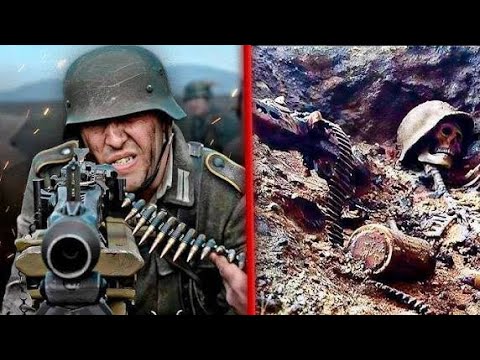
These bunkers were positioned to support one another with overlapping fields of fire. On Omaha Beach alone, there were 15 such positions, many of them designed to sweep bullets horizontally along the shoreline so that anyone escaping one gun’s line of fire would run directly into another. A standard MG42 team consisted of three men: a gunner, a loader who kept fresh ammunition belts coming and swapped overheated barrels, and a third man hauling extra ammunition. By 1944, many of these crews were inexperienced replacements who had never seen real combat, but their orders were simple and brutal.
On D-Day morning, their mission was to keep firing until the beach was empty or die behind their weapon. Allied planners knew what awaited them. They had spent months studying the coastline and labeling each resistance nest, believing that bombers and naval guns would smash the defenses before troops landed. But the plan did not hold up in reality.
The naval bombardment before dawn was enormous, with destroyers, cruisers, and battleships pounding the coast with thousands of shells, yet the solid concrete fortifications survived almost fully intact. When German soldiers peered outside, they saw hundreds of Allied landing craft pushing toward them. British and Canadian forces had special armored vehicles known as “Hobart’s Funnies” to clear bunkers, but the Americans were not so fortunate. Of the 32 amphibious Sherman tanks launched offshore, 27 sank.
Only five reached the beach, and just three remained functional before being knocked out. That left infantry alone to face the hidden machine guns. German MG42 crews used tactics that made their guns even deadlier. One method, nicknamed “mowing the grass,” involved aiming low to shatter legs and drop advancing men, since wounded soldiers would attract medics and comrades who then became additional targets.
Some crews used deception, firing tracers high to make the gun seem inaccurate while a concealed gun fired at the true killing height. Many attackers fell for the ruse. As the first assault waves hit the sand, the invasion plan unraveled. Casualties skyrocketed, and small groups of Allied soldiers began pushing forward on their own initiative, using whatever cover the beach offered: tank obstacles, bomb craters, even bodies.
Training had taught them to move during the MG42’s brief pauses, usually during reloads or barrel swaps, and officers shouted for men to sprint in those fleeting seconds. One sergeant gathered a handful of men and a bazooka to assault WN61, a strong point raking the beach with fire. They first destroyed a 50mm anti-tank gun supporting the machine gunners, then stormed the bunkers and eliminated the MG42 teams one after another. In that close-quarters fight, they killed seven defenders and knocked out two gun positions, losing only one man with another wounded.
Their success relieved pressure on that stretch of the beach and opened a route inland. But across Omaha Beach as a whole, it was a slow, brutal crawl. Rangers, engineers, and infantry advanced inch by inch for hours, fighting toward each bunker under relentless fire. At Dog White, Ranger units charged a fortified position under the cover of smoke and managed to shut down its guns.
On Easy Red, combat engineers blew apart beach obstacles, creating a route that allowed troops to scale the bluffs and flank the machine gunners who had pinned them down for hours. Reaching a machine gun bunker was only the beginning. Once assault teams closed in on an MG42 position, they tossed grenades and demolition charges inside, then finished off any defenders who survived the blasts. When they got close enough, flamethrower operators drenched the bunker in fire, wiping out the nest entirely.
Only after the beachhead was secured did some of the German gunners, wounded, low on ammunition, or completely spent, begin to surrender. But after inflicting such heavy losses and with emotions running high, not every attempt at surrender was accepted. By early afternoon, momentum had shifted. Scattered groups of American infantry and engineers had clawed their way up the bluffs, destroying or bypassing the last remaining strong points.
One official report later stated that the heights were captured solely through the raw, unwavering courage of the troops on the ground after the naval and air bombardment failed to neutralize the defenses. Once the MG42 positions were eliminated, the difference was dramatic. With the exits off the beach opened, tanks and reinforcements could move forward, and the German defensive line lost the firepower it relied on most. German machine gun crews continued fighting in Normandy’s hedgerows, but never again in such dense concentrations, and never again with the opportunity to halt the Allied advance in a single day.
For Allied infantry, facing an MG42 was sheer terror. Many men in the first wave were newly trained and had never experienced real combat. Long before they reached the shoreline, they could hear the weapon’s unnerving snarl, an unbroken ripping sound that some compared to tearing fabric or a chainsaw chewing through timber. Veterans later admitted that just the noise was enough to make your blood run cold, freezing you in place like an animal caught in headlights.
When the landing craft ramps dropped, the first instinct was to dive into the sand and not move. One American squad leader remembered shouting at his men to keep advancing if they wanted to survive. But on that wide, barren stretch of beach, every soldier knew he was completely exposed. Army medic Ray Lambert recalled how machine gun fire shredded the water, cutting down men who were already struggling just to make it ashore.
At Dog Green sector, one company suffered nearly 90 percent casualties within minutes. On the opposite end of those barrels, the experience was just as terrifying for the German machine gunners. The morning began in complete darkness. At Strong Point WN62 overlooking Omaha Beach, 20-year-old Heinricht Severloh woke to alarms announcing the invasion.
By sunrise, he was in his dug-in firing position behind an MG42, staring out at a sight he said felt unreal: a vast armada of ships and thousands of soldiers advancing straight toward him. As the first landing craft came within range, Severloh opened fire. Over the next nine hours, he fed belt after belt into the gun, firing close to 12,000 rounds. His assistant gunner had been killed, forcing him to operate the weapon alone.
Around him, the other defenders were cut down one after another. Severloh later said it felt hopeless: no matter how many he hit, more troops kept appearing. By early afternoon, with his position collapsing and his ammunition gone, he grabbed a rifle and tried to escape. His retreat became a frantic race for survival, diving through bomb craters and hedgerows until nightfall.
The next morning, surrounded, he surrendered, careful not to reveal that he had been behind one of the deadliest machine gun positions on the beach. Many MG42 operators never got that chance. Plenty were killed inside their bunkers, and those captured alive were often shocked to still be breathing, considering the devastation they had caused. Others were not so fortunate.
The fighting left deep psychological wounds on both sides. Allied veterans never forgot the MG42’s savage fire, while German survivors were haunted by the faces and moments that stayed with them long after the war. Taking out an MG42 nest was never a clean, cinematic assault. It meant creeping dangerously close, often within a few meters, while under relentless fire.
Every step forward was a gamble that the gunner would not spot you, and the price of being wrong was instant death. Many soldiers were killed just yards from the bunker, moments before they could deliver the final blow. Once they broke inside, the fight was quick, vicious, and over in seconds. Some incidents were rarely written down, likely to avoid public backlash over clear violations of the laws of war, and were overshadowed by the massive Allied victory that opened a new front in Europe.
But every soldier involved knew there were things they were not supposed to talk about. For the MG42 gunners who lived through D-Day, the war’s end did not erase their memories. Some, like Heinricht Severloh, returned home to quiet farms or small towns that looked unchanged yet carried the weight of that morning for the rest of their lives. Severloh barely spoke about Omaha Beach for decades, though the burden never left him.
Years later, he contacted the families of his fallen comrades and even met David Silva, a US soldier he had wounded on D-Day. The two men, once enemies, sat together and talked, something unimaginable in 1944. For Severloh, it offered a small measure of peace. Many other German veterans lived quietly, rarely mentioning the MG42 except in conversations with fellow survivors.
To them, the weapon was a strange mix of professional pride and private guilt. To Allied troops who faced it, the MG42 was unforgettable, a force of nature. In countless memoirs, when a veteran wrote “a machine gun opened up,” they almost always meant the MG42. Movies like The Longest Day and Saving Private Ryan carried its infamous buzzsaw sound into the modern era.
Even today, the cracked concrete bunkers in Normandy stand as silent but powerful reminders of its deadly reputation and the scars it left on both sides.