Tuesday Weld was twelve years old when she carefully lined up the bottles and pills that she hoped would end her life. She had fallen in love, hopelessly and for the first time, with a man who could never love her back. In the early hours of a New York night, that felt like reason enough to end everything. When she was found, she had already slipped into a coma so deep that she temporarily lost her hearing and sight.
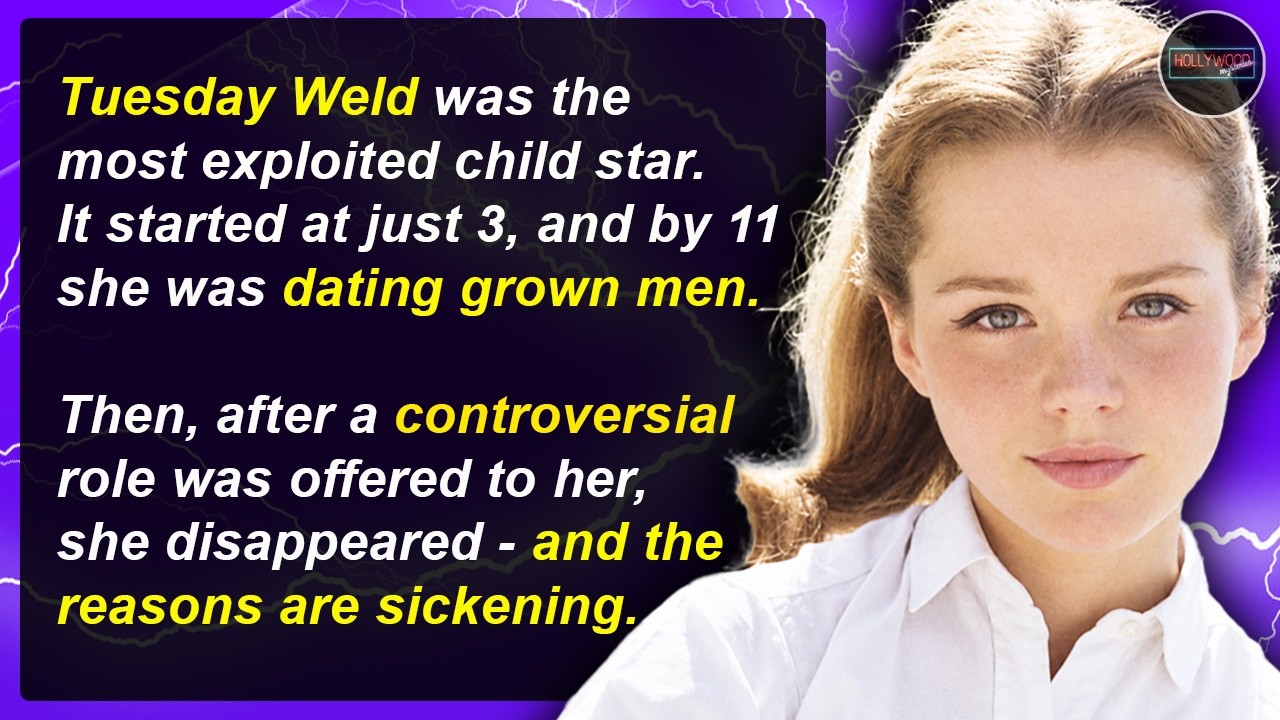
When she woke up, blinking amid the wreckage of the rescue attempt, the one adult who could have helped her decided that asking for help would look strange. That child was Tuesday Weld, already the sole breadwinner of her family and a veteran of modeling studios and television sets by the age of twelve. A hardened professional since the age of three, this was only the first of many times she would try to disappear. She was born Susan Ker Weld on August 27, 1943, in Manhattan, at a Salvation Army hospital, according to some accounts.
The Weld family was an old Massachusetts clan, the kind that produced statesmen and built Harvard buildings, with the kind of reserved Yankee wealth that considered mentioning money vulgar. Her father, Lathrop Motley Weld, was the family cautionary tale: a former investment broker and full-time gambler, the black sheep, a man who had consumed several wives and most of his opportunities by the time he married his fourth and final wife, an English orphan named Jocelyn Balfour Kerr. When Lathrop died of heart disease in 1947, shortly before Susan’s fourth birthday, he left his widow with three children, no money, and relatives who saw a simple and brutal solution. The family would take the children and pay for their education, on the condition that their mother agree never to see them again.
Jocelyn refused. “I have to give my mother credit,” Tuesday later said. “She refused to give us up. ”
Instead, the family got a cheap cold-water apartment for $20 a month and a plan.
If the youngest child could be made to earn money, everyone would eat. So at age three, before she could properly read, Susan Weld went to work. She said she went into it because she was good for nothing else, and it was the only path available. Her mother tried to make models of her siblings too, but they preferred swimming.
Tuesday was the late child and took to modeling immediately. Somewhere during those years, the name appeared. A young cousin who could not pronounce Susan called her “Tu-Tu,” which became “Tuesday,” and the name stuck, though she did not make it legal until October 9, 1959. She had not, as wits never tired of pointing out, actually been born on a Tuesday.
She was born on a Friday. Nevertheless, the name, like almost everything else about her, was a costume that fit her perfectly. What this arrangement did to the little girl is not hard to deduce, because the girl, grown up, described it clearly and without self-pity. She became the family’s provider.
She was expected to replace her father in too many ways. Her mother became obsessed with her, pouring her pent-up love, or what she claimed was love, onto her, and that was a heavy burden. When a journalist later asked whether teenaged Tuesday had to be home by 11:00, her mother reportedly answered: “That’s when her day begins. ”
The two fought for the rest of Jocelyn’s life, with Tuesday compulsively returning to the wound in interviews.
When Gay Talese of The New York Times asked her in 1971 whether she harbored harsh feelings toward her mother, she opened her wide eyes, repeated the question, smiled her radiant child-woman smile, and said: “I hate my mother. ”
The childhood work machine, the bright lights, the auditions, and the mother who needed her to be perfect did to Tuesday Weld exactly what such a machine usually does. At nine, she had a nervous breakdown, which she noted dryly “disappointed my mother greatly. ” She said she made “a comeback when I was ten.
” That comeback involved liquor. There were no laws protecting working children in New York then, so no one practically looked after her. Even when she had no work, she would wake up in the morning, say goodbye, announce she was going to school, then head to the Village and get drunk. Sometimes she drank in bars, sometimes at parties, sometimes she just stayed home and drank.
At eleven, by her account, she was having love affairs. At twelve, she made the suicide attempt that opened her story, mixing liquor and various pills to put an end to heartbreak and the nightmare she was living. She was sure it would end things, but her mother came in and found her. She stayed in a coma for a long time and lost her hearing, her sight, and many other things.
When she recovered, she decided to try to get some help, but her mother did not think she needed analysis. She thought it might look strange. After all, there was nothing wrong with her little girls. She said the cause was a broken heart.
She had fallen in love with a man like her, and when it did not work out, she felt pain. She was twelve, dealing with things that could crush a thirty-year-old. At fourteen, she went looking for God. It was four in the morning, raining, and she was very drunk.
She climbed the steps of one church after another, but every door was locked. She concluded that there could not be a God, because they said he was there, but you could not go in if you were going to steal from him. She never believed in God again. Meanwhile, the work was real and relentless.
She made her television debut at twelve, and that same year, 1956, appeared in a small role in Alfred Hitchcock’s “The Wrong Man. ” That year she also starred in a rock-and-roll picture called “Rock, Rock, Rock,” with her singing dubbed by an unknown Connie Francis. She worked as an understudy in William Inge’s “The Dark at the Top of the Stairs” on Broadway. Her mother, ever enterprising, tried to get the fourteen-year-old into the Actors Studio by passing her off as an eighteen-year-old.
The plan failed. She was told there were certain things you could not know as a little child. In 1958, the family moved west, and Hollywood, which had never met a young woman it did not want to can and market, took one look at Tuesday Weld and rushed to package her. The beginning was a supporting role in the 1958 Paul Newman and Joanne Woodward comedy “Rally ’Round the Flag, Boys!
” That was enough to convince Fox executives they had found their prize. In “The Five Pennies” the next year, she played Danny Kaye’s daughter, with Kaye noting that his co-star was fifteen going on twenty-seven. That equation would define her career for the next twenty years. Fox signed her to a long-term contract and loaned her to CBS for a new comedy series called “The Many Loves of Dobie Gillis,” where she played Thalia Menninger, the love interest of the money-hungry main character.
She got the role for a hefty $35,000 a year. Among the boys competing for Thalia’s on-screen affection was an unknown named Warren Beatty. The show made her nationally famous and landed her a Golden Globe as the most promising newcomer of 1960. But the series let her go after one season because one sponsor decided, ironically, that the appeal of a sixteen-year-old girl was unsuitable for a family show.
What followed was the era of the “sex kitten,” and Weld was for several years its most profitable star. The press celebrated her as Marilyn Monroe’s successor, and she was cast in films whose titles alone revealed their nature: “Sex Kittens Go to College,” “The Private Lives of Adam and Eve,” and others. In each, she played troubled teenagers or seductive nymphs. She earned $35,000 per film while the studio marketed her body even as the law still considered her a minor.
Gossip columnists chronicled her every slip, and morality guardians blamed her, a teenager working in a world of fragile morals since age three, for Hollywood’s decline. She responded by appearing in interviews barefoot and unapologetic. Then came two films in 1961 that hinted at what she could do if anyone let her truly try. In “Return to Peyton Place,” she played Selena Cross, an incest victim.
Even the trade press noticed she could act. In “Wild in the Country” she starred opposite Elvis Presley. She was seventeen. She was also the most famous rising star in town, involved with two of her co-stars: Presley, naturally, and the 45-year-old actor John Ireland, whom she had been dating since she was fifteen.
The Ireland affair, publicized in a 1960 issue of Photoplay under an unforgettable cover question, “Should a Girl Be Sexy at 15? ”, was exactly the kind of story that fan magazines condemned and fed on at the same time. Variety praised her as a steadily improving actress and a seductive, captivating siren. She remembered her nights with Presley with frank enjoyment for the rest of her life.
“He would walk into a room and everything stopped,” she said. “Elvis was so physically beautiful that even if he had no talent, just his face, his presence. He was fun, charming, and complicated, but he didn’t show that in public. ” They spent time together that summer, two rebellious kids who had found each other.
If the romance quickly faded into friendship, it was partly because everyone around Elvis realized that Tuesday Weld would not tolerate anyone for long, not even the King. Once, out of mischief, she threw a quart of milk from an upper-floor window of a Beverly Wilshire suite, just to watch it hit the sidewalk, long before any rock star tried that trick with champagne. Older men, drinking, bare feet in interviews, and the public refusal to behave properly made her an icon in the scandal press and a nightmare for her mother, who kept trying to restrain her. Tuesday settled the matter with a threat that any child worker knows as a last weapon: “If you don’t leave me alone, I’ll stop acting, which means no more money for you, Mom.
” In fact, in 1958, at sixteen, she made the exit she had been practicing all her life. “Finally, when I turned sixteen, I left home. I simply walked out the door and bought my own house. ” What she wanted from that house was space for the things her childhood had failed to contain.
She dreamed of a big house where she could put a bumper car system in the basement. And here we come to the most surprising truth of her professional life. Stanley Kubrick wanted her for the role of Lolita. She was his first choice for the title character in the 1962 adaptation of Nabokov’s novel, the most famous and controversial role for any young actress in the English-speaking world.
She was objectively perfect for the part, but she refused it with a sentence that outlived all the films she actually made: “I didn’t need to play the role. I was Lolita. ” It is either the most brilliant sentence ever spoken by a rising star or the saddest, because it is simply true. She had been a grown man’s fantasy since before she could spell, and she had hardened accordingly, learning never to pity herself.
She was not ready to spend three months pretending to be what her entire life had already made her. Refusing Lolita was the first step in what became her trademark: the systematic refusal of roles that would have made her a global star. Instead, she took time off, three months to go to Greenwich Village and “study herself. ” When she returned, people began taking her seriously.
In “Soldier in the Rain” (1963), a military comedy adapted by Blake Edwards from a William Goldman novel, she played a lighthearted, kind flirt who steals Jackie Gleason’s heart. What she really stole was the spotlight, and for the first time critics wrote about her as a gifted actress rather than focusing on her physical charms. She was extraordinary on television too, in an era when television still offered serious drama. In a 1962 episode of “Naked City,” she played a character inspired by Caril Ann Fugate, the teenage girlfriend of serial killer Charles Starkweather, opposite Rip Torn.
The reviews were excellent. She was building a reputation as one of the most naturally gifted young actresses in the country, doing work that ranged from superb to frankly unwatchable, sometimes in the same year. In 1965, she appeared opposite Steve McQueen in Norman Jewison’s “The Cincinnati Kid,” a genuine success that gave Hollywood one of its favorite Tuesday Weld stories. On her way to a charity event for hurricane victims one Monday morning, expected to be introduced to a local governor, she refused the honor by jumping out of a moving car in front of roughly 70,000 people.
She got some bruises but earned a day off. The Los Angeles Times inevitably headlined the story: “Blue Monday for Tuesday Weld. ”
The following year, she gave one of her best performances as the murderously ambitious cheerleader Barbara Ann Greene in George Axelrod’s black comedy “Lord Love a Duck,” a film adored by the few who saw it and ignored by everyone else, which was quickly becoming the pattern of her career. In the midst of all this, she decided to temporarily try being ordinary.
In 1963, she met Claude Harz, a young screenwriter, and on October 23, 1965, when she was twenty-two, she married him. “I really felt that what I had been doing with my life until then was probably wrong,” she said. “Maybe I should be a housewife. ” Her mother, predictably, hated him.
On August 26, 1966, a day before her twenty-third birthday, she gave birth to a daughter, Natasha, whom she described as the thing she was most proud of in the entire world. The marriage lasted about five years. The divorce became final on February 18, 1971, and she did not ask for alimony, partly out of principle. “Part of my reason is liberation.
I’m all for women’s liberation, but it’s as much liberation for men as for women. I see no reason why Claude should be burdened with that commitment. ”
That same catastrophic year, the universe seemed to take the divorce as a signal. “Everything really collapsed for me,” she said.
She got divorced, her car was wrecked, and her house burned down. Nothing of her house remained. Not even a photograph of Natasha. Her paintings, five years of diaries, and a novel manuscript were lost.
A book she said she might publish only after her ex-husband and her mother were dead. She was twenty-seven, everything she owned had burned, and yet by her strange memory, she became freer than she had ever been. The work she did in those years, looking back, was among the best of her life, and she often hated doing it. In “Pretty Poison” (1968), she played Sue Ann Stepanek, a small-town majorette whose apparent innocence hides a criminal streak, opposite Anthony Perkins as a man just released from a mental hospital.
The film failed commercially but later achieved near-religious cult status, which Weld could not accept. She fought with the novice director, Noel Black, every single day. She described the experience as the least creative one she ever had, a constant, unending conflict. A colleague remembered her as deeply troubled, a woman falling apart and crying, letting her hatred of the director control everything she did.
The result, paradoxically, was one of the greatest American performances of the 1960s. Around that time, Tuesday Weld perfected the style that would define her and mystify Hollywood for the rest of her career. She said no. She said no to “Bonnie and Clyde.
” She said no to “Rosemary’s Baby. ” She said no to “True Grit,” “Cactus Flower,” and “Bob and Carol and Ted and Alice. ” She would not even audition for Daisy Buchanan in “The Great Gatsby. ” Every one of these films was a huge success, and many became classics.
Her explanation to The New York Times was one of the most honest statements ever made by a movie star: “Do you think I want success? ” she asked. “I turned down ‘Bonnie and Clyde’ because I was nursing my baby then, and also because I knew deep down that it would be a huge hit. ” For her, stardom looked like a trap, and she had spent her entire childhood in traps.
She was not going to walk toward another one just because the money was good. What she wanted instead were the strange, difficult roles that were unlikely to work. She starred opposite Gregory Peck in “I Walk the Line” (1970) and in Henry Jaglom’s dreamlike, fragmented “A Safe Place” (1971). By twenty-eight, she had become exactly what she claimed she wanted to be: a cult figure, beloved by critics, a legend of what could have been.
“I’m happy being a legend,” she said. That choice reached its peak in 1972 with “Play It as It Lays,” Frank Perry’s adaptation of Joan Didion’s bleak novel about an actress who disintegrates in the moral void of Hollywood. It was as if the material had been assembled to fit Tuesday Weld’s specifications precisely. Her performance is a masterpiece of suppressed emotion.
She knew exactly what she was doing. American critics were puzzled by it. Roger Ebert, one of the exceptions, saw that she and Perkins were perfect in a film about collapse. She was nominated for a Golden Globe.
The film failed at the box office, and both results were fine with her. The Tuesday Weld who gave interviews in those years was charming, funny, articulate, and unmistakably sad. She drank less by then and was grateful. She had drunk regularly for ten years and considered her emergence unscathed a small miracle.
“At the time it seemed fun, not a problem,” she said. “One of the things I’m most grateful for is that I’m not an alcoholic, but I feel alienated everywhere. ” She was dating comedian David Steinberg and had not given up men by any means. “I adore men,” she said with a small cry.
“I love being around them, and I fall in love a lot. ”
She increasingly turned to television, which she loved because it required fewer of the machinations she did not trust. She played the wife in “Reflections of Murder” (1974) and, most powerfully, Zelda Fitzgerald in “F. Scott Fitzgerald in Hollywood,” a role for which she was almost genetically qualified.
She was honest about her approach, which was mostly having no approach. “What I like about television is its speed,” she said. “Two weeks even for the heavy role is great. Overthinking a role is a disaster for me.
Let’s just do it. Get the job done. ”
On September 20, 1975, she married again, this time to British comedian, pianist, and actor Dudley Moore, then a cult figure, still years away from the Hollywood stardom that “10” and “Arthur” would soon bring him. Moore, who was smitten with her, moved to Los Angeles for her.
On February 26, 1976, they had a son, Patrick. The marriage was not happy. Moore drank and went astray, and the marriage collapsed under the weight of two personalities, each in its own way allergic to stability. They separated in 1980.
The timing was conspicuously perverse. She left Dudley Moore just as he was about to become one of the biggest movie stars in the world. Then in 1977, she came as close to embracing the artistic establishment as she ever allowed herself. In “Looking for Mr.
Goodbar,” Richard Brooks’s harrowing depiction of the singles bar world, Weld played Katherine, the rebellious, out-of-control sister of a schoolteacher played by Diane Keaton. The role was small, but she packed her few scenes with a party, a divorce, a lot of alcohol, and two abortions. It earned her a nomination for the Academy Award for Best Supporting Actress. It was the only Oscar nomination of her life.
She lost to Vanessa Redgrave for “Julia” on the night of April 3, 1978. She followed that with performances opposite Nick Nolte in “Who’ll Stop the Rain” and in the ensemble satire “Serial. ” The ultimate irony of her film career is that her two best films came after her career had begun to decline. In “Thief” (1981), she filled a thinly written role with so much humanity that you could read her entire history in her face.
She played Al Pacino’s wife in “Author! Author! ” and earned an Emmy nomination for the 1983 television film “The Winter of Our Discontent. ” Then in 1984, Sergio Leone cast her in “Once Upon a Time in America,” giving her one of the most disturbing scenes of her career.
It was a bold, unsettling performance that brought her a BAFTA nomination. Meanwhile, her private life still looked like a guest list. Between marriages and around them, she was linked, seriously or otherwise, with a list of the era’s most attractive men: Al Pacino, Mikhail Baryshnikov, Omar Sharif, Richard Gere, Ryan O’Neal, and a parade that ran from Frank Sinatra to Albert Finney. On October 18, 1985, she married for the third and last time, to Israeli violinist and conductor Pinchas Zukerman, becoming a stepmother to his two daughters.
That marriage lasted into the new century and dissolved, like the others, into paperwork. Her last on-screen appearance came in 1993, when she played the agoraphobic wife of Robert Duvall’s retiring police officer in “Falling Down,” Joel Schumacher’s feverish film about Los Angeles rage. There were a few small roles after that, in “Feeling Minnesota” and in two 2001 films, “Investigating Sex” and “Chelsea Walls. ” Then Tuesday Weld did the one thing Hollywood could neither forgive nor understand.
She left. She never announced a retirement or returned to the stage. She did not write a memoir to settle scores. She simply faded away.
What remains is a matter of property and rumor. For years, she and Zukerman had a beach house in Montauk, at the far tip of Long Island, a property with an appropriately gothic background. They bought it from the estate of a Broadway producer who had killed his actress wife and then himself. She later moved to Colorado, to the mountains near Aspen, and in 2018, at seventy-four, she bought a house in the Hollywood Hills and came home.
She maintained her privacy entirely, famously replying, when a journalist asked what had brought her to seclusion: “I think it was a Buick. ”
She became an icon of a certain kind of mid-century promise: the beautiful girl devoured by the frivolous movie machine who resisted and refused to conform. She was, from beginning to end, engaged in one lifelong project: surviving on her own terms. That those terms cost her the stardom she could easily have won is not a loss she ever seemed to mourn.
As a girl, she said she wanted a house with bumper cars in the basement, another way of saying she wanted to own her own time. In the end, she got it. Now in her eighties, she remains alive, private, and utterly indifferent to it all. She was the most honest survivor Hollywood ever produced, because she understood that the surest way to keep your soul in that city is to refuse to sell it.
She was Lolita, but she refused to play the role, and that, more than any part she ever accepted, was the defining performance of her life.