The Wilderness of Virginia still reeked of smoke and death on the evening of May 7th, 1864. Flames had licked through the tangled brush the day before, trapping wounded men on both sides who screamed until the fire took them.
General Robert E. Lee sat alone in his headquarters tent on a low ridge overlooking the chaos. His gray uniform was stained with dust and sweat. Maps lay spread before him marked with the positions of the Army of Northern Virginia after two days of some of the bloodiest fighting the war had yet seen.
Lee had every reason to feel confident. His men had held. They had bled the invaders badly. And history, at least the history Lee knew so well, told him what came next.
Every Union general before this one had done the same thing after taking a beating in Virginia. They gathered their dead, counted their losses, and turned their columns north back toward the safety of the Rappahannock River and Washington.
McClellan had done it after the Seven Days. Pope after Second Manassas. Burnside after Fredericksburg. Hooker after Chancellorsville. Even Meade after Gettysburg had paused and then let Lee slip away.
Lee expected the same pattern now. The Army of the Potomac would lick its wounds and withdraw. The campaign would end, at least for the summer. His army could rest, refit, and wait for the next attempt.
But that night something shifted. Scouts began reporting movement. Not north, south. Along the Brock Road toward Spotsylvania Courthouse.
Lee listened to the reports in silence. Then, according to those closest to him, he spoke words that would echo through the rest of the war. "He will not go back."
In that single moment, Robert E. Lee understood he was facing a different kind of enemy. Ulysses S. Grant was not like any general he had ever fought. And the war in Virginia would never be the same.
To understand why that realization hit Lee so hard, you have to go back and look at the men who had come before Grant. The Army of the Potomac had marched into Virginia time and again with overwhelming numbers, fine equipment, and high hopes.
But its commanders had always carried the same invisible weight. Fear of failure. Fear of casualties. Fear of the newspapers back home. And fear of Robert E. Lee.
George McClellan had built the army into a magnificent machine in 1862, but when it met Lee on the peninsula, McClellan saw ghosts everywhere. He convinced himself Lee had twice as many men as he really did.
After the savage fighting along the Chickahominy, McClellan pulled back to the James River instead of pressing toward Richmond. He called it a change of base. The soldiers called it retreat.
Then came John Pope, brash and loud, promising to make war on the Confederacy's resources. Lee sliced him apart at Second Manassas and sent him reeling back across the Potomac.
Ambrose Burnside tried a direct thrust at Fredericksburg in December 1862. He threw division after division against Marye's Heights and left 13,000 men dead or wounded in front of that stone wall. Burnside himself admitted the mistake and was replaced.
Joseph Hooker, Fighting Joe, swore he would crush Lee. At Chancellorsville, he had the numbers, the position, and the plan. Lee and Stonewall Jackson split their smaller force, struck Hooker's flank, and shattered his confidence. Hooker retreated without ever using half his army.
Even George Meade, solid and careful, had only partially broken the pattern. At Gettysburg in 1863, he had stopped Lee cold. But when the Confederate army limped back toward Virginia, Meade did not pursue with the fury Lincoln wanted. He let Lee cross the Potomac unmolested.
Each time Lee had read his opponent correctly. He knew the Union generals feared losing the initiative, feared public opinion, feared the butcher's bill. So he fought with daring, with maneuver, with a kind of audacity that smaller armies sometimes used to win big.
And it worked until May 1864.
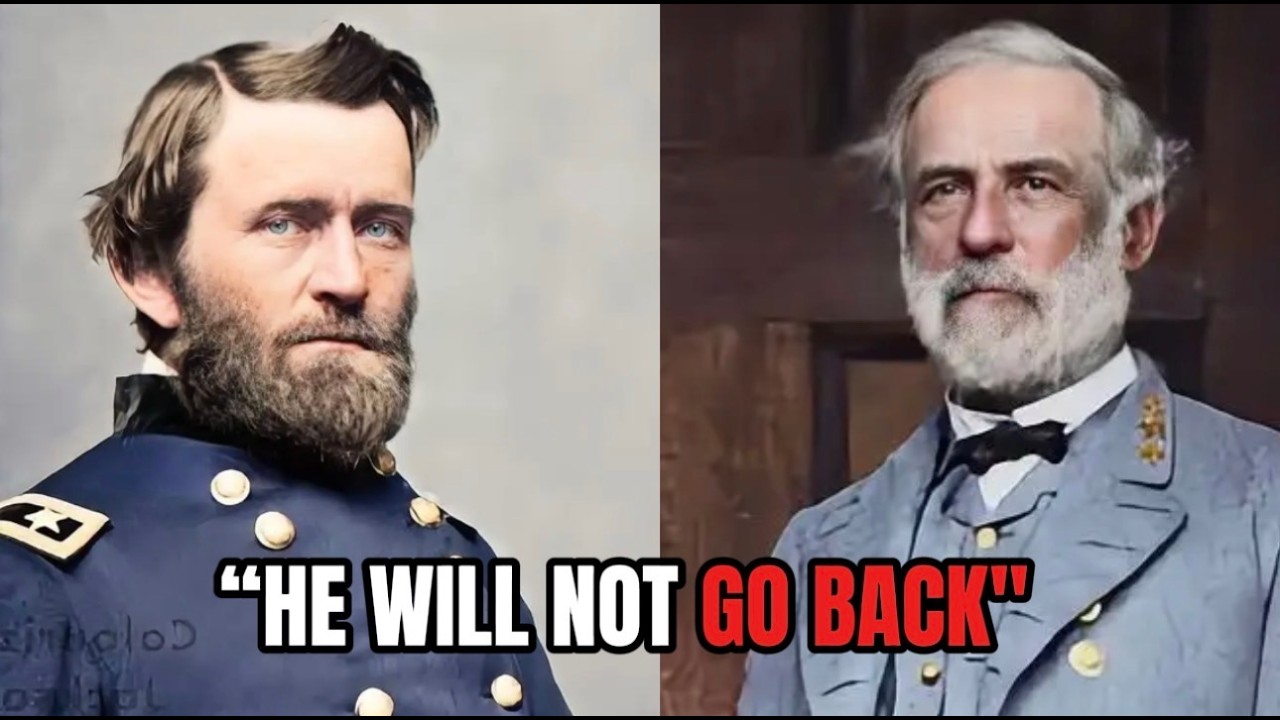
Ulysses S. Grant was different from the moment he arrived in the East. Lincoln had called him East after his string of victories in the West. Fort Donelson, where he demanded unconditional surrender. Shiloh, where he refused to quit even after a surprise Confederate attack nearly broke his army. Vicksburg, where he captured an entire Confederate army and opened the Mississippi. Chattanooga, where he broke the siege and drove the enemy into the mountains.
Grant didn't talk much. He didn't pose for photographers. He smoked cigars and wrote clear orders.
Most important, he understood something the Eastern generals never quite grasped. The war would not end by capturing Richmond or any other city. It would end when one side destroyed the other's ability to fight. And the way to do that was to keep hitting the enemy's main army until it could no longer stand.
When Grant took overall command in March 1864, he kept Meade as head of the Army of the Potomac, but stayed with the army himself. That alone told Lee something. The new man was not going to direct from Washington. He was coming to Virginia in person.
Grant's plan was simple on paper, but brutal in practice. All Union armies would move at the same time. Sherman would drive into Georgia. Banks would threaten Mobile. Sigel would move up the Shenandoah. And the Army of the Potomac, more than 100,000 strong, would strike Lee.
Grant's written orders to Meade were blunt. "Lee's army is your objective point. Wherever Lee goes, there you will go also."
The two armies collided in the Wilderness on May 5th. It was the last place either side wanted to fight. Dense second-growth forest, tangled vines, narrow roads, no clear fields of fire.
Artillery was useless. Cavalry, useless. It was infantry work at 10 paces, sometimes closer. Smoke and flames turned the woods into an inferno.
Grant attacked anyway. All day on the 5th and 6th, his corps slammed into Lee's lines. Lee struck back with everything he had.
At one point on the 6th, when A. P. Hill's corps was reeling, Lee rode forward himself with the Texas Brigade. His men shouted, "Lee to the rear!" They literally pulled at his bridle to keep their beloved commander from riding into the guns.
James Longstreet's corps arrived just in time to stabilize the line, only for Longstreet to be shot by his own men in the confusion.
The fighting was so savage that wounded men burned alive in the brushfires. One Union officer later wrote that the screams sounded like a thousand men being tortured at once.
By the end of the second day, both armies were exhausted. Casualties were staggering. The Union had lost about 17,000 men. The Confederacy, with fewer troops to begin with, had lost perhaps 11,000.
In any previous campaign, that would have been enough. The Army of the Potomac would have fallen back to the river crossings, regrouped, and waited for another season.
Lee's staff certainly expected it. One of his aides, Walter Taylor, later wrote that after the Wilderness, they believed Grant had been whipped and would now do what all the others had done.
But on the morning of May 7th, Grant gave a different order. The army would pull out of its lines not north toward safety, but southeast toward Spotsylvania Courthouse. The move was meant to get around Lee's right flank and force him to fight again on ground of Grant's choosing.
When the columns started moving south instead of north, something extraordinary happened among the Union soldiers. They had been through every failed campaign. They knew the old routine.
But this time the road led deeper into Virginia, deeper into danger. Words spread down the ranks. Men began to realize what was happening.
Wild cheers broke out. Hats flew into the air. Soldiers pressed forward to catch a glimpse of Grant riding past. One eyewitness remembered the forest echoing with shouts of triumph.

"It was the first time," another veteran wrote, "that the Army of the Potomac had moved in that direction after a battle. They finally had a commander who would not turn back."
Lee learned of the movement almost immediately. His scouts watched the dust clouds rising on the Brock Road. His engineers confirmed the direction.
And in that moment, the old pattern broke. Lee had faced cautious men, ambitious men, timid men. He had never faced a man who simply refused to accept defeat as the end of the day's work.
Grant was willing to lose men, lots of them, if it meant keeping Lee's army under constant pressure. He was willing to fight on ground that favored the defender. He was willing to accept the political cost back home.
That southward march after the Wilderness was the moment Lee understood he was no longer fighting a general who played by the old rules. He was fighting a general who intended to stay in the ring until one of them dropped.
The Overland Campaign that followed was six weeks of almost continuous combat. At Spotsylvania Courthouse, the armies slammed together again for nearly two weeks.
The fighting reached its horror in the Bloody Angle on May 12th, where men fought hand-to-hand for 20 hours straight. Rain poured down, the trenches filled with water and blood. Bodies stacked so high that soldiers had to climb over them to reload.
Grant kept feeding in fresh troops. Lee barely held the line. One Confederate officer described the scene as "simply appalling."
Yet, when the fighting eased, Grant again refused to retreat. He slid southeast once more, forcing Lee to follow.
At the North Anna River, Lee tried to trap Grant in a clever defensive position. He shaped his lines like an inverted V, so that any Union attack would expose both flanks. It was masterful.
Grant probed, saw the trap, and refused to spring it. Instead, he crossed the Pamunkey and kept moving. Lee, now ill with intestinal trouble and forced to ride in an ambulance for days, watched his opponent refuse every invitation to make a mistake.
By early June, the armies faced each other at Cold Harbor. Lee's men were behind strong earthworks. Grant's generals warned him against a frontal assault.
He ordered it anyway on June 3rd. The result was slaughter. 7,000 Union men fell in less than an hour. Some regiments lost nearly every officer.
The survivors dug shallow holes with bayonets and tin cups and refused to charge again when the order came. Grant later called it the only attack he ever regretted.
Yet, even after that nightmare, he did not pull back north. He stayed in contact, kept pressure on Lee, and within days began the most daring maneuver of the campaign.
On the night of June 12th, Grant pulled the entire Army of the Potomac out of its lines at Cold Harbor and marched south across the James River. It was one of the most complicated movements of the war, more than 100,000 men, thousands of wagons, hundreds of guns, all slipping away under cover of darkness without Lee realizing for days.
By the time Lee understood what had happened, Grant was already attacking Petersburg, the railroad hub that supplied Richmond and Lee's army.
The siege that followed would last nine months. Trenches, mines, constant artillery duels, disease, and the slow grinding away of Confederate strength. Grant had turned the war into a siege of the Army of Northern Virginia itself.
Lee saw it all coming after that first night in the Wilderness. His letters and the accounts of his staff show a man who still fought brilliantly, who still hoped for a decisive counterstroke, but who understood the new reality.

In one note to his son, Custis, he dismissed Grant's tactics as simply accumulating overwhelming numbers. But privately, he knew it was more than that.
Grant was not trying to outmaneuver him in the classic sense. Grant was trying to use the North's superior resources, men, guns, food, railroads, to keep hitting until the South had nothing left to hit back with.
Lee had always won by making the enemy quit first. Grant would not quit.
The arithmetic was merciless. In six weeks of the Overland Campaign, the Union lost more than 50,000 men. The Confederacy lost perhaps 35,000.
But the North could replace its losses. The South could not.
Every mile Grant advanced south brought the war closer to the Confederate heartland. Every day he kept Lee pinned down prevented the Confederates from sending help to other theaters.
By the time the armies settled into the Petersburg lines, Lee's army was a shadow of what it had been in May. Desertions rose, rations shrank, horses starved, and still Grant kept the pressure on.
The end came at Appomattox, but the decision had been made months earlier in the smoke of the Wilderness.
When Lee rode out to meet Grant on April 9th, 1865, both men knew the war was over. Grant's terms were generous. Officers could keep their sidearms. Men could take their horses home for spring plowing.
Lee accepted. Later, Grant wrote in his memoirs that he felt no triumph, only sadness for a brave enemy who had fought so long for a cause he believed was wrong.
Lee's own farewell to his army spoke of four years of arduous service marked by unsurpassed courage and fortitude. He did not need to say more. His men already knew.
What Lee had realized that night of May 7th was simple and devastating. The man facing him did not measure victory by ground gained or cities captured. Grant measured it by whether the enemy army still existed tomorrow.
He would lose battles, lose men, lose sleep, but he would not lose the war. He would not go back.
That single decision to keep moving south turned the Overland Campaign into the beginning of the end. It turned a war of maneuver into a war of attrition. It turned Robert E. Lee from the master of the battlefield into the defender of a shrinking cause.
Years later, when the guns had long been silent, some of Lee's former officers would say that Grant was no great strategist, just a butcher who won with numbers.
But Lee himself never joined that chorus. He had seen the truth in the smoke and fire of the Wilderness. He had watched an opponent refuse every opportunity to do what previous generals had done.
And in that refusal, Lee recognized something new in American warfare, the willingness to pay any price to finish the job. The man who would not go back had changed everything.
The soldiers who cheered in the burning woods that night in May 1864 understood it, too. They had followed cautious men and brave men and brilliant men, but only Grant had made them believe the war could actually end.
They marched south into more fighting, more death, more hardship. Yet they went willingly because they finally had a commander who saw the same road they saw, the road that led to victory, no matter how long or how bloody it was.
Robert E. Lee had faced many enemies, but only one refused to turn back. And that refusal broke the Army of Northern Virginia, broke the Confederacy, and ended the war.
It was not the most elegant campaign ever fought. It was not the most brilliant, but it was the one that finally worked. Because Ulysses S. Grant would not go back.