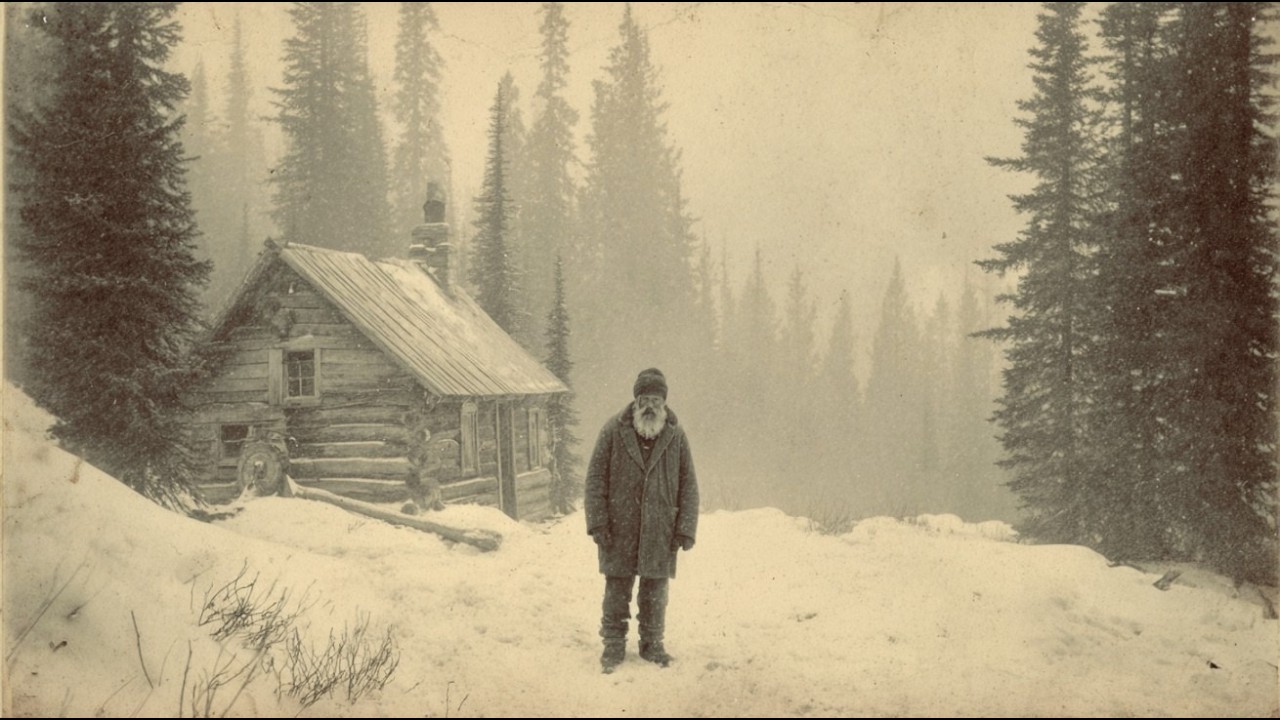
In the autumn of 1911, a 64-year-old trapper named Obed Henning was living alone in a cabin he had built himself in a remote part of northern Idaho. The cabin sat in a place called Withersedge Hollow, near where the Selkirks fold over into Canada. It was a name that locals avoided saying after sundown.
Henning had been in the hollow for five years. He had come there in 1906 after a bad season on the other side of the range, and he had told the storekeeper in Halverford, a man named Whitlow Pell, that he meant to build a place where he could die slow when his time came.
Pell warned him not to build in the hollow. He told Henning about a man named Garrick Mertens, who had built a cabin on roughly the same patch of ground in 1870. Mertens had walked out of the woods two winters into his stay, then walked back in. He never walked out again.
When men went up to find Mertens in the spring, they found his cabin. They found his boots set neatly by the door and his rifle leaned against the wall. The man himself was gone. There were no tracks, no blood, nothing.
Pell said his own father had been one of the men who went up there. His father said the cabin had felt occupied. He would not say by what.
On the table in Mertens’s cabin, they found an unfinished letter addressed to a brother in St. Paul. It read, in part, that something in the place had been good to him, but he did not believe it intended to remain good. He wrote that he was leaving in the morning, and that if he did not arrive by Christmas, he should be considered lost.
The letter was unsigned. The pen lay across the paper as if he had been called away suddenly. The brother never received it.
Henning listened to the story and said he would build there anyway. He was not a superstitious man. He believed he was mostly emptied out, and that emptiness was its own protection.
He found the foundation of Mertens’s old cabin in the late spring of 1906. The logs were gone, but the chimney stones were still there. Henning cleared the site over three weeks. He rebuilt the chimney on top of the old one, stone by stone. He raised the roof in late August and moved in before the first snow.
For the first three years, nothing happened.
Henning kept a journal. For three years, the entries were dull. Weather, game, the price of pelts. A note about a deer carcass killed by something he couldn’t identify. A long stretch of January in 1908 where he records almost every day that he heard nothing all day.
The first strange entry is dated the 12th of October, 1909. He wrote that he had set six marten traps along a creek line and found three of them sprung. The bait was gone. The traps were not damaged. Whatever had taken the bait had left no tracks.
The next morning, all six traps were sprung. The bait was gone. Still no tracks. This went on for almost three weeks.
He spent a night in a hide near one of the trap lines, intending to see what was taking his bait. He stayed awake from dusk until well past midnight. He saw nothing. The wind was still. The moon was bright enough to read by. And yet, sometime during the night, every trap on that line had been sprung. He had heard nothing.
He wrote that night, in a sentence that has been preserved, that he had been alone up there for some time, but that was the first night he had felt alone.
The entries from that point onward changed. The handwriting got smaller, denser. He stopped writing about the weather and started writing about the cabin itself.
He wrote about how the floorboards began to creak in a particular sequence late at night. The same five boards, in the same order, beginning at the door and ending at the foot of his bed. The time between the creaks was consistent with a slow human walking pace. But there was no one walking.
He poured a thin line of flour across the floor at the place where the first board creaked. He went to bed. He did not bar the door that night. He wanted to give whatever it was a way to leave a mark.
When he woke at dawn, the flour was gone. Not disturbed. Not scattered. Gone. He searched the cabin thoroughly. He did not find the flour.
Three days later, he found it in a small neat pile at the foot of a large fir tree about 40 yards from the cabin door. The pile was conical, perfectly shaped. There were no tracks around it.
In late November, he wrote that he had begun sleeping with his rifle across his chest. He wrote that he didn’t believe he would ever use it, but that the weight of it was the only thing that let him close his eyes.
In December of 1909, he began finding pelts in the cabin that he did not trap.
The first was a fox pelt, draped over the back of his chair. It was fresh. The flesh side was still tacky. The cut along the belly was different from the way he himself cut. It was longer, with a small jog in it near the throat.
Two days later, he found a marten pelt, neatly folded on his bed. The cabin had been locked. The windows had been shuttered.
He wrote that night, very simply, that he was being courted.
The pelts kept coming. By the middle of December, he had 11 entries on a list he kept in the back of his journal, headed with the words “not mine,” underlined twice. By the end of the month, 15.
He could not bring himself to burn them. He could not bring himself to throw them outside. He wrote that they had been given to him, and that to refuse a gift was a declaration he was not ready to make.
In mid-December, he decided to leave. He had a brother in Lewiston he hadn’t spoken to in 11 years. He wrote that he was packing the next morning.
The next morning’s entry is one sentence long. It says, “I find that I cannot go.”
He stayed through the winter. He stayed through the spring. He stayed through the summer of 1910 and into the winter of 1911.
The journal entries grew shorter and stranger. He wrote about a voice in the woods that said his name. He wrote that he had never gone toward it, even when it called from very close.
In October of 1911, he wrote that the voice had begun to sound sometimes like his own.
That was the last entry before a gap of three weeks.
On the 8th of November, 1911, there was one more entry. The handwriting was close to his, but not the same. The loops were tighter. The pressure was harder on the page.
The entry read that Obed was sleeping. That the traps had been set for him. That a fox had been brought. That whoever was writing was learning him, learning his name, learning to be him.
The boots were by the door. The rifle was against the wall. Everything had been set as he preferred. When he woke, the writer would be ready.
That was the last entry in Obed Henning’s journal.
When Henning didn’t come down to Halverford for supplies by the third week of December, Whitlow Pell went to the game warden’s office. The game warden for that district was a man named Cassian Volcker.
Volcker was 43 years old, a short, square-built man with a fair beard and a habit of speaking slowly. He had been a game warden for 16 years. He was the kind of man other men trusted to come back from a thing.
Pell told him about Henning, about Mertens, about what his father had said about the cabin feeling occupied. Volcker listened without saying anything. Then he said he would go up the next morning.
He went alone.
He left Halverford on the morning of the 22nd of December, 1911, with a pack mule named Dorsey and a week’s worth of provisions. He kept a small leather notebook in his coat pocket, in which he wrote every evening. That notebook survived.
The trail up to Withersedge Hollow was not a trail in any official sense. Volcker followed the game tracks and old skid lines and cairns slowly. The snow was deep, but the weather was clear. He made the hollow in two days.
On the second day, Dorsey balked twice at places on the trail where Volcker could see no reason for hesitation. At one crossing, the mule stood at the edge of the ice and refused to step forward. Volcker led him across by the bridle and felt the muscles of the mule’s neck shivering against his palm the entire way.
He came over the last ridge on the afternoon of the 23rd and stopped. He could see the cabin in a small clearing at the bottom of the hollow. The chimney was smoking.
He stood on that ridge for a full hour. The smoke continued to rise the entire time. He saw no one come out and no one go in.
He wrote that the smoke was the wrong color. He didn’t say what the wrong color was. He just said it was the wrong color, and that he knew the difference between pine smoke and birch smoke and pitch smoke. The smoke coming out of Obed Henning’s chimney was none of those.
He went down anyway.
He tied Dorsey to a young spruce at the edge of the clearing. The mule stood facing the woods, his ears back. Volcker noted the boots set neatly beside the door, the same way Garrick Mertens’s boots had been set four decades earlier. He noted the rifle leaned against the outside wall.
The door was not barred. It was slightly ajar. He pushed it open and went inside.
The fire was burning in the hearth. It had been recently fed. There was a kettle on the hook, and the water in it was hot. There was a single cup on the table with coffee in it. The coffee was still warm.
There was no one in the cabin.

The cabin had one room. He could see the whole of it from the doorway. The bed was made. The floor was swept. Pelts hung neatly along one wall in a row. More pelts than one man could have trapped in a season.
Henning’s journal lay open on the table beside the coffee cup. A pencil lay beside it as if set down a moment before.
There were no footprints in the snow leading away from the cabin. There were no footprints leading toward it, either, beyond Volcker’s own.
He searched the cabin. He looked under the bed. He opened the cupboard. He lifted the rug and checked the cellar door, which was bolted from above. He unbolted it and went down with a lantern. The cellar was empty except for a few sacks of meal and a coil of rope.
He came back up and bolted the cellar door behind him. He went to the table. He looked at the coffee. He did not touch it. He looked at the journal. He had the strong feeling that the journal had been left open for him. That the page it was open to was the page that someone wanted him to read.
He spent that night in the cabin. He felt he had no choice. The light was failing and the cold was deepening.
He fed the fire. He drank water from his own canteen rather than from the kettle. He did not touch the coffee. He read the journal cover to cover, twice, because he could not make himself believe what was in it.
He wrote that the door creaked once at perhaps half-past eleven, as if pushed gently from outside. He stood up with his rifle and opened it. There was nothing there. The snow in front of the door was unmarked.
He shut the door and barred it. He sat by the fire after that for a long while. He kept his rifle across his knees. He did not look directly at the door because he had the sense that if he did, the door would do something.
At perhaps 2:00 in the morning, he heard the floorboards creak. Five of them, in sequence, beginning at the door and ending at the foot of the bed. He was lying on the bed at the time. He felt the last one creak perhaps 18 inches from his right foot.
He did not move. He did not call out. He sat with the rifle across his knees and his eyes open, and he waited. The creaking did not come again.
He wrote in his notebook the single line, “There is something here that is being patient with me.”
He sat that way for the rest of the night. He did not sleep. At some point, perhaps an hour before dawn, he noticed that the coffee in the cup on the table had been drunk. The cup was empty. He had not drunk it. He had not gone near the table.
He wrote about that very briefly. He wrote, “The cup is empty. I did not empty it.” He underlined it.
He left the cabin at first light. He took the journal with him. He left everything else exactly as he had found it. He shut the door behind him. He did not bar it. There was, he wrote, no point.
He walked back over the ridge with Dorsey and did not look back.
He came down into Halverford on the 25th of December, 1911. He sat in Whitlow Pell’s store for a long time without saying anything. Then he told Whitlow that Obed Henning was gone.
He did not say dead. He did not say missing. He said gone, and he said it the way a man says it when he has chosen his word carefully.
Pell asked him if he had seen anything up there. Volcker said, after a pause, “I saw a fire that was tending itself.” That was all he would say.
He filed a report listing Henning as missing and presumed lost to weather. He recommended that no further search be undertaken until spring.
The spring search found the cabin still standing. The fire was long cold. The kettle was empty. The boots were where they had been left. The coffee cup was on the table, washed clean.
There was no sign of Obed Henning. There was, however, a fresh pelt folded on the bed. A fox. Skinned along the belly with a long cut that had a small jog in it near the throat.
The cabin was left to stand. It is, as far as can be determined, still standing today. The Forest Service has rerouted the few trails that used to come anywhere near the hollow. The maps no longer mark Withersedge by name. The men who know don’t go.
But Cassian Volcker went back.
He went back in the autumn of 1920, almost nine years after he had first walked out of the hollow. He was 52 years old. He had retired from the warden service. His wife had passed in the spring. He had begun to think about the cabin the way a man thinks about a sentence he never finished writing.
He went up in the first week of October. The weather was fine. He took no pack mule this time. He walked alone with a rifle and a small pack and a copy of his old notebook, which he had carried in his coat pocket every day for nine years.

He found the cabin standing in the clearing exactly as he had left it. The boots were by the door. The rifle was leaning against the wall. The chimney was not smoking this time. The fire was cold.
He stood in the clearing for perhaps half an hour listening. He wrote that the woods were entirely silent. No birds, no wind. The kind of silence that is not the absence of sound. The kind of silence that is the presence of something that is not making sound.
He went up to the door. He did not push it open. He stood in front of it and listened.
He heard a voice on the other side of it. The voice was very low, speaking quietly as if to itself. It was saying a single word over and over. The word was his name. Cassian. Cassian. Cassian.
He wrote that the voice sounded to his ear like Obed Henning’s voice. But it was also beginning to sound a little like him. A little like Cassian. As if whoever was on the other side of the door had been practicing.
He turned and walked away from the cabin. He did not run. He wrote later that he was very careful not to run because he had the sense that running would have been an answer to a question he did not want to answer.
He walked steadily out of the clearing and up the ridge and down the far side. He did not look back. He did not stop until he was three full miles from the hollow.
He sat down on a stump then and wrote in his notebook the only entry he made that day. He wrote, “I am being learned.” He underlined it.
He went home. He never returned to the hollow.
He lived another 26 years and died in 1946 at the age of 78, in his own bed, of natural causes. He raised two daughters. He took up beekeeping in his 60s. He lived, by every outward sign, the life of an ordinary man.
But he kept the notebooks from his two trips into Withersedge Hollow in a separate drawer of his desk. He did not mention them in the published article he wrote. He did not refer to them in the talk he gave to the historical society.
In his last year, his daughter Marlene, who had moved in with him after his health began to fail, kept a small diary of her own. She recorded that her father began to wake in the night and walk the halls of his house in a particular sequence. He would walk from his bedroom door to the kitchen, taking five steps, pausing between each one. Five footfalls, in the same sequence, with the same pauses.
One night in late February of 1946, she went out into the hall after him and asked him what he was doing. He turned and looked at her. She wrote that for a moment she did not recognize his face. The features were right. But something behind the face was not her father.
Then he smiled at her, and the smile was her father’s. He said, “I was just checking the door.” He went back to bed.
He died three weeks later.
Marlene found his old notebooks in the bottom drawer of his desk. She read them. She wrote that reading them felt like reading the diary of a man she had not strictly speaking lived with.
She wrote one passage that has been preserved. She wrote that she did not believe her father was visited in his last months by what was in that hollow. She believed her father was carrying something out of it. She believed he had been carrying it for 35 years, very carefully, like a man carries a glass of water across a long room. And that at the end, his hands began to shake.
She wrote, “I think he set it down. I think the thing he set down is still in this house. I will not stay here.”
She didn’t stay. She sold the house within the year. She moved to Oregon and lived to be very old.
After her father died, Marlene packed up his belongings. In the bottom drawer of his desk, she found a fox pelt wrapped in oilcloth. Old. Not recently put there. Skinned along the belly with a long cut that had a small jog in it near the throat.
She kept it for many years. Near the end of her own life, she gave it to a historian. The historian has it still. The fur is in remarkable condition for its age. The skin work is precise. The cut along the belly has that small jog near the throat that you would only notice if you knew to look for it.
It does not smell like an old pelt should smell. It smells faintly of wood smoke, which is consistent. And faintly of something else that cannot be placed, which is not.
That more or less is the story of Obed Henning’s cabin.
The man who built it, Garrick Mertens, was the first to be courted by whatever is in that hollow. Obed Henning was the second. Cassian Volcker, in a slower, gentler way across a longer span of years and from a greater distance, was the third.
What is in that hollow is patient. It learns. It has had a long time to practice. Every man it takes leaves something of himself behind, and those somethings accumulate the way snow accumulates on a roof.
If you walked into that hollow tomorrow, you would find the cabin still standing. You would find the boots by the door. You would find a rifle against the wall. You might find, if you came on the right day, that the chimney was smoking. The wrong color, faintly.
And if you got close enough to the door, you might hear a voice on the other side speaking quietly, saying a name you would not at first recognize. Until you did.