In the autumn of 1932, a surveyor named Ambrose Pickett rode out from a place called Crowder's Ford in Eastern West Virginia. He was 47 years old, a tall man with thick shoulders and a face the color of weather-stained pine. He carried a stadia rod, a brass compass with a cracked face, and a small journal bound in oilcloth.
Pickett was hired by a lumber company to mark off 3,000 acres on a ridge the locals called Burnt Saddle. What he did not know was that he was the third surveyor they had sent. The first quit after two days. The second, a man named Jeptha Vance, walked into the mountains in the spring and never walked out.
He arrived in Crowder's Ford on a Tuesday afternoon. The town was little more than a general store, a post office, a meeting house, and a dozen homes scattered along the creek. The man who ran the general store was Othniel Sturdevant. He looked at Pickett's papers for a long time before setting them down.
"You're going up on Burnt Saddle, then?" Sturdevant asked. Pickett said he was. Sturdevant told him to find a man named Lemuel Gough out on the Hatcher Road.
Lemuel Gough was 71 years old, gaunt, with a beard that was mostly white and one clouded eye. He lived alone with three hounds that did not bark when Pickett rode up. They just watched. Lemuel came to the door before Pickett was halfway through the gate.
"You'd be the surveyor," Lemuel said. He agreed to guide Pickett as far as the old line. He described it as a row of stones gone over with moss, older than the Cherokee. "Past that, you go on your own," he said.
That night, Pickett laid out his maps in a room above the general store. He wrote in his journal that he had met a solid man who would guide him to the old line. He underlined the words "on my own." He did not know why he felt the need to.
They set out the next morning at first light. The first part of the ride was unremarkable, beautiful country with clear creeks and high autumn air. But somewhere around the second hour, Pickett began to notice the quiet. The birds disappeared first. Then the small rustlings of squirrels and chipmunks. Even the wind seemed to go thin.
They made camp that night about half a mile short of the old line. After dark, Pickett asked Lemuel what he thought it was. Lemuel said it was like a well. The top of the water is fine, but the deeper you go, the worse the things get. "The deepest part is where the well started," he said. "That's where it came from."
Pickett slept poorly. There was no owl, no coyote, no fox. Just three creatures and a fire and a long stretch of darkness pressing in on all sides.
In the morning, Lemuel led him up the ridge to the old line. It was exactly as described, a row of low, overgrown stones running across the slope. Lemuel did not cross it. He pointed at the largest visible stone and said, "That's your mark. Go past it and you're in. Come back to it and you're out."

Before he left, Lemuel gave one final warning. "If you hear my voice in there, don't answer it. Don't come toward it. It won't be me."
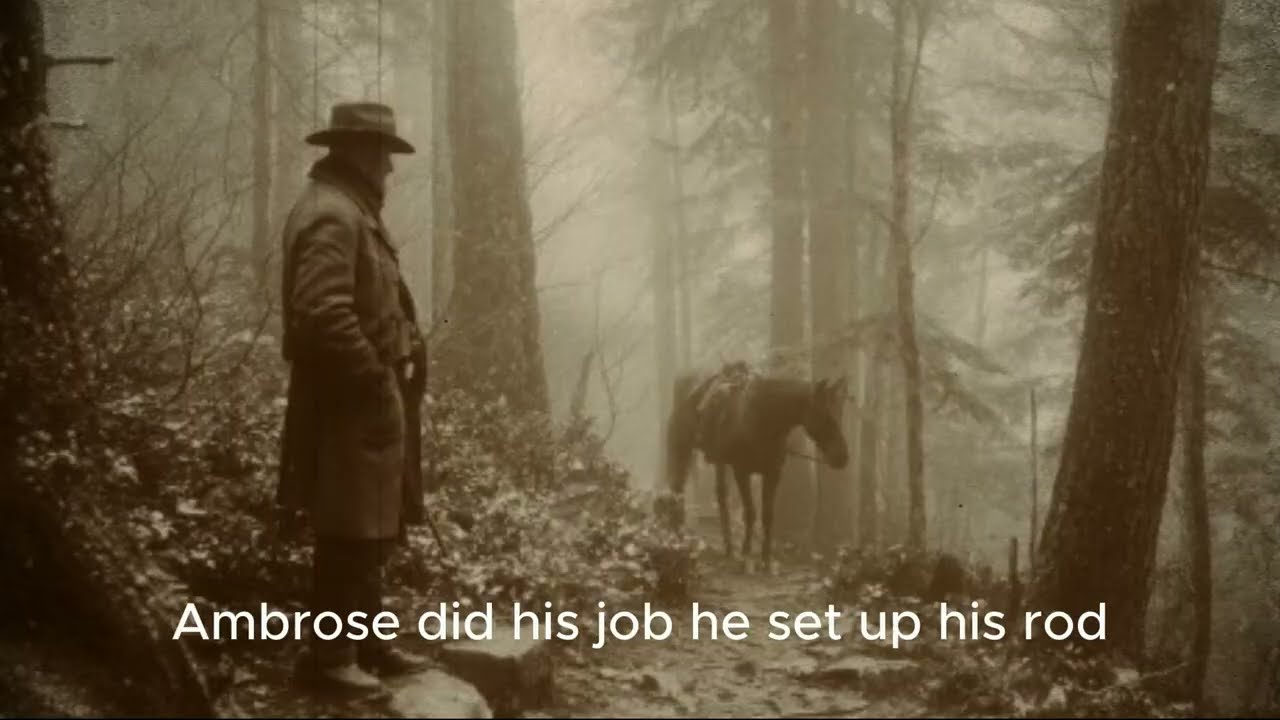
The first day past the line, Pickett did his job. He set up his rod, took his bearings, walked his lines, and made his notes. The woods were quiet, quieter if anything. But he found that if he focused on the work, he could almost forget about it.
Around 3:00 that night, he woke. The fire was low. His horse, Murchison, was standing rigid, ears forward, looking out into the dark. The horse was paying attention. Then Pickett heard it. A single deliberate footstep in dry leaves, a pause, another, another. The footsteps moved along a line parallel to camp, about 30 yards into the trees. They went on for a minute or two, then stopped. They did not approach. They did not retreat. Then they resumed, going west, and faded.
Pickett wrote in his journal the next morning. "No animal can move that deliberately. No man would have any reason to." He underlined the line.
He moved camp that day, pushing deeper into the tract. A thin fog had settled into the lower elevations. By midday, he had pushed about a mile and a half farther into the timber. That was when he found the first camp.
It was not his camp. It was not anybody's camp anymore. The fire ring was cold and overgrown. Two canvas tents had long since rotted. There was a stack of rusted crosscut saws leaning against a chestnut tree. Tin plates and tin cups lay where they had been set down years before by men who had not come back.
There was a small wooden chest. Inside were receipts, a pencil stub, a folded letter, a small Bible, and a brass card case with a name engraved on the front. Jeptha Vance.
Pickett took the card case, the letter, and the Bible. He left everything else exactly as he found it. He had a strong sense that the camp was not to be disturbed.
That night, the second night beyond the line, he heard the voice. From somewhere down slope, he heard a man call his name. "Ambrose." It was the voice of Lemuel Gough. He did not sit up. He did not move at all. Lemuel had said it would not be him.
A long minute went by. Then, from a slightly different direction, the same voice called again, a little softer. "Ambrose, come on, son. It's me." Pickett closed his eyes. He could feel his heart in the side of his neck. But he did not move. And he did not speak. The voice did not come a third time.
The next morning, Pickett decided two things. The first was that he would push another two days into the tract before turning back. The second was that he would never again let anyone call him by his Christian name in the woods. From here forward, he would be Pickett. "Ambrose was a name a man could be tricked with," he wrote. "Pickett was a name a man earned."

He moved camp again, climbing a switchback game trail up the eastern face of the ridge. He passed through a stand of old hemlock that must have been a quarter mile across. In that whole quarter mile, he did not hear a single bird or a single rustle.
Just before noon, he came out into more open timber. That was when he saw the deer. It was standing at the bottom of a shallow draw, drinking from a stream, about 80 yards downhill. It was a buck, four points on each side. But something was wrong.
The legs were too long. The body sat on the legs the way a man on stilts sits on stilts. The knees bent at angles that were slightly wrong, as though whatever made it had been working from a description rather than a drawing. The neck was long, too long. When it raised its head from the water, the head came up higher than it should have. One of the antler tines came down at an angle that no antler in nature comes down at.
Then its head turned. Its body did not turn with it. The neck rotated in a long, deliberate motion, the way a man at a window turns his head to look down the street. It looked up the slope at Ambrose. He could not see its eyes from that distance, but he could feel them. For perhaps three seconds, they regarded one another. Then it lowered its head and resumed drinking.
Pickett backed away. He moved as quietly and as quickly as he could without breaking into a run. When he had put a small rise between himself and the draw, he turned and made fast time east, away from the stream. He did not stop until the sun was past its highest.
He camped that night on the bare top of a stone outcrop. He did not build a fire. He sat with his back against the rock and his rifle across his knees. He wrote in the journal in the last of the light. "Saw something that wore a deer wrong," he wrote. "Legs too long, neck too long, head turned without body. I think it is doing what it does because that is what it does. I think this is a place where things wear what they have learned from looking, and they have not looked closely."
He did not sleep that night. At first light, he saddled Murchison and rode. He hoped to get back to the old line in two days, but the terrain did not allow it. The ridge folded into itself in ways the maps had not shown. His compass began to wobble, wrong by a degree or two, sometimes more. By mid-afternoon, he understood that he was lost.
He sat down on a fallen tree. He told himself aloud that he would not panic. That was when he saw the first one. It was standing in the trees about 120 yards down slope. When he tried to look at it directly, it was not there. It became a tree. But when he turned his head away and let it sit at the edge of his eye, it was not a tree. It was a thing standing, as tall as the trees, but not as wide. He turned his head the other way. There was another one.
He mounted up and chose a direction south. He rode with his eyes on the ground in front of Murchison. By dusk, he had come out of the upper ridge into a broad, shallow bowl in the mountains. The trees thinned. There was a kind of meadow in the center, and in the center of the meadow there was a ring of stones.
The ring was perhaps 30 feet across. The stones were set with great age and care. The grass within the ring was different from the grass outside it. It was very short and very pale and lay flat in a way that no grass ever lies on its own. In the center of the ring was something.
He looked at it for a long time. Then he turned Murchison around and rode out of that valley the way he had come in. He did not look back.
The journal does not describe what was in the center of the ring. There is a page dated to that evening with only one sentence. "I cannot describe what I saw and I do not believe describing it would do anything but feed it, so I will not." The handwriting on that page is shaky. The letters are too small and slope downward across the page. It is the handwriting of a frightened man.
He rode through the night. Murchison began to fail around 3:00 in the morning. Pickett got off and walked, leading the horse and talking to it low and steady. By first light, he was at the old line. He stepped over the largest of the visible stones, the stone Lemuel had pointed at, and stood for a moment on the other side. He looked back at the woods he had just come out of. He did not see anything.
At midmorning in the lower meadow, Lemuel Gough found him. Lemuel did not ask. He looked at Pickett's face and at Pickett's hands and at Murchison's flanks. Then he took the lead rope and walked them both down to the cabin without a word.
Pickett stayed at Lemuel's cabin for three days. He did not say much at first. By the third day, he was talking in fits and starts about the small things, about the camp, about the card case, about the letter. He did not talk about the deer. He did not talk about the things that stood in the trees. He did not talk about the ring.
When he left on the morning of the fourth day, Lemuel walked him to the edge of the property. "You'll go back to your people," Lemuel said. It was not a question. "You won't come back here." Pickett said no.
Lemuel looked up at the ridge. "It's not after you," he said. "If it was after you, you'd be there. Don't think it's after you." Then he said, "But it knows your name now. It heard you in the woods, and it heard me call you, and it will remember. It won't come after you. But if you come back to where it can hear, it will know."
Pickett rode out of Crowder's Ford that afternoon. He took a train to St. Louis, and from St. Louis another train back to the Ozarks, where his wife was waiting. He took a job surveying for the state. He kept it for the rest of his working life. He never surveyed in the Appalachians again. He never went east of the Mississippi again.
He returned the card case to the family of Jeptha Vance by mail with no explanation. He gave the letter and the Bible to a Methodist minister and asked him to see them sent on or burned as the man saw fit. He kept the journal in a locked drawer in his desk for the rest of his life.
After he died in the spring of 1961, his widow read the journal and chose to keep it. She once told a neighbor that for the last 30 years of his life, he could not sleep in a quiet house. He kept a wind-up clock with a heavy tick in the bedroom, wound every night. If the clock stopped in the middle of the night, he would wake up and lie very still. He said only that he did not like the quiet. He had been in a quiet place once, and that had been enough quiet for one life.
She also said that on autumn evenings, when the light went out of the sky and the leaves on the oaks began to rustle, he would stop whatever he was doing and stand very still in the kitchen, looking out the window at the trees. He would not move for a minute, sometimes two. She thought sometimes that he was listening for footsteps, footsteps walking parallel to the house just at the edge of where you could see.
There are pieces of this story missing. There are pieces no one wrote down because no one wanted to. And there are pieces, like what was in the center of the ring, that Ambrose Pickett refused to put on paper because he believed that to describe a thing of that kind is to feed it. He believed the only way to keep the deep places of the world from reaching out is to leave them unnamed.