In February 1916, in the depths of an Alabama winter, hundreds of Black families quietly packed what they could carry and left Selma. There was no announcement and no crowd at the train station. The only public record was a brief notice in the Chicago Defender, where the families summarized their reason for leaving in eight words: “The treatment was not worth staying. ”
Nobody in Dallas County considered that news worth attention.
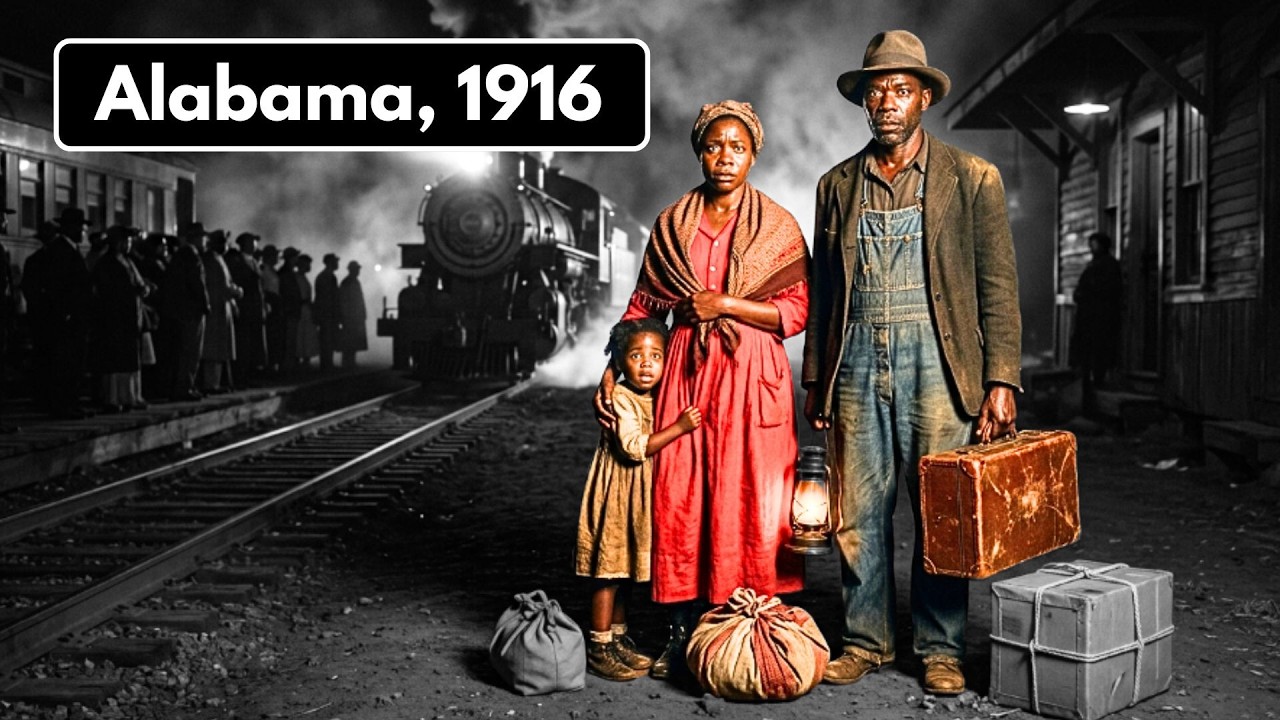
The cotton country had long seen families leave after bad settlements. But those trains leaving Selma were the first visible drops of what became the largest voluntary internal migration in American history. The ground had been prepared in advance. Pennsylvania Railroad had been quietly scouting for cheap Black labor in the South since 1915.
War in Europe had cut off the flow of immigrants who usually filled northern factories, and those factories were about to look for workers in the only place left with a labor surplus. To understand the scale: in 1910, roughly 7 million of the 8 million Black Americans in the country lived in the South. Alabama alone held nearly 900,000 Black residents. Between 1915 and 1918, about 500,000 Black southerners boarded northbound trains.
Over the following fifteen years, more than a tenth of the entire Black population of the United States left the region where their families had lived for 200 years. Why would families with almost nothing risk everything in the dead of winter, with no crops planted and no jobs waiting at the destination? What did Alabama do when planters, mill owners, and mayors realized their labor force was walking to the train station on its own? And how many people actually left, according to a number Alabama itself put on paper and gave to the federal government?
The first answer has nothing to do with cotton or wages. It begins fifteen years earlier in a Montgomery hall, where 155 men spent the summer writing a document that remains in effect today. In the summer of 1901, 155 delegates met in Montgomery to write a new constitution for Alabama. The convention president, John B.
Knox, told them plainly what the work was for. He said their goal, within the limits allowed by the federal constitution, was to establish white supremacy in the state, and to fix it by law rather than force or fraud. The delegates could not simply bar Black men from voting without violating the Fifteenth Amendment. So they built a mechanism that produced the same result.
Article Eight required applicants to pass a literacy test by reading and writing a passage from the U. S. Constitution to the satisfaction of a white voter registrar. It required proof of steady employment for at least a year.
It set property qualifications. It added a poll tax that accumulated year after year, so anyone who fell behind had to pay for every missed year. Article 182 disqualified anyone convicted of a long list of minor offenses, including vagrancy, as well as anyone the registrar judged to have moral defects. The numbers are not disputed.
More than 180,000 Black men in Alabama were qualified to vote in 1900. After the constitution was ratified, only 2,980 managed to register. The ratification vote itself passed through fraud, with officials in Black Belt counties reporting that Black residents voted overwhelmingly to disenfranchise themselves. Losing the franchise in 1901 meant losing everything attached to it.
No vote meant no say in who became sheriff, no Black jurors, no voice on the school board that decided how many months of schooling Black children would receive, and no way to remove a tax assessor or justice of the peace. A sharecropper cheated at settlement had no court that would hear him. The same article that excluded petty criminals fed another system. Alabama leased its convicts to private coal companies and mine operators, who paid the state for the labor of men often arrested on vagrancy charges, which practically meant being Black and unable to prove employment on demand.
Alabama was the last state in the country to abolish convict leasing, and it did not do so until 1928. So a family in Dallas County in 1916 was not merely poor. It was legally voiceless, unprotected in court, and one arrest away from being sold into the coal mines. That was the political bottom.
The economic bottom collapsed six years later, and it came from Mexico in the form of an insect a quarter of an inch long. The boll weevil crossed into the United States from Mexico in 1892 and chewed its way east county by county. It reached Mobile County, Alabama, in 1910. By 1916, it had swept across the entire state.
The insect feeds on cotton buds, the flower that becomes the cotton boll. A field can look healthy in June and produce almost nothing in September. Cotton yields in Alabama fell from about 155 pounds per acre to about 95 pounds per acre by 1916. In the worst counties, production dropped by as much as 70 percent.
In 1914, Alabama farmers planted four million acres in cotton alone. Within a few years, hundreds of landowners had to sell their land entirely. The state eventually adapted. Farmers turned to peanuts, corn, and livestock, a shift encouraged by the Agricultural Extension Service and George Washington Carver at Tuskegee Institute.
In December 1919, the town of Enterprise even erected a monument to the boll weevil, thanking the insect for forcing them off the single-crop economy. That monument is often told as a story of resilience. But who paid for the adaptation? Landowners and the people who worked the land did not share the loss equally.
A landowner facing a ruined crop could sell acreage, borrow against the deed, switch to peanuts, or absorb the loss and wait for next year. A sharecropper had none of those options. He was paid as a share of the crop. When the crop failed, his share of nothing was nothing.
He had already gotten food, seed, and supplies on credit from the plantation store at prices the store set and interest the store calculated. The crop failure did not erase that debt. It carried over to the next year, and the year after that. Families who had worked the same land for two generations found themselves owing more every January than the January before, without a single decision of their own, under laws written in 1901 that could treat running from that debt as a crime.
By 1915, the boll weevil had reached the Black Belt counties where the state’s largest concentration of Black residents lived and worked. The cotton economy that had kept 900,000 people in place for 50 years stopped working as a system that could feed them. At the same moment, 4,000 miles away, war changed the value of their labor. By 1915, the collapse in Alabama was not partial, it was total.
The weevil had spread across the Black Belt and into the Tennessee Valley. The counties with the highest Black population density were the least able to absorb a bad year. Then the calculation changed on the other side of the ocean. War in Europe had begun in 1914.
The United States, though not yet a combatant, was supplying the warring nations. Steel mills, packing plants, foundries, shipyards, and railroads all expanded at once. The labor those industries always depended on stopped arriving. European immigration, which had brought hundreds of thousands of workers a year to northern factories, collapsed to almost nothing as shipping lines closed and men returned home to fight.
For the first time since the Civil War, northern industry faced a severe shortage of unskilled labor. There was one large remaining source of unskilled labor in the country. It was in the South. It was already unemployed.
It was Black. The wage gap was not a matter of opinion. A day of farm work in the Alabama Black Belt paid in pennies, often as credit at the plantation store rather than cash, meaning a worker could finish the season without ever touching money. The same day in a northern factory paid in dollars, in cash, every week.
The most famous figure came from Detroit. On January 5, 1914, Henry Ford announced his company would pay five dollars a day for an eight-hour shift, instead of $2. 34 for a nine-hour shift. The announcement reached far beyond Michigan.
The offer was not as simple as it appeared. Half of the five dollars was classified as profit-sharing rather than wages, and it was only paid to workers approved by a company department that inspected their homes and personal habits. Black workers were hired in limited numbers and assigned the hardest, hottest jobs in the metal foundry. None of that changed the comparison a man in Alabama was making.
A week at a Detroit factory could provide more cash than an entire cotton season after settlement. Industry did not wait for word to spread on its own. In 1916, they sent men south to make the offer in person, and those men went first to the cities. In the summer of 1916, Pennsylvania Railroad brought 16,000 Black southerners north for unskilled work on its lines.
Illinois Central agents issued passes to move workers to Chicago. Steel mills sent their own recruiters. These men worked the train stations, boarding houses, and churches in Birmingham, Montgomery, Mobile, and Florence, carrying something no one in Alabama had ever offered a Black worker. They paid the travel costs.
The conditions were written down, and those letters survived. A man from Mobile wrote in April 1917 that he had answered an ad, and a Birmingham company sent him a blank form stating two dollars would cover his ticket, 10 percent of his first month’s salary would be withheld, and $24. 92 would be deducted after he arrived in Detroit and started work, which he had to repay before he could leave the job. He worked in cement and construction.
His wife was a seamstress. He asked to leave by May 15 or 20, and added that his brother-in-law wanted to go too. That letter is one of hundreds collected by Emmett J. Scott and published in the Journal of Negro History in 1919.
Read together, they show the same pattern county after county. People wrote asking about wages, about schools, about whether a barber or merchant could make a living there, and whether one could guarantee the ticket price. Employers moved fast because the effect was immediate and visible. In August 1916, the Chicago Defender reported that all Black dockworkers in Jacksonville, Florida, left at once after Pennsylvania Railroad hired them.
Without them, the port of Jacksonville effectively stopped working. The city council responded within weeks by passing a law to bar northern recruiters. White newspapers, which had never written a word about the value of these workers, suddenly filled with panic. The lesson traveled in both directions.
Southern white officials learned that recruiters could empty a labor force in one season. Black readers in the South learned their labor had a price someone was willing to pay. What turned recruitment into a movement was not a company. It was a newspaper printed 900 miles away and a date it put on its pages.
Robert Abbott, publisher of the Chicago Defender, had spent years urging Black southerners to stay and build where they were. He changed his position in the summer of 1916 when he saw that mass departure could strike the Jim Crow system at its weakest point, its economy. A system that depended on cheap Black labor could not survive that labor leaving. The paper then did something no institution in the South could match.
With a circulation exceeding 100,000 and national readership, it published job listings, wage figures, and train schedules alongside detailed reports of lynchings that southern papers ignored or justified. It ran editorials, poems, and cartoons urging readers to leave. It arranged discounted group fares on specific trains at specific times. Then it set a date.
The Defender declared May 15, 1917, the day of the great northern drive and told readers across the South to prepare to leave. Getting the paper into Alabama required its own network. Southern authorities in several towns confiscated copies and threatened distributors. So the Defender traveled via Pullman porters, who carried bundles south on the trains they worked and left them with barbers, ministers, and shopkeepers.
From there, single copies passed from hand to hand until they wore out and tore apart. It was read aloud in barbershops and after church for those who could not read it themselves. The scale of response can be measured. Between 1916 and 1918, at least 110,000 Black southerners reached Chicago alone.
Letters poured into the Defender’s offices from Mobile, Montgomery, Birmingham, Greenwood, and Augusta. Many were simply addressed to the editor, asking for help finding a job and covering the fare. A woman from Mobile wrote in 1917 saying she had a reputation as a first-rate laundress with experience on all washing machines, and asked for a description of the work and a reply as soon as possible. These were not desperate people acting on rumors.
They were skilled workers negotiating in writing, comparing offers, and choosing the best one. Alabama noticed. In 1917, the state began doing everything it could to stop them. By 1917, the departure was no longer quiet, and the response across the South became organized.
States and cities required labor agents to buy licenses costing $500 to $2,000, sums calculated to make recruiting impossible rather than merely expensive. Municipal ordinances made recruiting workers for out-of-state employers a punishable crime. Agents were arrested, fined, and run out of town. When recruiters were blocked, the pressure moved to travelers.
Black passengers were pulled off trains at southern stations and their tickets torn up in front of them. Ticket agents refused to sell to Black customers who could not name a white employer to vouch for their trip. In response, people walked miles through the night to catch the train in the next town where the agent did not know them, or bought tickets to a nearby city and rebooked from there. Families split up and traveled on separate days so the whole family would not be stopped at once.
The language of public argument flipped overnight. Newspapers and planters who had spent a generation describing Black labor as lazy and incompetent now published appeals describing loyal workers being lured away by outside agitators. Some landowners quietly raised wages, offered fairer settlements in the fall, or promised to fix the school. Committees of white businessmen in several Alabama towns held meetings to discuss improving conditions, which was itself an admission that conditions had been the problem all along.
The federal government began measuring what was happening. The Department of Labor created a division for Negro economics, which issued a study titled “Negro Migration in 1916–17,” gathering estimates state by state and interviewing officials and migrants about causes. The report listed those causes in order as given: crop failure, low wages, bad treatment, lynching, labor agents, the Black press, letters from friends in the North, and in some places advice from white southern men who saw no future in the ruined cotton counties. Nothing worked.
License laws could stop labor agents, but they could not stop a letter from a relative in Detroit describing the pay. The most effective labor agent in the South worked for no railroad at all. It was a money order that arrived at a rural post office box with a note saying work is available here, come. What the license fees and torn tickets could not answer was the simplest question of all.
Was the North actually better? The numbers show where people settled. Between 1910 and 1920, Detroit’s Black population grew from 5,741 to 40,838, an increase of about 611 percent, the fastest rate of any city in the country. Chicago rose from about 44,000 to 109,400.
Cleveland rose from 8,400 to 34,400. New York rose from 91,700 to 152,400. By 1926, 85 percent of Detroit’s Black residents had been born elsewhere, and most of that “elsewhere” was the Deep South. The wages were real.
A person who settled accounts in November owing the plantation store could now collect money every Friday and keep it. Black-owned businesses across the country grew from about 5,000 to 70,000 in that decade because migrants needed barbers, boarding houses, restaurants, funeral homes, and grocers who would serve them, services white northern businesses often refused. The rest was harder. Housing was the first wall.
Landlords and real estate associations restricted where Black families could rent or buy, so tens of thousands of newcomers were packed into a few city blocks, paying higher rents for older buildings than white tenants paid in the neighborhood. Overcrowding was immediate and severe. Employment came with its own trap. Factory managers often hired Black workers to break strikes, placing them on the factory floor against white workers on the picket lines, then leaving them to face the aftermath.
Most unions refused Black membership entirely, so there was no organization standing between the migrant and the boss. Violence followed them north. In July 1917, white mobs in East St. Louis, Illinois, attacked Black workers who had come for factory jobs, burning homes and killing an uncounted number of people.
In the summer of 1919, Chicago erupted after a Black teenager was killed at a segregated beach, and violence spread across cities nationwide that season. What migrants gained was not safety. It was leverage, cash wages, schools that stayed open, and the vote. In Detroit and Chicago, a Black man could register and cast a ballot without a registrar interrogating him about the Constitution.
That brings the question back to Alabama and to the number the state itself produced. When federal investigators asked how many people had left, they did not have to guess. Alabama’s Commissioner of Agriculture gave the number himself, and it appears in the Department of Labor report on migration in 1916–17. Nearly 90,000 Black citizens left Alabama in that period.
The same report estimated Mississippi’s outflow at 100,000 and Georgia’s at 50,000. That is one state in roughly 18 months. Across the entire South, about 500,000 Black southerners moved north between 1915 and 1918, and more than 400,000 left the region in the decade between 1910 and 1920. In the 1920s, at least another half-million followed, and by some estimates the number approached one million.
Inside Alabama, the effect showed in farm records. By 1920, the state had nearly equal numbers of white and Black sharecroppers, with the Black count down and the white count up, reversing the pattern that had held since Reconstruction. The Black Belt counties, named for their soil and home to the state’s largest Black population, began a decline in field labor that never reversed. Landowners who had depended on a permanent surplus of workers found they now had to compete for them.
The state’s total Black population did not collapse because birth rates remained high. Alabama counted about 900,000 Black residents in 1910 and almost the same number in 1920. That apparent stability hides the truth. Tens of thousands of people in their working years had left, and it took a full decade of births to replace them on paper only.
What the records cannot show is who left. Those who boarded the trains were mostly young, physically able, and willing to take a risk. Many were literate, because reading the Defender and corresponding with a labor agent required it. Alabama exported, in a decade and a half, a large portion of its most ambitious and mobile Black generation.
The men who wrote the 1901 constitution built a system to keep Black people in Alabama powerless and in place. It succeeded at the first and failed at the second. After the state removed every legal means of changing conditions, it left only one form of protest available, and hundreds of thousands of people used it. They stopped arguing and bought a ticket.
The consequences of that decision were not limited to the North, and they did not stop with that generation. By 1930, the receiving cities had transformed completely. Detroit’s Black population surpassed 120,000. Chicago reached about 234,000.
New York rose to 328,000. Neighborhoods that held a few thousand people in 1910 now housed entire counties transplanted from Alabama, Mississippi, and Georgia, with the same churches, cooking, and music reshaped on paved streets. The second generation grew up in those cities with something their parents never had: the chance to become something other than farm laborers. Joe Louis was born in 1914 in Lafayette, Chambers County, Alabama, the son of sharecroppers.
His family joined the migration to Detroit in the mid-1920s. He learned boxing at a Detroit club and became world heavyweight champion in 1937, holding the title longer than anyone in the division’s history. Nat King Cole was born in Montgomery in 1919. His family moved to Chicago when he was four, and he learned the organ at his father’s church on the South Side.
These are famous examples. But the ordinary people matter most. Parents born in Alabama and living in Detroit and Chicago sent their children to schools that ran nine months instead of four. They joined unions once industrial organizing opened its doors to Black workers in the 1930s.
They bought homes where they were allowed to buy, and they registered to vote, which meant that by the 1930s and 1940s, Black voters in Illinois, Michigan, Ohio, Pennsylvania, and New York carried real weight in close elections, and politicians who wanted to win those states had to respond to their demands. That weight traveled back south. Black churches, newspapers, and civic organizations in the North sent money, lawyers, and pressure to the movement that would eventually confront the very system their families had fled. The Chicago Defender, which urged Alabama to leave in 1917, spent the following decades carrying news of the South to the nation.
The arc closes where it began. The families who left Selma in February 1916 departed a state that had erased 180,000 Black voters with a stroke of the pen. Forty-nine years later, in March 1965, a march across a bridge in that same town forced the country to pass the Voting Rights Act. The ballot that Montgomery took away in 1901 came back under federal law.
Some who left never returned. But their descendants did, beginning in the 1970s, moving back to the South toward the states their families had once fled. The Great Migration was not the end of Black existence in Alabama.
It was the moment when 900,000 people proved they had one final decision no law could take from them, and they made it.