In the winter of 1864, Robert E. Lee wrote a letter that most Americans have never read. It sits in the archives of the Virginia Historical Society. Lee was a man who chose his words carefully. He had graduated second in his class at West Point and served the United States Army for over three decades.
In that letter, Lee dropped his formal language. He let his composure slip. He wrote about one Union general in particular. Not Grant. Not Meade. He wrote about a red-haired, restless, hollow-eyed man from Ohio who had not yet become famous. The name he wrote was Sherman.
What Lee saw coming, the rest of the country would spend the next 160 years trying to categorize. Was Sherman a hero? A war criminal? A military genius? A madman? The answer depends almost entirely on which side of the Mason-Dixon Line your ancestors were standing when he passed through.
What Lee recognized was that William Tecumseh Sherman was not simply a general who won battles. He was the architect of a new kind of destruction. It did not target armies. It targeted the will of an entire people to keep fighting.
Sherman was born in 1820 in Lancaster, Ohio. He was the sixth of 11 children. His father died when he was 9 years old, and the family was scattered. He was taken in by a neighbor, Thomas Ewing, a powerful Ohio senator who later became Secretary of the Treasury.
Ewing got young William the appointment to West Point. It was there that Sherman encountered the ideas that would reshape the way wars are fought. He studied Jomini's theories on massed force and the Napoleonic principles of rapid movement. He also absorbed the older, grimmer understanding that wars end not when armies are destroyed, but when populations lose the stomach to replace them.
He graduated sixth in his class in 1840. He was commissioned into the artillery. He served in Florida during the Second Seminole War and was posted to various southern garrisons. He spent time in Charleston, South Carolina, and later in Georgia.
He liked the South. He had friends there. He understood its rhythms and its vanities. This is not a small detail. It would later make him more dangerous to it than any general who saw the South as simply foreign territory.
He resigned his commission in 1853. He tried banking in San Francisco and failed. He tried law in Kansas and failed. He went to Louisiana and became the superintendent of what would later become Louisiana State University. He was genuinely admired there.
Then the war began. His first real engagement was at Bull Run in July 1861. It was a disaster for the entire Union. Confederate forces broke the federal lines and sent soldiers running back toward Washington in scenes of chaos.
Sherman handled his brigade adequately, but he was shaken. He wrote to his wife afterward that the war was going to be much longer than anyone in Washington was willing to admit. He was right. It would cost him.
He was transferred to Kentucky and given command of the Department of the Cumberland. There he began to unravel. The pressure of the command and his growing conviction that the Union was losing pushed him into a state of anxiety so severe that newspapers began calling him insane. He was relieved of command.
Ulysses Grant brought him back. Grant recognized something in Sherman that the newspaper editors missed entirely. The anxiety Sherman suffered was not weakness. It was the correct emotional response to a situation that everyone else was misreading as simple.
At Shiloh in April 1862, everything changed. Confederate forces launched a surprise attack on the Union encampment on the morning of April 6th. They came close to driving Grant's entire army into the Tennessee River.
Sherman was everywhere that day. He had two horses shot out from under him. He was wounded in the hand. He refused to leave the field. He did not break under pressure. He bent, sometimes dramatically, but he did not break.
Grant promoted him. Their partnership became the spine of the Union war effort in the Western theater. Together, they took Vicksburg in July 1863, splitting the Confederacy along the Mississippi River.
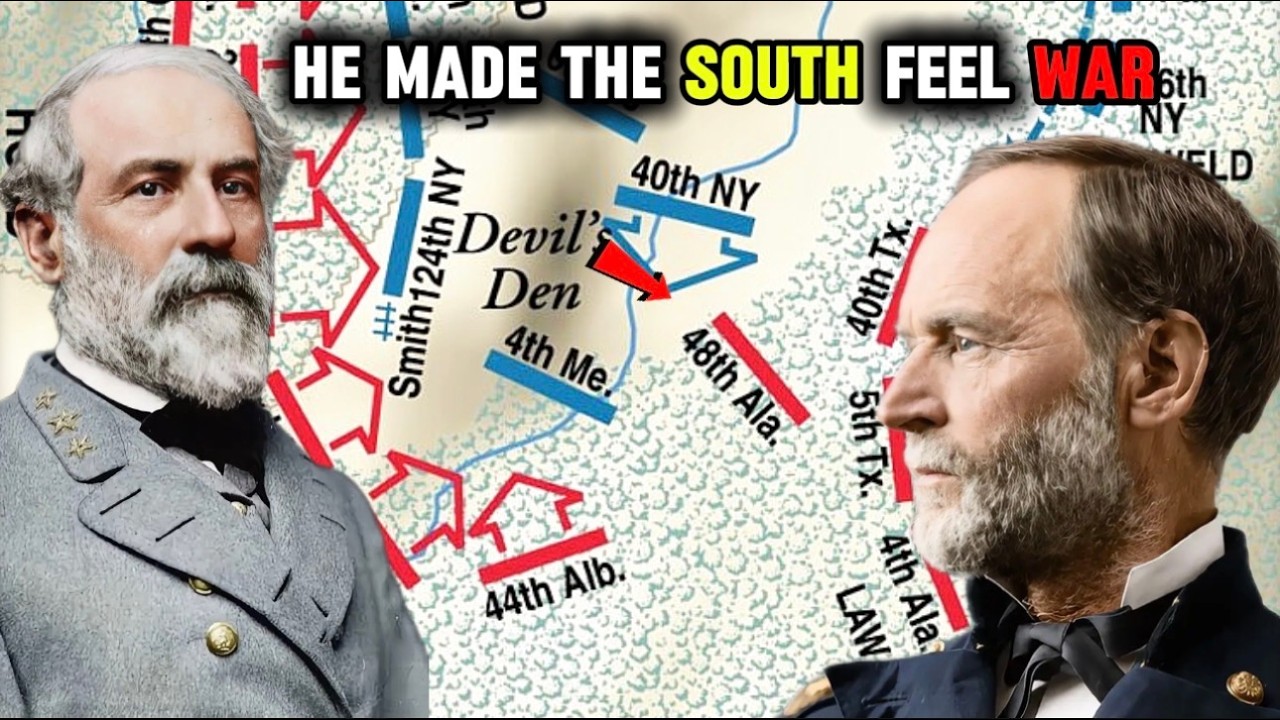
After Vicksburg, Sherman began to talk openly about the ideas that Lee was picking up on. He wrote that the Confederate civilian population was as much a part of the war as its armies. He argued that the war could not be ended by simply defeating Confederate armies in the field.
The only way to end it, he argued, was to make the population of the South feel the war in a way they had not yet felt it. He had a word for this. He called it hard war.
Robert E. Lee had been watching the Western Theater carefully. He was stretched thin holding the Army of Northern Virginia against Grant and Meade in the East. But he was watching. What he saw developing in Sherman troubled him in a way that conventional military threats did not.
Lee understood traditional warfare. He had mastered it. What he could not fully counter was a general who had decided to stop fighting the Confederate Army and start fighting the Confederate idea.
In private correspondence and in his communications with Confederate President Jefferson Davis, Lee flagged Sherman's approach as something qualitatively different. He was not warning about Sherman's battlefield tactics. He was warning about Sherman's philosophy.
In the fall of 1864, that philosophy was about to be demonstrated on a scale that no one had fully anticipated. Atlanta fell to Sherman on September 2nd, 1864. Atlanta was the industrial and railroad heart of the deep south.
Its capture came at a moment when northern morale was at its lowest point. Lincoln himself believed he would lose the November election to George McClellan on a peace platform. Sherman's capture of Atlanta saved Lincoln's presidency.
But what Sherman did next is what history remembers. He ordered the evacuation of the civilian population of Atlanta. Every man, woman, and child. He intended to use the city as a military base.
When the city's mayor and two Confederate generals protested the order on humanitarian grounds, Sherman wrote back a letter that is one of the most remarkable documents in American military history. He told them they were correct. It would cause suffering. He told them that war was cruelty and that it could not be refined.
Then he burned Atlanta's industrial and military infrastructure. He left the ruins behind him and turned his army south.
What followed has been called many things. Sherman's march. The march to the sea. The burning. In the south, it has been called something darker, passed down through family memory.
60,000 Union soldiers moved through Georgia in a column 60 miles wide. They destroyed railroads by heating the rails and bending them around trees. Soldiers called them Sherman's neckties.
They burned cotton gins, warehouses, granaries, and mills. They consumed or destroyed the livestock and food stores of every plantation and farm in their path. They systematically destroyed the economic infrastructure that supported the Confederate war effort.
The Confederate forces in Georgia had chased after Grant in Tennessee, leaving Sherman's path essentially uncontested. The Confederate government in Richmond was paralyzed.
Lee received reports from Georgia with a clarity that his dispatches to Davis carry even now. He told Davis that if Sherman reached the Atlantic coast and pivoted north toward Virginia, the Army of Northern Virginia would be caught between two Union forces. He was describing the end of the war.
He was also warning about something beyond the immediate military situation. Sherman's march was breaking something in the Confederate civilian population that could not be repaired by military victories in Virginia. Reports of plantations stripped bare and families writing to their sons telling them to come home were doing to Confederate morale what no battlefield defeat had managed.
Sherman reached Savannah, Georgia on December 21st, 1864. He sent Lincoln a telegram offering him the city as a Christmas present. Then he turned north.
The march through South Carolina was worse than Georgia by most accounts. South Carolina was where the war had begun. Sherman's soldiers carried a particular fury into it.
Columbia, the state capital, burned on the night of February 17th, 1865. The question of who burned it has been argued about ever since. Sherman denied ordering it. What is not disputed is that much of the city burned and that Sherman did not try very hard to stop it.
By the time he reached North Carolina in March 1865, the Confederate position had become exactly what Lee had warned it would become. Grant was pressing the Army of Northern Virginia from the north. Sherman was pressing from the south.
Lee's army was exhausted, undersupplied, outnumbered, and shrinking daily as soldiers deserted and went home to families who had written that there was nothing left to defend. Lee surrendered to Grant at Appomattox on April 9th, 1865.
The arguments began almost immediately. In the South, Sherman became a villain of nearly mythological proportion. Families passed down their stories of destruction and loss for generations.
In the north, Sherman was a hero. His portrait hung in public buildings. His name was given to towns and counties. Volumes were written celebrating his military genius.
The march did shorten the war. The destruction did demoralize the Confederate population in ways that contributed to Lee's decision to surrender. If the goal was to end the war as quickly as possible, Sherman's methods worked.
The question that neither side has fully answered is whether the goal alone justifies the method. Military historians have traced a direct line from Sherman's concept of hard war to the strategic bombing campaigns of the Second World War. They trace it to the firebombing of Dresden and Tokyo and to the doctrine of total war that defined the 20th century's most catastrophic conflicts.
Sherman himself argued in his memoirs that making war terrible was the most humane approach because a terrible war ends quickly. A gentle war drags on and kills more people in the aggregate. This argument has been made by military planners in every major conflict since.
Lee's warning was not simply a tactical assessment of a dangerous Union general. It was a recognition that Sherman represented a threshold being crossed. The Civil War was producing a new kind of warfare that the old rules were not equipped to contain.
Lee was a man of the 19th century. He believed in those rules genuinely. He did not make war on civilian populations. Sherman disabused him of that belief. In doing so, Sherman did not simply win a campaign. He changed the nature of war itself.
William Tecumseh Sherman died in New York City on February 14th, 1891. He was 71 years old. At his funeral, former Confederate General Joseph Johnston insisted on standing as a pallbearer despite the cold weather.
Friends urged him to put on his hat. Johnston refused. He said it would be disrespectful. He stood in the February cold, bareheaded, as Sherman's coffin passed. He developed pneumonia shortly afterward and died within the month.
Robert E. Lee died in 1870, more than 20 years before Sherman. But the warning he left in his letters and dispatches has been echoing ever since. The warning that Sherman was something different, something the old categories did not quite cover.
He was right. That is the terrible thing. He was right and it did not save him. It did not save the South. It did not prevent the precedent from being set.
It only meant that someone, at least, had seen clearly what was coming and understood its consequences before they arrived.