The gallows at Hamelin prison groaned under the weight of a soul that history would forever mark as monstrous. At precisely 9:34 AM on November 4, 1945, the trapdoor swung open, and the life of Irma Grese, the “Beautiful Beast” of Auschwitz, was extinguished. She was 22 years old.
The execution, carried out by British executioner Albert Pierrepoint, brought a brutal end to a reign of terror that had claimed the lives of thousands of women and children within the barbed-wire confines of the Nazi death machine. Her final words, a whispered “Schnell” (Quickly), were a stark final act of defiance from a woman who showed no remorse for her crimes.
 The trial that sealed her fate was a spectacle of human depravity that shocked a world already numbed by the horrors of war. The Belsen Trial, convened in September 1945, laid bare the sadistic practices of the camp’s female overseers. Grese, dressed in a dark suit and maintaining a cold, composed demeanor, listened as survivor after survivor testified to her cruelty.
Witnesses described her as a woman who derived genuine pleasure from inflicting pain, a predator who roamed the camp with a whip in one hand and a pistol in the other, her angelic face and blonde hair a chilling contrast to the devilish acts she committed daily.
Born on October 7, 1923, to a troubled family in Wrechen, Germany, Grese’s path to infamy began in tragedy. Her mother, a deeply depressed woman, committed suicide in 1936 after discovering her husband’s infidelity, leaving young Irma and her four siblings in the care of a father who showed little interest in them. The emotional void left by this fractured upbringing was filled by the allure of the Nazi regime.
At the age of 19, she volunteered for the SS auxiliary, a decision that would transform her from a disillusioned farm girl into one of the most feared women in occupied Europe.
Her initial posting to Ravensbrück concentration camp in 1942 served as a brutal apprenticeship. There, she learned the mechanics of oppression, but it was her transfer to Auschwitz-Birkenau in March 1943 that unleashed her full potential for cruelty. Within months, the 20-year-old had risen to the rank of Senior Supervisor (Oberaufseherin), becoming the second-highest-ranking female officer in the camp complex.
She was placed in charge of the women’s section, a sprawling hell of 30 barracks where over 30,000 prisoners lived in squalor, disease, and constant fear of the woman they called the “Angel of Death.”
Grese’s vanity was a weapon in itself. She was meticulous about her appearance, always impeccably dressed in a tailored blue uniform that matched her eyes, her hair perfectly coiffed, and her presence announced by the scent of expensive perfume. This aesthetic obsession extended to the tools of her trade.
 Her leather whip was encrusted with pearls, a grotesque symbol of the fusion of beauty and brutality that defined her. Survivor Gisela Perl recalled that Grese was “one of the most attractive girls I ever met,” a fact that made her cruelty all the more incomprehensible to those who suffered under her gaze.
Her methods of torture were as inventive as they were horrifying. She took a particular, perverse interest in pregnant women. She would wait until the moment of childbirth, then bind the laboring woman’s legs, forcing her to endure the agony of delivery without assistance.
She would watch for hours, a spectator to the suffering, often resulting in the death of both mother and child. If the mother survived this ordeal, Grese would personally select her for the gas chamber, ensuring no witness to her sadism remained. She also harbored a deep jealousy of any prisoner she deemed more attractive than herself, sending these “competitors” to their deaths without hesitation.
The camp was her playground, and her games were lethal. One of her favored pastimes was a twisted version of Russian roulette. She would assemble a group of prisoners in a circle, load a single bullet into a revolver, and spin the cylinder.
She would then press the gun to each prisoner’s head, pulling the trigger one by one, reveling in the terror that gripped her victims as they awaited the fatal click. When she grew bored of this, she would simply point the gun at a random prisoner and fire, letting fate decide who would die that day.
Her sadism extended to the animal kingdom. She maintained a kennel of starving, vicious dogs, which she would unleash on any prisoner who collapsed from exhaustion or who simply caught her eye. The dogs, driven mad by hunger, would maul the unfortunate victim as Grese watched, often laughing at the spectacle.
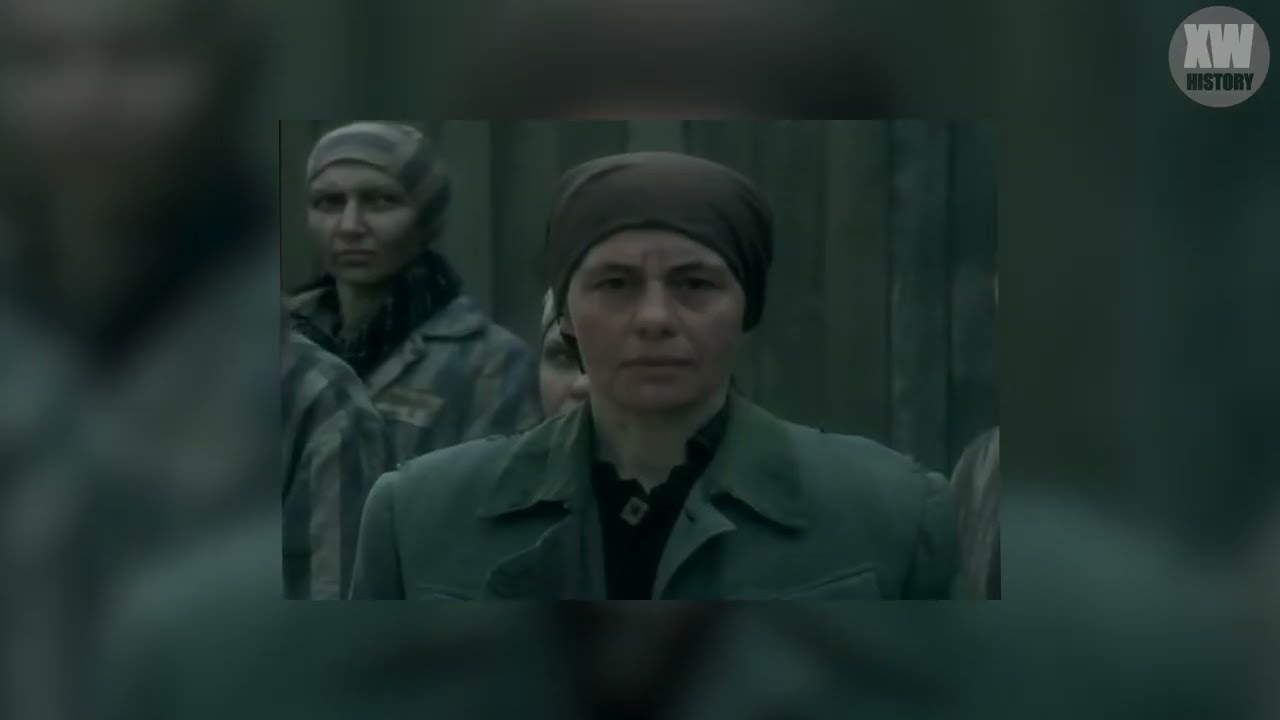 She also wore specially made, heavy boots with iron-capped toes, which she used to kick and stomp on prisoners, often breaking bones or crushing skulls with a casual, detached air. The beatings with her pearl-handled whip were frequent, and she would continue lashing until the victim was a bloody, lifeless mess on the ground.
Perhaps the most macabre symbol of her depravity was found in her personal quarters. A lampshade, crafted from the tattooed skin of a murdered prisoner, adorned her bedside table. This grotesque trophy was a testament to her complete dehumanization of her victims, a physical manifestation of her belief that the inmates were not people but objects to be used and discarded at her whim.
This level of cruelty was not lost on her superiors, who saw in her a ruthless efficiency that was to be rewarded. She was promoted and given free rein over her section, a decision that would cost thousands of lives.
Her personal life was as twisted as her professional one. An outspoken nymphomaniac, Grese engaged in sexual relationships with several high-ranking SS officers, including the camp commandant and the infamous Dr. Josef Mengele.
She was known to select attractive female prisoners for her own sexual gratification, a practice that further blurred the lines between her sadistic impulses and her twisted desires. This sexual predation was another layer of torment for the prisoners, who could never be sure if they were being singled out for death or for the warden’s perverse “affections.”
As the Red Army advanced towards Auschwitz in January 1945, the SS began a frantic evacuation of the camp, forcing prisoners on death marches towards the west. Grese participated in these brutal transfers, continuing her reign of terror even as the Third Reich crumbled. She was eventually transferred to Bergen-Belsen, a camp that had become a disease-ridden hellhole where typhus and starvation were rampant.
 It was here that British troops finally caught up with her on April 17, 1945. The liberators were confronted with a scene of unimaginable horror: over 60,000 emaciated survivors and at least 10,000 unburied corpses lying in mass graves.
Initially, Grese was forced to help bury the dead, a task she performed with visible disgust. During the Belsen Trial, she attempted to portray herself as a victim of circumstance, claiming she had been forced into the SS against her will. However, the mountain of evidence against her was insurmountable.
Witnesses testified with chilling clarity about her specific acts of cruelty, and her attempts to deny her past were met with overwhelming testimony. The military tribunal found her guilty of all charges, including murder, and sentenced her to death.
The night before her execution, Grese and her fellow condemned warden, Elisabeth Volkenrath, reportedly sang songs in their cells, a final act of bravado. In her last letter to her family, she wrote that she was happy to die for the ideals of the Third Reich, a statement that cemented her legacy as a true believer in the Nazi cause. Her execution was swift, but the memory of her crimes is enduring.
The burial site of Grese and the other executed war criminals was kept secret by the British authorities to prevent the site from becoming a shrine for neo-Nazi sympathizers.
The story of Irma Grese serves as a chilling reminder that evil does not always wear a monstrous face. It can be found behind a beautiful smile, in a neatly pressed uniform, and in the eyes of a 22-year-old girl who chose to become the “Angel of Death.” Her life was a testament to the capacity for human cruelty, a dark chapter in history that continues to haunt our collective consciousness.
The pearl-handled whip, the iron-toed boots, and the lampshade of human skin are not just artifacts of a bygone era; they are symbols of what happens when hatred is given absolute power over the innocent. Her name is forever etched in the annals of history, not as a person, but as a synonym for the absolute worst of humanity. The world remembers Irma Grese not for her angelic face, but for the brutal, bloody executioner she chose to become.