For decades, children on Staten Island passed down the same campfire story: a hook-handed monster named Cropsey lived in the tunnels beneath an abandoned institution, waiting to drag anyone who wandered too close after dark. It was a classic boogeyman tale, used by parents to get kids home before curfew. Then, in the 1980s, real children began disappearing. When police finally made an arrest, the suspect turned out to be a man who had once worked at that very building and had been living in its abandoned tunnels.
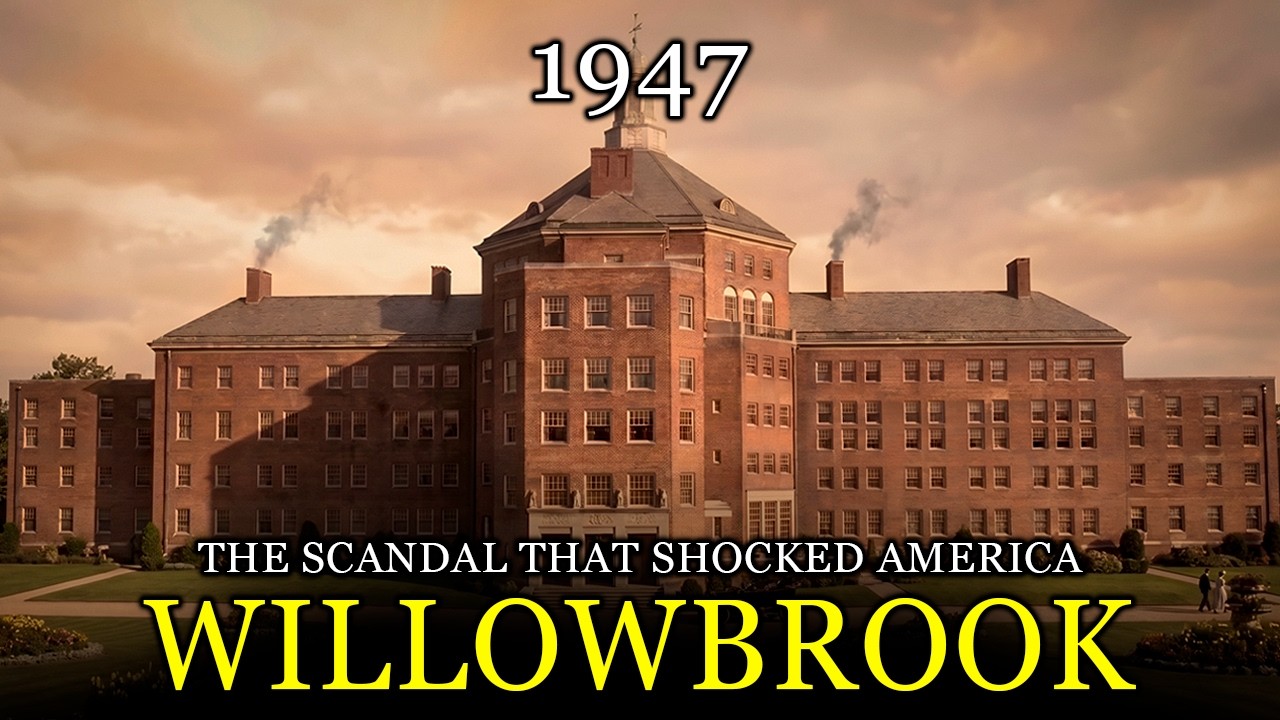
That building was the Willowbrook State School, an institution built by New York State to care for thousands of children with intellectual and developmental disabilities. Its history stretches from the highest ideals of post-war public health to one of the most infamous scandals in American institutional care, and its legacy remains a cornerstone of disability rights law today. The story begins in 1938, when the state legislature authorized a residential facility on 375 acres in the Willowbrook section of Staten Island. Construction finished in 1942, but the campus was immediately repurposed as an army hospital for wounded soldiers during the Second World War.
It served that mission until the end of the conflict. On October 11, 1947, the building finally opened as Willowbrook State School, nine years after it was first authorized. The campus was designed to hold roughly 4,000 residents in a sprawling complex of brick buildings connected by walkways and underground service tunnels. On paper, it was meant to offer children with disabilities a level of specialized care that families could not provide at home.
But in an era with no community-based support systems, desperate families sent their children in numbers the facility was never designed to handle. By the mid-1960s, a campus built for 4,000 held more than 6,000 residents, making it the largest state-run institution for people with intellectual disabilities in the United States. Overcrowding led directly to understaffing, and understaffing made basic sanitation and personal care nearly impossible. Reports described infants left for long stretches in standing boxes, wards so packed that residents could not receive adequate attention, and conditions that one visiting senator would later call a “snake pit.
” That senator was Robert F. Kennedy, who made an unannounced visit in September 1965. He toured the wards and publicly described children warehoused in facilities that provided little more than custodial storage. The comments made national headlines, but they did not lead to meaningful reform, and the institution continued operating essentially unchanged for years.
Beyond the overcrowding and neglect ran an even darker program. Beginning in 1955 and continuing for about two decades, Dr. Saul Krugman, a pediatrician and virologist affiliated with New York University, ran a series of hepatitis studies using Willowbrook’s own child residents as subjects. Krugman described the institution as a “natural laboratory,” where a virus that spread easily through poor sanitation could be studied under conditions no ordinary hospital could offer.
He worked with the full knowledge of the institution’s administration and with backing from federal research bodies. The research team deliberately infected specific groups of newly admitted children with hepatitis strains cultivated from the stool of other infected residents to study the disease and test early treatments. Krugman’s justification was that these children would be exposed to hepatitis regardless, so studying a controlled group might help develop vaccines that would protect countless others. But parents were told, in some documented cases, that enrolling their child in the study was the fastest, and sometimes the only, route onto Willowbrook’s enormous waiting list.
Bioethicists have since flagged this dynamic as a form of undue influence, consent obtained from parents who were not genuinely free to say no. Krugman’s work did produce genuine scientific value, advancing understanding of viral hepatitis and contributing to the eventual development of a vaccine that has protected millions. He later received significant professional honors and defended the ethics of his methods until his death in 1995. The case remains a defining example in bioethics courses precisely because it does not offer a simple villain, but a researcher convinced that the ends justified means that a subsequent generation of medical ethics would regard as plainly unacceptable.
The worst of what happened inside Willowbrook stayed out of public view for years, protected by institutional inertia and the fact that the people most affected had the least social power to be believed. That began to change in 1972, when two physicians who worked inside the institution, Dr. William Bronston and Dr. Michael Wilkins, brought a young ABC reporter named Geraldo Rivera onto the grounds, providing him with a stolen key so he could film what the institution had spent years hiding.
The footage Rivera’s crew captured shocked a national television audience. It showed residents, many of them children, living in overcrowded wards, left unattended for long stretches, surrounded by filth, with documentation of physical abuse and neglect. Rivera let the camera simply show what was there, and the raw, unedited footage did the work on its own. He later won a Peabody Award for the reporting.
Public reaction was immediate and sustained. John Lennon organized and headlined a benefit concert at Madison Square Garden on August 30, 1972, specifically in response to the conditions at Willowbrook. When the American College of Physicians presented Krugman with an award later that year, protesters attempted to storm the stage. In March 1972, the New York Civil Liberties Union and the Legal Aid Society filed a class action lawsuit on behalf of Willowbrook’s residents, arguing that the state had a constitutional obligation to protect people in its custody.
The case culminated in 1975 in the Willowbrook consent decree, a landmark settlement that required the state to dramatically reduce the facility’s population and develop community-based alternatives like smaller group homes. The decree also established a constitutional right for institutionalized people to be protected from harm, legal language that fed directly into the architecture that eventually produced the Americans with Disabilities Act in 1990. A 1993 ruling made the reforms permanent and enforceable. The work of moving residents out of Willowbrook proved slow and difficult.
Barbara Blum, who led the relocation agency, faced open hostility from neighborhoods that did not want group homes nearby; she was pelted with eggs and had her nose broken by an angry resident. The same prejudice that had justified building a massive segregated institution now resisted dismantling it. Willowbrook State School did not fully close its doors until September 17, 1987, forty years after it first opened and more than a decade after the consent decree that was supposed to end it. As the campus sat empty, the local legend of Cropsey began to intersect with documented crime.
Staten Island had more than one abandoned institutional campus with underground tunnels, including the former Seaview Hospital tuberculosis sanitarium. For years, Cropsey was exactly what every version of such legends is: a story parents told, not a person anyone had met. Then, beginning in the 1970s and continuing into the 1980s, real children on Staten Island began disappearing. In 1987, a 12-year-old girl named Jennifer Schweiger, who had Down syndrome, disappeared from her neighborhood.
Witnesses reported seeing her walking hand in hand toward the Willowbrook grounds with an adult man. A massive community search followed. After 35 days, her body was found in a shallow grave on the abandoned property. The man arrested was Andre Rand, a former orderly who had worked at Willowbrook in the mid-1960s and who had been living in makeshift camps among the abandoned buildings and surrounding woods.
Rand was convicted of kidnapping Jennifer Schweiger and later convicted a second time on kidnapping charges connected to another Staten Island girl who had vanished years earlier. Investigators and residents have long believed Rand was likely responsible for additional disappearances from the same era, but no additional convictions were ever secured. A 2009 documentary called Cropsey, made by filmmakers Joshua Zeman and Barbara Brancaccio, explored the collision between the childhood folklore and the real case. The filmmakers interviewed detectives and people who had known Rand, and by their own account, the deeper they dug, the harder it became to separate confirmed fact from accumulated speculation.
The film was praised specifically for its willingness to sit with genuine uncertainty rather than manufacture a tidy resolution. The building did not create Andre Rand, and most of the people who worked inside Willowbrook over its forty years were there because they wanted to help. But the timeline is not a coincidence. An institution defined for decades by the neglect of vulnerable children left behind acres of abandoned buildings and hidden tunnels that a predator could use as a hiding place for years.
Today, the site looks almost nothing like what it once was. Much of the campus is now occupied by the College of Staten Island, a public university built directly on and around the old grounds. Several original buildings were repurposed into classrooms, offices, and laboratories. Rather than hide that history, the college and local advocates created the Willowbrook Mile, a walking trail marked with historical panels that tell the real story at each stop: the founding, the overcrowding, Kennedy’s visit, the hepatitis studies, Rivera’s exposé, and the consent decree.
The project draws directly on oral histories from former residents, family members, and staff. Some former residents have returned to the campus to describe in their own words what daily life inside the institution had been like. It is a deliberate choice to keep teaching the institution’s worst chapter out loud, treating the memory of what happened there as a civic obligation. Jennifer Schweiger was 12 years old.
She liked ordinary things: her family, her routine. The 35-day search for her drew the entire community together in a way that reflected a Staten Island far more determined to find and protect its missing children than it had been a decade earlier. She deserves to be remembered as herself, not simply as a detail inside somebody else’s ghost story. The tunnels beneath Willowbrook did hide a man capable of real harm, but the story of that ground is not primarily his story.
It is the story of thousands of children the state was supposed to protect and instead warehoused past the point of basic dignity, until a handful of doctors, a young reporter, and a stolen key forced the country to look directly at what had been happening less than an hour from Manhattan. It is the story of parents who organized and turned their grief into a legal decree that still protects people with disabilities today. And it is the story of a college campus that chose to build a walking trail so that nobody crosses that ground without understanding exactly what happened there.