In June 1955, the International Olympic Committee awarded the 1960 Winter Games to a place with one chairlift, two rope tows, a small lodge, and no mayor. The location was Squaw Valley, California, a remote, nearly uninhabited valley in the Sierra Nevada, about 40 miles from Reno, with no town, no hospital, and no infrastructure. The man who pulled it off was a New York lawyer named Alexander Cushing, who had never organized a sporting event in his life. He beat Innsbruck, Austria, a city that had hosted international ski competitions for decades, by two votes.
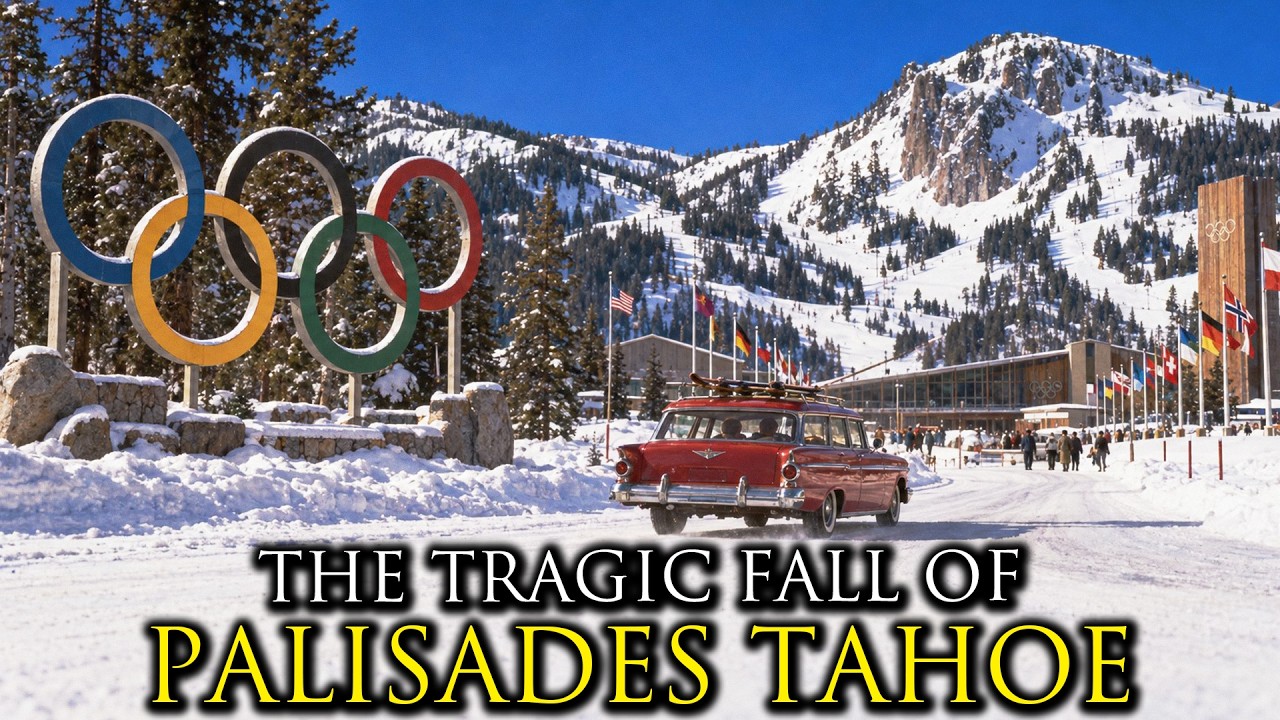
One IOC official privately called Squaw Valley a cow pasture with a chairlift. Cushing didn’t even own all the land he promised to build the Olympics on. The total cost of building a functioning Olympic city from raw wilderness would reach nearly $80 million, close to $900 million in today’s money. And when Cushing won the bid, he had no serious plan for where that money would come from.
To understand Cushing, you have to understand what he wasn’t. He wasn’t a real skier, not the way Wayne Poulsen was. Poulsen had been exploring the mountains around Lake Tahoe since he was a teenager in the early 1930s. As a high school kid, he’d hiked into the valley on a camping trip, a flat-bottomed valley flanked by soaring granite peaks, and felt something that shaped the rest of his life.
The Washoe people had gathered here in summers for thousands of years. The peaks rose to nearly 9,000 feet. The snowfall was staggering. Poulsen saw the natural bowls, the steep pitches, and thought this was where a world-class ski resort should be.
Poulsen built his first pair of skis as an 11-year-old Boy Scout. He became a ski jumper, then a University of Nevada racer, then a national championship coach. His Nevada team won the national title in 1939. That same year, he took out an option to buy land in the valley from the Southern Pacific Railroad.
Then came the war. Poulsen became a pilot, flew military transport routes across the Pacific, and stayed on with Pan-American Airways for 31 years. In 1943, he and his wife Sandy finally purchased about 640 acres at the head of the valley. The Poulsens moved there and lived in a tent, bathing in the natural streams of Shirley Canyon.
Sandy Poulsen had been a New York debutante. She never went back east. They raised eight children in that valley. Wayne Poulsen started a small ski operation called Papoose, which he ran for decades.
For Poulsen, this place wasn’t a business opportunity. It was the culmination of a boyhood dream. But building a world-class ski resort requires capital, and Poulsen didn’t have it. That’s where Alexander Cushing entered the picture.
Born in New York in 1913, Cushing moved through the world of old money institutions with ease. He attended Groton School, Harvard class of 1936, and Harvard Law School class of 1939. He practiced at Davis, Polk & Wardwell, one of the most prestigious law firms in the country, and argued a case before the Supreme Court. His early investors would include Lawrence Rockefeller, one of the five grandsons of John D.
Rockefeller. In late 1945 or 1946, Cushing was vacationing at Sugar Bowl, a ski resort near Donner Pass, just a few miles from the valley Poulsen had been developing. The two men met, and Poulsen invited Cushing to see his valley. Poulsen drove Cushing in on a surplus military vehicle called the Clipper Reindeer, pitching his vision the entire way.
Cushing saw the peaks, the terrain, the snowpack, and saw something different. Where Poulsen saw a home, Cushing saw a business model. Cushing invested $145,000 of his own money and raised another $275,000 from Rockefeller and other wealthy friends. In June 1948, the two men formed the Squaw Valley Development Corporation.
Poulsen contributed a portion of his land in lieu of cash and served as the company’s first president. On Thanksgiving Day 1949, they opened the ski area with a single chairlift and two rope tows. But the partnership was already cracking. Poulsen wanted to develop real estate, homes, community, a place for families.
He wanted the natural environment protected. Cushing wanted a vast European-style alpine resort, lifts on every reachable peak, steep terrain that would have been considered dangerously extreme at any other American resort. Poulsen saw stewardship. Cushing saw scale.
Their visions were incompatible, and only one of them had the money. By October 1949, Cushing had replaced Poulsen as president of the corporation. The split left deep scars. The Poulsens would later write letters to Olympic officials accusing Cushing and other members of the organizing committee of raging conflicts of interest, of using the Olympic bid to enrich themselves as stakeholders in the development company.
Whether that accusation was fair depends on whom you believe. What’s not debatable is that Cushing was now alone at the wheel. Sometime in late 1954, Cushing was reading a newspaper and saw that the city of Reno was considering a bid to host the 1960 Winter Olympics. His reaction, according to multiple sources close to him, was something like, “If Reno can bid, why can’t Squaw Valley?
” Reno was 40 miles away and had no mountains. Squaw Valley had one of the finest natural snow basins in the Sierra Nevada, with an average annual snowfall topping 450 inches. In 1954, Squaw Valley was not a town. It was barely a resort.
Olympic rules at the time specifically stated the games could only be awarded to a town or municipality. Squaw Valley was an unincorporated village with no municipal government, no city council, no mayor. The Winter Olympics had been held in Europe six out of seven times in their history. The lone exception was Lake Placid, New York in 1932, an actual place with hotels, roads, and a train station.
Cushing had something more valuable than infrastructure. He had nerve, a Harvard network of powerful friends, and a salesman’s instinct. The first step was getting the US Olympic Committee to endorse his bid. He recruited Curley Grieve, sports editor of the San Francisco Examiner, to run a front-page headline about the bid, turning a private fantasy into something that looked like real news.
He secured the support of California Governor Goodwin Knight, who was entranced by the idea of a Winter Olympics in his state and agreed to request a $1 million budget appropriation from the legislature. On January 7, 1955, Cushing traveled to New York for a meeting of the USOC’s special sites committee. He brought a speech and a film. He didn’t need them.
The committee was fascinated. The pristine emptiness that should have disqualified the place became, in Cushing’s framing, its greatest asset, a blank canvas, a return to Olympic ideals of simplicity and athletic purity. Lake Placid protested, but the USOC sided with Cushing, largely because of that million-dollar pledge. Consider what Cushing actually had at this point: one chairlift, two rope tows, a lodge, a million-dollar promise from a governor whose legislature hadn’t voted on it yet.
No arena, no ice rinks, no athlete housing, no road capacity, no sewage system. And he was about to walk into a room in Paris and tell the IOC the 1960 Winter Games should be held there. In June 1955, the IOC convened its 50th session in Paris. The competing bids included Innsbruck, Austria, and St.
Moritz, Switzerland, two of the most famous winter sports destinations on Earth. Innsbruck had world-class venues already built. Austria had just emerged from Soviet occupation, and sympathy was running high. When Cushing arrived, he was told again and again that Innsbruck was a foregone conclusion.
Cushing responded by building a scale model of the entire valley. The model weighed a ton and a half, so large it couldn’t fit in the IOC’s viewing hall. Cushing had it installed at the American Embassy in Paris. Then he personally walked IOC delegates in small groups through the streets of Paris to the embassy, pitching the valley every step of the way.
When Europeans worried that California meant warm weather, he talked about 450 inches of annual snow. When they worried about the remote location, he talked about simplicity and athletic focus. He’d recruited a Harvard classmate, George Weller, a Pulitzer Prize-winning foreign correspondent, to travel the world lobbying IOC members personally. He’d enlisted Joe Marillac, a decorated French war hero living in the Tahoe area, to work the French-speaking delegates.
He printed his bid proposal in Spanish, not just the official Olympic languages of English and French, an unorthodox move aimed squarely at Latin American IOC members. He leaned hard on a philosophical pitch: the Olympics belong to the world, not just one continent. Western North America had never hosted a Winter Games. Six out of seven had been held in Europe.
Was that really what the Olympic movement was supposed to be? On June 17, 1955, the IOC voted. On the first ballot, no bidder won a clear majority. On the second ballot, the count came back: Squaw Valley 32, Innsbruck 30.
Two votes. A shadow had been cast over the voting itself. European delegates had raised objections, pointing out that Olympic rules stated the games could only be awarded to a town or municipality. Cushing was called into the closed session and faced a barrage of questions.
He improvised, explaining with a straight face that Squaw Valley was essentially a self-governing community. The world was shocked. European newspapers ran furious editorials accusing the IOC of incompetence. True magazine later cracked that it was the first time in history a con man had duped the entire world into giving him the Olympics.
Cushing had sold something that didn’t exist yet. Now he had to build it. Before any construction could begin, Wayne Poulsen, Cushing’s former partner, wrote a letter in November 1955 to the executive director of the US Olympic Committee. Poulsen and his wife Sandy accused Cushing and other members of the organizing committee of having raging conflicts of interest.
They were stakeholders in the development company, which stood to profit enormously from the Olympics. Poulsen also raised a disturbing point: Cushing didn’t own all the land in the valley he’d promised to use for the games. The Poulsens owned significant acreage. The accusation hung in the air, but the USOC didn’t act on it in any way that derailed the bid.
Then the whole thing nearly fell apart for a different reason. IOC President Avery Brundage, the same man who had called Squaw Valley a cow pasture, looked at what the place actually was and was alarmed. He wrote a scolding letter to Cushing, warning that the initial $1 million wouldn’t come close to covering the true cost, which he estimated at no less than $5 million. He issued an ultimatum: unless the California state legislature committed another $4 million by April 3, 1956, the games would be reassigned to Innsbruck.
Cushing had been operating on bluster and a governor’s handshake. In March 1956, both the assembly and the Senate approved the $4 million budget item. On April 3, Brundage’s deadline, down to the day, the governor signed it. Squaw Valley was formally confirmed as the host of the 1960 Winter Games.
The state legislature would eventually commit nearly $8 million total. The federal government contributed several million more, authorized through a congressional resolution signed by President Eisenhower. By the time everything was built, the total cost came to roughly $80 million. What they built was remarkable.
An 8,500-seat arena called Blyth Arena, named for Charles Blyth, the investment banker who chaired the California Olympic Commission, cost roughly $3. 5 million. It was designed with its south side open to the elements so spectators watching figure skating or hockey could see the Sierra Nevada peaks rising behind the ice. It was by every account one of the most beautiful sports venues ever built.
A 400-meter speed skating oval sat just south of the arena. Indoor and outdoor ice rinks used artificial refrigeration for the first time in Olympic history. A 70-meter and 90-meter ski jump were built on Papoose Peak. An entire athletes’ village went up, another Olympic first, with dormitories, a recreation center, physical therapy rooms, and a dining center serving international cuisine around the clock.
The idea was simple and radical: keep the athletes together, comfortable, and focused. Every Winter Olympics since has had an athletes’ village. The concept was born at Squaw Valley. They had to build a city’s worth of infrastructure.
Roads were widened and paved, bridges built, water mains laid, electrical capacity expanded. A sewage treatment plant was constructed, as were a post office, the first ever constructed specifically for an Olympic Games, snow removal equipment, parking, and housing for workers. All of it in under four years. There was one more decision during planning that showed exactly who Cushing was.
The organizers polled the Winter Olympic nations and found only nine planned to send bobsled teams. Building a bobsled run was expensive and technically complex. Cushing made a decision that infuriated the International Bobsled Federation. He refused to build one.
No bobsled events at the 1960 Winter Olympics. The FIBT petitioned the IOC furiously. Cushing held firm. The absurdity of the whole enterprise was driven home at the closing ceremony of the 1956 Winter Olympics in Cortina d’Ampezzo, Italy.
There’s a tradition where the mayor of the current host city hands the Olympic flag to the mayor of the next host city. Squaw Valley didn’t have a mayor. So a California IOC member named John Garland had to stand in and accept the flag from the deputy mayor of Cortina. Cushing brought in Prentis C.
Hale to chair the organizing committee. Then he made one of the smartest decisions in Olympic history. He called Walt Disney. Disney was already the most famous entertainer on the planet, an avid skier, and a part owner of the Sugar Bowl Ski Resort just down the road.
Cushing and Hale recruited Disney to serve as chairman of the pageantry committee, responsible for the opening and closing ceremonies, the torch relay, the victory ceremonies, venue decoration, and nighttime entertainment. Before Squaw Valley, Olympic opening ceremonies had been perfunctory: a parade of athletes, some speeches, the lighting of the cauldron. Disney re-imagined the whole concept. He designed a Tower of Nations, a huge metal structure crowned with the Olympic rings and adorned with the heraldic crests of all 30 participating nations.
He conceived what he called the Avenue of Athletes. He planned a ceremony featuring a cast of over 5,000 participants, including more than 1,285 musicians in high school marching bands recruited from across Northern California. Disney arranged for 2,000 doves to be released, eight ceremonial cannons to fire in salute, fireworks displays, and the first ever performance of the official Olympic hymn at a Winter Games. He even designed the ice sculptures himself.
Then Mother Nature tried to cancel the show. The winter of 1960 started dry. By early February, just days before the scheduled opening, Squaw Valley was dangerously short of snow. For the Europeans who had mocked Cushing’s bid, it was vindication.
And then the storms came. When they arrived in early January, they never let up. On the morning of opening day, February 18, 1960, a blizzard was raging over the valley. The 2,000 doves, caged in flatbed trucks provided by Disney Productions, refused to cooperate.
About an hour before the ceremony was supposed to begin, the storm broke. The clouds parted, sunlight poured over the snow-covered peaks, and nearly 6,500 spectators looked up at one of the most staggering alpine vistas anyone had ever seen. The ceremony went off outdoors exactly as Disney had designed it. Vice President Richard Nixon declared the games open.
The actor Carl Malden recited the Olympic prayer. Life magazine would declare it the greatest winter show on earth. These were the first Winter Olympics ever televised in the United States. CBS purchased the exclusive broadcast rights for $50,000.
For comparison, CBS paid $550,000 for the Summer Olympics rights that same year from Rome. Winter Olympic broadcast rights would never again be such a bargain. CBS had to build an intricate web of communication lines to carry the video feed from the remote California valley all the way to New York. They broadcast over 15 hours of coverage.
For the first time, Americans who couldn’t travel to the mountains could watch world-class winter athletes compete in real time. It was the beginning of the Olympics as a television event. Something else was born at Squaw Valley that changed sports forever. During the men’s slalom competition, officials weren’t sure whether a skier had missed a gate.
Someone on the Olympic staff went to the CBS production team and asked an unusual question: could they review the videotape of the race? The CBS crew played the tape back, and officials got their answer. CBS sports director Tony Verna saw a practical application. For the next three years, he worked on developing a system that could replay video almost instantly during a live broadcast.
On December 7, 1963, during the Army-Navy football game, Verna debuted the first true instant replay system. The concept that became the most ubiquitous tool in sports broadcasting began with a question asked at Squaw Valley in February 1960 about a skier and a gate. The athletic stories from those games were extraordinary. The American ice hockey team was an afterthought, a squad of college players and amateurs, many from Harvard and other Ivy League schools, who’d only been practicing together for about a month.
Their coach was Jack Riley of Dartmouth. Nobody expected anything from them. The Soviets were dominant. Then on February 27, 1960, the US team faced the Soviet Union in the semi-final at Blyth Arena.
A packed crowd of nearly 8,500 watched the Americans stun the Soviets. It was the first time a US hockey team had ever beaten the Soviets in Olympic competition. The next day, the Americans defeated Czechoslovakia to win the first Olympic gold medal in ice hockey in United States history. The miracle on ice everyone knows, the one from Lake Placid in 1980, happened 20 years later.
Here’s the thread that connects them. The last player cut from the 1960 team was a young man named Herb Brooks. He went home heartbroken. Twenty years later, Brooks would coach the 1980 squad that replicated the miracle at Lake Placid.
And one of the 1960 gold medalists, Bill Christian, had a son named David who played on that 1980 team. Carol Heiss, 20 years old, won gold in women’s figure skating. She had won silver at Cortina in 1956, and shortly afterward, her mother had been diagnosed with cancer. Before she died, Carol’s mother made her promise she’d come back and win gold.
Heiss arrived at Squaw Valley on a personal mission, and she delivered. David Jenkins won men’s figure skating gold, making it an American sweep. French skier Jean Vuarnet became the first Olympic gold medalist to race on metal skis, a technological revolution in alpine racing. Women’s speed skating appeared in the Olympics for the first time.
The biathlon debuted as an Olympic event. Every skating discipline was held on artificially refrigerated ice, yet another first. Thirty nations participated. Six hundred sixty-five athletes competed in 27 events across eight disciplines.
There’s a detail from those games that carries a particular kind of chill. Competing in figure skating at Squaw Valley were the two daughters of Maribel Vinson Owen, herself a nine-time US champion. Both daughters, Maribel Jr. and Laurence, skated at Blyth Arena that February, in the same competition where Carol Heiss won her gold.
Less than a year later, on February 15, 1961, Sabena Flight 548 crashed on approach to Brussels, Belgium. On board was the entire United States figure skating team, 18 skaters plus coaches and family members traveling to the World Championships in Prague. Maribel Vinson Owen and both of her daughters were killed. The 1961 World Championships were cancelled entirely.
Blyth Arena, where those young women had last competed at the highest level, was one of the last great stages they’d ever stand on. Within 22 years, the arena itself would be demolished and paved over for a parking lot. The Olympics ended on February 28, 1960. The question nobody had wanted to answer was this: what happens to an Olympic city that was never a city to begin with?
In the short term, Cushing got exactly what he’d wanted. The television coverage projected the name Squaw Valley into every living room in America. The whole region was transformed. Cushing threw up new chairlifts, eventually more than 20, and opened terrain that would have been considered suicidal at most other resorts.
Top skiers loved it. The resort became one of the incubators of extreme skiing in America, producing talents like Rick Sylvester, Robbie Huntoon, and Scott Schmidt. Great racers came out of the mountain too, including Jimmy Heuga, who won a bronze medal at the 1964 Olympics in Innsbruck. The Olympic infrastructure was a different story.
The venues had been built for an 11-day event, and most had no plausible long-term purpose. The wooden ski jump facilities on Papoose Peak were left unmaintained and slowly rotted. The temporary venues were dismantled. The athletes’ village was converted into residential housing.
The speed skating oval fell silent. Then there was Blyth Arena. After the Olympics, it hosted occasional events, an alpine skiing World Cup in early 1969, some community gatherings. The Worldwide Church of God rented it for its annual Feast of Tabernacles.
But mostly it sat there, a beautiful, expensive, nearly empty building in the middle of a ski resort that needed parking more than it needed an arena. From 1963 to 1983, Cushing, still chairman of the Squaw Valley Ski Corporation, appealed regularly to the state of California, which still owned the facility, to have the arena demolished. He wanted the land for parking. Twenty years of asking.
The arena aged, the roof sagged, the seats emptied. In 1968, to reinvigorate the resort, Cushing ordered the construction of an aerial tramway one and a half miles long, manufactured by the Swiss company Garaventa, one of the largest cable car systems in the world at the time. It carried skiers from the base of the valley to High Camp at 8,200 feet, opening up vast terrain above the tree line. Then, on April 15, 1978, a spring blizzard hit the valley.
At about 3:45 in the afternoon, the descending cable car carrying 44 passengers was moving down the mountain at 11 mph through gusting crosswinds. Something happened at tower 2. A track cable came off its saddle. The car dropped 75 feet of free fall before the remaining cable caught the weight and snapped the car back upward like a yo-yo.
But the freed cable, a 17-ton steel rope, suddenly unburdened, whipped upward, broke loose from the tower, and came crashing down onto the rebounding car. It sliced through the metal shell. Three passengers were killed instantly. A fourth died later.
Thirty-one were injured. One man was thrown from the gash in the car and fell to the ground far below. He walked away with a broken rib. The rescue took hours.
Ski patrollers, volunteers, nearly 300 people worked through the blizzard to evacuate passengers dangling 80 feet above the rocks. Multiple investigations followed. A world-renowned tram design expert couldn’t pinpoint a definitive cause. The official ruling from both the district attorney’s office and OSHA was astonishing: an act of God.
Nobody was charged. The precise cause of the worst cable car accident in American history was and remains undetermined. Cushing promised the tram wouldn’t be replaced until the cause could be identified. A new car was installed eight months later, in December 1978.
On its first run in January 1979, hundreds of undaunted skiers poured in. In 1998, a completely new modern cable car system was installed, and the safety record since then has been spotless. Meanwhile, Squaw Valley’s financial underpinnings had been shaky for years. By 1971, after several years of financial losses on state-owned properties, California announced it would seek bids to sell.
An Australian company, Mainline Corporation, purchased the state’s interest, then collapsed spectacularly in August 1974. Ownership would change hands multiple times over the following decades, a revolving door of investment groups, ski industry operators, and venture capitalists. Through it all, Cushing remained chairman of the Squaw Valley Ski Corporation. He held on for decades.
He was still there in 1983 when a heavy snowstorm collapsed the roof of Blyth Arena. The building that had hosted the opening ceremony, the hockey tournament, the figure skating, the building where Disney had released 2,000 doves and Nixon had declared the games open, was demolished. The site became a parking lot. The ice where Carol Heiss fulfilled a promise to her mother, where an amateur American hockey team shocked the Soviets, all of it paved over for cars.
Cushing never let go. He remained chairman through every ownership change, every financial crisis. In his later years, he was known for playing piano in the Lodge Bar, his own compositions inflicted on guests whether they wanted to hear them or not. He died on August 19, 2006, at 92, of pneumonia at Sea Cove, his summer home in Newport, Rhode Island.
His wife Nancy succeeded him as president of the Squaw Valley Ski Corporation. Wayne Poulsen, the man who’d actually discovered the valley, died in 1996. He’d been inducted into the US Ski Hall of Fame in 1980. After the split with Cushing, the Poulsens had purchased over 2,000 additional acres in the valley through their company, Squaw Valley Land and Livestock.
They developed subdivisions. Sandy Poulsen ran the construction, the real estate, the ski hill operations. They fought to protect the iconic meadow at the center of the valley from overdevelopment. They raised their eight children there.
When Sandy Poulsen died in 2007, her sons described a woman who’d gone from being a New York debutante to a frontier matriarch. The Poulsen family’s 30-acre property in the valley was eventually purchased by a land trust and a public service district. No subdivision, no development, just land. After Cushing’s death, the resort’s ownership continued to change.
KSL Capital Partners took over. In 2011, Squaw Valley merged with neighboring Alpine Meadows Ski Resort under a single management umbrella. The combined operation became one of the largest ski areas in the country: over 6,000 acres of terrain, 42 lifts. Then, in 2021, came the name change.
The valley sits within the ancestral homeland of the Washoe people, who had gathered there in summers for millennia. The name Squaw Valley was given by westbound travelers in the mid-19th century. The word itself, derived from the Algonquian language, had originally meant “woman,” but over generations it had been shaped into something derogatory, a racist and misogynistic term used to demean Indigenous women. The Washoe tribe had been asking for a name change for decades.
In September 2021, the resort officially became Palisades Tahoe. The response was mixed. Some locals mocked the new name. Some skiers refused to use it.
Some people thought it was overdue. Today, if you drive up Highway 89 from Tahoe City and turn into Olympic Valley, you’ll find a resort town that would be unrecognizable to anyone who stood there in 1955: luxury condominiums, hotels with spas and rooftop pools, restaurants, a village center with retail shops and après bars. The aerial tram still runs, rebuilt completely in 1998 with a spotless safety record since. There’s a monument near the entrance to the valley with the Olympic rings, an eternal flame, and a commemorative marker from the 1960 games.
The address of the resort itself is 1960 Olympic Valley Road. Only three buildings from the original Olympics still stand. The ski jumps are long gone. The Blyth Arena site is still a parking lot.
But the resort is thriving. Palisades Tahoe is consistently ranked among the top ski destinations in North America, drawing serious skiers from every continent. There’s a political footnote worth knowing. During the planning stages, there was serious concern among IOC members that the United States, in the heat of the Cold War, might refuse entry to athletes from communist nations.
In 1957, IOC President Avery Brundage announced that if the US refused entry to any country recognized by the IOC, he would revoke Squaw Valley’s invitation to host the games and resign the presidency. In the end, the State Department cooperated, and athletes from 30 nations competed. Innsbruck hosted the Winter Olympics in 1964 and again in 1976. The established European cities got their turn, but they got it after Squaw Valley, not instead of it.
The story of the Olympics, the way they were televised, the way the ceremonies were staged, the way athletes were housed, the way the whole enterprise was sold to a global audience, had been permanently altered by a Harvard-educated lawyer from New York who looked at a cow pasture with one chairlift and saw the world watching.