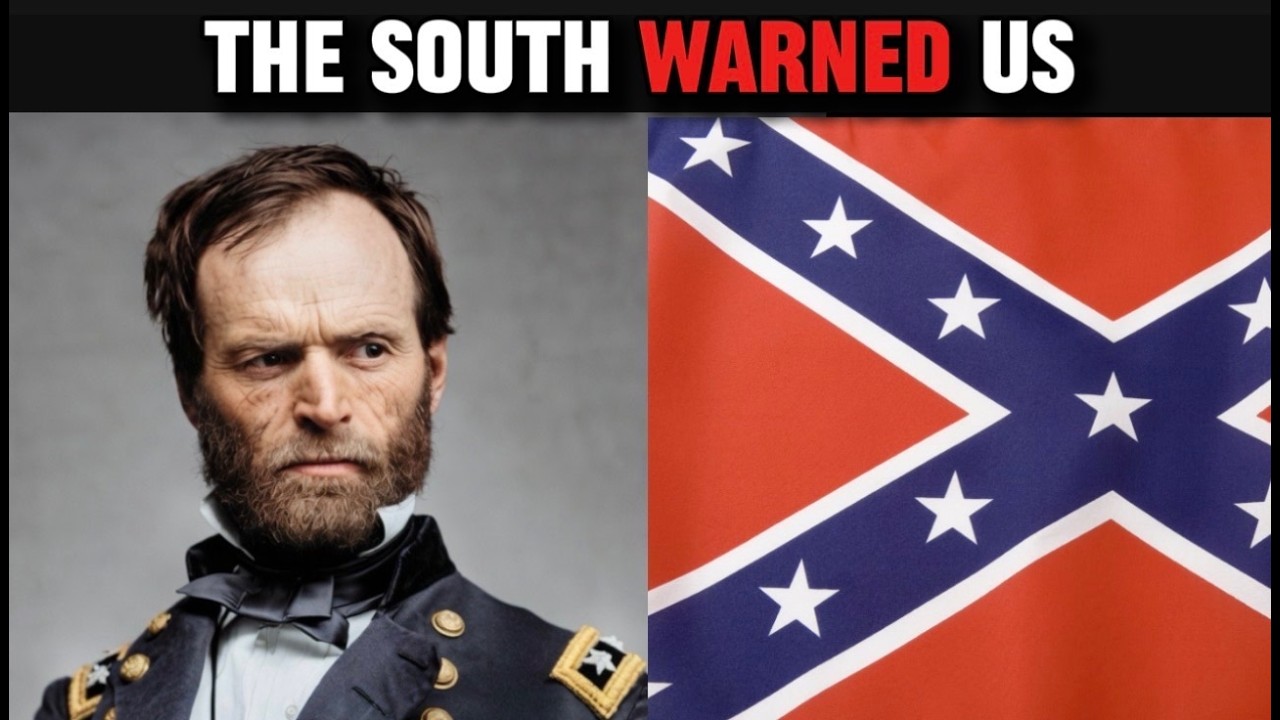
The story of William Tecumseh Sherman is often told as a tale of a brute or a military visionary. Both portraits are incomplete because they remove the political architecture that made him possible. The South did not simply suffer Sherman. In a very real sense, it created him.
The Antebellum South constructed its moral and political universe on the premise that the North intended to destroy its economy, customs, and racial order. Firebrands thundered about Yankee aggression and the coming annihilation of Southern civilization. Sherman listened to all of this. He lived among Southerners and genuinely liked the South. When the war came, he became, with almost surgical precision, the exact man they had warned everyone about.
He was born in Lancaster, Ohio in 1820. When his father died, he was taken in by Thomas Ewing, a prominent Whig politician. He was named after the Shawnee leader Tecumseh. West Point shaped him, and he graduated sixth in his class in 1840. He was posted to Florida and various southern assignments, where he developed a lasting affection for the South.
He was stationed in Charleston, South Carolina, a city at the apex of its aristocratic self-regard. He knew the land and the particular pride of the planter class. This familiarity made his later actions more deliberate, not less.
At Shiloh, Sherman was wounded twice and had three horses shot under him. He held his line with tenacity. After the battle, Grant told Sherman he had given up thinking about retreating. Something had clarified for both men. The war had revealed itself as a conflict that would consume men in industrial quantities.
Sherman began thinking in systematic terms. Confederate armies were not going to simply collapse under military pressure. The machinery of Confederate resistance was located in the civilian population, in the farms and railroads that supplied the armies. Sherman drew the logical conclusion and acted on it.
In the spring of 1864, Grant went east to fight Lee. Sherman drove into the Confederate heartland to take Atlanta. The campaign was a master class in operational maneuver. He fought Joseph Johnston and John Bell Hood across 100 miles of Georgia, forcing the Confederates to abandon position after position.
Atlanta fell on September 2nd, 1864. The political consequences were immediate. Lincoln had expected to lose the November election. Atlanta changed the calculation overnight. Sherman, more than any other figure, had saved Lincoln’s presidency.
Sherman was already thinking past Atlanta. He was thinking about how to break the Confederate will to resist before it could reconstitute itself after a formal surrender. He called it hard war.
The march to the sea began on November 15th, 1864. Sherman burned Atlanta’s military infrastructure. He issued orders against the destruction of private residences, but those orders were only partially followed. He made a calculated decision that imperfect discipline was an acceptable price for the strategic objective.
The terror was primarily psychological. The Confederate government had been unable to stop 60,000 soldiers from walking through Georgia. They could not protect the homes or the food. The plantation mistresses who wrote about Sherman’s soldiers taking their silver were writing the obituary of Confederate political legitimacy.
The army reached Savannah by December 21st. Sherman telegraphed Lincoln offering him the city as a Christmas gift. The Carolina campaign that followed was even more intense. South Carolina was the birthplace of secession.
Columbia, the state capital, burned on the night of February 17th. The question of who bears responsibility has occupied historians for a century and a half. Confederate cavalry burned cotton stores. Sherman’s troops were not well controlled. The wind spread whatever fires had been set. By morning, much of Columbia was ash.
The more interesting question is what Sherman intended. His correspondence shows he was not writing like a man who wanted to punish. He was writing like a man who wanted to end the war as quickly as possible. He was trying to shorten the war.
The terms he offered Joseph Johnston at Durham Station in April 1865 were so generous that Washington rejected them outright. Sherman was savaged in the Northern press. He refused to shake Secretary of War Stanton’s hand at the grand review of the armies.
The man who had marched through Georgia was also the man who offered the most lenient surrender terms of any major Union commander. He was not animated by hatred. He was animated by a theory that the only durable settlement was one that came quickly and then stopped.
The South understood Sherman as a monster because the alternative was to understand him as a rational actor. If Sherman was a barbarian, then what he did was aberrant. If he was simply a general who identified the foundations of Confederate resistance and destroyed them, then the Confederacy had been defeated by logic.
The Lost Cause needed the war to have been lost for honorable reasons. Sherman did not cooperate. In his memoirs, he said the war had been about slavery. He said secession had been treason. He said the Confederacy had lost because it built its economy on human bondage.
His famous 1880 speech, from which the phrase "war is hell" derives, captures his thinking. He was not celebrating. He was insisting on the reality of what war actually is. He kept insisting it had just been terrible.
Whether he was right about the peace is a question worth sitting with. Reconstruction collapsed. The freedmen who followed his army were largely abandoned. Sherman was not a champion of black equality. His special field order number 15 set aside land for freed families, but it was reversed by Andrew Johnson.
He was a man of his time. His treatment of Native Americans as commander of the army after the Civil War was brutal. He prosecuted the Indian Wars with the same logic of total war. The man who insisted on the humanity of Georgia civilians did not extend that instinct to the Lakota and Cheyenne.
The Southern secessionists built their argument on the claim that the North intended to destroy their civilization. They used this claim to justify secession and war. What they produced through four years of war were the conditions that made Sherman inevitable.
The Confederate strategy required the full mobilization of Confederate society. The civilian economy was not incidental to the war effort. It was the war effort. Once Sherman grasped this, the implications were unavoidable.
Destroying Confederate armies was insufficient. The only way to break Southern will was to demonstrate that the cost of continued resistance exceeded any possible benefit. The march to the sea was that demonstration.
What the Confederates had warned their people about was not wrong as a prediction. It was wrong as a justification. They had used the prediction to justify war, and the war produced the thing they had predicted.
The destruction they warned about was not the cause of the conflict. It was the consequence. The women who watched Sherman’s soldiers take their horses were not the architects of secession. They were its victims in a double sense. First of the war that secession brought, and then of the march that the war produced.