Jefferson Davis made many decisions during the Civil War. Some were justified. Some were catastrophic. But few were as consequential, or as avoidable, as his decision on July 17, 1864, to remove General Joseph E. Johnston from command of the Army of Tennessee.
Davis handed Atlanta to William Tecumseh Sherman on a silver platter. That is not hyperbole. It is what happened.
Davis saw a general who kept retreating. He saw a commander who surrendered ground and offered excuses instead of victories. Every request to attack was met with a polished explanation of why an attack was not feasible at that moment.
Davis saw weakness hiding behind a mask of strategy. He saw a man unwilling to fight for the city that kept the Confederate war machine alive.
What Davis actually had was a general executing the only campaign that had a realistic chance of surviving the summer of 1864.
Davis removed him anyway.
When Sherman crossed the Tennessee border in early May 1864, he was not leading a cavalry raid. He was advancing with 98,000 men and the stated intention of driving into the heart of Confederate territory. Grant, meanwhile, was tightening his grip on Lee in Virginia.
Sherman’s campaign through Georgia was the southern half of a coordinated strategy. The goal was to break the Confederacy’s ability to fight before the 1864 election stripped Lincoln of the political will to continue.
Johnston understood what he was facing. He took command of the Army of Tennessee in December 1863 after Bragg’s defeat at Missionary Ridge. The army was beaten in numbers and broken in spirit.
The men had watched their generals fail them repeatedly since Shiloh. They had seen Bragg blame subordinates for his operational failures. They had watched him retreat from Kentucky, then from Tennessee, then from Missionary Ridge in a pattern so clear that even Confederate newspapers could not defend it.
Johnston inherited an army that did not trust its leadership. His first task was not tactical. It was psychological.
He clothed the men. He fed them. He trained them. He promoted competent officers. By the spring of 1864, he had accomplished something the Army of Tennessee had not seen in years. He had a force that believed in itself again.
But Johnston also assessed his situation realistically. He had about 65,000 men of varying quality. Sherman had nearly 100,000. Johnston was short on artillery and desperately short on supplies.
Sherman’s supply line stretched back through Tennessee to Louisville like a conveyor belt of food, ammunition, and reinforcements. Johnston’s forces moved south through Atlanta on a single railroad line that grew more vulnerable with every mile Sherman advanced.
Johnston calculated that any attack would cost Confederate lives at a rate the South could not replace. The math was clear. So Johnston chose to fight on the defensive.
Northwest Georgia is not flat ground. It is a region of hills, rivers, and narrow valleys where a smaller force could anchor its flanks and force a larger force to attack uphill or waste time searching for an alternate route.
Johnston exploited every one of these features with systematic intelligence. It frustrated Sherman to no end.
At Dalton, Rocky Face Ridge, Resaca, Cassville, Allatoona, New Hope Church, Pickett’s Mill, Dallas, and Kennesaw Mountain, Johnston chose his positions, fortified them quickly, and waited for Sherman to arrive. When Sherman tried to flank, Johnston retreated to the next defensible hill and repeated the process.
The tragedy is not that this strategy failed. The tragedy is that it was working, and no one in Richmond could see it.
Davis craved aggression. He had honed this instinct in the Mexican War, where bold attacks produced brilliant victories. He carried that approach into a conflict with a completely different strategic situation.
The Confederacy was fighting a defensive war for survival. It did not need to destroy the Union army. It needed to hold on long enough for the North to lose the will to fight.
That was always the Confederate path to independence. Not battlefield victory, but the erosion of Northern morale.
Johnston understood this. Davis could not accept it. He wanted victories. He wanted headlines. He wanted the Army of Tennessee to attack.
Johnston refused. And he kept his reasons to himself. That was a problem in itself.
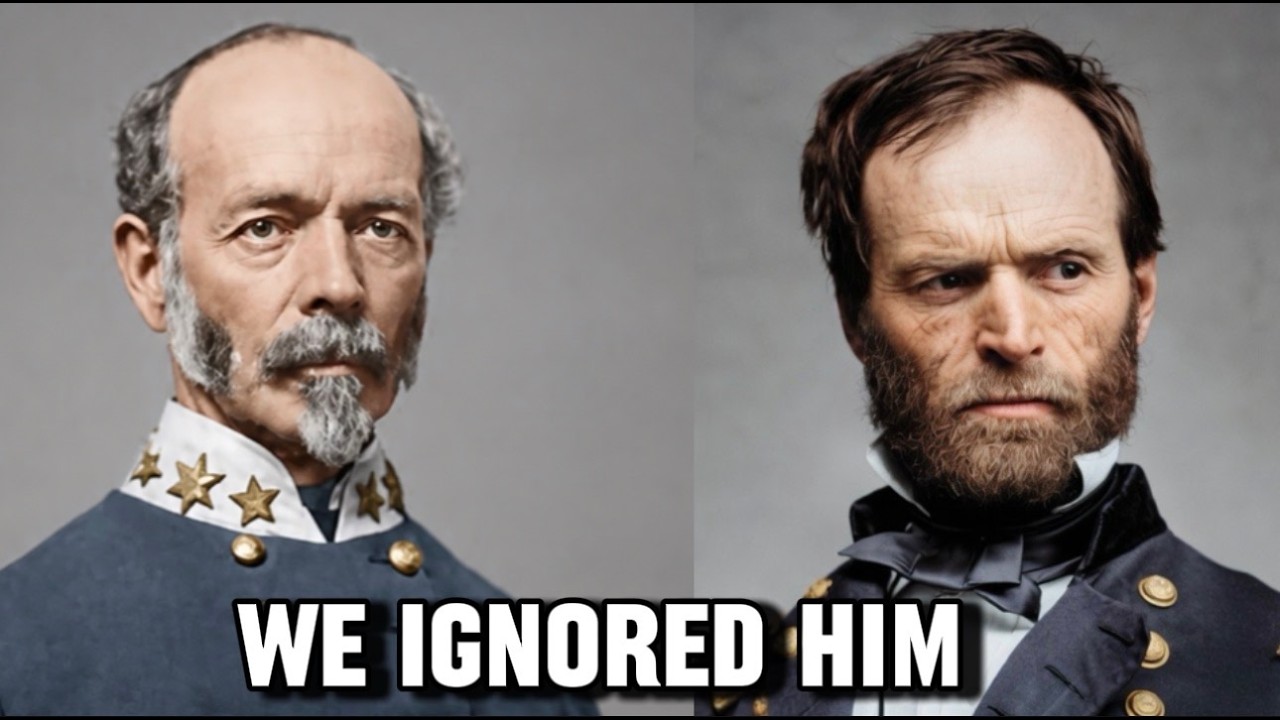
Johnston was naturally disinclined to share his plans with Davis. Partly as a matter of principle. Partly because Davis had leaked operational plans before, and Johnston did not trust him with details.
The silence fed Davis’s suspicions. Every telegram from Johnston was more evidence that he had no intention of attacking. Every retreat confirmed that Johnston lacked the will to fight for the industrial heart of the South.
Braxton Bragg, Davis’s military adviser in Richmond, had a deep personal hatred for Johnston. He fed the president reports that poisoned whatever confidence remained in the commander.
Bragg visited Johnston’s headquarters in July and returned to Richmond with the assessment that Johnston had no intention of holding Atlanta. Whether Bragg believed it or was simply exploiting Davis’s anxiety remains a question historians have debated ever since.
What is not debatable is the effect. By mid-July, Johnston’s army had reached the Chattahoochee River, the last major natural barrier north of Atlanta. Sherman had flanked him again. He always flanked him. Johnston retreated across the river.
That was the moment that sealed his fate.
Davis sent a telegram demanding to know Johnston’s plans for defending Atlanta. The reply he received was, by Johnston’s standards, close to insubordination.
On July 17, 1864, Johnston was relieved of command.
John Bell Hood was 33 years old. He had lost the use of his left arm at Gettysburg and his right leg at Chickamauga. He entered battle strapped to his saddle.
Hood had served as a division commander and then as a corps commander under Johnston. During the campaign, he had written letters to Richmond that Johnston did not know about. The letters criticized Johnston’s reluctance to attack and suggested that bolder action was possible and justified.
Davis chose Hood because Hood would fight. That was the calculation in its simplest form.
The Army of Tennessee needed a commander who would not retreat. A commander who would take the war to Sherman. A commander who would defend Atlanta with the offensive spirit the situation seemed to demand.
What the situation actually demanded was the opposite.
Sherman received the news of Johnston’s removal. By many accounts, he appeared relieved, then suspicious that he was being manipulated into lowering his guard. He was not.
The Confederates had simply done him a great favor. They replaced the one general who had a working strategy with one who would make his campaign easier.
Hood attacked within days of taking command.
The Battle of Peachtree Creek on July 20, 1864, two days after Hood assumed command, was a declaration of the new Confederate philosophy. Where Johnston had conserved his forces and made Sherman come to him, Hood sent his men across open ground against entrenched Union positions.
The Confederate attack achieved surprise in some sectors and gained some initial momentum. But the coordination of the flanking movement collapsed. Union forces regrouped. The attack fell apart.
Confederate losses were about 2,500 men. Sherman lost less than half that number.
Hood attacked again two days later. The Battle of Atlanta on July 22 was more ambitious. The plan involved a night march and a flanking maneuver designed to strike McPherson’s Army of the Tennessee from the flank and rear while another force pinned it from the front.
The plan was bold. In the early morning hours, it nearly worked.
James McPherson, one of Sherman’s most capable corps commanders and one of Grant’s closest friends, was killed while riding between his lines when he encountered Confederate skirmishers. His death shook Sherman deeply.
But the battle did not go as Hood planned. Union forces adjusted. They launched counterattacks. The Confederate assault, which had already expended enormous energy and lives in the night march alone, was broken.
Confederate losses on July 22 ranged from 5,000 to 8,000 men. Sherman lost about 3,700, including McPherson.

Hood attacked a third time eight days later at Ezra Church, west of Atlanta. He was trying to cut Sherman’s supply lines and force him to fight at a disadvantage or retreat. The attack was repulsed with about 3,000 Confederate casualties against far fewer Union losses.
In nine days, John Bell Hood inflicted irreplaceable losses on the Army of Tennessee. He achieved no strategic gains. He handed Sherman the initiative that Johnston had denied him for three months.
The pattern was now set. Hood would fortify Atlanta and respond to Sherman’s flanking maneuvers with attacks that accomplished nothing but bleeding an army that was already outnumbered.
Sherman settled into a systematic siege. He extended his lines around the city. He cut the railroads that fed it. He waited for the situation to resolve itself.
It did not take long.
Atlanta was always in danger. Sherman had the numbers, the supplies, and the operational flexibility to keep probing until he found a gap. Georgia’s geography favored the defender, but not forever.
Johnston knew this. He never claimed he could hold Atlanta indefinitely. What he argued, and what his campaign proved, was that the Army of Tennessee could remain a coherent and effective fighting force throughout the summer of 1864 as long as it was not squandered in futile offensive operations.
The goal was not Atlanta as a geographic location. The goal was to prevent Sherman’s campaign from achieving a decisive result before November.
Time was the Confederate resource that no Union flanking maneuver could attack directly. Every week that passed without a Union victory in Georgia was another week of accumulated war weariness in the North.
The 1864 election was not an abstract distant idea. Every general on both sides understood that Lincoln’s political survival was tied to military success. Military failure meant a negotiated peace that might preserve Southern independence.
Johnston was buying time. He was betting on November.
The extraordinary thing is that his plan was working. Sherman had been moving since early May. August arrived, and Atlanta was still in Confederate hands. Sherman’s losses were mounting. His supply lines were stretched. His correspondence with Grant focused increasingly on the difficulty of drawing Johnston into a decisive battle.
Davis looked at a map with an arrow pointing toward Atlanta and a general who kept retreating. He did not see, or could not accept, that the arrow was the point.
The strategy was to make Sherman advance slowly and at great cost. The map was supposed to look threatening. The arrow was not what mattered. Time was what mattered.
When Hood replaced Johnston and began attacking, he gave Sherman exactly what Johnston had denied him for three months. A Confederate army willing to fight on Union terms, in the open, against superior numbers and firepower.
The results were as predictable as they were devastating.
Johnston’s reputation has gone through several cycles since the war. His supporters, and he had many among the soldiers who served under him in Georgia, argued with an almost devotional intensity that he was the best defensive commander the Confederacy produced. A man who understood the true nature of the war more clearly than the president who removed him.
His critics, led by Davis himself, insisted to the end of their lives that Johnston had no plan and no intention of fighting. That his retreat was an elaborate surrender without the formality of a declaration.
The historical record has mostly sided with Johnston, though not without reservations. Johnston’s secrecy, his refusal to communicate his intentions clearly to Richmond, was a genuine error. Both professionally and politically.
In a command structure where the president needed consultation and reassurance, Johnston’s silence was not merely a personal quirk. It was a strategic weakness that undermined his own campaign. A general who could not maintain the support of his civilian leadership for his strategy, no matter how sound, was a general operating without the institutional backing he needed to execute it.
But silence does not change the facts. It does not change what happened when Hood attacked. It does not change the casualty ratios, the chronology, or the election results.
Johnston may have been difficult to command. He may have been sharp-tempered, secretive, and temperamentally unsuited to managing his superiors. But that does not mean he was wrong.
The Army of Tennessee that Johnston handed to Hood in July 1864 was exhausted but intact. Outnumbered but effective. Positioned inside the fortifications of Atlanta. Its combat capability was still substantial.
Hood spent most of that capability in the first ten days. What Johnston had carefully preserved over two months, Hood spent in less than two weeks.

There is a particular kind of tragedy in military history that comes not from incompetence but from the collision between sound strategy and impatient authority. The commander knows what must be done. The authority wants something different.
Authority wins because authority always wins in the short term. Then reality reasserts itself in the medium term, usually at a cost that cannot be recovered.
Johnston’s campaign in Georgia is one of the clearest examples of this pattern that the Civil War produced. The strategy was clear. The situation was understood. The outcome was nearly inevitable once Davis made his decision.
The ones who paid for it were not Davis, who survived the war and spent the remaining decades of his life defending his decisions in writing. Nor Johnston, who lived to write his memoirs and explain his case in exhaustive detail.
The ones who paid were the men of the Army of Tennessee, who faced Sherman’s entrenched positions in July 1864 under a new commander with different ideas. And the Confederate civilians in Georgia and the Carolinas who spent the next eight months watching Sherman advance through their region unchecked.
William Tecumseh Sherman entered Atlanta on September 3, 1864. He almost immediately began planning his next move. He had been thinking about it for months.
A march not toward another Confederate army, but directly through the Confederate interior. Living off the land. Destroying the infrastructure that kept Southern resistance alive.
The March to the Sea. Savannah by Christmas. Then north through the Carolinas to squeeze the Confederacy from both sides while Grant finished his work in Virginia.
None of this was possible without Atlanta. Atlanta was the pivot. The railroad junction. The supply center. The symbol. The gateway.
Sherman could not push deeper into Confederate territory while Atlanta remained in Confederate hands. Atlanta was the launching point for his next campaign. Taking it did not just remove the city from Confederate control. It gave Sherman the starting point for the campaign that would end the war.
Johnston understood the importance of Atlanta. That is the bitter irony of everything that followed his removal. He knew better than almost anyone in Confederate leadership what losing Atlanta would cost.
His campaign was designed to prevent it. His methods were chosen with the specific intention of keeping Atlanta in Confederate hands long enough for time to accomplish what rifles could not.
He played the only card available with the skill and patience the situation required. Jefferson Davis took the game away and gave it to a man who bet everything on three consecutive gambles and lost them all.
After the war, Davis insisted that Johnston never intended to hold Atlanta. That the retreat would have ended with the city falling regardless of who commanded the army.
Johnston insisted that he was winning the campaign by the only standard that mattered. That Hood’s appointment was both a personal injustice and a strategic catastrophe for the Confederacy.
They argued this in their memoirs, their magazine articles, and their public lectures. With the ferocity of men who had ample time, excessive pride, and enormous stakes in historical judgment.
The historical judgment, delivered slowly and imperfectly over subsequent generations, has not been kind to Davis on this matter. The evidence is overwhelming. The chronology is too clear.
Whatever Johnston’s personal flaws, and they were real, the campaign he conducted in the spring and early summer of 1864 was achieving its objective. The Army of Tennessee was intact and capable. Sherman’s patience was wearing thin.
The clock was approaching November. The Union’s will to continue was genuinely in doubt.
Hood’s attacks bled the army of irreplaceable manpower in days. Atlanta fell in weeks. Lincoln won reelection in a landslide. The war continued for eight more months and ended with the destruction of the Confederacy, not merely its defeat.
None of this was predetermined. It was the result of choices. The choice to remove Johnston. The choice to appoint Hood. The choice to prioritize the appearance of offensive defense over the substance of effective strategy.
Davis made those choices. The results followed from them with an almost clinical directness in retrospect.
Johnston was right. Nobody listened. Atlanta fell. The rest is history.
But it is history that did not have to happen the way it did. And understanding why it happened that way requires confronting the bitter truth that the Confederacy, in the summer of 1864, threw away its best chance with its own hands. Then spent the next century arguing about whether that chance was worth playing at all.
It was worth playing. The opportunity was there. Davis folded it away, and Sherman walked through the door.