On September 17, 1862, a single morning in Western Maryland became the bloodiest day in American history. In less than four hours, thousands of men were shot down inside a narrow, sunken farm lane. It was not an open maneuver or a fight across equal ground. It was a confined strip of earth that turned into a killing zone.
For generations, the event has been called a battle. But the letters of the men who survived it suggest a different picture, one that does not fit neatly into that word. The fight at what became known as Bloody Lane was not just a clash of armies. It was a collapse of order, space, and options.
By dawn, the fields near Sharpsburg, Maryland, were buried under heavy fog. General Robert E. Lee had taken a gamble. His Army of Northern Virginia had crossed into Union territory, hoping a decisive victory on northern soil might shift international opinion. Perhaps it could bring recognition from Britain or France. But Lee’s army was stretched thin.
Opposing him was General George B. McClellan, commanding a larger and better-supplied force. McClellan held something rare in war: clarity. A copy of Lee’s Special Order 191, his battle plan, had been discovered by Union soldiers in an abandoned camp, wrapped around cigars. McClellan knew where Lee’s forces were divided. He knew where they were vulnerable. But he hesitated.
Hours passed, then more. In that delay, the battle lines hardened. One of those lines formed along a quiet farm road. It had no name that morning. Farmers had used it for years to move cattle. Wagon wheels had worn it down below ground level, carving it into the earth. In some places, the banks rose three feet high.
To soldiers, it looked like protection. Confederate troops under General D. H. Hill, about 2,500 men, many from North Carolina and Alabama, took position there. They stacked fence rails along the edge. They arranged their ammunition. They waited. From their vantage point, they could see open farmlands stretching ahead. They expected an attack. What they could not fully see, through fog and distance, was how large that attack would be.
By mid-morning, the fog began to lift. What it revealed was not a scattered enemy. It was a line. Union forces under General Edwin Sumner were advancing in strength, thousands of fresh troops moving forward in organized formations.
From the sunken road, the Confederate soldiers opened fire. Their position gave them an advantage. The road acted as a natural trench. Their volleys tore into the advancing Union lines. Men fell quickly. Some units staggered before they could even return fire. But the advance did not stop.
More Union soldiers pushed forward, then more behind them. The distance closed, and once it did, the nature of the fighting changed. This was no longer a long-range exchange. This was close. Men fired at distances of a few feet. Units overlapped. Commands became harder to hear, harder to follow.
Confederate officer John B. Gordon later described the intensity of the fire as overwhelming. He was wounded multiple times during the fighting, yet remained on the field. Inside the road, the conditions worsened rapidly. The space that had seemed like protection became confinement.
Men were packed together, shoulder to shoulder, with little room to move. Reloading became difficult. Stepping back was nearly impossible. When men fell, there was nowhere for them to go. They stayed where they dropped, and others fought over and around them.
As the battle continued, the dead and wounded began to accumulate inside the lane itself. The ground changed, not all at once, but steadily. Then the pressure shifted. Union units advancing along the Confederate left began to move farther than expected. There was no strong barrier anchoring that end of the line, no natural obstacle, no deep reserve to reinforce it.
As Union soldiers reached higher ground along that flank, they gained a new position. One that looked down into the length of the road. From there, they could fire along it, not just into it, but through it. At that moment, the fight changed again.
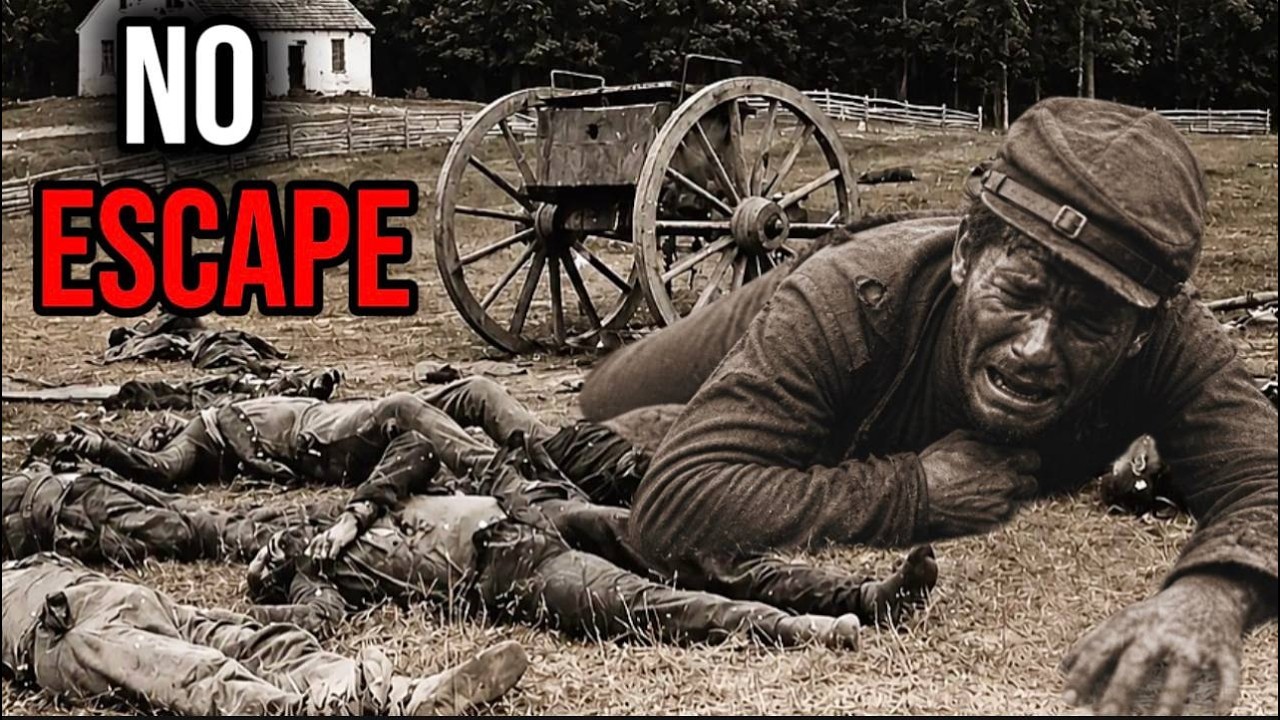
Some Confederate soldiers attempted to withdraw. Others tried to surrender. Some stayed in place, whether from orders, confusion, or the simple impossibility of moving through the bodies and men around them. Inside that narrow stretch of road, options disappeared quickly. Those who could escape did. Those who could not remained. And the firing continued.
For the men inside the sunken road, there was no clean line between attack and defense anymore. There was only survival. By the time the position finally gave way, the road was filled with dead and wounded from both sides. Bodies lay across its length, layered where they had fallen.
In the years after, that place would be given a name: Bloody Lane. A name that acknowledges the violence but softens its edges. Because lane sounds ordinary, almost harmless. But the accounts written after the battle suggest something far less ordinary.
Two days later, a photographer arrived at the battlefield. Alexander Gardner came with equipment from Mathew Brady’s studio, prepared to document what remained. What he found had not yet been cleared. The dead still lay where they had fallen.
Gardner photographed them as they were. No staging, no rearranging, no attempt to make the scene more presentable. His images captured rows of bodies, some alone, others in clusters, spread across the ground near the sunken road and beyond. These photographs would become some of the first widely viewed images of war dead in American history.
When they were displayed in New York, they shocked the public. Viewers who had only read about battles were now confronted with their aftermath. A newspaper wrote that the images brought the reality of war directly into the homes of ordinary people.
But the photographs did not spread widely in print, not because they were officially suppressed, but because the technology of the time made reproduction difficult. Newspapers relied on engravings, interpretations of scenes, not direct photographic prints. So, while the images existed, most people still experienced the war through words and drawings. And words can soften what images cannot.
After the battle, both sides moved quickly to define what had happened. Confederate reports emphasized resistance, how long the line held, how intense the pressure had been. Union reports focused on progress, positions taken, ground gained. Neither side described the sunken road in terms that suggested loss of control.
Instead, the language remained familiar. Heavy fighting, severe losses, determined resistance. But private letters tell a different story. Some Union soldiers wrote about firing into tightly packed groups of enemy troops. Some Confederate soldiers described being unable to move, unable to retreat, unable to escape the pressure inside the road.
A few accounts used words that did not fit comfortably inside the usual language of battle. And that difference matters. Because history is not only what happened. It is how what happened is described, and what gets emphasized, repeated, or quietly left out.
Bloody Lane fits within the language of war, but it does not fully capture what the terrain, the positioning, and the conditions created that day. The Confederacy fought to preserve a system built on slavery. That truth defines the war at its highest level. But the men inside the sunken road were not shaping policy.
They were soldiers, many young, many exhausted, many with little control over where they stood when the firing began. Understanding what happened there is not about changing the cause of the war. It is about understanding the reality of how war unfolds when control breaks down, when terrain traps men, when formations collapse, and when survival replaces structure.
History often compresses events into something cleaner than they were. But the closer you look, the less clean they become.