On February 17, 1944, a Japanese cruiser and her escorts were fleeing north from the burning wreckage of Truk Lagoon. They were hoping that distance and darkness would save them from the American carrier aircraft that had just devastated Japan’s most fortified island outpost.
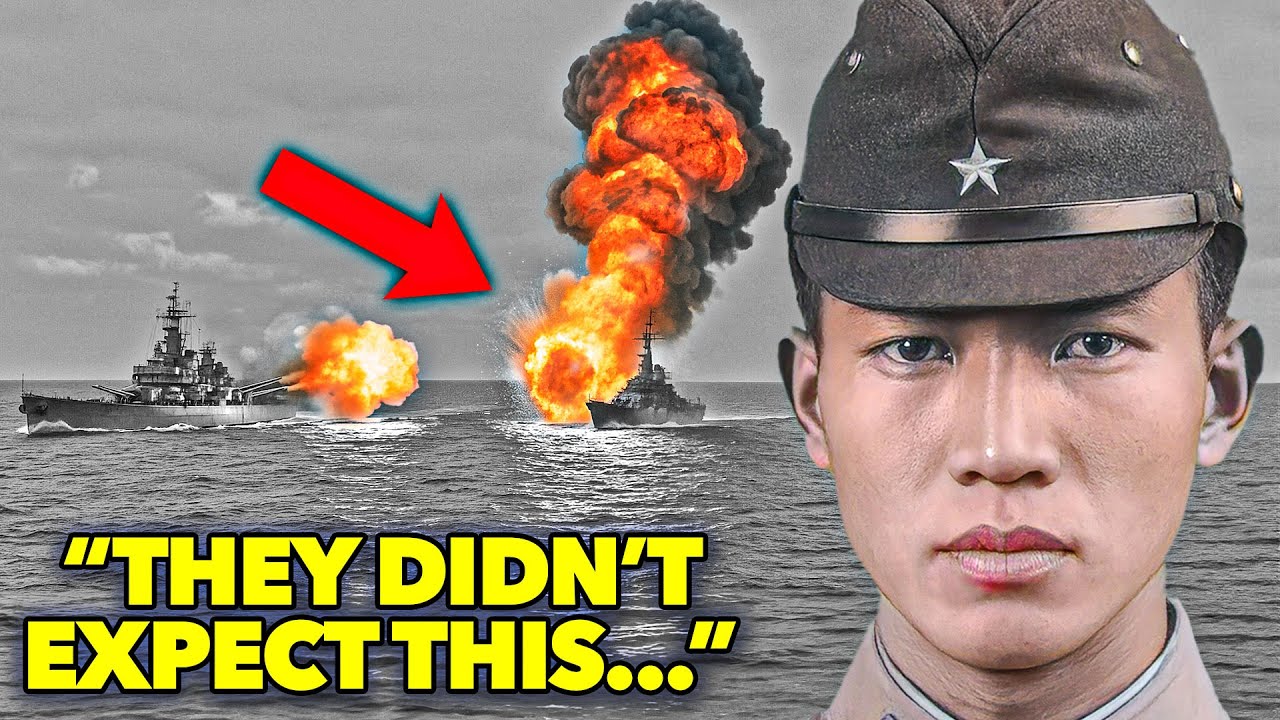
Instead, they ran into the guns of the USS Iowa and USS New Jersey. The resulting chase would become the longest-range surface gun engagement in naval history.
For most of World War II, Truk Lagoon was a dark shadow over Allied strategy. The Japanese Empire treated it like a crown jewel. Inside its reef ring, battleships, cruisers, aircraft carriers, submarines, and hundreds of support ships sheltered beneath thick natural defenses.
Strategists called it the Gibraltar of the Pacific. The lagoon was vast, calm, and deep, providing perfect protection from rough seas. Radar stations, airfields, and anti-aircraft batteries ringed the horizon. The Japanese believed assaulting it head-on would be suicidal.
American intelligence, however, was improving faster than Japan imagined. Code breakers poured over intercepted messages. Reconnaissance flights captured images of ship movements and fuel reserves. Analysts realized that if Truk remained intact, Japan could replace losses faster than American island advances could matter.
By early 1944, the Pacific balance had shifted. When commanders received intelligence that large warships inside Truk would soon reposition, the opportunity was too valuable to ignore.
To understand why this surface chase rattled Japanese admirals, you have to understand their naval doctrine. Since the early 1900s, they studied a concept called Kantai Kessen—the idea of one glorious, decisive fleet clash. They imagined battleships closing within visual distance, exchanging heavy artillery at medium range, while destroyers darted in to launch torpedoes.
For decades, Japan trained obsessively for this moment. Their victory against Russia at the Battle of Tsushima convinced generations that superior morale and nerve could determine naval combat.
The problem was that technology didn’t stand still. American engineers built tools that could see without light. Radar systems fed analog computers capable of predicting where a moving target would be by the time a massive shell returned to Earth.
Japanese planners barely invested in long-range engagement tactics. Firing beyond the horizon sounded wasteful to them. Without eyes on the impact, how could you adjust? Their doctrine quietly assumed such ranges were impossible.
That left a fatal blind spot. If the enemy struck from beyond eyesight, no amount of bravery could return fire accurately. When American radar-guided salvos began landing on fleeing warships, Japanese crews were stunned. Their rangefinders could barely see smoke on the horizon.
Doctrine met mathematics, and mathematics won.
Mounted high on the Iowa-class ships sat the Mark 8 fire control radar. Every sweep sent pulses bouncing across the ocean surface, returning precise measurements of bearing, distance, and speed. It didn’t blink, it didn’t sweat, and it didn’t need sunlight.
But radar alone wasn’t the revolution. The true marvel was the rangekeeper. This analog computer performed ballistic mathematics continuously. It considered dozens of variables at the same time—not just where an enemy ship was, but where it would be when a 5,000-pound broadside came crashing down a minute later.
Operators fed radar data into the rangekeeper, and the machine spat out firing solutions with cold precision. When the order came, the ship didn’t guess. It executed.
Meanwhile, Japanese gunnery officers still stood behind optical sights. If smoke obscured the horizon, their accuracy fell apart. If rain blurred lenses, numbers became meaningless. They were fighting physics with binoculars.
While Truk Lagoon erupted behind them, a small formation of Japanese warships slipped quietly toward the open Pacific. The light cruiser Katori, accompanied by destroyers and an auxiliary transport vessel, made a desperate run north.
On paper, this escape looked possible. The destroyers were fast, able to push into the mid-30 knot range. Katori, though damaged from earlier air strikes, still had enough life to limp north at more than 20 knots.
But American reconnaissance pilots were relentless. Patrol planes from the light carrier Cowpens spotted the fleeing column. Radio operators transmitted bearing, speed, and heading straight back to Admiral Spruance.
Spruance chose to commit surface vessels. He assembled a pursuit group built around USS Iowa and USS New Jersey, plus heavy cruisers Minneapolis and New Orleans, with destroyers ready to counter torpedo threats.
Hours later, radar operators aboard Iowa detected faint returns at the far edge of their scopes. Blips too far away for any lookout to see. The plotting team went to work, marking courses and predicted movement.
By early afternoon, the American task group had shortened the distance dramatically. The horizon shimmered with heat, but on radar screens, the enemy was crisp and unforgiving.
Aboard USS Iowa, turret crews braced behind armored bulkheads. Deep within the ship, powder bags were lifted like sacred cargo. If a single spark kissed the powder, the entire turret could vanish in an instant.
Up in the fire control director, operators watched the fleeing Katori creep across a coordinate grid. Distance: 32,000 yards. That was beyond direct human vision. To the naked eye, the enemy didn’t exist.

When the order came—commence firing—Iowa unleashed its opening salvo. The ship lurched sideways under the shockwave. A rolling column of smoke and flame curled across the deck.
For nearly a full minute, the ocean was silent. Then a geyser of seawater erupted beside Katori. A near miss.
A second salvo thundered. The shells walked closer, bracketing the cruiser with towering sprays. Japanese gunners swung their barrels desperately, but optical sights refused to lock onto anything but haze.
Then came the third salvo. One shell slammed into Katori’s midship superstructure, detonating with concussive violence. Fires immediately roared to life, fed by ruptured fuel lines.
Seeing their flagship in distress, the destroyer Maikaze closed into the line of fire like a loyal guard dog. Her captain laid thick smoke across the ocean surface, a desperate curtain meant to break the American firing solution.
American radar saw straight through the smoke. The heavy cruisers New Orleans and Minneapolis opened up. Their 8-inch shells stitched a line of fire across the destroyer’s superstructure.
Still, Maikaze refused to break off. She launched a fan of deadly Long Lance torpedoes into the Pacific swell.
Aircraft overhead circled like hawks, spotting the torpedo wakes and relaying corrections through radio. New Jersey angled slightly starboard. The weapons passed harmlessly into foam.
Then a perfectly timed broadside tore through Maikaze’s hull, punching a furnace-hot crater through decks stacked with ammunition. Her magazines ignited. The destroyer buckled, cracked, and snapped in half.
Back aboard Katori, survival evaporated. Shell hits punched open her engine spaces. Power died. Pumps stalled. The cruiser rolled, listing hard to port as compartments flooded too quickly to control.
When the order to abandon ship finally echoed through dying corridors, many Japanese sailors refused. When American destroyers approached to rescue survivors, they were met with blades and fists. The sea claimed every last man.
Only one major Japanese warship still had a chance to escape. The destroyer Nowaki was smaller, lighter, and far faster than any battleship. She poured everything into her engines, clawing past 35 knots.

But Iowa and New Jersey refused to let her go quietly. Their massive rifles elevated to their highest angles, hurling shells into the sky on trajectories that looked impossible to the human eye.
Then came the moment historians still talk about. A salvo landed so close it straddled Nowaki at more than 35,000 yards—over 20 miles away. No battleship had ever scored a straddle at such range in combat.
Then clouds and rainfall swallowed the destroyer whole. Radar returns faded into noise. Speed saved her where armor could not. She vanished into the storm, limping, battered, and terrified.
On the American decks, nobody cheered. They simply logged the range, confirmed the radar echoes, and prepared to turn south. The message was already written in smoke. Distance no longer protected the Imperial Navy.
For decades, Japanese naval strategy revolved around a single glorious vision. A decisive clash at manageable distance where skilled gunners and devastating torpedoes would shatter an enemy battle line.
But the shots fired that day proved something terrifying. Warfare had quietly evolved beyond the reach of binoculars and instinct. Radar-driven accuracy chained mathematics to gunpowder, allowing American battleships to land blows long before Japanese optics could even acquire a silhouette.
Back in Tokyo, fragmented reports drifted into headquarters. At first, disbelief colored every discussion. How could shells land so precisely from distances once considered absurd?
Japanese engineers realized they lacked both the equipment and industrial capacity to replicate such systems quickly. Fuel shortages, limited factories, and mounting convoy losses strangled every hope.
For the first time, senior planners whispered the unthinkable. Fighting spirit couldn’t close range. Courage couldn’t bend ballistic arcs. Years of training meant nothing if the enemy killed you before you ever saw him.
In just 90 minutes, American technology didn’t just sink ships. It sank a doctrine. And when doctrine dies, entire empires follow.
Ironically, this stunning display would be the last time Iowa and New Jersey ever fired at surface ships in World War II. Afterward, their role shifted to escort duty, shore bombardment, and anti-air screens.
Japan’s largest battleships, built to dominate such duels, would never trade broadsides with their American counterparts. Instead, they met their end under swarms of carrier-launched bombs and torpedoes.
Decades later, the Iowa-class ships would find brief second lives, launching missiles in distant conflicts. Today, they rest as museum giants. Silent, towering reminders of a moment when steel, steam, and analog computation ruled the seas.
For 90 minutes near Truk Lagoon, the battleship stood at the top of naval warfare’s throne one last time. The record they set that day may never be broken, because no navy will ever build weapons like these again.