Inside the Nazi concentration camp system, the men and women who ran it found ways to be entertained. The forms that entertainment took were documented in testimony, described independently by survivors, and confirmed by historians. Cruelty on this scale was not maintained purely through ideology or fear of punishment. It was maintained in part through games, rituals, and competitions that guards could watch, laugh at, and place bets on.
Turning suffering into spectacle served two purposes. It broke prisoners down faster than starvation alone could. And it let the people inflicting the suffering feel, for a few minutes at a time, like they were simply having a normal day at work.
Some of the earliest Nazi persecution had a theatrical quality. During the November 1938 pogrom known as Kristallnacht, witnesses described Jewish men being forced to crawl on the ground and bark like dogs while onlookers laughed. They were ordered to perform calisthenics regardless of age or health, and made to dance while their own synagogues burned behind them.
None of this served any military or economic purpose. Its only function was psychological, aimed in two directions at once. It broke the will of the people being humiliated, and it trained the people doing the humiliating to see cruelty as normal, even entertaining.
Franz Stangl, who later commanded the Treblinka death camp, was asked after the war why prisoners were degraded in ways that served no operational purpose. His answer was direct: to condition those who actually had to carry out the policies, to make it possible for them to do what they did.
Degradation was not a byproduct of the system. In many cases, it was a deliberate tool built to manufacture distance between the people giving orders and the human beings on the receiving end of them. Once a guard has laughed at a prisoner crawling in the dirt, shooting that same prisoner an hour later becomes a much smaller step.
Inside the camps, this logic scaled up into daily ritual. Roll calls lasted for hours in freezing weather for no reason except to watch prisoners suffer while standing at attention. Forced labor assignments were deliberately designed to be pointless, moving stones from one pile to another and back again because the pointlessness itself was the punishment.
Survivor accounts described public floggings staged in front of the entire assembled camp. Prisoners were forced to count their own lash strokes aloud and forced to sing. Entire work units made to march to their labor sites singing German songs while barely able to stand from hunger.
The common thread in every one of these rituals was an audience. Cruelty performed for no one is just cruelty. Cruelty performed for a watching, laughing crowd of colleagues becomes something closer to theater. And theater is remembered, retold, and repeated.
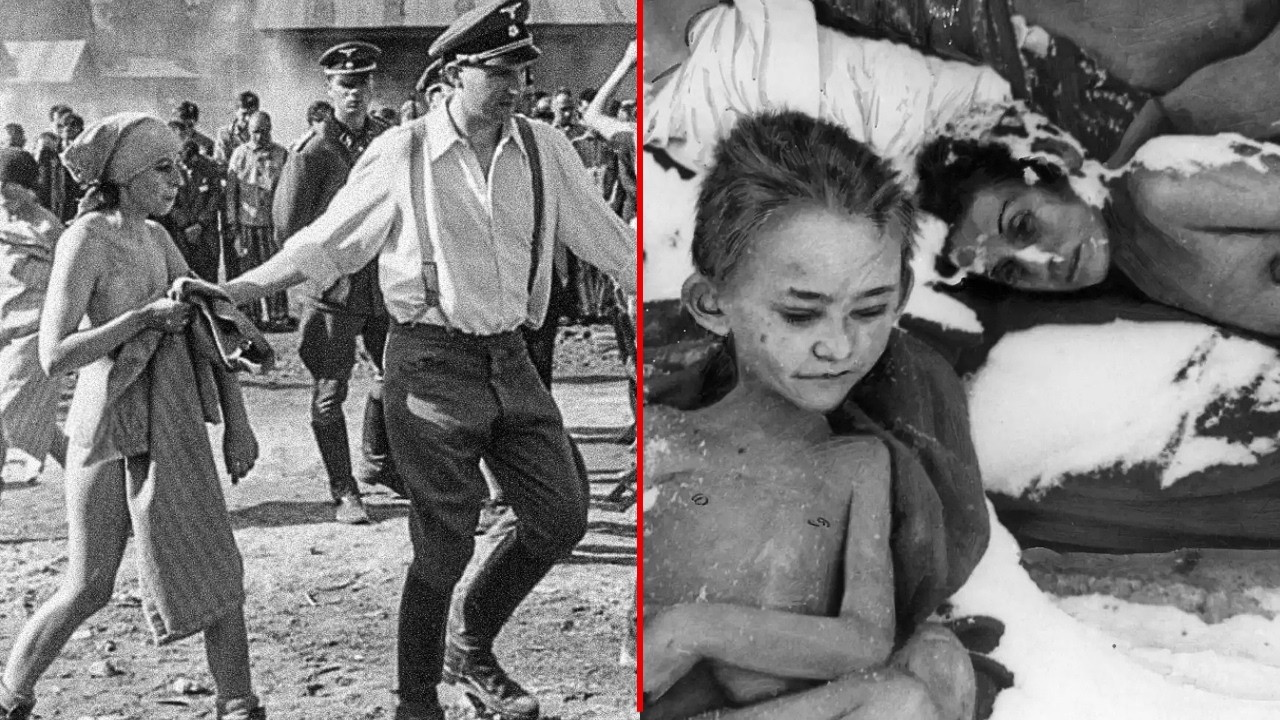
Camps built around forced labor and detention often held large numbers of children alongside their parents. Conditions there killed them by the thousands through disease, exhaustion, and neglect long before any gas chamber was involved.
One such camp, Salaspils in what is now Latvia, has become the center of a difficult historical argument. For decades, Soviet-era accounts described Salaspils as a factory of child blood, claiming that tens of thousands of children were drained for German military transfusions on an industrial scale.
Modern archival research conducted after Latvia regained independence does not support numbers anywhere near that large. What the documented record does confirm is still deeply disturbing. Children were held at Salaspils in brutal, overcrowded conditions. Roughly 2,000 deaths at the camp were documented through disease and malnutrition, rather than systematic extermination. And blood was, in fact, drawn from a smaller number of children, in the low hundreds, for medical use by the occupying military.
The exaggerated Soviet version was propaganda. The confirmed version does not need exaggeration to be horrifying.
What made the child's experience in these camps a form of theater for the adults running them was rarely a single dramatic act. It was the routine. Parents and children were frequently separated on arrival in full view of both as camp staff conducted what they clinically called selections, deciding in seconds who would be sent toward labor and who would not.
Guards performed this process the same way, shift after shift, indifferent to the fact that on the other side of their clipboards stood a parent watching their child walk away. That indifference, repeated as routine, was its own kind of performance, one designed to prove to everyone watching exactly who held power and who did not.
Survivors who had been children at the time later described something almost more disturbing than the cruelty itself. Some guards were kind to them individually on some days in ways that felt genuine in the moment, and then indifferent or violent the next. That inconsistency was another way of keeping everyone around them off balance, never certain which version of a person they were about to encounter.
Ilse Koch, the wife of the commandant at Buchenwald, became one of the most notorious figures to emerge from any war crimes trial, known in the press as the Beast of Buchenwald. At her original 1947 trial, prosecutors displayed pieces of tattooed human skin and objects allegedly made from it. The image of a concentration camp commandant's wife decorating her home with lampshades made from murdered prisoners became one of the defining atrocity stories of the entire war.
A postwar American military review, and later a separate West German trial in the early 1950s, examined the lampshade evidence specifically and could not conclusively confirm that any surviving lampshade was made from human skin. What was never in serious doubt, and what the West German court upheld with a life sentence, was something else entirely.

Prisoners with distinctive or elaborate tattoos were selected, in documented cases killed, specifically so that their skin could be removed and preserved as personal curiosities. Koch was found directly responsible for documented physical abuse of prisoners under her authority. The single most famous image people associate with her may not hold up to scrutiny. The actual proven crime underneath it is still monstrous enough on its own.
Koch died by suicide in a West German prison in 1967, having spent nearly two decades behind bars for what the courts could actually prove.
Irma Grese offers a different kind of case. Grese served first at Ravensbruck, then rose to command a section of roughly 30,000 women at Auschwitz-Birkenau, and finished the war at Bergen-Belsen. Popular accounts describe her setting trained dogs on prisoners. That specific claim does not appear in the trial record itself.
What the trial record from her 1945 prosecution at Luneburg does establish, in graphic survivor testimony, is arguably just as disturbing. Grese personally beat and kicked prisoners attempting to flee selections, carried a whip and a pistol as daily accessories, sent both the sick and the healthy to the gas chambers on her own authority, and ordered exhausted, starving prisoners into what she and other guards literally called sport, punishing calisthenics performed for no purpose except to be watched.
She was 22 years old when she was hanged in December 1945, making her the youngest woman executed under British law in the 20th century. Survivor Gisella Perl, a physician imprisoned at Auschwitz who testified against Grese after the war, described watching her observe medical procedures performed on prisoners without authorization or anesthetic, seemingly for her own curiosity rather than any operational reason.
Maria Mandel represents perhaps the strangest and most disturbing form entertainment took inside any camp because in her case the entertainment was music. As the senior woman in charge of the women's camp at Auschwitz-Birkenau, Mandel personally ordered the creation of a women's orchestra and later brought in the celebrated violinist Alma Rosé, niece of composer Gustav Mahler, to lead and discipline it.
The orchestra rehearsed for hours daily and performed at the camp gate every morning and evening, playing marches as exhausted labor units marched out to work and back in again. They also gave what amounted to private concerts for SS officers on their days off.
For the musicians themselves, membership in the orchestra could mean the difference between survival and death, better food, warmer barracks, protection from the next selection. For everyone else marching past them under armed guard, the music turned the walk to forced labor, and for some, the walk toward the gas chambers, into something staged, almost ceremonial.
Alma Rosé herself did not survive to see liberation. She died at Auschwitz in the spring of 1944 under circumstances that remained debated before the camp was evacuated.

Then there was the closest thing the system produced to something resembling a contest with actual stakes: organized boxing. In several camps, most famously at the Auschwitz-Monowitz labor complex, guards organized boxing matches between prisoners, staged for their own amusement and sometimes for wagers.
Salamo Arouch, a young boxer from Thessaloniki, was forced into dozens of these fights, told afterward by fellow prisoners that losing badly enough could mean being sent to the gas chamber. He survived the war.
Victor Perez, the former flyweight world champion from Tunisia known as Young Perez, was similarly forced to fight for the entertainment of his captors at the same camp complex. He did not survive. Reports from fellow prisoners describe him being killed during the chaos of a forced evacuation march in early 1945, shortly before liberation would have reached him.
For guards, these matches were spectacle. For the men forced into the ring, winning meant an extra ration and a strange, uncomfortable legacy of having been forced to become both victim and unwilling performer at once.
The final story belongs not to a single guard or a single camp, but to an entire region. In February of 1945, close to the war's end, roughly 500 Soviet officers held in a special punishment block at the Mauthausen camp in Austria staged the largest mass escape in the history of the Nazi camp system.
What followed became known in the bitter language locals themselves later used as the Mühlviertel hair hunt. For roughly three weeks, SS units, local police, Hitler Youth, Home Guard militia, and ordinary civilian volunteers combed the surrounding countryside hunting down the escaped men, treating the manhunt explicitly as recreation.
One participant later described the piles of recovered bodies using a phrase that still stops people cold: stacked just like the bag at an autumn hunt. Of the several hundred who made it out of the camp, only 11 survived to see liberation.
What makes it especially chilling historically is how ordinary the participants were. Not fanatical ideologues, but neighbors, shopkeepers, and teenagers picking up whatever weapon was closest because a manhunt had been announced.
Taken together, these stories point towards something more unsettling than any single atrocity on its own. The word entertainment implies choice, leisure, a break from something else. Inside these camps, it was neither. It was a mechanism that let ordinary people participate in mass murder without having to feel hour by hour like murderers.
When a system needs its own perpetrators to be constantly distracted, amused, or numbed in order to keep functioning day after day, it raises a difficult question. How fragile is the line really between an ordinary person and someone capable of this?