Ethel Skakel Kennedy died in Boston on October 10, 2024, at the age of 96. She outlived her husband Robert F. Kennedy by more than 56 years and buried four of her children before her own death. Her passing, along with the eventual publication of her son’s private journals, reopened questions the family spent seven decades trying to suppress.
The marriage at the center of those questions lasted 18 years. It produced 11 children, survived two assassinations, and ended in a Los Angeles hotel kitchen where a restaurant worker cradled Robert Kennedy’s head and placed a rosary in his hand.
Ethel Skakel was born on April 11, 1928, in Chicago, the sixth of seven children. Her father, George Skakel, started as a railroad employee earning $8 a week. He and his partners noticed price fluctuations in industrial coke and built a company to buy and resell it at margins the market had not yet corrected. That company became the Great Lakes Carbon Corporation, one of the largest private firms in the United States by mid-century.
The family moved from the Midwest to a 16-acre estate in the wealthy Belle Haven section of Greenwich, Connecticut. Locals remembered the Skakel household as loud, athletic, and undisciplined. Children were known for reckless stunts, speeding cars, and a general disregard for convention. That pattern would repeat tragically two generations later.
On October 3, 1955, months after the birth of Ethel’s fourth child, her parents died together when their private plane crashed near Union City, Oklahoma. Eleven years later, in September 1966, her brother George Skakel Jr., who had taken over the family company, died in a separate single-engine plane crash in Idaho. Two Skakel family heads, two plane crashes, eleven years apart.
Ethel entered the Kennedy orbit through friendship, not romance. She became close with Jean Kennedy, Robert’s younger sister, at Manhattanville College. She met Robert Kennedy in December 1945 on a ski trip to Mont Tremblant in Quebec. At the time, Robert was dating Ethel’s older sister, Patricia. He only began seeing Ethel after that relationship ended.
They married on June 17, 1950, in a Catholic ceremony at St. Mary’s Church in Greenwich. The Boston Globe noted the union brought together two great fortunes: the political and industrial wealth of the Kennedys and the carbon-based fortune of the Skakels. The reception was held at Rumbleside, the Skakel family mansion.
In 1956, Robert and Ethel bought Hickory Hill, a six-acre, 13-bedroom estate in McLean, Virginia, from Robert’s brother John and his wife Jacqueline. Over the next decade, the home became the operational and social nerve center of the New Frontier generation. It hosted parties with guest lists of 300 names, including cabinet members, Supreme Court justices, foreign ambassadors, and journalists.
The property also hosted the Hickory Hill seminars, informal gatherings that brought together administration insiders and leading intellectuals between November 1962 and February 1964. A 1969 Time magazine profile noted Ethel was remembered by New Frontier veterans as a champion of asking embarrassing questions at those seminars.
Ethel and Robert had 11 children in 18 years. The children arrived in near-annual succession: Kathleen in 1951, Joseph in 1952, Robert Jr. in 1954, David in 1955, Mary Courtney in 1956, Michael in 1958, Mary Kerry in 1959, Christopher in 1963, Max in 1965, Douglas, and Rory, born six months after her father’s assassination in December 1968. Rory was the only one of the 11 who never met her father.
The household operated on an institutional scale. It maintained round-the-clock domestic staff, tutors, and a rotating group of nannies. Neither parent, by any reliable account, spent the kind of sustained one-on-one time with each child that an average family might have provided. The math makes the claim easy to verify: eleven children in eighteen years, with a father who was running a Senate committee, managing a presidential campaign, or serving as attorney general for most of that time.
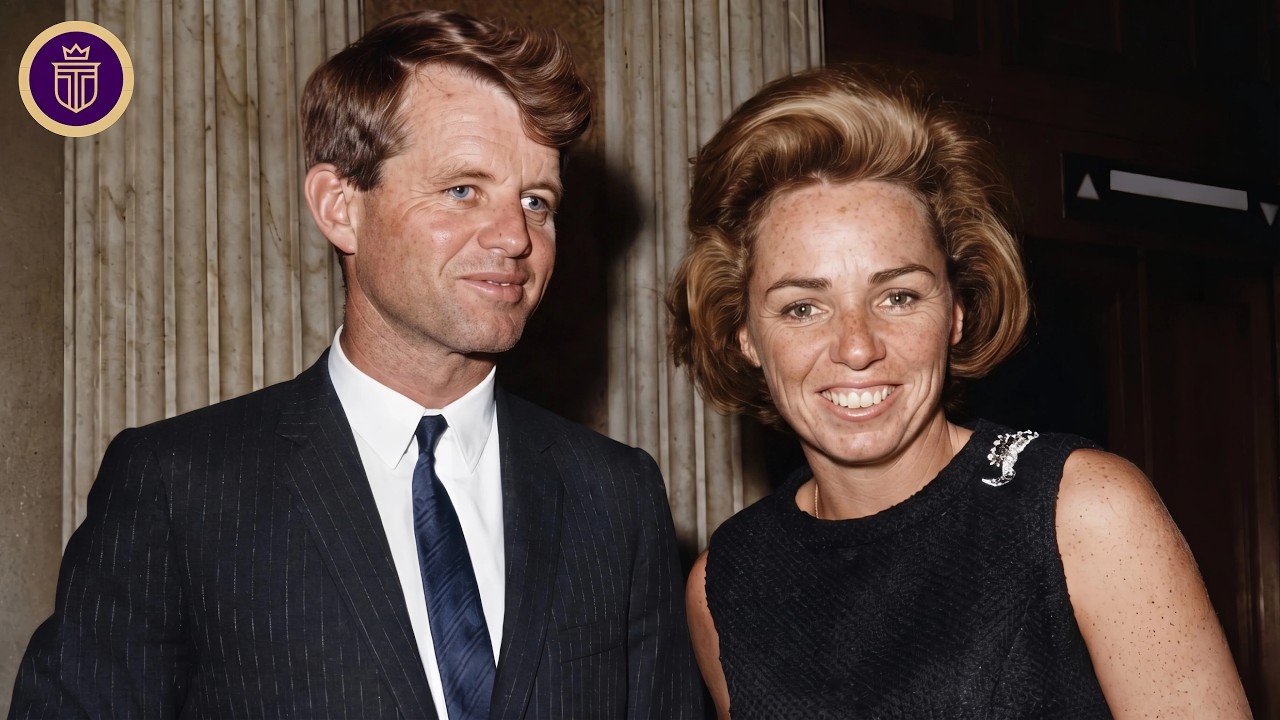
Robert Kennedy’s early career was defined by confrontation. In December 1952, he joined the Senate Permanent Subcommittee on Investigations under Senator Joseph McCarthy. He became disillusioned with McCarthy’s tactics and resigned in July 1953. He returned in 1954 as chief counsel to the Democratic minority and clashed with McCarthy’s counsel Roy Cohn during the Annie Lee Moss case.
From 1957 to 1959, he served as chief counsel to the Senate Rackets Committee, where his aggressive pursuit of Teamsters leaders Dave Beck and Jimmy Hoffa made him a national figure. He left the committee in September 1959 to manage his brother’s presidential campaign.
As attorney general from 1961 to 1964, Kennedy expanded the civil rights division by 60 percent, played an executive role in the Freedom Rides and the integration of the University of Mississippi in 1962, and authorized the FBI to wiretap Martin Luther King Jr. under a written directive in October 1963. He also played a documented high-stakes role in the back-channel of the Cuban Missile Crisis with Soviet ambassador Anatoly Dobrynin in October 1962.
The schedule required relentless hours. Robert traveled constantly, testified, or sank into Justice Department crises that could last weeks at a time. Ethel managed a growing household of young children almost entirely alone, with a large staff but without the kind of daily co-parenting presence that even less ambitious political families could provide.
The most famous rumor about Robert Kennedy’s personal life, an affair with Marilyn Monroe, is the least supported. Biographer Donald Spoto documented alibis that disproved four alleged secret meetings. He traced the rumor’s origin to Norman Mailer’s 1973 book, in which Mailer speculated without evidence that intelligence agents might have killed Monroe to implicate Kennedy. Mailer later admitted on 60 Minutes that he never believed his own theories and wrote them because he desperately needed money.
The broader reputation for infidelity rests on firmer ground. Multiple reliable biographers, including Evan Thomas in his book Robert Kennedy: His Life, describe a general pattern of extramarital behavior without naming verifiable partners. After John Kennedy’s assassination, Robert became extremely close to his brother’s widow, Jacqueline, serving as her primary emotional support and protector. Several authors speculated about a romantic dimension to that closeness, though no documented contemporary testimony or confirmed document proves a physical affair.
Ethel never publicly described what she knew or believed about her marriage. She gave almost no candid recorded interviews about her private married life. The 2012 HBO documentary directed by her daughter Rory was a loving, authorized family portrait rather than an investigative inquiry. One anecdote from the promotional period captured Ethel’s personality. She reportedly found a suggestion box on set and placed a note in it that read: “Hire a new director.”
Robert Kennedy announced his presidential candidacy on March 16, 1968. Ethel was in her eighth month of pregnancy with their 11th child for much of the campaign and traveled with him frequently. She was present for primary victories and defeats, at speeches before enthusiastic crowds, and in motorcades where her husband stood on the back seat of open cars in a country that had already assassinated one Kennedy brother less than five years earlier.
Robert Kennedy was shot shortly after midnight on June 5, 1968, in the kitchen pantry of the Ambassador Hotel in Los Angeles by Sirhan Sirhan, moments after declaring victory in the California primary. Restaurant worker Juan Romero cradled Kennedy’s head and placed a rosary in his hand. Kennedy died at 1:44 a.m. on June 6, about 26 hours after the shooting. He was 42 years old with 11 children. The oldest was 17 and the youngest was not yet born.
Ethel was present at the Ambassador Hotel that night, three months pregnant with Rory. Robert’s body lay in state at St. Patrick’s Cathedral in Manhattan before a funeral train carried him to Washington. The trip normally took four hours but lasted more than eight due to crowds along the 225-mile route. Two onlookers died when a passing train struck the crowd in Elizabeth, New Jersey.
He was buried in Arlington National Cemetery near his brother John in what cemetery officials described as the only nighttime burial ever conducted there. Ethel was 39 years old, a widow with 10 children and an 11th on the way. She stated publicly that she would never remarry. She kept that promise for 56 years.

Ethel founded the Robert F. Kennedy Center for Justice and Human Rights in 1968. She led the organization for decades. For a time after the funeral, she was accompanied at social events by family friend and singer Andy Williams, who sang the Battle Hymn of the Republic at the funeral mass. But she never remarried and never publicly expressed any desire to do so.
She raised 11 children, the youngest of whom was not yet born when her father died, as a largely single mother for the rest of her life. Supporters and critics agree that the single-parent years shaped the family’s later decades, though they draw different conclusions about whether she succeeded.
David Anthony Kennedy, the fourth son, was 12 years old on the night his father was shot. Biographers consistently identify the trauma of that night as the starting point of his later addiction. He reportedly learned of his father’s death by watching television alone. He also broke a vertebra in a Jeep accident in Nantucket in August 1973 that paralyzed his brother’s friend Pam Kelley.
David died on April 25, 1984, in a Palm Beach hotel room at age 28. The official autopsy concluded his death was accidental, caused by cocaine toxicity combined with two prescription drugs. The medical examiner noted needle marks on his body. Reports at the time described him as crying and depressed during a family Easter gathering shortly before his death.
Michael LeMoyne Kennedy, the sixth son, became a lawyer, businessman, and director of the family’s Citizens Energy nonprofit before his life unraveled publicly. In April 1997, he was accused of having an affair with the family babysitter, Marisa Verrochi, that began when she was between 14 and 16 years old and lasted about five years. Prosecutors investigated potential statutory rape charges, though no criminal charges were ultimately filed.
On December 31, 1997, eight months after the babysitter scandal broke, Michael Kennedy died in a skiing accident on Aspen Mountain in Colorado. He hit a tree while playing a family recreational game called “ski football,” a practice ski officials had explicitly warned the family was too dangerous for the terrain. The autopsy revealed his injuries would have left him paralyzed from the shoulders down even if he had survived. He was 39 years old, the same age his mother was when she became a widow.
On August 13, 1973, Joseph P. Kennedy II, the oldest son of Ethel and Robert, was driving a Jeep recklessly in Nantucket when it rolled over. The accident broke a vertebra in his brother David’s back and left his passenger, Pam Kelley, permanently paralyzed from the chest down. Kelley’s sister said doctors told the family Pam would never have children and would likely not live past 40.
Joseph was cited for reckless driving and later convicted of driving to endanger. The fine was $100. The judge urged him to use his famous name for better purposes. Pam Kelley did not sue the Kennedy family directly. She accepted an insurance settlement of approximately $1 million and a later separate settlement of approximately $668,000. She spent the rest of her life in a wheelchair.
By 2005, more than three decades after the accident, Kelley stated formally to a news agency that Joseph Kennedy had simply stopped paying her ongoing medical bills. It was a documented claim from a named source, the affected party herself. Kelley died on November 20, 2020, at age 65, having lived 25 years longer than doctors predicted. She spent 47 years of that life in the wheelchair where a Kennedy put her.
On October 30, 1975, 15-year-old Martha Moxley was murdered in the Belle Haven section of Greenwich. She was beaten and stabbed with a golf club later traced to the Skakel family home. The suspect was a Skakel, not a Kennedy: Michael Christopher Skakel, Ethel Kennedy’s nephew. He was 15 years old on the night of the crime.
Thomas, Michael’s older brother, was the last person seen with Moxley and became the initial primary suspect. But Rushton Skakel prevented investigators from accessing his sons’ school and health records, and the case remained unsolved for more than two decades. Michael Skakel’s early biography was marked by trauma. His mother died of brain cancer in 1973, after which he began drinking in his early teens. He was reportedly expelled from about a dozen schools and suffered for years from undiagnosed dyslexia.

The case was reopened in the early 1990s after unfounded rumors during the 1991 William Kennedy Smith rape trial suggested a Kennedy connection to the Moxley case. A private investigation firm hired by Rushton Skakel found that both Thomas and Michael had changed their accounts of the night of the crime over time. A rare one-person grand jury was formed in June 1998, and after an 18-month investigation found sufficient evidence to indict Michael Skakel.
He surrendered on January 9, 2000, and was tried as an adult beginning May 7, 2002. He was convicted on June 7, 2002, and sentenced to 20 years to life. Key evidence included a recording of an unpublished book proposal in which Skakel described his movements near the Moxley property on the night of the murder, and testimony from two former classmates who claimed Skakel confessed to the killing while at a rehabilitation facility as a teenager. One witness testified Skakel boasted he would get away with the murder because he was a “Kennedy,” though he did not actually bear the Kennedy surname.
In January 2003, Robert F. Kennedy Jr. published a lengthy article in The Atlantic Monthly arguing his cousin was wrongly convicted, pointing to the family’s former live-in tutor, Kenneth Littleton, as a more logical suspect. The conviction was upheld on appeal, and the Supreme Court declined to hear the case. A long habeas corpus battle followed. In 2013, a judge granted Skakel a new trial based on ineffective defense counsel and released him on bail. The Connecticut Supreme Court reinstated the conviction in 2016, then reversed itself in 2018 and vacated the conviction again.
On October 30, 2020, exactly 45 years after the crime, prosecutors announced Skakel would not be retried, concluding the state could no longer prove the case beyond a reasonable doubt. No one has been convicted in a verdict that survived final appeal in the Martha Moxley murder case.
The most revealing primary source to emerge from the Kennedy and Skakel world in decades came not from a hostile biographer or tabloid journalist, but from a family member. Robert F. Kennedy Jr. kept detailed diaries between 1999 and 2001 during his marriage to his second wife, Mary Richardson Kennedy. In April 2026, journalist Isabelle Vincent published a full biography based on more than 1,200 pages of those diaries, obtained through a source about a year after Mary Richardson Kennedy’s death in May 2012.
The diaries revealed Kennedy tracking his infidelities on a numerical scale of 1 to 10, with 10 meaning sex. He referred to his temptations as “demons of lust” and wrote the note about his late father that opened this story: “I knew my father was watching me and that he loved me, but I also felt I was letting him down when I lied, or had sexual thoughts, or got bad grades.” His father died in 1968. The entry was not just a memory but a confession, from a grown man in his late 40s still comparing himself to his father’s ghost.
Mary Richardson Kennedy married RFK Jr. on April 15, 1994, after becoming pregnant while he was still separated from his first wife. The marriage deteriorated over nearly two decades. On Mother’s Day 2010, Kennedy told Mary he intended to file for divorce. Police were called to the home the next day for a domestic incident involving intoxication. He filed for divorce on May 12, 2010, and Mary was arrested for driving under the influence three days later. The divorce proceedings were never completed.
On May 16, 2012, Mary Richardson Kennedy was found dead, hanging in a barn on the family property in Bedford, New York. She was 52. The medical examiner’s report noted her fingers were caught between her neck and the ligature, consistent with a struggle in the final moments. She left no known suicide note. In the immediate aftermath, reports said Mary’s sister told the Kennedy family they had killed her sister. Mary’s family held a private, separate memorial service.
The diaries are a first-person primary source with exceptional credibility as evidence of RFK Jr.’s psychology and behavior. But they say very little directly about the marriage of Robert and Ethel themselves. What they reveal instead is something potentially more significant: the psychological legacy the marriage left in their children, a legacy of internal surveillance, Catholic guilt, and emotional compartmentalization that the father seemed to embody and the son clearly mastered.
The Camelot myth was not built by accident. The Kennedy-era “Camelot” branding was a deliberate narrative construction by insiders, most famously exemplified by the 1963 Life magazine interview with newly widowed Jacqueline Kennedy, who invoked the Camelot musical as a frame for describing her husband’s presidency. Historian Arthur Schlesinger Jr., who chronicled the administration in books still widely cited, was a participant in the government he was writing about, with direct personal loyalty to the family whose story he was shaping.
The Robert and Ethel Kennedy archive, the Hickory Hill seminar records, and the personal correspondence and papers reside primarily within the JFK Presidential Library, an institution legally and administratively connected to the family’s own foundation. That means the family had, and to a large extent still has, significant influence over which documentary materials become available, when, and in what curated form.
At least 15 Kennedy family members appeared with President Biden in April 2024 to explicitly undermine Robert Kennedy Jr.’s candidacy, including his sister Kerry. When he suspended his campaign and endorsed Donald Trump in August 2024, five of his siblings issued a joint statement calling it a sad ending to a sad story and a betrayal. His sister Kerry wrote an op-ed invoking the presumed political values of the recently deceased Ethel directly against her son. It was the first time in the family’s modern history that the public relations discipline of the united front visibly collapsed among Robert and Ethel’s own children.
The documented record supports a marriage marked by genuine intensity, shared political purpose, Catholic devotion, and enormous private pressures stemming from scale, trauma, and a culture of privilege that normalized risk in ways that cost several of their children their lives, health, or marriages. The more sensational claims, most notably the Marilyn Monroe affair, do not survive scrutiny of the documentary record and must be excluded from any serious account. The most credible material to emerge recently, the diaries themselves, speaks more to the psychological legacy the marriage left in its children than to the marriage’s internal nature itself.
What remains after stripping away tabloid sensationalism and letting the documented record speak for itself is no less disturbing than what the myth suggested. It is disturbing in a different way. A story about scale, grief, and the corrosive effects of a family narrative maintained for 70 years by the very people who had the strongest incentive to control what the public was allowed to know.