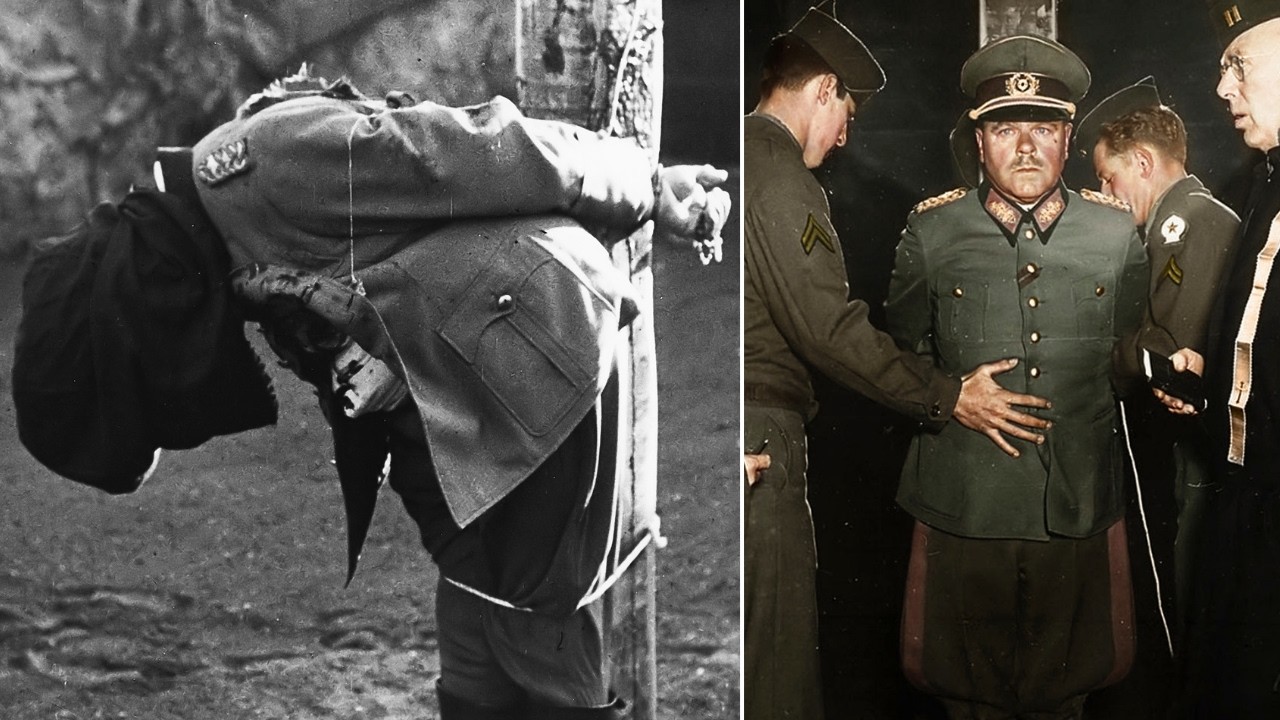
On December 1, 1945, at 8:00 in the morning, Anton Dostler was bound to a wooden post in a stockade outside the Italian town of Aversa. Twelve riflemen stood 50 feet away. A medical officer placed a black hood over his head and pinned a small white target over his heart.
Dostler was 54 years old. He had fought in two world wars and wore the Iron Cross, first and second class. In less than a minute, he was dead.
He was the first man the Allies ever put on trial for a war crime. The crime itself was simple: he ordered the execution of 15 American prisoners of war. What made his case unusual was his defense. He did not deny what he did. He argued that he should not be blamed for it.
To understand how Dostler ended up facing a firing squad, you have to go back to the summer of 1934. That year, the German military quietly rewrote the terms of its own loyalty. Soldiers no longer swore an oath to the German Constitution or even to the country itself. They swore unconditional obedience to one man: Adolf Hitler.
It was a small change in wording with enormous consequences. The German officer corps traded its independence for a seat at the table. Not every general believed in Hitler’s ideology. Many found him crude and embarrassing. But Hitler offered something they wanted more: a military rebuilt from the humiliation of Versailles and a war they were promised they would win.
For the men at the very top, there was something even more personal. Bribes, extra pay, land grants, and entire estates were handed out to generals who kept quiet and did their jobs. It was less an ideological alliance than a business arrangement.
The bill came due almost immediately after the invasion of the Soviet Union in June 1941. Behind the advancing German front lines, mobile killing units called the Einsatzgruppen began the systematic murder of Jewish men, women, and children across Eastern Europe. Between one and a half and two million people were executed in forests, ravines, and open fields.
The German army was not a bystander. It supplied trucks, fuel, intelligence, and sometimes manpower. Liaison officers filed reports. Nobody up the chain claimed not to know. When officers objected, it was rarely about the killing itself. It was usually about logistics.
This was the machine Anton Dostler belonged to. Not the SS, but the regular army, the Wehrmacht. For decades after the war, the Wehrmacht insisted it had simply fought a conventional war and left atrocities to somebody else. Dostler’s career is one of the clearest proofs that story was a lie.
Anton Dostler was born on May 10, 1891, in Munich. He joined the Bavarian Army’s 6th Infantry Regiment as a 19-year-old cadet in 1910. He was disciplined, ambitious, and unremarkable in exactly the way that lets a soldier rise quietly through the ranks.
When the First World War broke out, Dostler went with it. He was promoted to lieutenant, then to first lieutenant in 1916, and by October 1918, weeks before the war’s end, he had made captain. Along the way, he earned the Iron Cross, both classes, and the Bavarian Military Merit Order.
After the war, the newly formed Weimar Republic gave Dostler a different kind of career. Versailles had gutted the German military down to 100,000 men. Dostler adapted. In 1924, he moved into military intelligence at the Reichswehr Ministry in Berlin. By 1932, he had made major.
That changed in January 1933 when Hitler took power. Two years later, Nazi racial law reached into the military itself. Jewish soldiers were expelled. By 1938, Hitler had made himself supreme commander of the entire armed forces. A new generation of soldiers was arriving straight out of the Hitler Youth, indoctrinated before they ever put on a uniform.
Officers who might have privately winced at what Germany was becoming had already watched Hitler annex Austria and dismember Czechoslovakia without firing a shot. Then, in the spring of 1940, Germany crushed France in six weeks. Whatever doubts existed were buried under the sheer intoxicating success of it all.
Dostler was not some fanatic who joined the Nazi cause out of ideological hunger. He was a career officer who built his entire adult life inside an institution, watched that institution get slowly hollowed out and refilled with something monstrous, and made the choice over and over at every promotion to stay.
Anton Dostler took command of the 57th Infantry Division on September 26, 1941, three months into Operation Barbarossa. The division was part of Army Group South, the force that had spent the preceding weeks fighting its way toward Kiev. By the time Dostler took command, the city had already fallen.
On September 29 and 30, 1941, SS and police units operating with the knowledge of the German military command in the region marched Kiev’s Jewish population to a ravine on the outskirts of the city called Babi Yar. In two days, they murdered nearly 34,000 people. It remains one of the largest mass shootings at a single site in the history of the war.
Dostler had taken command of the division stationed in that exact theater only three days earlier. There is no surviving order that puts a gun in his own hand at Babi Yar. But there is no distance between him and it either.
From the middle of 1942, Dostler’s career took him to the northern edge of the Eastern Front. He was given command of the 163rd Infantry Division, fighting alongside Finnish forces. He stayed there until German troops withdrew from Finland into Norway in the autumn of 1944.
On January 1, 1943, he was promoted to major general, a rank that put him firmly among the senior leadership of the German army. While the war around him was collapsing into some of its darkest chapters, Dostler’s career simply kept climbing.
By January 1944, the climb had brought him to Italy in command of the newly formed 75th Army Corps. Italy was in chaos. It had surrendered to the Allies the previous September, and Germany had responded by occupying the north of the country outright. Dostler’s corps was handed responsibility for defending the Ligurian coastline.
In March 1944, 15 young Americans were about to land on that coastline, and Anton Dostler was about to make the decision that defined the rest of his story.
On the night of March 22, 1944, 15 soldiers of the United States Army came ashore on the Italian coast, about 15 kilometers north of the port city of La Spezia, roughly 250 miles behind the established front line. This was Operation Ginny II, a sabotage mission with a single specific target: a railway tunnel at Frara, part of the vital line connecting La Spezia to Genoa.
Every one of those 15 men was wearing a proper United States Army field uniform. Not disguises, not civilian clothes. Under the laws of war at the time, that single fact should have settled everything about how they were to be treated if captured.
They never reached the tunnel. Two days after landing, the group was caught by a combined force of Italian fascist troops and German soldiers and marched to La Spezia. They were held near the headquarters of the 135th Fortress Brigade under the command of a German colonel named Kurt Almers. Almers answered directly to the commander of the 75th Army Corps, Anton Dostler.
Wehrmacht intelligence officers interrogated the captured Americans and learned exactly what their mission had been. A commando raid, not an act of espionage. That information went straight to Dostler at his corps headquarters.

Dostler passed the information up the chain to his superior, Field Marshal Albert Kesselring, commander of all German forces in Italy, and asked what should be done with the prisoners. According to Dostler’s own adjutant, Kesselring’s answer came back quickly: execute them.
That order rested on something called the Commando Order, issued personally by Hitler in 1942. It was a standing directive that any Allied commando captured in Europe, in uniform or not, surrendering or not, was to be shot immediately without trial. By any legal standard that existed at the time, it was an illegal order.
Dostler relayed it. He sent a telegram to Colonel Almers instructing him to carry out the execution. Almers hesitated. He understood that shooting uniformed prisoners of war violated the Geneva Convention of 1929, a treaty Germany had signed. He went back to Dostler and asked whether the order could be delayed or reconsidered.
Dostler’s response was to send a second telegram repeating the instruction. Almers tried again by telephone, this time a direct personal appeal to stop what was about to happen. It didn’t work.
On the morning of March 26, 1944, the 15 Americans were led out to a stretch of coastline called Punta Bianca, south of La Spezia. All 15 men were shot. Their bodies were buried afterward in a mass grave, deliberately camouflaged to hide what had happened.
One officer in Dostler’s own staff, a man who apparently hadn’t been told about the Commando Order at all, refused outright to sign off on the killings. He was dismissed from the Wehrmacht for insubordination. That was the only immediate consequence anyone faced.
Anton Dostler went back to his command as though the previous week hadn’t happened. There was no inquiry, no reprimand. In November 1944, he was simply reassigned to another corps and continued serving until the war’s end.
When the war ended in May 1945, American forces began piecing together what had happened to the Operation Ginny II team. It didn’t take long for the trail to lead to Dostler. He was captured and held as a prisoner of war.
On October 8, 1945, a military tribunal convened at the Royal Palace in Caserta, Italy. It was the first Allied war crimes trial of the Second World War, weeks before the far more famous proceedings would open at Nuremberg.
Dostler sat in the dock facing a single specific charge: ordering the illegal execution of 15 American prisoners of war. His defense was simple. He argued that he hadn’t personally decided to kill anyone. He’d simply passed along an order from Field Marshal Kesselring, a superior officer giving a lawful command in wartime.
The tribunal didn’t buy it. Judges found that in issuing and enforcing that execution order, Dostler had acted on his own initiative in ways that went beyond what even Hitler’s own directive required. No rank, no chain of command, and no claim of just following orders could excuse what had happened.
The killing of the 15 Americans was a direct violation of Article 2 of the 1929 Geneva Convention, which explicitly prohibited reprisals against prisoners of war. It also violated the 1907 Hague Convention, which drew a hard legal line between saboteurs disguised as civilians and soldiers captured in their own uniform who were entitled to be treated as prisoners of war.
The 15 men at Punta Bianca had never been in disguise. They had been exactly who their uniform said they were. And Dostler had known it.

The tribunal’s ruling put it in words that are worth hearing almost exactly as they were written: that no soldier, and least of all a commanding general, could claim that summarily shooting prisoners of war was legitimate, even as an act of reprisal.
In rejecting Dostler’s defense, this tribunal set a precedent that would matter far beyond one Italian courtroom. A few weeks later at Nuremberg, dozens of far more powerful men would try exactly the same argument. They would say they were only following orders. Thanks in part to what happened at Caserta, that defense would never again be enough on its own to walk a man free.
On October 12, 1945, the tribunal delivered its verdict: guilty on all counts. The sentence was death, to be carried out by firing squad.
On the morning of December 1, 1945, Dostler was brought from his cell to a prisoner stockade in the Italian town of Aversa. The proceedings were read aloud to him one final time. He was given a brief moment with a Roman Catholic chaplain before it began.
Three soldiers bound him to a wooden post, his hands tied behind his back. A medical officer placed a black hood over his head and pinned a small white target, four inches across, directly over his heart. Twelve riflemen took their positions 50 feet away.
At 8:00 in the morning, on the order of the officer in charge, they fired in unison. Dostler’s body slumped forward against the ropes.
Army photographers and a film crew recorded all of it on both still cameras and motion picture film. It remains one of the only executions of a German general captured on camera in this much detail.
Afterward, his body was placed on a stretcher, wrapped in a plain white cotton shroud, and driven away by truck. He was buried in the German war cemetery at Pomezia outside Rome.
Field Marshal Kesselring, the man who gave the original order, was tried separately. He was sentenced to death himself, but that sentence was commuted, and he was released from prison within a decade.
There was no dramatic confession at Dostler’s execution. No last statement of remorse recorded for history. By every account that survives, he went to his death still believing on some level that he’d been the wrong man to pay for someone else’s order.
For decades after the war, a comforting myth took hold in Germany and beyond: that the regular army, the Wehrmacht, had simply fought a conventional war following honorable rules of engagement, while the real atrocities belonged entirely to the SS. That myth started almost immediately at Nuremberg itself, where the SS was formally declared a criminal organization and the broader German military was not.
Decades of research since have picked that myth apart. The evidence is overwhelming. The German military didn’t stand apart from the machinery of Nazi atrocity. It was part of it. From the logistics behind the Einsatzgruppen’s massacres to the forced labor camps to men exactly like Anton Dostler, willing to relay an illegal execution order twice over rather than risk his own career by questioning it.
Dostler was one of the very few senior German officers who paid for that willingness with his own life. He paid early, months before Nuremberg had even opened its doors, in a trial most people have never heard of, over a crime involving 15 men whose names rarely make it into the history books. Fifteen young Americans who did their job, wore their uniforms honestly, and were murdered for it anyway.