An estimated 300 million people watched her wave from the steps of Westminster Abbey. May 6th, 1960, was the first royal wedding ever televised, and Britain decided it was proof that love had finally won.
The best man wasn't there. Jeremy Fry had withdrawn days earlier, officially with jaundice. Three weeks after the ceremony, Fry's wife gave birth to a daughter. A DNA test in 2004 established the father was the groom.
The government file proving Margaret was never forced to give up Peter Townsend stayed sealed until two years after she died. She had burned the rest herself.
Start with that file, because everything Britain thought it knew about this woman's heart was built on not having read it.
In October 1955, Princess Margaret came down from Balmoral to London to see Peter Townsend for the first time in months. He'd flown in from Brussels, where the palace had parked him as an air attaché two years earlier.
They met at Clarence House. They spent a weekend at a cousin's house in Berkshire while reporters camped in the lanes outside and the country held its breath.
On October 31st, she released a statement saying she would not marry him. Mindful of the church's teaching that Christian marriage is indissoluble, and conscious of her duty to the Commonwealth, she had resolved to put those considerations before all others.
That sentence became the whole legend. Duty over love. The princess who did the right thing while her uncle, 15 years earlier, had done the selfish one.
Here's what the National Archives released in 2004, decades after everyone involved had stopped being able to comment on it. Anthony Eden's government had drawn up a plan.
Under it, Margaret could have married Townsend and kept her title. She would have kept her civil list allowance of £6,000 a year, with another £9,000 on marriage. She could have gone on living in Britain and continuing public duties if the public wanted her to, which the government privately believed it did.
The only thing she had to give up was her place in the line of succession, and her children's. That was it.
The Royal Marriages Act of 1772 was the obstacle. So, the government proposed to amend the act. Commonwealth Prime Ministers had already been quietly squared.
Eden's letter to them contained a line that would have detonated the entire story if anyone had read it in 1955. Her majesty would not wish to stand in the way of her sister's happiness.
The Lord Chancellor, Lord Kilmuir, went further in a scrawled note to Eden that September. He thought the 1772 act might not even legally apply to her, given how badly it was written.
His verdict on it: no pride of ancestry, badly drawn, uncertain, and embarrassing in its effect. He also estimated that at least 75% of the electorate would be in favor of the marriage being allowed somehow.
The final draft of the procedure was produced. Three days later, she announced she wasn't going to do it.
There's one clue in the files about what was actually happening inside her, and it's a letter she wrote to Eden in August of that year, before the October meeting. She said she needed to see Townsend before she could properly decide whether she could marry him or not.
That's a woman making an appointment with her own uncertainty. And it doesn't sit comfortably beside the image of a heartbroken girl being crushed by the state.
Townsend himself, in a 1978 memoir written when he was long remarried and had a book to sell, said he simply hadn't the weight to counterbalance everything she'd have lost. He also said the statement was partly his own drafting.
Take that as you like. He's an interested witness with an obvious stake in a graceful ending. What's harder to argue with is the paperwork.
The paperwork says the door was open, and she closed it.
Why does this matter for a story about a wedding five years later? Because the 1955 statement taught an entire country how to read Princess Margaret. It cast her permanently as the woman whose real life had been taken away from her by rules.
Every later thing she did, the marriage, the island, the drinking, the divorce, got filed under consolation prize. And she never once corrected it.
She'd learned early what it cost to be second. Margaret Rose was born in 1930, the spare to a spare. Then her uncle abdicated in 1936, her father became king, and her sister became the future.
There is no job description for the second daughter of a monarch. Elizabeth was trained. Margaret was decorative.
Their father indulged her, kept her at the dinner table when the guests were amusing. Let her be the funny one. She was very good at it.
She did impressions. She played the piano and sang. People who met her in the late 40s described someone with a room-flattening kind of glamour and absolutely nowhere to put it.
Her father died in February 1952. She was 21, and she had just lost the one person in the building whose affection came with no conditions attached.
Peter Townsend had been in that building for eight years. A Battle of Britain pilot, equerry to George VI, then to the new queen. Sixteen years older than Margaret.
In 1952, he divorced his wife on the grounds of her adultery. That made him legally the innocent party, but in the eyes of the Church of England, still a divorced man.
The way the country found out is almost funny. At the coronation in June 1953, in the Abbey annex, Margaret was seen picking a piece of fluff off Townsend's uniform.
A reporter from the Daily Mirror clocked it. Her editor spiked the story. He wasn't going to spoil the queen's day.
The Americans printed it instead, and within weeks the British papers followed. One small gesture, and her private life became a national administrative problem.
What happened next was handled by men who worked for her sister. Churchill was consulted. Townsend was posted to Brussels in July 1953, alone in a hotel room, and the couple were told to wait until she was 25, when the act would supposedly free her.
She waited. She turned 25 in August 1955, and then discovered that reaching the magic age had not freed her at all. Only moved the problem to a different desk.
Keep that in mind, because it explains something about the woman who walked into Westminster Abbey in 1960. By her mid-20s, Margaret had already learned three things that would define the rest of her life.
That her intimate decisions would be processed as government business. That a newspaper editor could make a scandal disappear if he felt like it. And that the version of events released to the public need not resemble the one she'd actually lived.
She didn't fight that system. She learned it.
In February 1958, at a dinner party in Chelsea given by her friend Lady Elizabeth Cavendish, Margaret was seated near a photographer named Anthony Armstrong-Jones.
He was five months older than she was. He'd had polio at 16, and it had left him with a weakened leg and a limp he mostly refused to acknowledge.
He'd coxed the winning Cambridge crew in the 1950 boat race. He worked for a living, actually worked, which in court terms placed him somewhere around tradesmen. Photographing debutantes, actors, dock workers, whoever interested him.
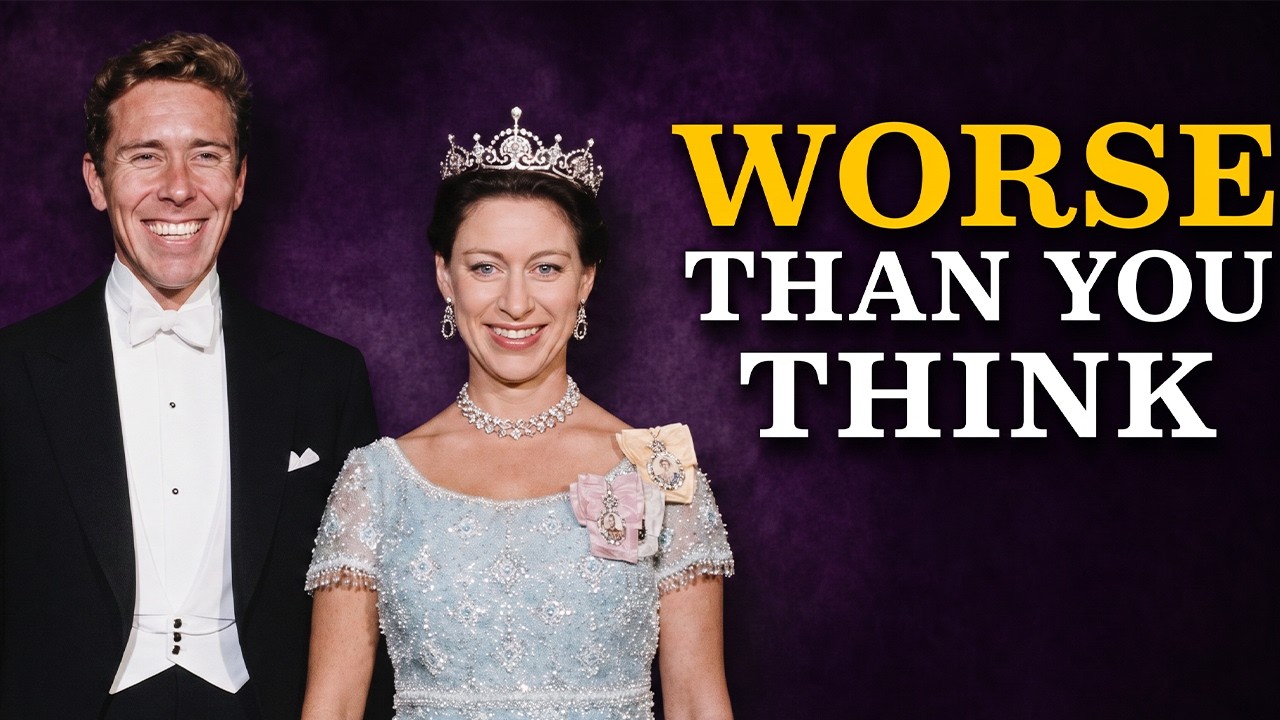
He was small, charming, sexually ambiguous in a way that misled a great many people, including several biographers argue, Margaret herself.
He had a room at 59 Rotherhithe Street, down river in a working part of London, rented from a journalist named William Glenton. That room is where the courtship happened.
She would arrive without ceremony, and they'd sit with the view of the Thames, and nobody in Fleet Street had the faintest idea.
The press spent 1958 and 1959 marrying her off in print to a series of eligible aristocrats, and never once looked at the photographer standing at the edge of the room with a camera, because he was staff.
Glenton, the man who lent them the privacy, published a book about it in 1965 while the marriage was still very much alive. That is the pattern for this entire story.
Almost everyone who got close enough to see anything eventually monetized it. And almost everyone who could have contradicted them was either dead or institutionally silent.
The proposal came in the autumn of 1959. And here the timing gets uncomfortable.
In December 1959, Peter Townsend married a 19-year-old Belgian woman, Marie-Luce Jamagne. Several biographers report that news of Townsend's engagement reached Margaret shortly before she accepted Armstrong-Jones. That the letter arrived, and the answer changed.
It's a claim built on friends' recollections rather than a document, and it's the kind of story that gets tidier with each retelling. But the calendar is the calendar.
Townsend engaged himself to a teenager in the autumn of 1959. Margaret was engaged by the end of it.
The announcement came on February 26th, 1960, and the country lost its mind with pleasure. A princess marrying a commoner, a photographer, a man with a job.
After the gray misery of 1955, this looked like the system finally bending.
The wedding was set for May 6th at Westminster Abbey, and the groom asked Jeremy Fry to be his best man. Fry was a close friend, an inventor, an heir to the chocolate fortune, married to a woman named Camilla.
Weeks before the ceremony, Fry withdrew. The official reason given was jaundice.
Camilla Fry was at that point five months pregnant.
The best man's job went instead to Dr. Roger Gilliatt, a neurologist Armstrong-Jones barely knew well enough to describe as an old friend. The wedding went ahead exactly as scheduled.
Norman Hartnell made the dress, and made it plainer than anyone expected. A column of silk organza with no embroidery at all, which was the bride's choice and read at the time as modern and confident.
The groom designed the engagement ring himself. A ruby set in diamonds, shaped like a rose bud. He also designed her going-away outfit.
That detail was reported everywhere in 1960 as romantic.
The cameras were the real story. Prince Philip had argued for televising the coronation seven years earlier and won. Now the machinery turned itself on a wedding for the first time, and an estimated 20 million people watched inside Britain alone.
Philip walked her up the aisle because her father was eight years dead.
What almost nobody in the country registered was who wasn't there. Foreign royalty largely stayed away. A princess marrying a working photographer was, to a certain kind of European court, not an event you attended.
The Abbey was full, and the guest list was still a verdict.
They honeymooned for six weeks on the royal yacht Britannia in the Caribbean. And somewhere in the Grenadines, they stopped at an undeveloped island called Mustique, owned by an old friend of Margaret's named Colin Tennant.
Tennant offered her a wedding present. Not jewelry. A piece of land, 10 acres on the southeastern shore.
His line, as he told it for the rest of his life, was that it was better than something in a little box. She took the land.
The marriage came back to Kensington Palace, to Apartment 1A. Twenty rooms that had been bombed in the war and needed gutting.
The refurbishment ran to around £85,000 of public money, and got itself argued about in Parliament. That was Margaret's first real lesson in the arithmetic that would follow her forever.
She had a great deal of house and very little of her own income, and every pound of it was visible to people who got to vote.
In October 1961, the queen created her brother-in-law Earl of Snowdon. This was not a romantic gesture. Margaret was pregnant, and a child born to a plain Mr. Armstrong-Jones would have been a plain Mr. Armstrong-Jones.
David was born on November 3rd, 1961, and arrived with a courtesy title because the institution had adjusted the paperwork three weeks in advance. Sarah followed in May 1964.
Look at how that works. The family did not particularly want him, but the family absolutely required that his children be presentable. And so it ennobled him on a deadline.
Snowdon hated a great deal about the life. He was a man with a trade being asked to walk two steps behind his wife.
In 1962, he took a job as artistic adviser to the new Sunday Times magazine. It was a genuinely serious appointment. He was very good, and the work he did on disability, on old age, on institutions, holds up.
It also required constant travel. He went to India, to Japan, to Africa on assignments that lasted weeks.
The couple's official reason was his career. The practical effect was that the marriage acquired a permanent architecture of absence, approved in advance by both of them, and applauded by the press as terribly modern.
Meanwhile, there was a girl in Bath being brought up as Jeremy Fry's daughter. Polly Fry was born on May 28th, 1960, three weeks after the Abbey.
She grew up in the Fry family and knew nothing. In 2004, in her 40s, she persuaded Snowdon to take a DNA test, and it established he was her father.
At the time, Snowdon publicly denied having taken any such test, and Jeremy Fry called the whole thing nonsense. Four years later, in the biography written with his cooperation, Snowdon confirmed it was true.
So, the sequence is this. He conceived a child with the wife of the man he'd chosen as best man. That man withdrew from the wedding. The child was born three weeks into the marriage.
And the truth stayed sealed inside a friendship group for 44 years, before a middle-aged woman went and got it tested.

Margaret, as far as anyone can establish, was never told. The record does not show her knowing.
The record shows a couple photographed constantly through the early 60s looking like the most glamorous people in Britain. Which they were, and which is precisely what made the images so useful.
The monarchy in 1960 was stiff, elderly in its presentation, and visibly nervous about a country that was about to become the country of the Beatles. The Snowdens were its answer.
They knew Peter Sellers. They had dinner with the ballet crowd, the theater crowd, the men who made the 60s look like the 60s. Every photograph of the two of them at a first night did work for the institution that Margaret's sister could not do herself.
The palace never had to ask them to perform it. They enjoyed it, and the enjoyment was real, and that is what made it convincing.
Under the photographs, the private version deteriorated in a specific and documented way.
Snowdon's method, as reported by people who worked in the house, was the note. He wrote things down and left them where she would find them.
A list of reasons why he hated her, placed in her desk. Written insults about her appearance, left in her glove drawer.
These accounts come from later recollection rather than surviving paper. The notes themselves, by their nature, did not survive. And they come to us through a book he cooperated with, which is a strange and revealing thing.
He allowed the cruelty into the record. He seems to have thought it made him interesting.
She was not a saint being persecuted. Margaret drank, and by the 70s she was drinking in a way her friends discussed.
She was capable of freezing a room over precedents, of arriving two hours late and expecting the party to have waited, of humiliating her own mother at dinner.
Two difficult people can make each other worse. That is not a defense of either.
What made it a trap, rather than simply a bad marriage, was that neither of them could leave. Divorce for the sister of the Supreme Governor of the Church of England in 1965 was not a legal problem. It was a constitutional embarrassment of the exact type that had cost the family an uncle in 1936, and cost Margaret her 20s in 1955.
She had personally been told, with government letterhead behind it, that a marriage to a divorced man was impossible. She could not now become the divorced woman.
Money mattered too. She had a civil list allowance and a grace-and-favor apartment and no capacity whatsoever to earn. And there were two small children whose existence was the stated reason on both sides for keeping the arrangement alive.
So they built a system instead. Separate schedules, separate friends.
He had affairs, including a long relationship with a woman named Ann Hills that ran for around 20 years. She had her own.
They continued to appear together. That was the deal.
And then she started building a house.
The Mustique land had sat unused for over a decade. Around 1971, she had it drawn up by Oliver Messel, the theater designer, the man who had done Glyndebourne and half the West End, and who happened to be Snowdon's uncle.
The house was finished in 1972, and she called it Les Jolies Eaux. Five bedrooms, white above the water.
It was the only house Princess Margaret ever owned. Not grace and favor, not the queen's. Hers. Freehold, on an island 4,000 miles from the Church of England, reachable only by people she invited.
The public read it as an indulgence. Newspapers ran the phrase Princess Margaret's Caribbean hideaway as a synonym for public money being wasted, which was unfair, because the land had been a gift and Colin Tennant's development had paid for the setting.
What almost nobody understood was what she had actually acquired. For 15 years, she had lived in buildings that belonged to her sister, on an income voted by Parliament, on a schedule set by the household.
Now she had somewhere with a door that only she controlled.
Her marriage did not improve. It relocated. Snowdon went where the assignments were. Margaret went to Mustique, and the two of them met in the middle for the photographs.
Then in February 1973, at a house party in Scotland arranged by Colin Tennant's wife Anne, Margaret was introduced to a 25-year-old with no money and a talent for gardening.
Anne Tennant later told biographers her immediate thought, watching the two of them, was, Heavens, what have I done?
His name was Roddy Llewellyn. He was 17 years younger than she was, the son of a famous showjumper, drifting between jobs and a commune in Wiltshire.
Everyone who described him described him the same way. Sweet, unserious, unthreatening, funny. After two decades married to a man who left insults in her desk, unthreatening may have been the entire appeal.
The relationship ran for years without a single photograph. Margaret took him to Mustique, to her own house, which was the point of having it.
Snowdon knew. Their friends knew. The household knew. Nobody printed a word, because the British press in the early 70s still ran on an understanding that royal private lives were not a story unless the palace made them one.
That understanding died on the beach at Les Jolies Eaux in February 1976. A long lens caught the two of them in swimsuits at a table. The News of the World ran it.
By the standards of anything published since, the picture is nothing. Two people sitting down in daylight having a drink.
In 1976, it was a detonation, because it was documentary proof of something everyone had agreed not to know.
Llewellyn issued a statement that declined to comment on the events of the previous week while expressing the greatest respect, admiration, and loyalty toward the queen and the royal family. It was the most establishment sentence he ever produced in his life, and it fooled nobody.
On March 19th, 1976, Kensington Palace announced a formal separation. The wording put the decision at Snowdon's initiative.
Within days, he was on television in Australia, where he happened to be working, saying he was leaving with great sadness and asking for privacy, and coming across, deliberately or not, as the wounded party.
He then went home, and in December 1978, five months after the divorce was finalized, married Lucy Lindsay-Hogg. He had been involved with her before the separation.
So, a husband who had fathered a child by a friend's wife three weeks into the marriage, conducted a 20-year affair, and left written cruelty around the house, exited the marriage as the sympathetic figure.

His wife, photographed sitting in a swimsuit at her own house, exited as the disgrace.
Newspapers demanded her allowance be cut. A Labour member of Parliament called her a parasite in the Commons. She was formally dropped from the line of duties for a while, and her health, already bad, got worse.
The divorce came through on July 11th, 1978. The first divorce of a senior member of the royal family in modern history. The thing the entire machinery of 1955 had existed to prevent.
It happened anyway. 23 years after she was persuaded to give up a man on the grounds that Christian marriage is indissoluble, Margaret dissolved hers, and the sky did not fall.
Here's what nobody expected. She was fine with it.
That's not sentiment. It's the consistent report of the people who were there. Anne Glenconner, who was her lady-in-waiting for 30 years and published her own account in 2019, describes relief rather than devastation.
The humiliation was public. The freedom was private, and in the private column, she was for the first time since she was 21, not accountable to her husband, not waiting on a government file, and in possession of a house on an island with her name on the deed.
Llewellyn did not become the great second act. In 1981, he told her he intended to marry someone else, Tanya Soskin, and did that July.
Christopher Warwick, who knew them both and became Margaret's biographer, wrote that he thought she was hurt, but that by then the romance had already turned into friendship.
She went to the wedding of his brother. She kept him as a friend for the rest of her life.
That too is worth sitting with. The great scandal of 1976, the affair that supposedly destroyed a royal marriage, ended with the two of them still on good terms. And the marriage was already dead for a decade before the camera ever found them.
The last 20 years were not kind. She smoked heavily for most of her life and had part of her lung removed in 1985. She had strokes in 1998 and 2001.
In 1999, in the bathroom at Les Jolies Eaux, she scalded her feet badly enough that her mobility never fully recovered, and she never went back to the island again. She gave the house to her son David that same year, and he sold it.
Friends reported she was upset about it. The one piece of property she had ever owned outright, the only address in her life that had never belonged to her mother, her sister, or the state, left the family within a year of her giving it up.
But she had already done the thing that mattered most, and she did it with a chauffeur and some bin bags.
Through the 90s, Margaret systematically destroyed her private correspondence. Not a symbolic bonfire. A sustained clearance, bag by bag.
Letters from her mother, letters from her sister, letters from the men. Decades of it.
She called it tidying up. Her staff helped.
There is no Margaret archive, because Margaret burned it.
Think about what that means from a woman who had spent her entire adult life being narrated by other people's documents. A cabinet memorandum decided who she could marry. A newspaper photograph decided when her romance became public. A palace statement decided who ended her marriage.
She could never control the official record, so she made certain there would be no unofficial one.
The result is that the version of Princess Margaret we have was assembled almost entirely by other people. Townsend published his memoir in 1978, the same year as her divorce.
Snowdon cooperated with Anne de Courcy's biography in 2008, sat for the interviews, confirmed the daughter, allowed the notes and the cruelty into print, and lived until 2017. 15 years past his ex-wife, with 15 years of unopposed testimony.
Servants published. Guests published. Everyone who ever sat next to her at dinner and wrote it down that night got a vote.
She got none, because she'd decided she wanted none.
Except in one place she couldn't reach. The 1955 papers were never hers. They belonged to the government. They sat in the National Archives under the 30-year rule, and no amount of tidying up at Kensington Palace could touch them.
They opened in January 2004. Margaret had died two years earlier, in February 2002, weeks before her mother.
Out came Eden's plan, and the allowance figures, and Kilmuir's contempt for the 1772 act, and the Queen's stated wish not to stand in the way of her sister's happiness, and Margaret's own August letter saying she would decide after she'd seen him.
The single fact underneath her entire public identity, that the state took her love away, turned out not to be true in the form the country had believed it.
The state had awkwardly and pragmatically tried to give it to her. She said no.
We do not know why. And she made sure we never would.
Whether it was the succession, or her sister, or the archbishop, or 6,000 miles of Brussels hotel rooms having quietly ended something, the surviving record does not say. The one woman who could have explained it spent her last decade making certain the explanation didn't survive her.
So go back to the Abbey steps. May 6th, 1960, the first televised royal wedding. 300 million people watching a princess in a plain white dress on the arm of a man who designed her ring and her going-away clothes.
The country read it as love winning at last. And it read it that way because the country had spent five years feeling guilty about 1955.
Look at it again. The best man is missing, and his pregnant wife is in Bath. The groom will be a father in three weeks. The bride accepted him within weeks of learning the other man had proposed to a 19-year-old.
The cameras are there because the institution needed exactly this image at exactly this moment.
And the one person on those steps who understood what a photograph could be made to do was the woman who had already watched a piece of fluff on a uniform turn into a constitutional crisis.
She wasn't a fairy tale. She was a national utility.
And when she finally got the chance to write her own version, she looked at everything she'd been given, the letters, the evidence, the whole documented archive of her life, and she burned it.
Which is the only decision in this entire story that was hers alone, from start to finish.
Britain never saw the marriage. It saw the wave.