In the summer of 255 BC, a Roman fleet of 364 ships carrying more than 100,000 men was destroyed off the southern coast of Sicily. No enemy fleet attacked them. There was no battle at all. A violent storm drove the ships onto the rocks, and only 80 vessels survived.
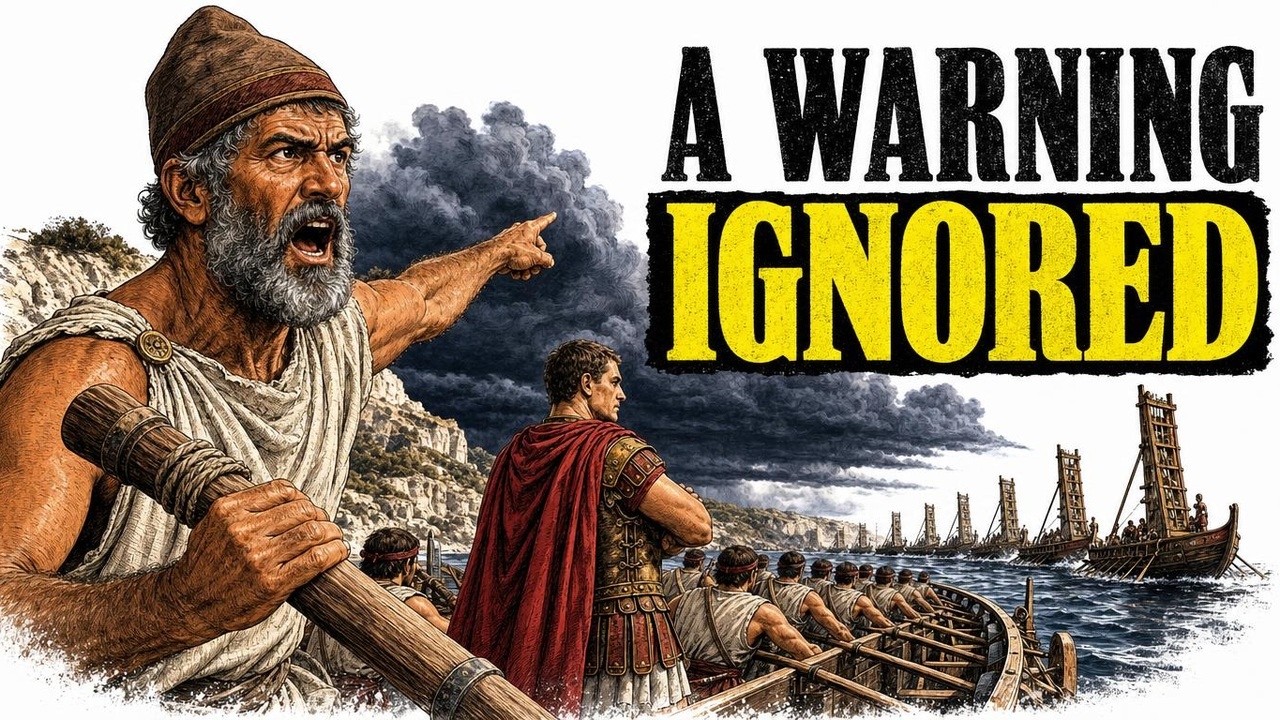
More men died in a single afternoon than in any sea disaster recorded in the ancient world, and Rome had built the machine that caused it. The disaster grew directly out of Rome’s proudest naval invention: the corvus, or the Raven. It was a heavy boarding bridge, eleven meters long, hinged on a tall wooden pillar and fitted with an iron spike at its end. The idea was to drop the bridge onto an enemy deck, pin the two ships together, and send Roman legionaries across to fight a land battle at sea.
Earlier in the First Punic War, Rome had no real fleet. Carthage ruled the waves. So the Senate ordered a captured Carthaginian warship to be copied plank for plank, and in roughly sixty days, more than a hundred new hulls were built. Farmers and laborers who had never been to sea learned to row on benches cut into the sand of the shore.
The corvus worked brilliantly at first. At the Battle of Mylae in 260 BC, it helped the consul Gaius Duilius capture or sink fifty enemy ships. It brought Rome its first naval triumph. The weapon seemed to have made Rome unbeatable on the water.
Years later, the fleet that set out for Africa was carrying home the survivors of a failed invasion. The consul Marcus Atilius Regulus had been defeated in Africa the year before by a Spartan mercenary named Xanthippus, who used war elephants to break the Roman line. Regulus was captured, and his army was shattered. The survivors held out at the fortress of Aspis until the fleet arrived to evacuate them.
The returning fleet was a floating triumph. It carried thousands of rescued legionaries, silver from the sack of Aspis, captives destined for the slave blocks of Sicily, and armor enough to fit two legions. On the command deck, a junior clerk whose name has not survived tallied the day’s numbers as if the war were already over. At about one in the afternoon, the sea began to change.
The Greek pilot of the flagship warned the consul Marcus Aemilius Paulus that a southerly gale was coming and that the fleet was running along a lee shore, a coast where a south wind would drive the ships onto the rocks. He begged the consul to stand out into deep water while there was still time. Paulus waved the warning off. He had a victory to celebrate and a triumph waiting in Rome.
The fleet held its course along the coast. By three in the afternoon, the sea had turned violent. The waves rose into gray hills, and the wind kept climbing. The corvus, mounted high at the bow, made every ship top-heavy and slow to recover.
In a heavy sea, the weight drove the prow under the waves instead of letting it ride over them. The weapon that had won the war was now breaking the fleet’s back. By six in the evening, the wind had become a wall of moving air, and rain arrived in a single flat sheet. The fleet scattered in the dark.
Signal flags and trumpet calls were useless. Each ship was alone. The corvus made matters worse. With its tall pillar and raised arm, it caught the wind like a crude sail, forcing the ship’s head down into the water.
Some crews tried to cut the device loose, but it had been built deep into the hulls and could not be removed in time. On some ships, the swinging arm swept men off the decks. The storm drove the fleet onto the coast between Camarina and Cape Pachynus, a shore of reefs and shoals that Sicilian sailors avoided even in fair weather. The transports below deck carried the survivors of Regulus’s army, men who had survived war elephants and starvation only to drown within sight of home.
Most of them could not swim. The clerk survived the night. When dawn came, he looked out over a sea covered with wreckage, splintered planks, snapped oars, and the bodies of men and animals. He found a lump of charcoal and a strip of sailcloth and began to record the dead.
It was all he knew how to do. The ancient historian Polybius, who studied the Roman archives, recorded that more men died that night than in any sea disaster the ancient world had ever known. Of 364 ships, only 80 came through. He placed the blame not on the storm but on the commanders who forced the pilots to run a dangerous coast in a dangerous season rather than delay their homecoming.
Both consuls of that year, Paulus and Servius Fulvius Nobilior, survived. Neither was stripped of office. Fulvius went on to hold the censorship years later, one of the highest honors the republic could grant. Rome did not punish the men who had led the fleet into the storm; it simply raised another fleet.
The corvus disappeared from the record. It was never used again. Rome learned what it cost to bolt a siege engine to a ship and call it a navy. The losses did not stop there.
Two years later, in 253 BC, another Roman fleet was wrecked in a storm off the same coast. In 249 BC, the consul Publius Claudius Pulcher lost ninety-three of his 123 ships at the Battle of Drepana after a disastrous engagement, and his colleague Lucius Junius Pullus lost most of the remainder to a storm off Cape Pachynus. Within a single decade, Rome had lost four great fleets and well over 100,000 men. Any other power in the ancient world might have sued for peace.
Carthage, watching Rome’s disasters pile up, believed the war was nearly won. But Rome’s real weapon was never the corvus. It was the state’s capacity to absorb staggering losses and keep building. By 241 BC, the treasury was empty after twenty years of war.
Rome raised a new fleet of 200 ships through forced loans from its richest citizens, senators and knights who each paid for a warship against the promise of repayment from captured spoils. That fleet, commanded by the consul Lutatius Catulus, met the last Carthaginian supply fleet off the Aegates Islands near the western tip of Sicily. This time there was no boarding bridge and no boarding brawl. It was decided by seamanship alone.
The Romans outmaneuvered their enemy, sank fifty ships, captured seventy, and pulled nearly 10,000 men from the water into chains. Carthage surrendered and agreed to pay Rome 3,200 talents of silver over ten years. The war that had begun over a single stolen town twenty-three years earlier was over. Sicily became the first Roman province beyond Italy.
Centuries later, bronze rams from the sunken ships of that final battle were recovered from the seabed off the Aegates. Unlike the corvus, they were sleek and engineered for speed, each cast to a fixed weight and stamped with the names of the Roman magistrates who had approved the contracts. The clerk’s name did not survive, but his arithmetic did. He began the day counting the profits of a victory and ended it kneeling on a broken deck, inventing a new column for the drowned with a lump of charcoal on a scrap of sail.
The republic received his figures, read the shortfall, balanced the books, and built again.