Nelson Rockefeller, the billionaire heir, four-term New York governor, and former vice president, died on January 26, 1979, in a way that shattered the carefully constructed image he had maintained for decades. The 70-year-old suffered a massive heart attack at a private townhouse on West 54th Street in Manhattan, not at his office as his family initially claimed. He was in the company of Megan Marshack, a 25-year-old assistant half his age. The official story released by family spokesman Hugh Morrow stated that Rockefeller had died at his desk at Rockefeller Center while working on a book about his art collection and was discovered by a security guard.
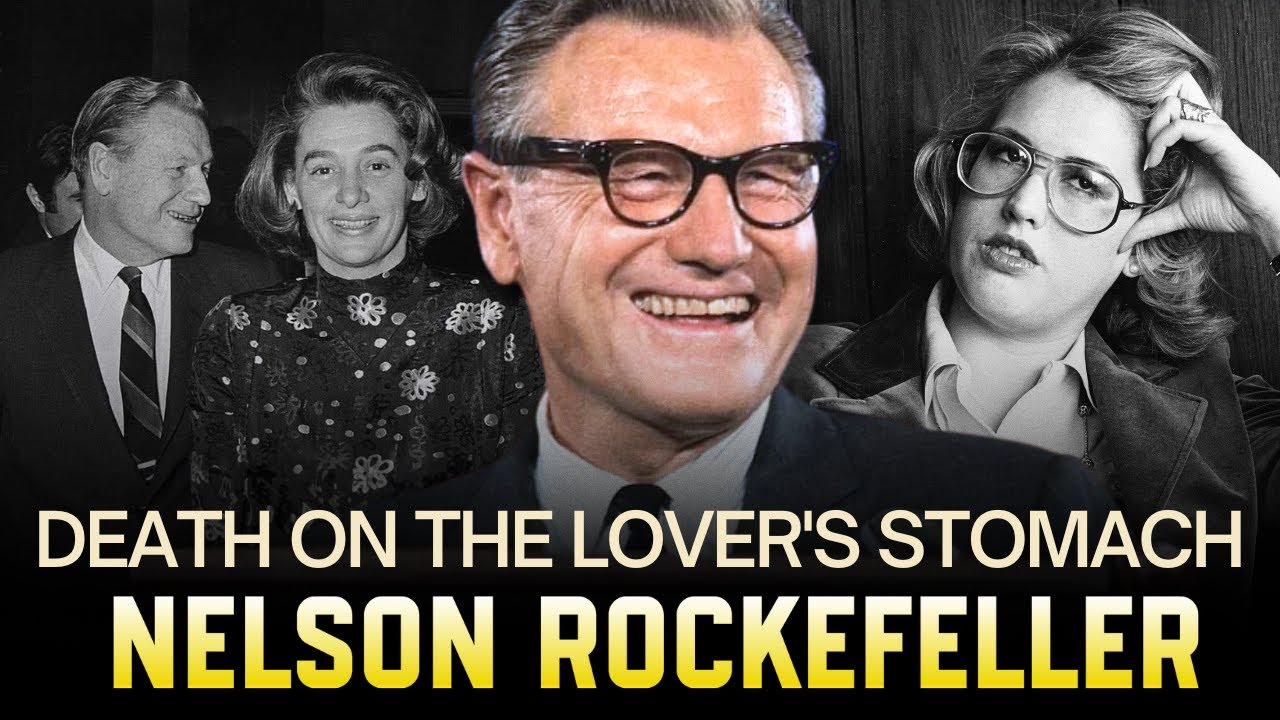
That account quickly unraveled. Police records showed the death was reported at a townhouse, not his office, and the 911 call had been placed by a woman. According to police sources and subsequent journalistic investigations, Marshack did not call for help immediately when Rockefeller collapsed. Reports indicate she instead contacted a friend, television host Ponchita Pierce, who lived nearby.
The two women then allegedly attempted to dress the dead man and stage the scene to make it appear he had suffered a heart attack while seated, rather than being found in a compromising situation. A 911 call was finally placed more than an hour after his heart stopped, a delay that likely cost him any chance of survival. He was pronounced dead at the hospital shortly after midnight. Rockefeller was born on July 8, 1908, in Bar Harbor, Maine, into what was effectively American royalty.
His grandfather, John D. Rockefeller Sr. , built Standard Oil into a global empire, and his father, John D. Rockefeller Jr.
, devoted himself to philanthropy to repair the family name. Nelson, the third son, was the most forceful and ambitious of the brothers. He was severely dyslexic at a time when learning disabilities were neither understood nor accommodated, and he developed a strategy of dominating conversations and relying on oral briefings from staff to compensate. His first major public act came in the 1930s when his family placed him in charge of leasing and decoration for Rockefeller Center.
He commissioned Mexican muralist Diego Rivera to paint a fresco in the RCA Building lobby but ordered the work destroyed after Rivera refused to remove a portrait of communist leader Vladimir Lenin. On the night of May 9, 1933, Rivera was removed from the site and paid his full fee. Months later, workers with sledgehammers demolished the mural. Rockefeller later claimed he would try to preserve it, but he did not.
During World War II, President Franklin D. Roosevelt appointed him coordinator of Inter-American Affairs, a position that made him a key figure in U. S. policy toward Latin America.
He used economic pressure and cultural diplomacy to counter Nazi influence in the region. After the war, he helped secure the United Nations headquarters for New York City on land donated by his father. In 1958, Rockefeller ran for governor of New York, defeating Democrat W. Averell Harriman in a landslide.
His campaign, built on a friendly public persona and enormous personal spending, made him a national figure. As governor for 14 years, he pursued an aggressively interventionist agenda. He expanded the State University of New York from roughly 38,000 students to nearly 250,000, built highways and parks, and created public benefit corporations to issue debt without voter approval. His most controversial project was the Empire State Plaza in Albany.
After a visit from Dutch Princess Beatrix left him embarrassed by the city’s aging appearance, he seized 98 acres in a working-class neighborhood known as the Gut, displacing approximately 9,000 residents and demolishing 1,200 buildings. In their place rose a modernist complex of white marble towers and a distinctive egg-shaped performing arts center. The project, originally estimated at $250 million, cost more than $2 billion and was the most expensive government complex in North America at the time. The collapse of his presidential ambitions began with a personal scandal.
In 1962, Rockefeller announced he was divorcing Mary Todhunter Clark, his wife of more than 30 years, to marry Margaretta “Happy” Murphy, who was then married to a physician who worked for the Rockefeller Institute. Happy Murphy had four children, and custody arrangements left them with her former husband. The public reaction was harsh, and crowds at campaign events taunted him with chants of “Where are the children? ”
At the 1964 Republican National Convention in San Francisco, Rockefeller took the stage to attack extremism within the party.
Supporters of rival Barry Goldwater drowned him out with boos and chants, and he stood at the podium for 16 minutes refusing to yield. Goldwater won the nomination, and the episode marked the death of the moderate Republican establishment Rockefeller represented. The 1964 defeat hardened him. In September 1971, a riot at Attica Correctional Facility, a maximum-security prison that was severely overcrowded, put his governing philosophy to the test.
Inmates took 42 staff members hostage and issued demands that included better food, medical care, religious freedom, and amnesty for the riot. State officials accepted most of the demands, but negotiations stalled. Inmates and outside observers, including New York Times columnist Tom Wicker, urged Rockefeller to visit the prison, but he refused, saying he would not negotiate with criminals. On September 13, he ordered state troopers to retake the prison by force.
During the assault, which involved gas and gunfire, 39 people were killed, including 10 hostages, and nearly 90 more were wounded. Prison officials initially claimed the hostages had been killed by inmates slitting their throats, and Rockefeller repeated that version to President Richard Nixon. But autopsies showed every hostage had been killed by state police gunfire. Rockefeller never apologized for the deaths and dismissed the suggestion that he bore responsibility.
In 1973, Rockefeller signed legislation creating mandatory minimum sentences for drug offenses. Selling two ounces of heroin, cocaine, or cannabis carried a penalty of 15 years to life, the same as second-degree murder. Judges lost the discretion to offer lighter sentences, and the prison population soared. The laws, which became a template for mass incarceration across the country, did little to reduce addiction but devastated minority communities.
After Nixon resigned in August 1974, President Gerald Ford chose Rockefeller as his vice president. Confirmation hearings exposed his extensive loans and gifts to public officials, totaling more than $2 million, which looked like a patronage system. Once in office, he was isolated by a younger generation of White House staff, including Dick Cheney and Donald Rumsfeld, who saw him as a threat. Ford removed him from the ticket in November 1975 in a reshuffle known as the Halloween Massacre.
In his final political moment, during a campaign appearance in Binghamton, New York, in September 1976, Rockefeller was heckled by protesters and responded by raising his middle finger. The photograph became an iconic image of his frustration. He left office in January 1977 and returned to New York, saying he looked forward to writing and selling reproductions of art from his collection. Later that year, he hired Marshack, a former radio reporter for the Associated Press.
He paid her $60,000 annually, a substantial salary at the time, and loaned her $45,000 to buy a co-op apartment on West 54th Street, just down the block from the townhouse he used as a private retreat. The townhouse, connected to the Museum of Modern Art, had no bedrooms in the traditional sense but featured galleries, a study, and deep sofas. Staff were often dismissed at night for privacy. On the night of his death, Rockefeller dismissed his bodyguard and told his wife by phone that he was staying late to work on his art book.
Marshack was with him at the townhouse. Family spokesman Hugh Morrow issued a series of revised statements as the press uncovered inconsistencies. The family refused an autopsy, and Rockefeller’s body was cremated just 18 hours after his death, eliminating any independent medical examination of the circumstances. Marshack’s loan was forgiven in his will, and she never gave an interview, wrote a book, or publicly discussed what happened.
Happy Rockefeller endured the funeral under intense public scrutiny, knowing her husband had died in the company of a much younger woman after lying to her about his whereabouts. Rockefeller was buried in the family cemetery in Sleepy Hollow, New York. He left a permanent physical imprint on New York through the State University system, the Empire State Plaza, and his role in the original World Trade Center project.
But his final hours, shaped by a delayed emergency call and an attempt to control the scene of his own death, became the lasting contradiction of his life.