Some places are better left unmapped. The ridges and hollows that locals called Halverson’s Cleft carried an older Cherokee name that loosely translated to “the place that watches back. ” For years, older mountain families refused to carry iron onto that ridge, and those who knew the old stories said the mountain did not care for noise. The last known story tied to that mountain belongs to Othniel Crowder.
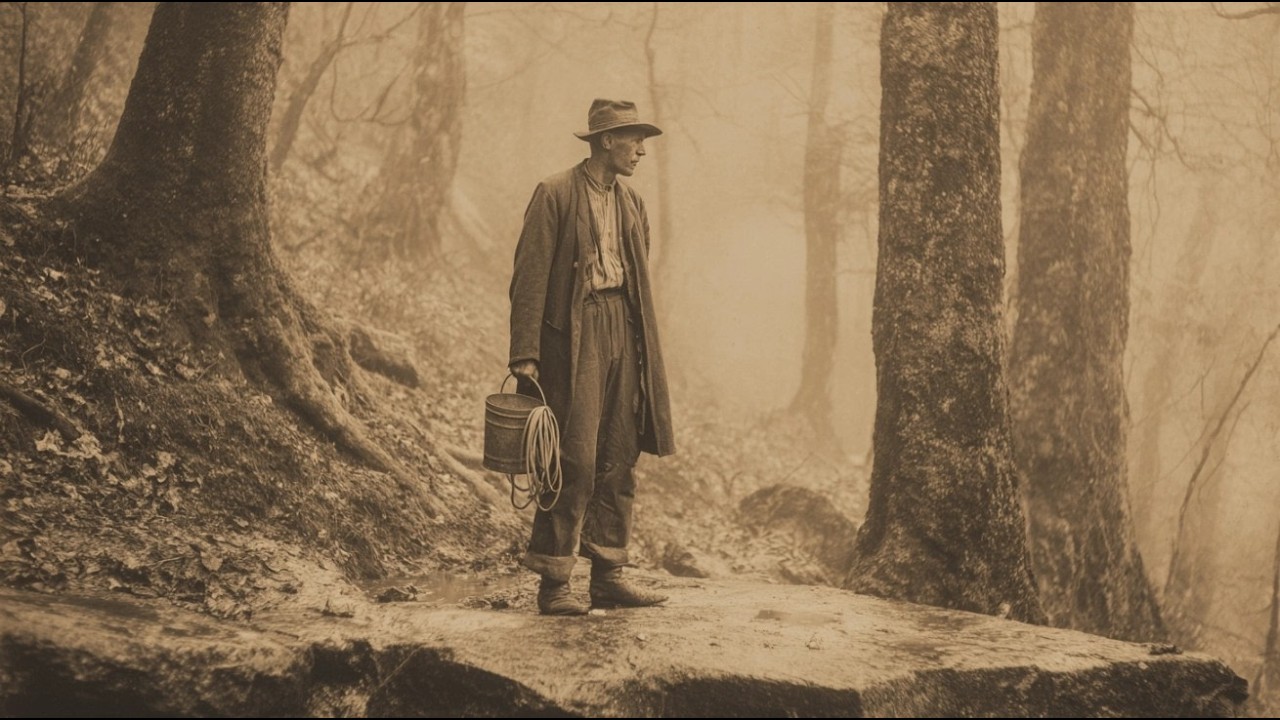
He was a moonshiner, not the caricature found in folklore, but a real man who had quietly worked the cleft since the spring of 1919. By the autumn of 1926, he was 38 years old, tall and narrow-shouldered, with a small white scar on his cheek from a mule kick. He lived alone in a one-room cabin with a black-and-white hound named Ribbon. The two were rarely apart.
The written record of what happened to him survives through letters, official reports, and witness statements—documents that sat unread for decades before researchers discovered them. Crowder had a sister in Ohio who kept his correspondence. Early letters were warm and ordinary, filled with routine observations about deer and foxes and shared family concerns. But a letter dated October 14, 1923, shifted in tone.
Crowder wrote that he had begun hearing the mountain itself—a low, steady sound he described as a presence in the room that simply refuses to announce itself. His sister begged him to come down for the winter. Two weeks later, he wrote again, apologizing for worrying her and claiming everything was fine. He never mentioned the sound again, but a final letter, dated October 3, 1926, hinted that it had changed.
The sound that used to be in one place, he wrote, was now coming from two places. The second one was closer. Ten days later, he was gone. A neighbor named Quincy Ardell visited the cabin in late September to settle a debt.
He noticed immediately that the dog was missing, and Crowder’s face carried a look that Ardell never quite shook off. Crowder acted as though he had misjudged the season, smiling slowly. On the walk back down the mountain, Ardell heard footsteps behind him. He stopped twice.
Both times, the trail was empty. When he finally reached the road, the footsteps stopped all at once—as if someone had decided not to come any further. On October 7, Crowder walked into the valley town on his own, which was unusual. At the general store, run by a woman named Ottilie Mercer, he bought salt, lamp oil, coffee, and matches.
He paid in four thin copper coins. The storekeeper later wrote to her sister that the coins bore a long-faced, closed-eyed figure unlike any president or monarch she could identify. When she checked on the coins that night, they were warm, though the box had sat on a shelf away from any fire. The coins were never seen again after the store burned down two years later.
Phineas Troll, the young man who hauled Crowder’s jars down the mountain, made his last run on October 8. Crowder was sitting on the front step, his hands flat on his knees. He asked Phineas whether he had ever counted the trees on the way up, then warned him not to start, because the number would never match on the way down. Phineas told the sheriff that when Crowder turned to look at him, something seemed wrong about the fingers on his left hand.
He counted them twice. The second count did not match the first. On October 11, Ardell passed Crowder on the lower trail. Crowder was carrying his tin pail, muttering in a language that produced hard, rolling syllables that Ardell had never heard in any human mouth.
He did not appear to see the neighbor at all. Two days later, on October 13, a Forest Service ranger named Roderick Vaughn was on the higher ridge conducting a mapping survey when he saw a man matching Crowder’s description crossing a flat shelf of rock about half a mile below. The man carried a tin pail and a length of copper tubing. The sky was clear, and nothing obscured the view.
Vaughn watched as the man took one step, then another, and on the third step simply was not there anymore. Vaughn lowered his field glasses and scanned the slope above and below the shelf. Nothing. He later wrote in his official report that the man had not fallen, had not run, and had not walked behind anything.
He had stepped into a place where the ground had stopped being ground. By the time the ranger reached the shelf, it was nearly dark. There were no tracks, no pail, no tubing, no body. But at the edge of the bare stone, the grass was bent in a straight line about six feet long, all leaning inward toward the point where the man had disappeared, as if the air itself had moved and not yet returned.
A search party of eight men and three dogs went up the mountain on October 17. The cabin was untouched. The fire had gone out. The bed had not been used.
Ribbon the dog was still missing. On the table sat an unfinished cup of coffee with a film on it. Beside it was a brown piece of paper, folded once, with a list of twelve names. The first eleven belonged to old valley families that had mostly died out or moved away.
The twelfth name was Othniel Crowder. Next to it, in fresher ink, was a check mark. Crowder’s private ledger was also found. The final entry, dated October 11, read: “They have started to know my name.
I should not have answered the first time. I do not know how to take it back. ” In pencil beneath it, he had written a warning: “If you find this book and you cannot find me, do not speak my name on this mountain. Burn this page.
”
The men did not burn the page. The ledger was taken to the sheriff and locked in a metal cabinet. Three months later, every page was blank—including the front cover, where Crowder’s name had once been written. Two members of that search party never came down the mountain that night.
Wilbur Hexum, a young deputy, was found the next morning sitting on a fallen log near the cabin. His eyes were open, and he was breathing, but he did not respond to anything. He lived another 41 years without ever speaking again except for a single whispered phrase, repeated in a language no one could identify. A recording of it survives, and a linguist who studied it said the sounds were not a sentence at all, but a list of names—including, she claimed, a name that belonged to whoever was listening.
The other missing man, a tracker named Norvell Tate, was never found. A clerk later left a note in his file describing a photograph that kept changing, with a stone shelf appearing in a studio portrait where a curtain should have been. She resigned two weeks later and left the county. When she agreed to an interview years afterward, the last thing she said was that she had never spoken his name out loud since the day she left.
One year after Crowder vanished, a man matching his description came down off the cleft into the valley. He entered the rebuilt general store, set down salt, lamp oil, coffee, and matches, and paid with four thin copper coins. He left without looking back. The young clerk who took the coins locked them in a wooden box.
Decades later, after his death, his daughter opened the box. The coins were gone, but four small burns in the shape of coins were marked deep into the wood. Sightings followed over the years. A traveling preacher in 1928 saw a figure whose outline passed through a dogwood branch.
A surveyor in 1933 claimed the man spoke back to him in the surveyor’s own voice. A woman in 1952 said she watched in her rearview mirror as the stranger in a wool cap greeted her—and her own reflection in the backseat raised its hand in answer. Roderick Vaughn, the ranger who first reported the disappearance, returned to the mountain one last time in 1948. He told his wife he wanted to see the place before he was too old to make the climb.
When he came home, he told her there had been a man standing on the shelf, holding a pail and copper tubing. Asked if it was Othniel, he shook his head. “No, but it had Othniel’s face. ” He never spoke of it again.
The records of Halverson’s Cleft remain scattered across sealed reports and faded letters. Those who have studied the case suggest that some places are thin, like ice over a pond, and that Crowder answered something that made him visible on the wrong side of that thin place. What came down the mountain the following year, they believe, was not him. It was wearing him.
And it is still up there.