Doris Duke was one of the richest women in American history, inheriting an estimated $100 million fortune as a 12-year-old when her father, tobacco magnate James Buchanan Duke, died in 1925. By the time she died in 1993, she had been married twice, publicly blamed for the death of a longtime associate, adopted a woman she believed was the reincarnation of her infant daughter, and left her fortune under the control of her butler. Born in New York City on November 22, 1912, Duke was the only child of James and his second wife, Nanaline Holt Inman. Her father had built the American Tobacco Company in 1890, transforming a family tobacco business into a dominant industrial empire before the government broke it apart under antitrust laws in 1911.
He turned next to hydroelectric power and real estate, and the wealth continued to grow. At his death, he left the bulk of his estate to Doris and to the charitable Duke Endowment. The press dubbed her the richest little girl in the world and never left her alone afterward. She had bodyguards as a child, was privately tutored, and her father had been intercepting threatening letters about her before his death.
After he died, the mail arrived unfiltered, and Doris read those letters herself. On his deathbed, James Duke reportedly told her to trust no one. Relations with her mother were strained from the start. James had left Nanaline a relatively modest trust fund, while the real fortune went to Doris.
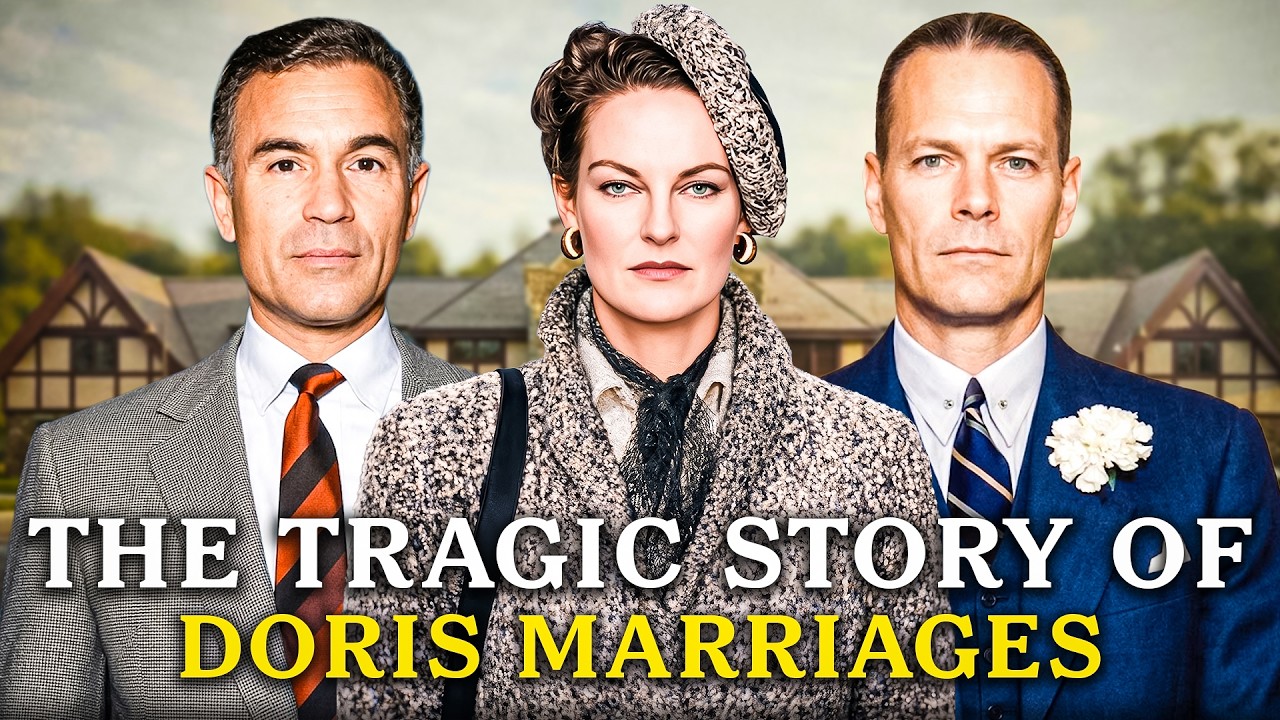
At 14, Doris took her own mother to court to prevent her from selling family assets and won. She was later barred from attending college, instead presented as a debutante in London in 1930. By her early 20s, she had no formal education, little trust in her family, and a fortune beyond nearly anyone alive. Her first marriage, in 1935, was to James Cromwell, a 38-year-old socialite from a once-prominent family and a politically ambitious New Deal Democrat.
Duke was 22. She gave him a monthly allowance of about $10,000, effectively financing his political career, including an unsuccessful run for the U. S. Senate from New Jersey in 1940.
The honeymoon included a two-year world tour that sparked Doris’s lifelong passion for Islamic art, eventually leading her to build Shangri-La, a winter home in Hawaii designed with Islamic and Hawaiian influences. The marriage fractured under distance, political failure, and grief. In 1940, Doris gave birth to a premature baby girl, Arden, who lived only one day. Historical research has suggested the biological father may have been a British politician with whom Doris had been involved, though Cromwell accepted legal paternity.
Doris was told she could never have more children and mourned Arden quietly for the rest of her life. The couple divorced in 1943. Her second marriage, in 1947, was to Porfirio Rubirosa, a Dominican diplomat and polo player closely connected to dictator Rafael Trujillo, described in the press as one of the most extraordinary figures of mid-century high society. The U.
S. State Department cautioned Doris about using her wealth in ways that could grant a foreign government political leverage. Rubirosa signed a prenuptial agreement. During the marriage, Doris gave him millions of dollars, including polo ponies, sports cars, and a converted bomber he crashed within a year.
After she found him with his first wife in 1948, she filed for divorce. It was finalized in October 1948, fourteen months after the wedding. Doris never married again. What she turned to instead was her own work: building one of the most significant private collections of Islamic art in the United States, and creating an ambitious enclosed botanical garden at Duke Farms in New Jersey.
She was a serious jazz pianist who helped found the Newport Jazz Festival in 1954, and she quietly funded causes that were unpopular at the time, including HIV and AIDS research in the early 1980s. Over her lifetime, she gave away an estimated $400 million, much of it anonymously. In 1966, her life was marked by a death that was never fully resolved. On the evening of October 7, Doris and Eduardo Tirella, a designer and consultant who had worked with her for a decade, were leaving her Newport estate, Rough Point, in a rented station wagon.
Tirella got out to open the massive wrought-iron gates. Doris slid into the driver’s seat. The car accelerated, struck Tirella, dragged him across the road, and pinned him against a tree, killing him instantly. Doris told police, days later, that the car had suddenly leaped forward.
Newport’s police chief declared the death an accident within about 96 hours. No inquest was held, and no charges were filed. Officers on the scene later expressed discomfort with how the case was handled. Tirella’s family sued, and Duke was found negligent in a civil proceeding, ordered to pay eight siblings roughly $5,620 each after legal fees.
Within days of the accident, she donated $25,000 to restore Newport’s Cliff Walk, and $10,000 to the local hospital. The case never entirely went away. In 2020 and 2021, investigative journalist Peter Lance published a detailed examination, including an alleged fabricated police transcript in which her attorney reportedly suggested police write something up that Duke would sign. Newport police briefly reopened a review in 2021 after a new witness came forward, but the official finding remained that Tirella’s death was an accident.
In the years that followed, Doris built much of what she is remembered for today. Shangri-La grew into a collection of roughly 3,500 objects representing Islamic and Southeast Asian decorative arts, now open to the public as the Doris Duke Foundation for Islamic Art. At Duke Farms, she created Duke Gardens, 60,000 square feet of enclosed botanical displays opened to the public. She studied with jazz composer Hall Overton, learned tap from Bill “Bojangles” Robinson, and sang in a black gospel choir on weekends.
She preserved more than 80 historic buildings in Newport through the Newport Restoration Foundation, which she established in 1968 with Jacqueline Kennedy Onassis serving as its vice president. Her personal life became increasingly isolated. In 1985, she met Chandi Hefner, a 32-year-old Hare Krishna devotee who told Doris she believed she was the reincarnation of the baby daughter who had died in 1940. Doris, who had consulted psychics for decades, found this deeply resonant, and in 1988 legally adopted Hefner, then 35.
Two years later, she disinherited Hefner and moved to reverse the adoption, but the process was incomplete when she died. It was Hefner who introduced Bernard Lafferty into the Duke household. Lafferty, an Irish-born butler with a complicated relationship with alcohol, was hired in 1987 and eventually became Duke’s primary companion. Six months before she died, Doris rewrote her will, making Lafferty the executor of her estate and a central figure in the Doris Duke Charitable Foundation, while also giving him a $500,000 annual income for life.
Doris died on October 28, 1993, at her Beverly Hills home, the former estate of Rudolph Valentino, at age 80. The official cause was progressive pulmonary edema leading to cardiac arrest following complications from a stroke and knee replacement surgeries. The will was contested almost immediately. A deathbed nurse, Tammy Payette, stated she witnessed Lafferty administering quantities of morphine and Demerol far exceeding what had been prescribed.
The Los Angeles County District Attorney’s Office investigated but announced in July 1996 that there was no credible evidence to support a homicide charge. Payette was later convicted of stealing from her patients, though her account was never definitively disproven. The legal battles consumed years, involving roughly 40 lawyers and an estimated $10 million in legal fees. In May 1996, Lafferty agreed to step down as executor.
On November 4, 1996, barely three years after Doris died, he was found dead in his Bel Air home, age 51, of a heart attack. No foul play was suspected. His ashes were scattered in the same Hawaiian waters where he had scattered Doris’s ashes three years earlier. The Doris Duke Charitable Foundation eventually settled and has since given away hundreds of millions of dollars to arts, environmental conservation, medical research, child welfare, and wildlife protection.
Duke Farms has become a nature preserve, Shangri-La a museum, and the Newport Restoration Foundation continues its preservation work. Authorized biographer Sally Bingham later worked to reconstruct the life of a woman who had spent 50 years resisting documentation. Doris rarely wrote letters, refused most interviews, and wanted not to be known the way the public had always tried to know her.
Underneath the spectacle was a woman who built lasting institutions, gave away nearly half a billion dollars mostly without her name attached, and never quite escaped her father’s warning to trust no one.