When historians count the dead of the American Civil War, they usually focus on battlefield slaughter. But more than 49,000 men who wore military uniforms died not from bullets or bayonets, but inside prisoner-of-war camps. That figure represents nearly 15 percent of all those captured during the conflict. According to extensive research by Civil War historian E.
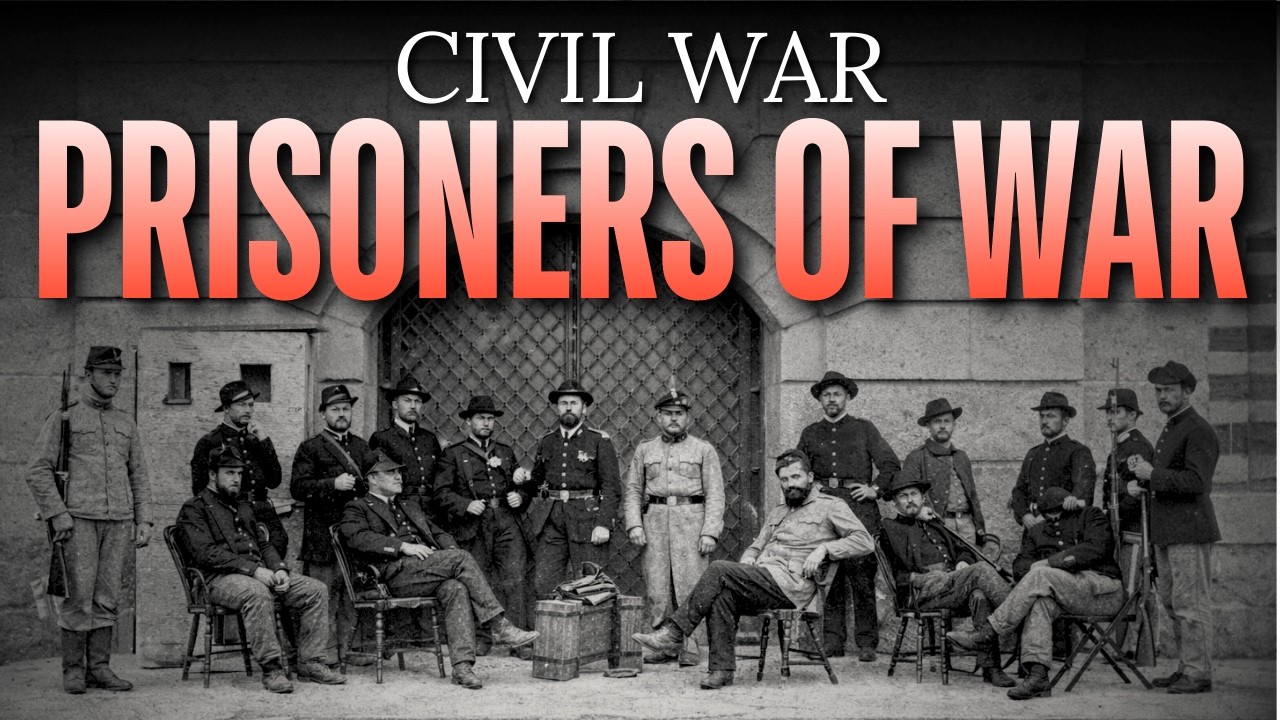
B. Long, one out of every ten active soldiers was taken prisoner. Of those sent to prison camps, one in seven died while in captivity. The numbers are staggering.
The Union captured 211,411 Confederate soldiers. After those paroled in the field were subtracted, 194,743 became prisoners of war. Of that number, 30,218 died in captivity, a mortality rate of 15. 5 percent.
From the Confederate perspective, 462,634 Union soldiers were captured. Of those, 214,865 were imprisoned in Northern camps, and 25,976 died, a rate of just over 12 percent. The crisis began almost immediately. When the war started, both sides expected a short conflict, and neither was prepared for large numbers of captives.
In the early months, prisoners were simply paroled after swearing an oath and sent home. In July 1861, Quartermaster General Montgomery Meigs was assigned responsibility for handling prisoners. By October, that duty passed to Colonel William Hoffman, an officer of the 8th U. S.
Regular Infantry. As Commissary General of Prisoners, Hoffman organized the system with a purely practical style. He centralized the command structure, standardized treatment procedures, and created a process allowing Confederate prisoners to take a loyalty oath and be released. Hoffman was efficient but rigid, lacking in imagination, and cold in his approach.
His system worked well for the government but proved disastrous for human beings when prisoner numbers exploded. On the Confederate side, the same task fell to Brigadier General John H. Winder, a friend of President Jefferson Davis. Winder faced far greater difficulties than Hoffman due to scarce resources and limited facilities.
As provost marshal of Richmond, he was responsible not only for prison camps but also for arresting and returning Confederate deserters and maintaining order in a city whose population had more than doubled. By November 1864, as the Confederate Commissary General of Prisoners, Winder supervised all prisons east of the Mississippi River. Northerners accused him of deliberately starving Union prisoners, but most of those accusations were baseless given the Confederacy’s impossible logistical situation. The first large influx of prisoners came after the surrender of Fort Donelson in Tennessee, where about 12,000 Confederates were captured.
After the Seven Days campaigns in Virginia, another 6,530 Union soldiers fell into Confederate hands. As prisoner numbers grew on both sides, an exchange system was attempted. On July 22, 1862, Brigadier General John A. Dix of the Union and Confederate Major General Daniel Harvey Hill signed an agreement establishing regular exchanges.
The system was based on a 50-year-old cartel used by Americans and British during the War of 1812. The exchange rates were precisely structured. One soldier for one soldier. A corporal or sergeant for two soldiers.
A second lieutenant for three. A first lieutenant for four. A captain for six. A major for eight.
A lieutenant colonel for ten. A colonel for fifteen. A brigadier general for twenty. A major general for thirty.
A lieutenant general for forty. A commanding general for sixty. Problems emerged from the start. Exchanges were supposed to occur within ten days, but paperwork, logistics, quarrels, and distrust created constant obstacles.
Still, the system worked from July to December 1862. Congress then passed two laws that ultimately sabotaged the system. The Second Confiscation Act allowed punishment of traitors through property seizure. Another measure allowed the president to enlist persons of African descent.
It is estimated that 178,892 Black soldiers served in the Union military, and 32,369, about 18 percent, died during the war. The Confederacy refused to recognize Black soldiers and would not include them in the exchange program. When Black prisoners were captured, controversies erupted. In late May 1863, captured Black soldiers were put to work in Richmond and Charleston and forced to labor within range of enemy fire.
That practice stopped when Union forces retaliated by exposing a similar number of Confederate prisoners to the same conditions. In May 1863, President Davis received legislation from the Confederate Congress refusing legal recognition of Black soldiers. The law stated that Blacks found in military uniform would be re-enslaved, and white officers of Black units would be executed. The Union response was swift.
Lieutenant General Ulysses Grant was furious about the refusal to recognize Black soldiers and about the fact that many Confederate prisoners paroled from Vicksburg and Port Hudson had been recaptured at Chattanooga, violating their parole terms. On April 17, 1864, Major General Henry Halleck announced the end of all prisoner exchanges, both official and unofficial. The consequences were immediate and tragic. Prison camps built for specific capacities could not handle the massive influx.
Grant reflected on the decision, saying it was cruel to the men held in Southern prisons not to exchange them, but it was humane to those remaining in the ranks to fight battles. He argued that releasing or exchanging prisoners simply became a war of extermination. The exchange system had actually favored the Confederacy, as most of their released prisoners returned to service in greater numbers than their Union counterparts. Attempts to restart exchanges failed.
In August 1864, Union Major General Benjamin Butler expressed hope for resuming exchanges if all colors were respected, but the Confederacy refused. By August 1864, the Confederacy was holding approximately 50,000 Union prisoners, while the North held about 67,500 Confederates. In October 1864, Robert E. Lee proposed an informal exchange, but Grant agreed only if both races were included.
Lee repeated the Confederate position, and the attempt failed. In January 1865, near the end of the war, the Confederacy finally relented. Several thousand prisoners were exchanged weekly over the following three months, but the damage had already been done. From May 1863, when the Dix-Hill agreement failed, until the surrenders at Appomattox and Bennett Place, up to 210,000 Union soldiers and about 220,000 Confederates were captured.
More than 400,000 people suffered in over 150 prisons with varying designs and conditions. These prisons fell into seven structural categories. Some were pre-war prisons or jails, such as the Old Capitol Prison on the site of the current U. S.
Supreme Court building. Others included locations in Selma, Alabama; Savannah, Georgia; Alton, Illinois; and Columbus, Ohio. The second type used coastal forts like Dry Tortugas, Fort McHenry, Fort Warren in Boston, Fort Lafayette in New York City, the dreaded Fort Delaware, and Confederate Castle Pinckney in Charleston Harbor. The third type was modified older buildings like Castle Thunder in Petersburg, or Libby Prison, a former food warehouse on the James River in Richmond.
Tobacco warehouses were also converted, including examples in Danville, Virginia, and on Myrtle Street in St. Louis. The fourth design consisted of walled barracks. Examples included Camp Douglas in a meadow south of Chicago, Rock Island Prison on a swampy island in the Mississippi River along the Iowa-Illinois border, and Elmira in New York, converted partly due to its proximity to the Erie and Northern Central railroads.
Johnson’s Island stretched about two and a half miles into Lake Erie. Other examples included Camp Morton in Indianapolis and Camp Chase in Columbus, Ohio. This type was used almost exclusively in the North. The South favored the fifth category, especially late in the war: open fields with guards.
The sixth option was tents surrounded by high walls. Such prisons existed at Union prisoner-of-war camp Point Lookout in Maryland and Belle Isle in Richmond. Point Lookout was the only prison in the North without barracks and was the largest, holding up to 20,000 Confederates at once. Belle Isle, a Confederate prison for enlisted Union soldiers, sat in the middle of the James River.
The 80-acre site had once been a resort for wealthy Richmond residents. After the Battle of Fair Oaks or Seven Pines and the Seven Days campaign in July 1862, numbers swelled from a capacity of 3,000 to 8,000. The final type was open-air camps, which were the worst. Almost exclusively Confederate, they were usually located near a transportation hub but deliberately away from population centers.
They existed in Florence, South Carolina; Salisbury, North Carolina, where 12,126 graves lie in a federal cemetery, 99 percent unidentified; and Camp Sumter, commonly known as Andersonville. Other Confederate camps of this design were found in Lynchburg, Virginia; Charleston and Columbia, South Carolina; Tuscaloosa and Mobile, Alabama; Milan, Macon, and Atlanta, Georgia; New Orleans; and Camps Groce and Ford in Texas. Rock Island Prison, called the “Andersonville of the North,” sat on an island in the Mississippi River near Davenport, Iowa, and Moline and Rock Island, Illinois. The island was accessible by a 550-foot government bridge to Iowa or two smaller bridges to Illinois.
The river was full of rapids, with rock bluffs rising about 20 feet. The site had been a frontier outpost and became an arsenal in 1862. Conversion to a prison began in August 1863. Eighty-four buildings were constructed and surrounded by a wooden fence.
The buildings were 100 feet long, 22 feet wide, and 12 feet high, with 12 windows, two doors, two roof ventilation openings, a kitchen, and capacity for 120 prisoners each. The barracks were arranged in six rows of fourteen. The river and rapids made escape extremely difficult, yet surprisingly, 41 prisoners managed it. The first group of Confederate prisoners arrived in time for the bitter winter of 1863-1864.
December 21, 1863, was a day those present never forgot. It was so cold the Mississippi froze, and Union soldiers walked to Iowa or Illinois across an ice bridge. Some Confederate prisoners never forgot September 24, 1864, when a new guard unit, the 108th regiment, arrived. Composed of Black soldiers, former slaves and freemen from the border state of Kentucky, their presence enraged Confederate prisoners.
Even white fellow guards and citizens of Davenport made clear the new guards were unwelcome. At Rock Island and many other camps, prisoners had a legal option for freedom. With approval from the War Department, Colonel Hoffman established a policy releasing Confederate prisoners of war if they swore an oath of loyalty, which required them to fight on the side of their captors. Those who did were called “Galvanized Yankees.
” Union prisoners of war had the same opportunity in Southern camps. Extra food or clothing rations were also offered to recruit spies among prisoners. When people think of Civil War prisoner-of-war camps, Andersonville, officially Camp Sumter, comes to mind, and it was truly horrific. But from the Southern perspective, Camp Elmira in southern New York was their Andersonville.
Opened in July 1864, it contained 30 acres of drafty barracks with one stove per building. In the camp’s center was a pool three to five feet deep and 40 feet wide, filled with mud and human waste teeming with insects. For starving prisoners, rat hunting became what one described as a “deadly slaughter” regardless of age or sex. By August 1864, news of alleged Southern atrocities spread through the North, provoking a backlash.
Under pressure from the press and civilians for revenge, Secretary of War Edwin Stanton and Colonel Hoffman reduced Confederate prisoners’ rations to equal those of a Confederate soldier. Symptoms of starvation were universal, regardless of uniform color. It began with the usual pain of a missed meal, followed by headaches and sharp stomach pains, then progressive weakness with trembling limbs, and eventually death. Another disease, scurvy, resulted from a lack of fresh vegetables.
A prisoner could test himself by pressing a thumb into his flesh; if the color changed, he was in danger. Eventually hair and teeth fell out, and in the final stages, victims could not walk. Hoffman had his own agenda by August 1864. Not only did he cut rations, he also banned peddlers from entering the camps.
He was famous for his frugality. At war’s end, he proudly returned $1,845,125. 99 to the U. S.
government, money allocated for prison and prisoner maintenance that he never spent. Camp Elmira was truly hellish. For six months of its 14-month existence, it recorded the highest death rate of any Northern camp. Ten Confederate prisoners died there daily.
In total, about 3,000 prisoners died, 24 percent of its inmates. Conditions were certainly worse in the Confederate states as infrastructure collapsed. In Richmond stood what Union soldiers called the “Libby Hotel,” where Union officers were housed. Originally a brick warehouse for food storage on Cary Street built by a former Maine businessman named Luther Libby, Confederate authorities seized it early in the war and ordered Libby and his family to vacate within 48 hours.
The building was four stories in the back and three in front, with running water. Inside were nine rooms, each 102 feet long and 45 feet wide, with seven-foot ceilings except on the top floor. Five windows were placed at each end. The basement was dark, damp, and dungeon-like.
Prisoners in Libby and other camps played cards, checkers, carved wood, rolled dice, played marbles, and in some camps, played baseball, then the most popular game. A famous lithograph shows Union prisoners playing baseball in the yard of Salisbury Prison in North Carolina. Rat hunting was also common entertainment because food was consumed quickly and hunger soon returned. Rumors never ceased in all camps.
At Libby Prison, stories centered on Confederate bloodhounds, particularly a Russian hound named Hero who weighed about 198 pounds and stood three feet two inches tall. The dogs were there to discourage escape attempts. Yet at Libby Prison, Union Colonel Thomas Rose led one of the largest escapes ever. At the end of one room behind a fireplace, a hole was dug providing access to the basement.
From there, a nearly 60-foot tunnel led to a shed in an adjacent building. On Tuesday, February 9, 1864, 109 federal prisoners vanished, and 59 actually made it back to Union lines. Punishments varied greatly for escape attempts or infractions. One common punishment was “riding the sawhorse,” where a prisoner with bound hands and feet straddled a wooden beam for hours, perhaps with an iron ball and chain attached to his ankles.
Another punishment was hanging a prisoner by his thumbs. These punishments were considered excessive since daily imprisonment in harsh conditions was punishment enough. All prisons were bad, but one in particular came to be considered the worst. Camp Sumter, or Andersonville, Georgia, was located near a small railroad station known as Station No.
8 or Anderson Station, about 60 miles from Macon in southwest Georgia. Mill owner Benjamin Dykes leased the site, about a mile and a half from the depot, to the Confederacy. As the war progressed and Richmond was threatened, Camp Sumter was created quickly to move prisoners from Belle Isle. It was built without any realistic long-term plan.
Axes were unavailable, there were no nearby sawmills, and the fence was erected despite a shortage of nails. Yet somehow a fence was raised around a large open field. There were no buildings. Only two trees were left standing inside.
Despite its extreme primitiveness, the site was considered acceptable because Sweetwater Creek, a tributary of the Flint River, ran through the camp. The five-foot-wide stream was supposed to provide drinking water at its upper end and serve as a latrine at its lower end. On both sides of the water were low-lying mud flats perhaps 150 feet wide. The original camp was 16.
5 acres designed for 8,000 to 10,000 men who were to be housed in barracks. The barracks were never built. The first group of prisoners arrived in February 1864, all under the watchful eyes of a short, stoop-shouldered man born in Zurich, Switzerland. Captain Henry Wirz was prematurely bald, with unusually thin features and constantly trembling eyes.
His movements were jerky and unsteady. Described as a man of ferocious appearance, his accent was as heavy as his temper was sharp and volatile. Before coming to the United States, he had served in nine different European armies. When Camp Sumter opened in February 1864, Wirz was 40 years old.
Born on November 25, 1823, he arrived in Massachusetts in 1849. He later emigrated to New Orleans, where he found work as a bartender. He subsequently apprenticed with a number of Kentucky physicians and practiced homeopathic medicine in both Kentucky and Louisiana. In June 1861, he volunteered as a private in the 4th Louisiana Infantry.
By June 1862, he had suffered an injury that disabled his right arm. He went on to become an aide to Brigadier General Winder, then commanded a Confederate prisoner-of-war camp in Tuscaloosa, Alabama. Interestingly, Wirz also served in a diplomatic role for Jefferson Davis, traveling to Paris and Berlin. By 1864, he was back in the Confederacy and in charge of Camp Sumter.
By August 1864, the camp had expanded from 16. 5 to 26. 5 acres. With the exchange program collapsed, prisoner numbers swelled to as many as 33,000 in that 26.
5-acre space. That equaled 1,100 humans per acre, or 34 square feet per person. With 33,000 inmates, Camp Sumter was effectively the fourth largest city in the Confederacy. In May 1864, Secretary Stanton ordered Confederate prisoners’ rations reduced to equal those issued by the Confederate army.
In 1863, the ration for the Army of Northern Virginia was a quarter pound of bacon, 18 ounces of flour, and 10 pounds of rice, peas, and dried fruit per 100 men for 30 days. During the summer of 1864, Stanton received a petition from Union soldiers held at Andersonville, with Confederate permission and possible encouragement, begging for a return to the exchange system. A clergyman who knew conditions there wrote to Stanton in September 1864, “For God’s sake, intervene. ” But the Secretary of War and the U.
S. government refused. At Andersonville, just outside the outer fence, about 15 to 20 feet away, was the “deadline,” the origin of that journalistic term. It was a row of stakes driven into the ground with boards stretched across the tops.
If a prisoner approached it, guards shot him. At night, prisoners reported that going to the latrines was dangerous. Wandering meant death. As in all prisons, random violence was common, especially at night.
If anyone escaped the walls of Camp Sumter, packs of dogs were always on standby. Confederate records document 351 escapes, only 0. 7 percent of those imprisoned. Most were recaptured and returned to Andersonville or sent to another prison.
Union records document that 32 Union soldiers not only escaped but reached Union lines, one out of every 1,400 prisoners there. In the winter cold of an open prison or the blazing heat of July and August in Georgia, suffering was unimaginable. But amid the summer suffering came a godsend in the first days of August 1864. During the first ten days of that month, rains were so heavy that part of the prison wall washed away.
On Tuesday the 9th, the season’s fiercest thunderstorm struck. In the midst of nature’s fury, something providential occurred. The floods pushed up an underground spring, creating drinkable water in the middle of the northern slope on the western side of the stockade. It was a miracle.
During a period that summer, exposure, overcrowding, and disease killed more than 100 men daily. The worst day saw 127 deaths, one death every 11 minutes. Over Camp Sumter’s existence, 13,000 of 45,000 prisoners died, 29 percent. Surprisingly, Andersonville was not the worst in percentage terms.
That dubious distinction went to Salisbury at 34 percent. Within prison communities existed miniature communities. Inmates tended to stay with their own kind: Irish with Irish, Georgians with Georgians, New Yorkers together. At Andersonville, Captain Wirz organized a group of Union prisoners he called the “Regulators” to help maintain internal security.
But by the summer of 1864, another group emerged: the “Raiders,” who plundered, tortured, and killed. They extorted new prisoners, called “fresh fish. ” Often moving at night, they stole money, food, and clothing. Their most common method involved identifying promising targets among crowds of new prisoners, pretending to help them find a good place to sleep, then beating and robbing them.
Led by William Collins of Company D, 88th Pennsylvania, known in camp as “Mosby,” the Raiders numbered about 500 men at their peak. Finally, fed up with their bullying, 24-year-old Sergeant Lyle Key, six feet two inches tall, a Mississippi native of the 16th Illinois Cavalry, took decisive action. He organized men to stand against the Raiders. On Wednesday, June 29, 1864, they moved against them with help from the Confederates.
After successfully overthrowing the main elements, Wirz, with Winder’s approval, allowed inmates to conduct a trial by jury of prison residents. Twelve jurors were selected. Wirz removed them from the stockade for their safety. No Union prisoners volunteered to defend the accused, so a Confederate guard was appointed for the task.
After a trial lasting several weeks, six were convicted of murder, while 18 others were convicted of lesser charges. Collins, known as Mosby, and three of his leaders were among the six sentenced to death. With Confederate permission, the 18 were forced to run a gauntlet of Union soldiers who beat them, and three died from their wounds. With Winder’s approval and Wirz’s assistance, materials were provided for Union prisoners to build their own gallows.
On Monday, July 11, just before 4 p. m. , the condemned were led to the platform. Charles Curtis briefly broke free and tried to hide among prisoners but was forcibly returned, bleeding and beaten.
After each spoke their last words, flour sacks were placed over their heads and the platforms opened. Five died quickly. Collins’s rope broke, and he fell to the ground. To refute superstitions that this indicated his innocence, Collins was returned to the platform within a minute, a new rope was brought, and the second attempt succeeded.
For 15 minutes in front of the lifeless bodies, no one moved. Perhaps for the first time at that camp, between 26,000 and 30,000 men stood in complete silence. Many were not silent in June 1865 when illustrations of emaciated prisoners appeared in Northern newspapers and Harper’s Weekly. At Andersonville, 12,912 prisoners died.
Those drawings of living skeletons were images of the living dead. A Southern woman perhaps expressed it best: she feared God would bring terrible punishment for allowing such things to happen. Those illustrations and subsequent photographs demanded a scapegoat, and Wirz became that person. Charged with war crimes after the war, his trial lasted 63 days.
It was conducted by an angry victor determined on revenge, filled with false accusations, manipulated evidence, and repeated rejections of defense pleas. The North wanted a guilty verdict. Wirz was convicted of one conspiracy charge and 11 of 13 murder charges. The execution was carried out on Thursday, November 10, 1865, before 250 spectators at the Old Capitol Prison in Washington.
When a Union major hesitated to place the noose around his neck, Wirz said something echoing 80 years later in the aftermath of World War II: “I know what orders are, Major. I am being hanged for obeying them. ” Seconds before 10:32 a. m.
, as guards and spectators chanted “Remember Andersonville,” Wirz spoke for the last time: “I am going before God, and He will judge between me and you. ” The trap door opened. He fell through, but the rope did not break his neck. Horrifically, he struggled until death finally took him.
Confederate Brigadier General John H. Winder would likely have faced war crime charges had he not died of a heart attack in February 1865 while visiting a Confederate prisoner-of-war camp in Florence, South Carolina. That camp became home to many healthy Andersonville prisoners after William Sherman’s forces threatened Atlanta in the summer of 1864. Prisoners of war were first moved from Camp Sumter to Charleston, then to Florence, located near a large pine forest in northeastern South Carolina where three railroad lines converged.
The first Union prisoners arrived on September 17, 1864, just five days after construction began. This 23. 5-acre rectangle was later expanded to 27 acres with the help of 1,000 slaves. A stream called Four Mile Branch ran through it.
Based on their Andersonville experiences, Union prisoners moved quickly upon entering the new camp. Each found a good spot, dug a hole three feet deep, planted three stakes, stretched an army blanket across, and created what they called a “shebang. ” If lucky enough to find tree branches, they would use them for the back or sides. By October 1864, there were 12,362 prisoners, 458 per acre.
The camp proved as bad as Andersonville. In the town named after a railroad president’s daughter, 23 percent of the prison population died. Despite their suffering, on Tuesday, November 8, 1864, prisoners participated in the presidential election. It was a mock election.
White beans served as votes for Democratic candidate General George McClellan, and red or black beans for Lincoln, who won. When Sherman threatened South Carolina in February 1865, prisoners were moved again to Wilmington, North Carolina, or even Greensboro. Sherman’s advance signaled the war’s end, and Union soldiers were finally released from eastern prisoner-of-war camps and sent to Camp Parole in Annapolis to recover. What about Confederate prisoners after defeat On Friday, June 2, 1865, Grant issued General Order No.
104, requiring the U. S. Army’s Quartermaster to provide transportation for released prisoners. Imagine the staggering irony for Union soldiers returning home after suffering in Confederate camps aboard the commercial side-wheel paddleboat S.
S. Sultana. On April 26, 1865, the same day Joseph Johnston surrendered to William Sherman at Bennett Place, freed Union prisoners were heading up the Mississippi River heading home. The boat was capable of safely carrying 376 passengers.
There were 2,128 people aboard. Most were heading to Cairo, Illinois, with only 19 hours to live. An exhausted boiler sprang a leak. Around 2 a.
m. on April 27, about an hour north of Memphis, a boiler exploded, followed quickly followed by two more. The explosion threw some passengers into the cold water and destroyed much of the vessel. The forward part of the upper decks collapsed over the open fireboxes, caught fire, and the remaining hull became an inferno.
Although about 961 survived immediately, up to 200 later died from burns and exposure. Among the confirmed dead were 791 from Ohio and 491 from Kentucky. Some bodies were found 120 miles downriver in Arkansas. Although the exact death toll will never be known, estimates range from 1,200 to 1,600.
Even the lowest estimate exceeds the Titanic disaster in the North Atlantic 47 years later. The sinking of the S. S. Sultana remains the largest maritime disaster in U.
S. history. Although the Civil War ended, Reconstruction brought new conflicts over prisoner treatment and experiences. At least 500 prisoners left written accounts.
Given their harsh experiences, these accounts must be treated with caution. Publishers exploited pent-up anger and potential commercial profits, printing many Union prisoner-of-war narratives in the 1870s, almost all portraying Southern camps negatively. A southern reaction came in the 1880s and 1890s, but Union focus targeted Andersonville. In defeat, the Confederacy had little influence when pointing to similar conditions in the North.
Their observations about terrible conditions at Elmira, New York, and Point Lookout, Maryland, deserved more attention. Southern camps quickly fell into ruin and became ruins. But debate over camp conditions persisted and worsened. Wirz was the only man executed after the Civil War, but some considered him a scapegoat.
Defenders from Georgia and across the South rose to defend him. In 1909, the United Daughters of the Confederacy erected a statue in his honor near the prison site. Neither side could be proud of its record. Among 194,000 Confederate prisoners of war, 25,796 died.
Among 214,000 Union prisoners, 30,128 died, 15. 5 percent. Some prison commanders were seen as worthy and humane by their inmates. Confederate Colonel Robert C.
Smith at Danville, Virginia, and Union Colonel Richard Owen at Camp Morton in Indianapolis earned such respect that Confederate prisoners commissioned a bust of him. In late June 1865, Clara Barton found a new campaign from an unexpected source. From a hotel in Washington came a letter from a 20-year-old Connecticut-born youth named Dorance Atwater, thin, blue-eyed, light brown-haired, beardless, with a sad smile. A boy who enlisted at age sixteen, he possessed something of great importance: a handwritten copy of the death register from Andersonville, containing 12,658 names.
Captured at Boonsboro, Maryland after the Battle of Gettysburg, he was sent to Belle Isle and Andersonville. At each site, he kept records and updated his list when Confederate surgeons were absent. He recorded names, units, medical records, cause and date of death, and grave numbers. When transferred to Columbia, South Carolina, he smuggled his list out by hiding it in his luggage.
Barton invited him to accompany her to Andersonville. She went to Secretary Stanton, who approved the trip. The two found an interesting change: freedmen now occupied Henry Wirz’s home. In 1866, two Rhode Island schoolteachers turned the prison hospital into a school for freedmen that lasted until 1874.
Barton and Atwater wanted to use his Andersonville list to identify the thousands who died at Camp Sumter. Captain James M. Moore, assistant quartermaster responsible for military burials, was to lead the expedition. Moore refused to let Barton or Atwater go.
Others heard Moore exploding in anger: “To hell with hell. Some people don’t deserve to go anywhere. What the hell do you want to go there for? ”
The trip was arduous, but after overcoming obstacles, they arrived around 12:30 p.
m. on Tuesday, July 25. They could imagine the horror that existed there. Twenty-six and a half acres of hell.
The dead lay in mass graves of 100 to 150 corpses in ditches. Using Atwater’s list, grave markers were made to document the dead. Moore prevented both Barton and Atwater from entering the site while his men worked. After making 6,000 grave markers, while Moore’s men rested from cleaning ditches and preparing individual graves, an investigation by Barton and Atwater revealed numerous errors.
They forced Moore to correct them. On August 16, the last board was completed. 12,461 men would now rest in peace. Only 451 bore the sad word “Unknown.
”
On Thursday morning, August 17, Moore showed unusual kindness, allowing Barton to join a common soldier in a flag-raising ceremony. With that soldier, she helped raise the U. S. flag.
When the flag unfurled, everyone sang the national anthem. After the last note, she buried her face in her hands and wept. The mission complete, everyone headed back to the capital. Moore ignored both during the journey.
Returning to Washington, Barton discovered her position at the patent office lost again. Atwater received an order to surrender his list to the War Department. When he refused, he was accused of theft and thrown into prison, the same prison that once held Camp Sumter commander Henry Wirz. Harper’s Weekly mentioned Moore’s name five times in its report; Barton’s name appeared once, and Atwater’s not at all.
On the day of Moore’s official report, Wednesday, September 20, Barton read in the New York Herald that Atwater, for refusing to surrender his Andersonville list, was convicted of theft, sentenced to 18 months hard labor at Auburn State Prison, fined $300, and dishonorably discharged. Atwater had volunteered at sixteen, served honorably as a Union courier, been captured and became a prisoner of war at Belle Isle and Andersonville. His records identified many whose grave markers bore “Unknown. ” His reward was 18 months in Auburn State Prison.
Barton lost $7,533 of her own money and faced a flood of about 3,500 letters from Union families hoping to find missing loved ones. On Friday, December 1, she learned Captain Moore was promoted. The next day, she learned President Andrew Johnson had pardoned all Union prisoners convicted in military courts of crimes less than murder. That presidential order freed Atwater after two months of his sentence, but his discharge papers still bore “dishonorable” discharge.
Barton lost all positions in Washington. On February 14, 1866, Horace Greeley’s New York Tribune obtained Atwater’s death list and published it as a 74-page booklet titled “List of Union Soldiers Buried at Andersonville. ” Sold for 25 cents, it was alphabetical by state with grave numbers. It included a note from Atwater and Barton’s report, creating a national sensation.
Newspapers exposed Moore’s behavior and government overreach. One paper published a story titled “The Greatest Atrocity of the War. ”
The story of military prisons and prisoners of war endures, evoking nightmares and controversy regardless of century. Militarily and politically, the North won the war.
The Union was preserved, slavery ended. But on this subject, no one won. It seems no one ever wins. Nearly 160 years later, 56,014 Union and Confederate prisoners of war died, equivalent to America’s dead in Vietnam.
On Thursday, April 9, 1998, the National Prisoner of War Museum opened at Camp Sumter, Andersonville, to honor those who survived that hell and those who died amidst a national and personal nightmare. For every Civil War prisoner of war, prison camps in both North and South attempted to destroy one of the most powerful four-letter words among their inhabitants: hope. Without it, we are all prisoners.