On September 6, 1901, President William McKinley stood in a reception line at the Temple of Music in Buffalo, New York, shaking hands with the public as he had done countless times before. Two shots fired at close range struck him down. As he bled on the floor, his first coherent words were not about his wound or his assailant. He turned to his secretary, George Cortelyou, and said: “Be careful, Cortelyou, how you tell her.
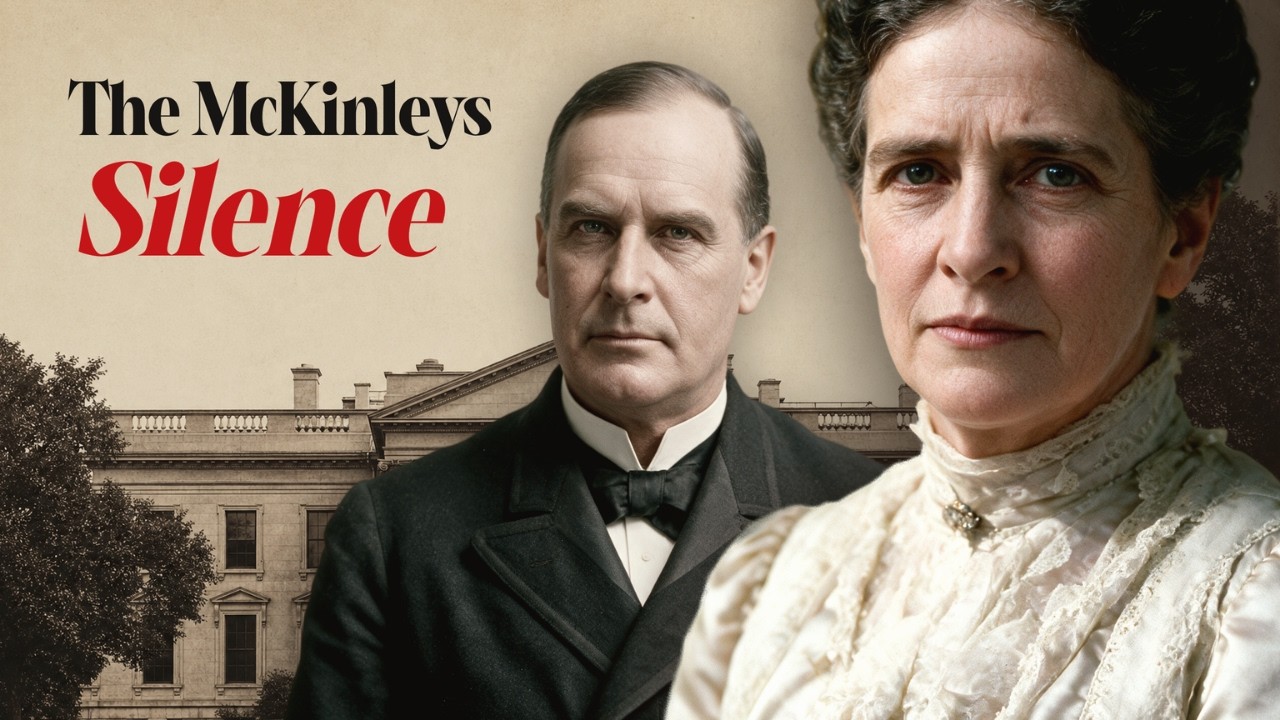
” The “her” was Ida McKinley, the First Lady, who was waiting a mile away and did not yet know anything had happened. For thirty years, William McKinley had built his entire public life around protecting his wife from the world, and the world from the truth about her condition. The story began long before the White House, in a bank in Canton, Ohio, in the summer of 1870, where a young woman named Ida Saxton worked as a cashier. Her father, a wealthy and unusually progressive banker, had made her a teller at a time when respectable young women were expected to do little more than wait for marriage.
Ida was sharp-tongued, independent, and unaccustomed to being directed by anyone. After an extended European tour of Europe with a companion she openly clashed with, she had returned to Canton and taken charge of her father’s ledgers with an efficiency her male elders did not question. A young lawyer named William McKinley, a 27-year-old Civil War veteran who still preferred the rank of major, began inventing reasons to visit the bank. By most accounts, she rejected his first advances outright.
He courted her patiently, in writing when visits were not possible, letting her decide her answers in her own time. On January 25, 1871, the couple married in Canton. A thousand guests filled the church and grounds. Her father gave the couple a house to begin their marriage.
That first year, they seemed exceptionally fortunate. William’s legal career rose; a daughter, Katherine, was born that Christmas. A photograph survives from that period showing Ida at ease and laughing, a woman who had not yet learned what grief was about to cost her. Within two years, that ordinary happiness began to collapse.
In the spring of 1873, Ida was pregnant again. The second daughter, also named Ida, was born in April. The birth nearly killed her. The infant was weak from the start and died within months.
Accounts conflict over exactly when. By the end of that summer, the second Ida McKinley was dead. Six weeks later, Ida’s mother died. What followed inside the house was never documented.
She suffered headaches, then seizures. In the social vocabulary of 1873, epilepsy was not a word the family used. It suggested madness, moral failure, or a woman too weak for ordinary womanhood. The family called it nerves and a delicate constitution.
For nearly two more years, little Katie was the one fact that held the household together. In 1875 or 1876, at around age four, Katie fell ill and died. By the time of that second small funeral, William and Ida McKinley had lost both children. They never had another child.
The woman who came out of that grief was not the woman who had run her father’s bank. Her seizures became more frequent. Phlebitis in her legs made walking painful. Those who loved her began to describe her as an invalid.
William did not accept that description of his wife. That year, 1876, William McKinley was elected to the U. S. House of Representatives.
Ida insisted on going to Washington, determined not to survive as something fragile. Washington did not make the task easy. Congressional life demanded endless dinners, receptions, and occasions where a political wife was expected to remain calm and unremarkable. Ida’s seizures came without warning, sometimes mid-conversation at a full table.
William was prepared. He carried her medicine with him wherever they traveled. When Congress kept him in Washington and she remained behind, he wrote constantly, signing every letter the same way: “Your loving husband. ”
By the time McKinley was elected governor of Ohio in 1892, the arrangement had taken a recognizable form.
Cabinet protocol required the governor’s wife to sit at the far end of the table by rank. McKinley broke that rule without apology: Ida sat beside him, close enough to reach within a moment and without rising. At one such dinner, a young lawyer named William Howard Taft, decades before his own presidency, heard a faint hissing sound from behind the governor’s shoulder and turned to see McKinley lift a handkerchief from his coat, place it gently over his wife’s face, then fold it away and resume his conversation as if nothing had changed. The idea behind the design was that the world should never notice what was happening.
People repeated the story of the governor’s devotion not as scandal but as legend. Newspapers of the era mentioned only “fainting spells. ” The entire capital city learned the same implicit agreement: no matter what they witnessed, they would not say it in print. By 1896, the handkerchief traveled to Washington with the family, to a house the nation would observe.
Campaign advisers made an unusual decision during the presidential race: they allowed the country to see this, releasing a campaign biography that presented her illness as evidence of strength, facing personal tragedy rather than weakness. It was the first time in American history that a candidate’s wife was the subject of her own published biography. The word epilepsy was never named. She won the presidency in November 1896, and Ida McKinley became First Lady in March 1897.
At the evening inaugural reception, she stumbled. She regained her balance before anyone could reach her, and nothing was in print the next day. Within the White House, the Ohio arrangement simply expanded onto a larger stage: protocol officers were overruled without debate, and Ida sat at the president’s side. The letters continued, the same formula, “Your loving husband.
” By 1899, the United States took control of Cuba, Puerto Rico, and the Philippines after the war with Spain. According to a presidential military aide, Colonel Benjamin Montgomery, Ida’s quietly persistent pressure, especially on behalf of Methodist missions in the Philippines, helped tip her husband’s decision toward retaining the islands rather than relinquishing it. In 1899, on her urging, McKinley appointed General Leonard Wood to command U. S.
forces in Cuba. Ida McKinley also became the first First Lady of her position to publicly support women’s suffrage, a cause that took another two decades to become law. In the summer of 1901, planners prepared for the president’s appearance at the Pan-American Exposition in Buffalo, New York. Ida’s health was fragile that spring.
William insisted that she come anyway, as he had never once allowed a public occasion to matter more than keeping her near him. On September 6, 1901, the Temple of Music was filled not with an orchestra for a concert hall, but a reception line. McKinley stood near the entrance shaking hands with every citizen who wanted to shake his hand. A young man, Leon Czolgosz, age 28, approached with his right hand wrapped in a handkerchief, as if injured.
McKinley reached for it. Two shots nearly together. McKinley rose slightly on his toes, then fell. Guards seized the shooter and began beating him.
McKinley, already bleeding, ordered them not to hurt his attacker. Before doctors arrived, before anyone knew he would live another hour, he turned to his secretary and spoke his one coherent instruction: worry about how to tell his wife. For thirty years, he had done that single task with his hands, leaning down, covering her face, folding the truth away before it reached her. Now his hands were useless, and all that remained was one sentence, spoken to the man who could carry the message.
Doctors performed surgery that evening in a private house near the fairgrounds without adequate electric light. They could not find one of the two bullets. For days, reports were cautiously optimistic. Ida was brought to his bedside immediately, sitting near him as she always did.
The infection, gangrene spreading quietly under the surgical wound, killed him on September 14, eight days after the shooting. He was 58 years old, leaving behind all the seating charts, the folded handkerchief, and everything he had built for 30 years of care. Ida did not attend the funeral in Washington. She was not strong enough for the train trip, the crowds, the rotunda.
She waited in Canton, and when the funeral train arrived, she found strength to stand through the ceremonies, dry-eyed and upright. Then the crowds went home, and Ida returned to the house on North Market Street with her sister, who moved in to care for her for the rest of her life. Each morning, when weather allowed, Ida walked to the cemetery where William was temporarily buried and sat with him for a time before walking home, for nearly six years. On the main chair where Ida sat and near her, a photograph of Katie, the daughter she had lost at under four years old, which Ida had not let fade from her memory for 32 years.
She never had a seizure after William died. In early May 1907, she caught a bronchial infection, developed. Fatal stroke followed within days. Ida McKinley died on May 26 in the house on North Market Street, the same house where, according to more than one account, she had been born nearly 60 years before.
She did not live to see the McKinley memorial completed in completed form. They moved her and placed her beside William in that place, beside her the two small graves waited for decades to complete the family again. No handkerchief remains. No museum cabinet preserves the one William McKinley is said to have carried folded and ready for thirty years.
What remains is the dying sentence: “Be careful how you tell her. ” Four small graves, one memorial, and silence that was finally hers alone.