In December 1974, a king in exile made a public promise to his nation about his mother. Constantine II of Greece pledged to keep Frederica, the former queen, away from the country and away from politics. The promise was not enough to save the crown, and 69% of Greeks voted to end the monarchy. The woman at the center of that political drama was buried at Tatoi, the royal estate north of Athens, on February 6, 1981.
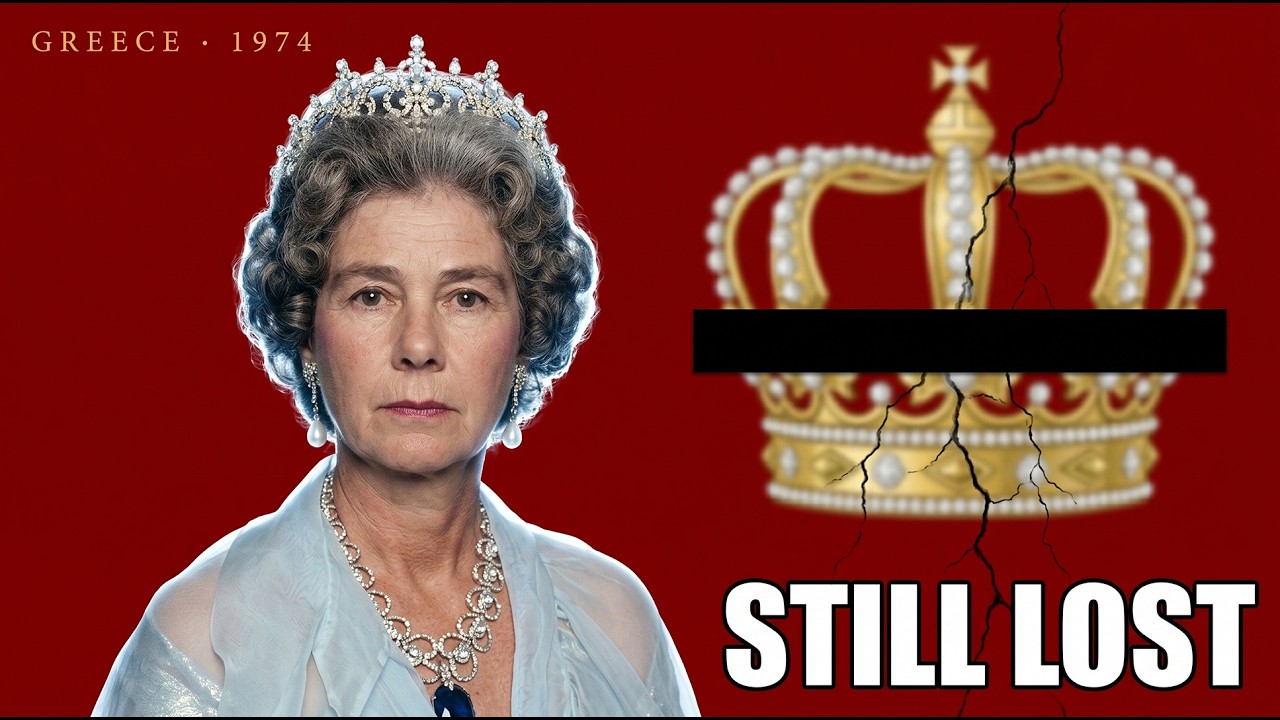
Her son, no longer a king, flew in from London for the funeral under strict conditions. The former royal family was permitted to attend the burial, then required to leave Greece immediately. He stood at the grave and calculated how long he was allowed to remain. Frederica of Hanover was born in 1918, a granddaughter of Kaiser Wilhelm II and a great-granddaughter of Queen Victoria.
She was 20 when she married Paul of Greece in January 1938, choosing his country with complete commitment. That deliberate choice would shape the rest of her life as she became one of the most consequential queens consort in modern European history. Her early years in Greece were marked by crisis. During the Greek Civil War between 1946 and 1949, Frederica organized a network of children’s homes, refugee shelters, and welfare programs reaching into the hardest-hit regions.
In early 1948, with her husband bedridden in Athens, she traveled toward the besieged town of Konitsa. Her vessel narrowly avoided a naval mine near Preveza. She later described that visit as one of the most significant experiences of her life. Paul became king in 1947, and Frederica was praised in the international press as modern and grounded.
The couple’s partnership worked as a system of complementary temperaments, with Paul providing institutional weight and Frederica supplying energy and initiative. For years, Greeks responded to her with genuine warmth. But the qualities that made her effective in wartime became liabilities during peacetime. Frederica intervened directly in electoral politics and actively campaigned against Prime Minister Alexandros Papagos, the decorated field marshal who had twice defended the dynasty.
Left-wing politicians also used her German ancestry against her. Her grandfather was Kaiser Wilhelm II, two of her brothers had served in the SS, and she had briefly belonged to the Hitler Youth as a teenager. Supporters argued the membership was circumstantially required under the conditions of early Nazi Germany and that she left as soon as she could. The arguments were technically honest but politically insufficient in a country occupied and devastated by German forces.
In 1963, demonstrations outside her London hotel became violent, forcing Frederica to take refuge in a stranger’s home. That same year, the assassination of left-wing parliament member Grigoris Lambrakis was found to be a political killing involving high-ranking officials with ties to the palace. The monarchy, whether directly responsible or not, became entangled in public perception with the kind of power arrangement that produced it. Paul died on March 6, 1964, after surgery for stomach cancer.
His son Constantine ascended the throne at 23, young and personally popular but with no governing experience. Frederica withdrew from official duties after Constantine married Princess Anne-Marie of Denmark. Opposition politicians long claimed she remained the real decision-maker behind her son, an accusation that is still disputed. The more the opposition pointed at her, the less Constantine’s authority appeared to originate from him.
On April 21, 1967, a military junta seized control of Greece. When a tank was parked outside Frederica’s residence that night, she returned inside wearing her highest military decoration, earned during the civil war, and told the officer she had earned the right to come and go. She did not leave. Constantine attempted a royalist counter-coup in December 1967, failed, and fled with his family into exile.
The junta fell in July 1974, and a referendum on the monarchy was scheduled for December 8. Constantine campaigned from outside Greece, acknowledging past errors and describing a restrained, accountable monarchy. His most publicly noted promise was to keep Frederica away from Greece and Greek politics. He named his mother as a condition of his potential restoration.
Greeks voted no, and the monarchy was abolished. Constantine’s public promise implies the institution fell because of Frederica. Yet her political presence was a symbol of deeper structural failures. She had not caused the 1967 coup, nor the counter-coup’s failure.
Symbols do not bring down monarchies alone. When he named his mother, he was finding a way to name those failures without accepting responsibility for them, and 69% of Greeks recognized the difference. Frederica’s story resists a simple verdict. She was described by credible voices across many decades as the most dangerous person the monarchy ever produced.
She was also capable, politically astute, and more effective at building networks and making decisions than her husband. The problem was the visibility of her capability. A queen consort was not supposed to have political strategy. Frederica would not fit inside that frame, and opponents built a sustained case around her.
She published a memoir in 1971 titled “A Measure of Understanding. ” It was controlled and reflective without being confessional. She recorded what she had done and left the interpretation to others. The restraint itself is revealing for a woman who had spent decades in active political life, accused of being a Nazi, a manipulator, and a danger to democracy.
Frederica spent her final years moving between Rome, London, and Madrid. She died in Madrid on February 6, 1981, at 63. The reported cause was heart failure during what was officially described as routine eyelid surgery, though a biographer later noted the procedure was most likely for cataracts. Even the manner of her death became a site of minor disputed fact.
She was buried at Tatoi beside Paul. The monarchy she had served had been gone for seven years, and the ground was still Greek. She was allowed to enter it one last time, and her family was required to leave immediately after. The story of a woman who had crossed a naval minefield to reach a besieged town, who had appeared on the cover of Time magazine, and whose political presence was considered so consequential that her own son had to promise a nation to contain her, ends at that grave with a family counting the minutes.
She loved Greece. Greece could not hold what she was. The institution fell, and she was buried under the trees she had chosen.
The life was larger than the frame constructed to contain it, and it was lived all the way to the end without anyone managing to resolve the question of what she actually meant.