The last shooter stepped to the firing line, his hand wrapped in a bloodstained cloth. Silence fell over the crowd. He fired at a steel target a thousand yards away, waited for the muffled echo to roll across the farmland, and then the crowd erupted—on ground that would one day hold people who had not come to cheer for anyone. On that same ground, on October 3, 1967, Woody Guthrie died in a state hospital bed at age 55.
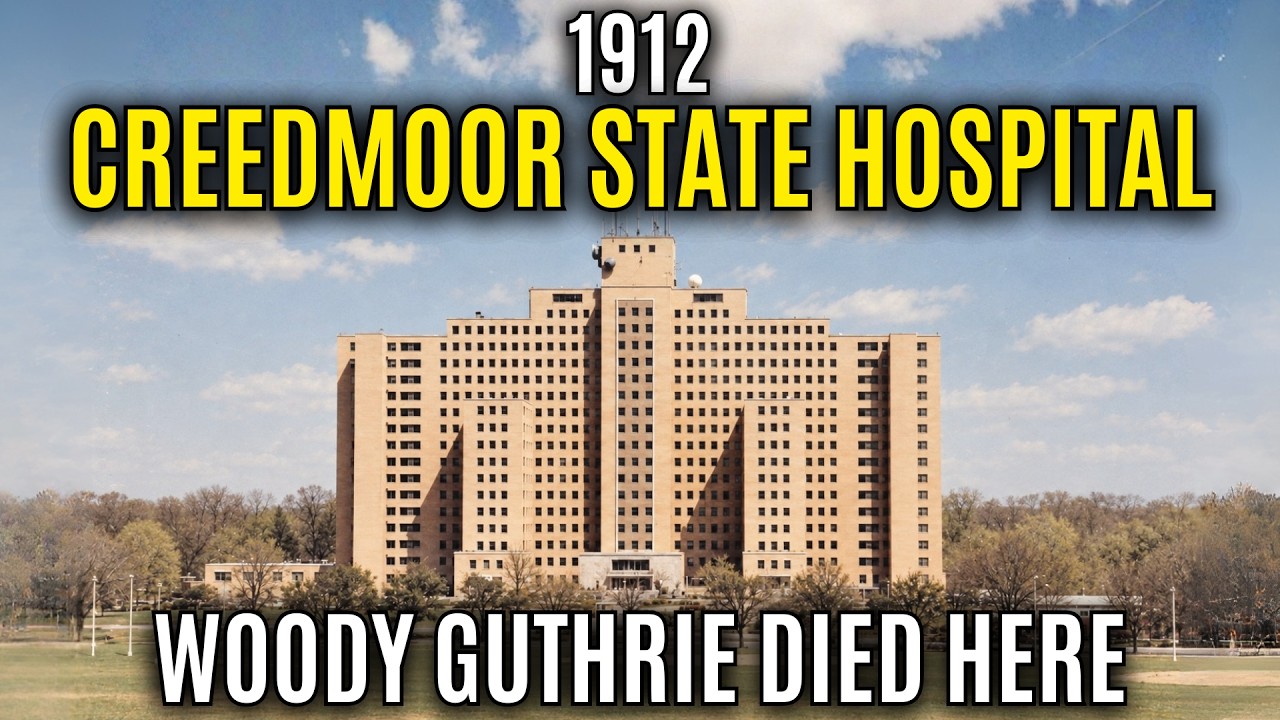
The man who wrote “This Land Is Your Land” could no longer speak a sentence or hold a guitar. This is the full story of Creedmoor State Hospital, the asylum where Woody Guthrie died. It was a colony built to relieve pressure on an overcrowded hospital—and it became the most overcrowded hospital in the city in its own right. It was supposed to be a farm, a place where fresh air and fieldwork would calm troubled minds.
It became a city of locked wards the state never stopped filling. Restraints, electric current, insulin coma, a man who died from a wound to his throat on the floor of a maximum-security ward. And the state still uses the land to contain whatever surplus arrives next. But this story does not begin in 1967, and it does not begin with a shooting match.
It begins in 1872, on a farm owned by a family named Creed. In 1872, eastern Queens was still farmland, and a wide, flat piece of it belonged to that family. Visitors who thought the land resembled the plains of Britain began calling it “Creed’s Plains,” and the two words merged into one: Creedmoor. That year, according to history compiled by the site Forgotten New York, the state and a new organization called the National Rifle Association took more than 70 acres of the Creed farm to build a long-distance shooting range.
Available documents do not show how much the Creed family was paid. The range opened officially on January 21, 1873. Within two years, it hosted the most famous sporting event in the country. On September 26, 1874, a team of Irish shooters who had arrived in New York ten days earlier lined up against an American team.
Each man fired 15 shots at three distances, the longest more than half a mile. America won, 934 to 931. Accounts differ on how many people watched. One modern account says about 5,000.
Harper’s Weekly, quoted decades later, said 8,000. A publication from the rifle association itself put the number above 10,000. Before the day ended, the Irish captain, Arthur Leech, revealed a large silver cup and presented it to the American riflemen. That cup became a permanent trophy, and the competition for it continues to this day.
Remember that cup—silver turned out to last longer than almost anything else that happened on this ground. The crowds did not last. Neighbors complained about the shooting, public interest drifted elsewhere, and the firing stopped. Sources disagree on the exact date—1892, 1907, 1908, or around 1910.
By the time the last rifle went silent, the state had found a new use for the land. Thirteen miles away in Brooklyn, the state was running out of room for a different kind of crowd. The state hospital then known as the Long Island State Hospital, later Brooklyn State Hospital, was overcrowded and getting worse. The first precise count available, from 1917, reported 925 patients in a building designed for 637—roughly three people for every two beds.
The hospital found one solution of its own. East of its grounds lay an old potter’s field where the poor of Kings County had been buried for years. The state wanted to build on that cemetery, so the city’s Department of Charities was asked to remove the bodies buried there over the previous two years. That summer, according to the same journal, hundreds of bodies were dug up and moved to make room for patients.
But the state had chosen its larger solution years earlier. Under legislation passed in 1908, New York took control of the Creedmoor land, 192 acres according to a survey done by the hospital itself. When officials considered abandoning the project, they held onto it for a practical reason, noted in the 1912 annual report: finding another suitable site on Long Island would be extremely difficult. In April of that year, the governor signed a comprehensive bill with a budget of $50,000 to begin construction there—a rail transfer station, a power plant, and cottages.
What did the state plan to build on the site of an old shooting range? The idea carried a name: the Farm Colony. No founder is credited, at least not in the records that survive. What remains is the belief common to hospitals of that era: people worn down by crowded cities could be treated with fresh air, open land, and the steady discipline of working in the fields.
New York was already trying this on Staten Island at a place called the New York Farm Colony. Creedmoor would be the Brooklyn version. The idea deserves to be taken seriously because it was humane. It assumed patients could work and recover, that they could be trusted outdoors.
It treated the countryside itself as medicine. In the summer of 1912, the idea became 32 people. According to the hospital’s 1912 annual report, they were moved into one of the twelve old military buildings left by the National Guard and began working just over 40 acres of farmland. The report says they were carefully chosen and notes why that mattered: no complaint had been received about their presence in the neighborhood.
Think about what that sentence measures. Not whether the patients were improving—but whether the neighbors objected. There was a financial side too. Later historical accounts describe farm labor partly as a way to offset the cost of housing and feeding patients.
Fresh air as treatment, work as treatment, and the harvest as a way to pay the bill. Remember that line about the neighbors. A century later, neighbors would have a great deal to say about who would be housed on this land. To understand how that simple idea changed, you have to look at what the state built next—and who built it.
According to the Encyclopedia of New York City, new buildings rose at Creedmoor in 1926, 1929, and 1933. By then, Creedmoor was no longer a branch of Brooklyn State Hospital but an independent state hospital of its own, though the available sources do not give the exact year of independence. The designers were the state’s own engineers. Louis Belcher, who served as state architect, designed the power plant—a Romanesque-style coal-fired building whose fuel arrived via a Long Island Rail Road branch from Floral Park.
His successor, William E. Haugaard, state architect from 1928 to 1944, designed Building 18, which resembles an assembly hall. Haugaard’s other projects show what kind of architecture the state was buying in those years: prisons, hospitals, armories, and office buildings, all from the same government office. The Depression brought the labor.
Under the Works Progress Administration, federal relief workers laid underground heating pipes, dug steam tunnels between buildings, leveled the ground, planted trees and shrubs, and fenced the site. Those tunnels still exist today. The fence was the first thing that made the colony look the way it does now. Available documents do not show the total cost, or how far it exceeded the original estimate.
The building everyone remembers was built last: Building 40, a yellow brick tower visible from miles away along the Grand Central Parkway. It was built to hold 1,068 patients. One source says it was 17 stories and opened in 1957; another says it was completed in 1959. The sources disagree on the date.
Its design is nearly identical to the Manhattan Psychiatric Center on Wards Island—another yellow tower across the city. It was as if the state had found a solution and decided to repeat it. The beds are evenly divided, which means about 63 people per floor. Imagine a single hallway with 63 people in it, then imagine 16 more hallways stacked on top.
Today the campus spans more than 300 acres and includes more than 50 buildings. One historical source says the campus had 70 buildings in the 1930s. Every building was built for the same reason: to solve overcrowding. They all filled up.
This is what the place became: a complex built to relieve pressure on one overcrowded hospital, then grown building by building into the most overcrowded hospital in the city. For a time, the original idea worked well. In 1919, an engineer from the Department of Health toured the farm and recorded his observations, according to that year’s annual report: 195 acres, mostly under cultivation; milk from a herd of five cows; hospital waste hauled over to feed the pigs. Had you visited, you would have seen a pleasant rural scene: a working farm on the edge of the city, patients in the fields, livestock fed from the kitchen.
The farm persisted in one last form: the Adriance Farm, which survived the housing projects that swept through eastern Queens because it sat inside the hospital grounds, with patients tending its crops and animals. It became the city’s last farm colony. By mid-century, Creedmoor also had something to be proud of: a research institute. The Creedmoor Institute for Psychobiologic Studies brought together three Brooklyn brothers—Arthur, Mortimer, and Raymond Sackler—with a psychoanalyst named Johan van Ophuijsen.
In 1950, their group published research on “Sex Hormone Therapy in Psychiatric Disorders” and presented a summary at the American Psychiatric Association’s annual meeting in Detroit on May 1 of that year. The farm colony had become a center for studying the biology of mental illness—which sounds like progress until you notice who the subjects were. The patients did not write the papers. They were the material.
The available sources do not record how Creedmoor was run during those years, who the supervisors were, or what outcomes they reported. The documents are incomplete, and that incompleteness is part of the record. But the first warning in the file comes from the same 1919 inspection, three decades before the research institute was founded. The cow barn, where the cows were milked, was an old wooden structure the inspector found in unsanitary condition.
The pigsty was unsatisfactory as well, and some garbage barrels were uncovered. Sewage drained into two large pits about 300 feet from the building. The inspector made four recommendations: cover the garbage, build a proper pigsty, pasteurize the milk, and finish the sewage treatment plant. That was the farm colony at its best—and the state’s own engineer was filing the report.
So who was sent here, exactly? In 1919, the Department of Health recorded the admission rule in a single line: the hospital accepted all classes of mental patients except insane criminals. That is the entire recorded standard—not a diagnosis but a category. The parent hospital’s 1917 report shows what that category looked like on arrival.
There were 626 admissions in one year. According to the report, at least 51 percent were of the “weak and exhausted” or “acute maniacal” type and were carried in on stretchers. “Weak and exhausted” is institutional language for people so weak, so sick, so worn out they could not walk—people who had nowhere else to go. The physically able were sent to another state hospital at Kings Park.
More than half of the people admitted could not walk. This continued for decades, and the records show how easily a life could slide into this fate. Mary Ellen O’Brien, mother of the painter Elaine de Kooning, was admitted to Creedmoor for a year after being reported for neglecting her children. That is the documented reason—not a diagnosis, just a report.
Then there is the man you came for: Woodrow Wilson Guthrie. He was born in Okema, Oklahoma, on July 14, 1912. Look at that date again—the same summer the first patients arrived at Creedmoor to work the fields. The songwriter and the hospital began in the same season, and they would end up in the same place.
Guthrie’s mother, Nora, had a disease no one around her could diagnose. She was misdiagnosed with some form of muscular degeneration and dementia, and she was committed to the Oklahoma State Mental Hospital, where she died in 1930. Her son inherited the disease. In his late 30s, the man who had traveled the country with his guitar became moody and unpredictable.
Doctors in New York diagnosed him with everything from schizophrenia to alcoholism. He had neither. He had Huntington’s disease—a hereditary, degenerative neurological disorder with no cure, destroying muscular coordination. In the 1950s, the standard treatment was commitment to a mental hospital.
There was no other kind of building to house him. In September 1954, according to one biography timeline, Guthrie entered Brooklyn State Hospital. Another account places his first admission that year at Greystone Park in New Jersey. The sources disagree.
By May 1956, he was at Greystone in Morris Plains, where he was diagnosed with Huntington’s disease—the same disease that had hospitalized his mother. In the spring of 1961, he was transferred again to Brooklyn State Hospital. For a time, his wife Marjorie brought him home on weekends. She bathed him, mended his clothes, fed him chocolate cake and hot dogs to build his weight back.
Friends visited to play his songs for him. In 1966, he was transferred to Creedmoor. The reason was specific: a young doctor named John Whittier, the research director there, had begun studying Huntington’s patients. Guthrie did not come to Creedmoor to be treated.
He came to be studied. The sources do not give the month of his arrival. By then, he had lost control of his muscles. Marjorie taught him to answer by blinking his eyes.
A man credited with a thousand songs—or more than 2,500, or nearly 3,000, depending on the account—now spoke with his eyelids. The length of his institutional stay is disputed too: one account says 12 years, another 13, another 15. His journey ended at Creedmoor, after which his family scattered his ashes in the waters of Coney Island, where they had lived. Guthrie did not enter a state hospital because of anything he had done.
He entered because the building existed. That is the central idea of this story, told through one life. The place was not a result of diagnosis. It was a result of convenience.
And the convenience turned out to be limitless. In 1918, six years after the colony opened, its population was 150, still housed in the old National Guard barracks. The plans kept growing faster than the buildings. In 1912, the state architect submitted plans for an institution of more than 2,000.
By 1917, talk had reached about 2,500 for Creedmoor alone. In 1919, the Department of Health counted Brooklyn State Hospital and its Creedmoor farm together: 441 men and 603 women—1,044 patients in space built for 800. By the 1940s, according to the Encyclopedia of New York City, there were 6,000 patients in a hospital with a stated capacity of 3,300—nearly two people per bed. Then came 1956: 6,018 patients in a facility certified for 4,188.
That left 1,830 people with no certified place to stay. The ratio was almost exactly three people per two beds—nearly the same ratio recorded at Brooklyn State Hospital in 1917, the very overcrowding Creedmoor was built to relieve. Four decades and one tower later, the state had rebuilt the original overcrowded facility at more than six times the size. Then came the peak.
By 1959, the hospital held 7,000 people—the figure most historians favor. One account puts the peak at 8,000. The sources disagree. Consider what 7,000 means: if one doctor gave each person a single minute of attention, one after another, without sleep or breaks, it would take nearly five days to see everyone once.
The available sources do not record the smell of those wards, or their sound, or what the patients felt in August or January. The people who could describe it were mostly never asked. But the record preserves one of the results: in the 1940s, the hospital came under scrutiny after an outbreak of dysentery attributed to unsanitary conditions in the wards. The available documents do not show the number of patients, or the number of deaths.
The causes, stated plainly in the encyclopedia: understaffing and insufficient funding. The warnings were old. The parent hospital’s overcrowding was documented on paper in 1917, the farm’s poor sanitation in 1919, and the gap between beds and bodies every year after. Despite nearly forty years of documentation, the wards kept filling.
You might expect what happened next had a dramatic cause. It did not. What happened in Creedmoor’s treatment rooms over the following decades was not simply sadism, though the records show cruelty. It was not secret science in a hidden basement, though research was conducted there.
It was not only a budget crisis, though the money was never enough. It was much simpler: a schedule, two or three times a week. That phrase, from a patient’s record in 1948, is the real engine of that era. A hospital holding thousands of people beyond capacity does not need a monster.
It needs a routine—a procedure applied to patient after patient on set days by a small staff, producing a calmer ward by the end of the week. The treatments that reached Creedmoor during the crowded years were wildly different—water, chemistry, electricity, surgery—but each was delivered the same way, on a schedule. A schedule can be repeated, and that is the point. The treatment had to work; the schedule only had to be maintained.
This is the part of the story most accounts skip or compress into a single word like “shock therapy. ” But if you want to understand how a farm colony became a place people remember with dread, you have to track the chronology tool by tool. The first tool was water. According to the Encyclopedia of New York City, hydrotherapy was among the treatments offered at Creedmoor during its crowded decades.
There the record stops: the available sources do not show how the water was used, how long a patient spent in it, or how many patients received it. The second tool was insulin. In the same years, Creedmoor patients were given what was called insulin coma therapy. The name describes the goal.
The number of people subjected to it here is not recorded. The third tool was chemistry, and it came with the research program. At the Creedmoor Institute, the Sackler brothers and van Ophuijsen wrote a paper titled “Technique of Biochemotherapy with Histamine and Suggestions for Its Use in Psychiatry. ” The paper survives in a university archive in Oregon.
It is a technique designed for use on patients. The archive does not record how many Creedmoor patients received it. The fourth tool was electricity, and here, finally, the record has a name and a date. Put yourself inside the situation.
You are a jazz pianist. You have been in this ward for just over two months. On February 4, 1948, the treatments begin. They run through February, March, into April.
On April 5, they stop. Your record contains a single phrase: “no improvement. ” Two weeks later, they start again—a second series. According to the timeline compiled by the pianist’s biographer, it produced a similar number of induced partial comas.
No one needed your consent. No one asked. The pianist was Bud Powell. Electric shock treatment did not cure him—that is what the record itself indicates.
Eleven years later, in the summer of 1959, the parents of a teenager from Freeport, Long Island, brought their son to Creedmoor on a psychiatrist’s recommendation. He received 24 electroshock treatments on alternating days. His sister later remembered watching their parents help him home afterward. He could not walk.
He was in a daze. She said the treatments damaged his short-term memory for the rest of his life. His name was Lou Reed. Here, the story most people know goes beyond the record.
The popular account claims his parents sent him for electroshock therapy to cure his homosexuality. That story spread among rock biographers. Victor Bockris’s 2015 book about Reed described how his family sent him away to be treated for his behavioral problems and apparent homosexuality. The story has repeated ever since.
In 2015, Reed’s sister, Merrill Reed Weiner, addressed it directly. She called the interpretation simplistic. She wrote that her brother suffered from depression, anxiety, and withdrawal, and that the treatment was a last resort for frightened parents who had been told by doctors that they were the cause. The record does not entirely settle this.
She is one witness, but she is the only family witness on record, and she contradicts the famous story. And the famous story is not gentler. Twenty-four sessions; a boy who could no longer enter his own home. It remains devastating either way.
The fifth tool was the knife. According to the Encyclopedia of New York City, lobotomy was performed at Creedmoor in a small number of cases. The available documents do not specify the number, who received it, or who performed it. The sixth tool was a pill.
In 1955, tranquilizers and antidepressants came into common use across the state hospital system. At Creedmoor, as the encyclopedia records, they meant calmer wards, fewer injuries to staff and patients, and a significant rise in the number of patients able to manage daily life outside the hospital. Notice what comes first in that list: calmer wards. The record shows no moment when the state decided an old tool was wrong.
It shows only that each new tool kept the wards calmer than the last. Bud Powell arrived as many did, through a chain of institutions. On November 14, 1947, he got into a fight in a Harlem bar. A punch to the face led him to Harlem Hospital, then Bellevue, and ten days later, he was admitted to Creedmoor.
While there, on June 1, 1948, his only child was born. From the hospital, he insisted she be named after the patron saint of music. Her name was Celia. On October 23, 1948, Creedmoor released him in what it called convalescent care.
His biographers call it parole—an institutional word for freedom the hospital could take back at any time. On January 9, 1949, while he was performing at a club, something happened. He was found to have violated the terms of his release and was returned to custody. But the same door opened for very different people.
Robert Torsney was a New York City police officer. On November 25, 1976, in Brooklyn, he shot and killed a 15-year-old boy named Randolph Evans. Torsney was acquitted by reason of insanity, and in December 1977 he was committed to Creedmoor. In July 1979, after a psychiatric review found he no longer posed a danger, he was released.
Creedmoor’s director, Dr. William Werner, said he had recovered from a psychotic episode. George Metesky, known to New York as the “Mad Bomber,” was committed to the facility in 1973 and released the same year. In 2007, a patient known in court only as Simone D.
won a ruling that overturned an order issued two years earlier allowing doctors to subject her to electroconvulsive therapy against her will. She spoke Spanish and had not been transferred to a unit with Spanish-speaking doctors. The person who worked hardest to change the situation was not on the hospital staff. She was married to one of the patients.
Marjorie Guthrie spent twenty years as a core member of Martha Graham’s dance company and met Woody in 1942. When he became ill, she was told his case was hopeless. By her account, she accepted that for years. Then she stopped accepting it.
She went to Dr. Whittier, the head of the research institute, where Woody was a patient, and said she wanted to help. The scientist told her what they desperately needed: finding families. The disease was hidden, he said; people who knew they carried it were too ashamed to tell anyone.
So she placed a small ad in a New York City newspaper. A handful of volunteers responded, and with five of them she formed the Committee to Combat Huntington’s Disease. The committee was officially founded on September 18, 1967. Fifteen days later, Woody died.
She kept working for another 16 years, traveling to families, medical students, congressional committees, and state legislatures. From 1973 to 1977, she served on the advisory council of the National Institute of General Medical Sciences. Her committee became the Huntington’s Disease Society of America. The organizations that honor her credit her work with the discovery of the disease’s genetic marker—a claim her admirers strongly support.
She died in 1983. What it cost her personally is not in the records. A movement that changed how we understand the disease began in the one building that could study her husband but could not save him. But the person this place should memorialize is neither a celebrity nor a reformer.
She was a young woman from Queens Village, and for most of her life, almost no one outside her family knew her name. Just after midnight on Friday, June 16, 1978, she filled the bathtub. Days earlier, she had cut her hair in a bowl shape she liked. She washed her hair with shampoo and red mouthwash, believing the color would soak into her scalp and turn her hair red forever.
She was so delighted with her haircut that she imagined herself a mermaid from old Superman comics. As she stepped out of the tub, she slipped and struck the back of her head on the floor. In the emergency room, doctors found she had a psychotic disorder. She was sent to Creedmoor for the eighth time.
During her earlier stays, according to the Columbia Journalism Review account written about her, she was injected with Thorazine, strapped into a straitjacket for weeks, given electric shock therapy, and insulin coma therapy. She once described her illness as a cancer of the nerves. The journalist who followed her was Susan Sheahan. Accounts differ on how long she followed her—one says two and a half years, another says about a year.
Sometimes Sheahan slept on a cot in the hospital room. In 1981, the New Yorker published her findings in a four-part series called “The Patient,” which drew 500 letters from readers. In 1982, it became a book whose title was itself a question: “Is There No Place on Earth for Me? ” In 1983, it won a Pulitzer Prize.
Sheahan gave her the pseudonym Sylvia Frumkin. Publication changed the way she was treated, and she received more effective care, but it did not change the pattern of her life. She kept returning to hospitals in what she herself called the revolving door. She died in 1994.
The available sources do not state the cause of death. In the New Yorker’s epilogue, her real name was finally published: Maxine Mason. Her sister Trudy Mason was a Democratic Party activist. Her life before all of it is rarely mentioned.
One summary of the book says the illness appeared in her late teens. Almost everything else about the girl she had been before Creedmoor remains unrecorded. Bud Powell was a genius known around the world. Maxine Mason was a patient almost no one knew.
He was released for convalescent care, then returned to Creedmoor. She was released and returned seven times before any journalist met her. Two opposite lives. The same door.
The same revolving. If you follow the money in this land, it begins with a road. While the state was still deciding whether to keep Creedmoor, it sold nearly 7 acres to the Long Island Motor Parkway for a road that cut diagonally through the property. The price, according to the 1912 annual report as quoted, was $18,942.
The legislature returned the money to the hospital for alterations and new construction. Before the colony had built anything, it had begun funding itself by selling pieces of its own land. That habit never stopped. The most valuable thing to leave Creedmoor, however, was not grown in its fields.
It went out the gate with the research team. Raymond and Mortimer Sackler had studied skin burns for the Atomic Energy Commission at Creedmoor in the early 1950s. In 1953, according to Raymond Sackler’s obituary in the New York Times as published, the two were dismissed after refusing to sign the Army loyalty oath that would have required them to report colleagues for conversations considered subversive. Their older brother Arthur had already financed, in 1952, the purchase of a small Greenwich Village drug company called Purdue Frederick.
That company later became Purdue Pharma, and the family fortune came from an opioid painkiller called OxyContin. At Raymond’s death, Forbes ranked the Sacklers among America’s wealthiest families, with an estimated $18 billion. None of that fortune came from hospital revenues. The patients who were the subjects of the brothers’ early research do not appear in any of that wealth.
The records likewise do not show whether they were paid for their farm labor. The available sources show nothing about what the state spent per patient, whether the top job at Creedmoor was a political appointment, or how dependent the surrounding neighborhoods were on staff salaries. The documents are incomplete. Today the land is valued differently.
In 2023, the state agreed to cover the cost of an on-site shelter for a population with nothing to do with psychiatry. The amount is not stated in the available sources. The state now plans to turn most of the surplus land into housing. The most valuable thing left at Creedmoor is the empty space the patients once occupied.
$18,942 for a road cut through the site. Eighteen billion dollars for a family that began there. Some incidents at Creedmoor were documented and then left in the dark. In 1953, according to a newspaper report cited by the Asylum Projects archive, two patients overpowered an attendant and escaped.
Police in 13 states were alerted. The report says both men evaded capture. Where they went, or whether anyone ever found them, the available sources do not say. In 1977, according to a newspaper article cited by Atlas Obscura, a man committed to Creedmoor after killing his wife and child was allowed to roam the facility freely until the day he left.
The records do not state who allowed it, or what happened after he left. There are questions no one has answered for the families: where are Creedmoor’s dead buried? A researcher who spent years documenting New York state hospital cemeteries wrote that she is unsure whether Creedmoor had its own cemetery, and that it may have used public burial grounds. Descendants researching today report they can request a death certificate from the state, but historical patient records are withheld even a century later.
If your grandmother died in one of these wards, the state may tell you when. It may not tell you why or where she was buried. None of this proves a cover-up. It proves something more ordinary: a system that carefully recorded who came in and was much less careful about recording what happened to them afterward.
The rule of this story is simple: where the record stops, the story stops. In 1974, Creedmoor held about 2,200 patients—a fraction of its peak. Fewer people, but conditions had not improved. That year, Senator Frank Padavan made allegations covering the previous 20 months, as reported by the New York Times: three rapes of patients by employees, 22 assaults, 16 incidents of theft, harassment, and vandalism, 52 suspected arson fires, 130 burglaries and thefts, six suicides, a shooting, a riot, and an attempted murder.
The state’s director of institutional services confirmed the figures. Creedmoor’s director called them somewhat exaggerated. The sources disagree, and the available record does not settle it. According to AbandonedNYC, those allegations prompted an investigation of all mental hospitals in the southern part of the state.
Ten years later, the violence had a name. In May 1984, Roberto Venegas was a Colombian immigrant, recently admitted to the security unit at Creedmoor. What follows is quoted from an account citing the New York Times: staff decided he was agitated. A number of therapy aides sat on him.
In violation of regulations, he was placed in double restraint. First a straitjacket, then he was covered with a sheet. He was tied to a wall. He was beaten with a stick one of the attendants had smuggled into the unit.
Roberto Venegas died. An autopsy revealed a crushed throat. The accused attendant, Cecil Hines, denied everything. Hines said: “No one hurt Mr.
Venegas on the day he died. The only person who witnessed what happened was another patient. ” That witness’s testimony was rejected. In December 1985, after a swift trial, Hines was acquitted of all charges.
The report describes a series of procedural errors. “Procedural errors” is institutional language for a man restrained, tied to a wall, beaten, and dead with a crushed throat. No one was held accountable for his death. The sources documenting this sequence are fewer than they should be, and the full court record is not in the available sources.
The documents are incomplete. Creedmoor was not ended by a riot. No court order closed it. It shrank.
In 1975, its farmland opened to the public as the Queens County Farm Museum. The 47 acres where patients had worked became a school field-trip site. By 1991, there were 1,100 inpatients. By 2006, the number had dropped to 470.
It looks like an institution that finally recovered—until you realize what it means. Almost everyone who was here is now somewhere else. There is no record accompanying them. The hospital was never closed.
There was no final notice, no last day. The state simply abandoned the place, building by building, parcel by parcel. It stopped using some of those buildings and left them standing. Building 25 had been an active ward until sometime in the 1970s.
Then it closed. No one demolished it. In May 2012, a photographer named Will Ellis, who documents abandoned places for a site called AbandonedNYC, went inside. What he published is the most detailed available description of the empty building.
The lower floors look like any hospital abandoned long ago: peeling paint, dusty furniture, dark hallways. On the third floor, a cafeteria with its furniture stacked in piles, office equipment obsolete before it was left there. The fourth floor was different. For roughly forty years, pigeons had nested inside.
Their droppings had piled into gray mounds under the sprinkler pipes, some several feet high, like cave formations. And someone had been living inside—in a garbage-filled kitchen and a living room with arranged chairs, Ellis found a makeshift toilet, hundreds of empty batteries, and a newspaper printed only weeks before. Then he found the man himself, asleep in a sunlit living room. On the walls around him, old patient murals were beginning to show through the peeling paint: distant lands, country gardens, the Virgin Mary.
And then the bathroom. It looks ordinary—a sink and a wall where you expect to see your reflection, but there is no mirror. Instead, flat metal plates are mounted on the wall where glass should be, so a patient could never break the mirror and use it as a weapon. For as long as the ward operated, residents washed their faces in front of a metal plate.
This period—the decades Creedmoor sat abandoned and unwatched—is the source of the ghost stories, not the years of operation. In June 2013, about a year after Ellis published his photos, anonymous commenters on his page began reporting strange things. One said a woman’s ghost appeared in a photo of two armchairs when the colors were adjusted. Another said a face could be seen in the bathroom mirror.
The mirrors, of course, were metal. These are 2013 superstitions, attributed to strangers on a website. They prove nothing except how quickly an empty building fills with stories. The site still draws visitors.
In 2021, a reporter for Forgotten NY who was walking the grounds decided not to enter the abandoned buildings—a police car was nearby, and he feared arrest for trespassing. By 2025, the Queens Daily Eagle reported that the campus had become fodder for local ghost stories and urban adventures. How many people have been arrested there? The available sources do not say.
Building 25’s bricks still stand, and the metal plates are still mounted on the wall. The name “Creedmoor” spread much further than its patients ever did. Start with the Creed farm, which became “Creed’s Moor,” which became Creedmoor. In 1873, it was a shooting range; in 1874, it was famous.
Long after the shooting stopped, Creedmoor Sports—a company selling equipment to competitive shooters—took the name from the historic range. At the 2005 National Rifle Championships at Camp Perry, Ohio, according to the rifle association’s own magazine, Dennis DeMille of that company raised a problem with Dave Emary, the chief ballistician at Hornady Ammunition. In 2007, Hornady produced the solution: a rifle cartridge called the 6. 5 Creedmoor.
It has since become one of the most celebrated precision cartridges of the century. The name of one of the world’s most famous rifle cartridges is attached to a shooting range in Queens that became a mental hospital. And a legend has grown around this chain. One retailer’s blog, among others, claims the cartridge was named after the Creedmoor range in New York because it was first tested there and proved its accuracy.
It sounds plausible from the outside. It is not true. Do the math. The range had closed nearly a century before the cartridge existed.
There was no shooting range left in Queens to test it on. The accounts of how the cartridge was developed say it was named after Creedmoor Sports, which borrowed its name from the range. The real story is surprising enough: a name outlasted a farm, a rifle range, and most of a hospital building, and ended up printed on boxes of ammunition. The hospital has created its own confusion around Woody Guthrie.
In 1963, when Bob Dylan was asked to write a 25-word comment for a book about Guthrie, he sent a 194-line poem instead. In that poem, the place you go to find Woody is Brooklyn State Hospital. Because the poem is famous, people often assume Dylan’s visits to Guthrie took place at Creedmoor. They did not.
Dylan first met Guthrie at Greystone in New Jersey, and the poem was written three years before Guthrie was moved to Queens. Creedmoor has its own culture as well. In 1983, by most accounts, an art therapist named Paulick Gratczynski and a psychologist named Janos Marton founded a living museum in Building 75, a former café, where patients make and display their art. The Encyclopedia of New York City dates it to 1984.
It has been described as the first museum of its kind in the country, and the idea has since spread to hospitals and asylums around the world. A radio program hosted by Bill Moyers followed Creedmoor patients inside the hospital and after they left. In 2010, writer Katherine Olson spent weeks interviewing staff and patients in the women’s ward, publishing her findings in 2013 under the title “Something More Wrong. ”
This is the price of the popular version of Creedmoor.
The rifle and the rock star and the folk singer are remembered. The thousands of people who lived here without a song, a book, or even a cartridge to their name are not. If you searched for it today, you would find the hospital at 79-26 Winchester Boulevard in Queens Village, still treating patients. The land around it has been divided.
On the western edge, the abandoned buildings were demolished and 8. 5 acres were sold for private housing in a development called Country Pointe. Another parcel became a public school campus. One source dates the sales to schools and housing at 2001; another places the school campus at 2004.
Then, in the summer of 2023, the state’s land was used again as a shelter. The city planned a tent shelter for about a thousand single adult men seeking asylum in a parking lot on the Creedmoor campus. The tents went up within ten days. On August 15, 2023, the first arrivals came—about a hundred people.
The next night, hundreds gathered against the shelter, and at least 13 people were arrested. City spokesman Fabien Levy responded to the criticism with one line: “We don’t have good options left. ” Local officials objected to the site’s isolation, its distance from transit, jobs, and services. By December 1, 2024, about 1,270 men were staying there.
Officials later said no increase in crime could be attributed to them. On February 13, 2025, the governor’s office announced the shelter would close. Built to hold a surplus of patients from one hospital, the site was used a century later to hold a surplus of the city’s people. The next plan is housing.
In December 2023, the state proposed building 2,873 homes on the surplus land. Community leaders objected. Susan Peritz of the Rocky Hill Civic Association said any housing should be low-density. A petition gathered about 1,100 signatures.
Assemblyman Ed Braunstein said community views had been largely ignored. On the other side, Queens Borough President Donovan Richards said decades of failed plans had left the land abandoned and purposeless. Father Daniel Kingsley and Reverend Patrick O’Connor of the Queens Power Coalition argued that working New Yorkers were being pushed out of the city entirely. In August 2025, the housing unit count was reduced by 850.
In November 2025, the state approved building 2,022 homes, 950 of them affordable, to be constructed over roughly 13 years. Both sides have a point. The neighbors are right that the plan will change their community. The advocates are right that the land sat empty while the city ran out of housing.
Places like this met different fates. Willowbrook on Staten Island became a college campus. The old farm colony on Staten Island became a public park with ruins inside. Bloomingdale Asylum in Manhattan made way for Columbia University.
Creedmoor’s parent company in Brooklyn still operates under the name Kingsboro. Creedmoor got the middle status: a working hospital, some scattered ruins, and a long chain of plans for its land. In 1912, the hospital’s directors wrote one hopeful line in their first report about this ground: “There is no reason why the colony system should not be extended. ” They were right.
It was extended from a single barracks to a yellow tower holding more people than beds for most of a century. The founding promise was fresh air and useful work. The records show straitjackets, electric current on a schedule, and a man who died tied to a wall. Creedmoor was not an anomaly.
Accounts of that era describe hundreds of similar asylums and colonies built across the country at the turn of the century, repeating the same arc: an idea of healing, a building, a crowd, a collapse. And the arc did not end when the wards were emptied. It moved. Today, the largest mental health facility in New York City is not a hospital.
It is a jail. In October 2025, according to a report by the John Jay College Data Collaborative for Justice and the Katal Center, 60 percent of the roughly 7,000 people held on Rikers Island needed mental health services, and 22 percent had serious mental illness. Sixty percent of 7,000 is about 4,200 people—nearly the number of beds Creedmoor was certified for in its most crowded year. The city’s plan to replace Rikers with smaller neighborhood jails was estimated in 2019 at about $8.
7 billion. The jail now holds a population nearly the size of Creedmoor at its peak. They are sent there because it was convenient. Sent there because the city was crowded.
Sent there because a doctor, or a parent, or a court, or a neighbor wanted them somewhere else. Sent there because there was no other building. Think of everything this land has been. A family farm.
Creed’s Moor. A rifle range where a crowd cheered a bleeding shooter. National Guard barracks. A farm colony for the surplus of Brooklyn.
A state hospital. A research institute. A yellow brick tower. A security unit.
Ruins full of pigeons. A tent city. And now, on paper, a neighborhood of new homes. Some things have not changed.
Building 40 still stands over the parkway. Its bricks are still yellow, its windows still face the traffic. Most passersby do not know what it is. And the silver cup presented on this ground in 1874 is still competed for.
The Leech Cup has a history. It has a record of every winner. Where the many who lived and died on the same ground are buried, the record does not show. The bricks remain.
The silver remains. The record stays sealed. So the question is not what Creedmoor was. The record answers that.
The question is addressed to the state that built it, and to a country rebuilding it in other forms. When the next surplus arrives, when the hospitals and shelters and jails fill up, where will the people no one wants to see go? The land does not answer.
It just remains.