She was known to the world as the Jersey Lily, the clergyman’s daughter whose beauty captivated a future king and turned her into the most photographed woman of her era. But behind the legend of the great Victorian romance was a colder story—one of calculated escapes, buried secrets, and a daughter raised to believe her own mother was her aunt. Emily Charlotte Le Breton was born on October 13, 1853, at St. Saviour’s Rectory on the island of Jersey.
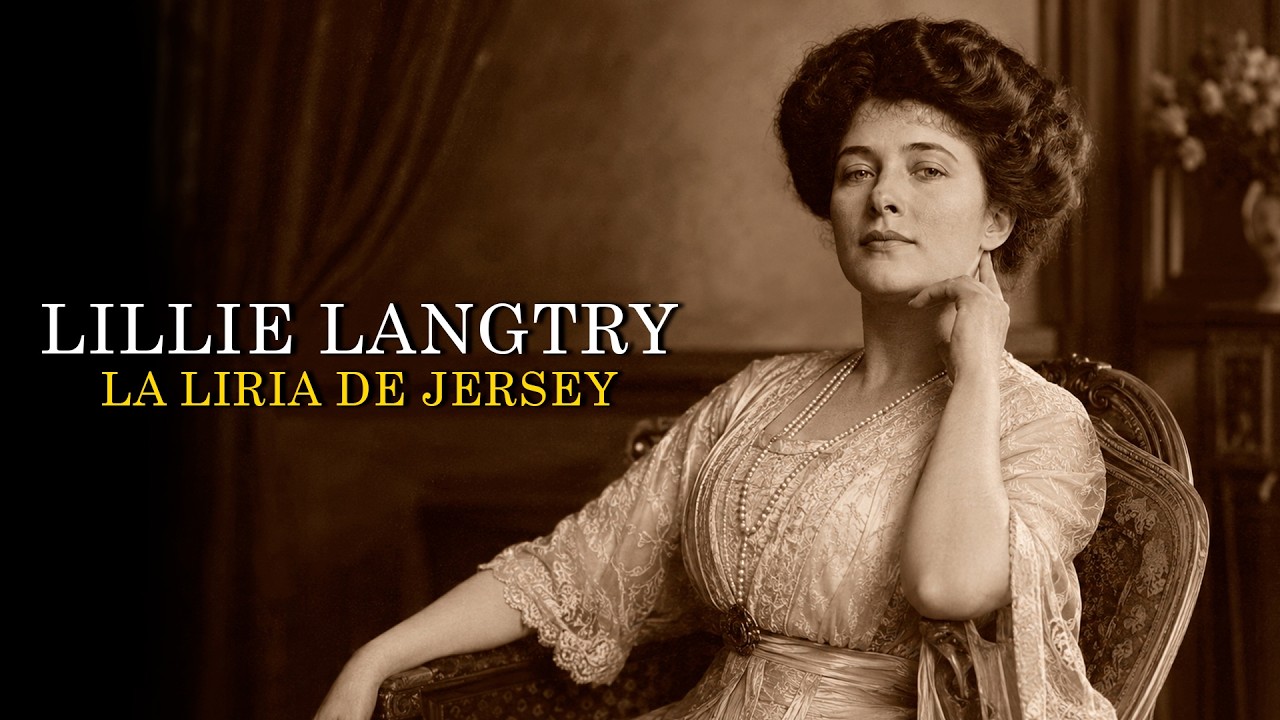
Her father, William Corbet Le Breton, was the Dean of Jersey and a respected clergyman who, in private, was known for fathering children with women from his own parish. Her mother, Emily Davis Le Breton, had been a celebrated beauty in her youth and left her husband in 1880. Growing up as the only girl among six brothers, she learned early that a beautiful surface could hide almost anything. She was educated in Latin, Greek, and French, and by her teens, she was already the beauty of the parish.
In 1874, she married Edward Langtry, a quiet, wealthy Irish widower. It was not a love match. She married him for his yacht, hoping he would take her away from the island. Weeks after the wedding, he sold the vessel.
When she fell ill with a fever, she persuaded her doctor—and through him, her husband—that she needed to recover in London. In 1876, the couple took an apartment in Belgravia. She was 22 years old, unknown, and already growing bored with her husband. She entered London society at a reception on April 29, 1877, wearing a simple black dress and no jewelry.
In a room full of diamonds, she was the only simple thing in it, and no one could look away. Artists sketched her that evening, and within weeks, she was being called a “professional beauty”—a woman famous solely for her appearance. Cheap photography had just made it possible to reproduce a face by the thousands. Her portraits sold in shops across the country, and crowds gathered in Hyde Park just to see her ride.
She became, in the plainest sense, the first modern celebrity. By 1878, she was being called the most publicized beauty in Europe. In the summer of 1878, John Everett Millais exhibited her portrait, titled “A Jersey Lily,” at the Royal Academy. The painting had to be roped off and guarded by police because of the crowds.
Ironically, the lily in the painting was actually a Guernsey lily, as no Jersey lily could be found at the time. On May 24, 1877, she met Albert Edward, Prince of Wales, at a dinner hosted by Sir Allen Young. The prince, heir to the throne and married to Princess Alexandra, arranged to be seated next to her. According to the common account, their affair lasted from late 1877 until the summer of 1880.
Unlike the prince’s other affairs, this one was not hidden. He took her openly through the great houses and racetracks of England. Princess Alexandra herself accepted the situation and received Lily at Marlborough House. Women copied her hairstyle, known as the “Lillie knot,” and shopkeepers put her name on soaps, perfumes, and hats.
Modern historians have noted that much of the romantic detail survives mainly in Lillie’s own memoirs, written near the end of her life. The historian Jane Ridley, a biographer of Edward VII, found no love letters from those years and demonstrated that Lillie was a tireless inventor of her own myth. What is beyond doubt is that the prince favored her and made her the most talked-about woman in England. While she rose, her husband faded.
Edward Langtry had no profession and no talent for making money, only the habit of spending it. Against a fashionable London address and the demands of a wife who wanted everything the city could offer, his income from Irish lands plummeted during the agricultural depression of the 1870s and 1880s. He retreated into melancholy and drink. In 1879, a scandal sheet called Town Talk published a false story claiming Edward was divorcing his wife and had named the Prince of Wales.
No such filing existed. Edward appeared in court and declared he had always lived with his wife on affectionate terms. The editor, Adolphus Rosenberg, was found guilty of libel and sentenced to 18 months in prison. The truth of Lillie’s private life in those years was far more complicated than the public romance suggested.
There was the Earl of Shrewsbury in mid-1879, with whom it was said she planned to run away. There was Prince Louis of Battenberg, a young naval officer, with whom she became involved around March 1880. When he confessed the affair to his parents, he was sent to sea on a voyage around the world to keep him away. And there was Arthur Clarence Jones, a young man from Jersey and a childhood friend.
Letters that survived and only came to light in the 1970s show Lillie writing to him with a warmth she gave no one else. Biographer Laura Beatty studied those letters and said they changed the picture of this hidden chapter of her life. In the summer of 1880, Lillie discovered she was pregnant and could not be sure—or could not say—who the father was. History has debated between Prince Louis of Battenberg and Arthur Jones.
The official answer, accepted by royal descendants, named the prince. Most modern historians, based on the private letters, consider Jones more likely. The truth has never been resolved. Her private letters from the time carry a desperation.
She wrote to Jones begging him to buy her something that could end the pregnancy. It did not work. The child was on the way. In December 1880, Edward Langtry was sent to the United States on a thin business pretext, kept there by stalling letters while the months passed.
Lillie herself disappeared to Paris, where the pregnancy was hidden. She gave birth to a daughter in the early spring of 1881, most likely on March 8. There was no birth certificate; the birth was deliberately left unregistered. The baby was named Jeanne Marie and was given to Lillie’s own mother to raise in Jersey.
Jeanne Marie was raised believing that Lillie was not her mother but her aunt. She was told her father was Edward Langtry, a man she never met. Lillie visited from time to time as the glamorous, distant aunt who was, in truth, her mother. In that same year, her fortunes collapsed.
The Shrewsbury scandal had made her name synonymous with recklessness, the prince’s favor cooled, and the creditors closed in. In October 1880, she was forced to sell her possessions to raise money to keep her husband from being dragged into bankruptcy court. The Prince of Wales, whatever the truth of their romance, did not fully abandon her. He helped her open the stage door.
In December 1881, she made her professional debut in London’s West End, playing Kate Hardcastle in “She Stoops to Conquer. ” The Prince and Princess of Wales attended. The critics were never kind. The Times later wrote that she never managed to touch the emotions.
But the public came to see her, not her acting, and her name on a poster filled seats. For the first time in her life, she earned her own income. In October 1882, she sailed to New York. America welcomed her like visiting royalty.
The theater where she was to debut burned down the night before opening, which only sharpened the country’s appetite. Her manager said she received a larger share of receipts than any other actress of the time. According to one account, she took home $100,000 from a single tour and invested it in Fifth Avenue real estate and a private railroad car. She traveled with a private car painted cobalt blue and decorated with gilded lilies.
For nearly a decade, she was accompanied by Frederick “Freddy” Gebhard, a wealthy young New Yorker, with whom she entered the world of horse racing. And it was a piece of that passion that produced the most terrible night of her American years. On August 13, 1888, a train carrying Lillie, Gebhard, and their racehorses derailed near Shohola, Pennsylvania. Seventeen horses were on board.
One person and 15 horses died in the fire, including Gebhard’s champion. A single horse, named Saint Saviour after the parish where Lillie was born, survived. America scattered her name across the map. A frontier judge in Texas named Roy Bean, who styled himself “The Law West of the Pecos,” was so taken with her photograph that he named his saloon—and the town that grew up around it—Langtry.
She visited the town only after his death. In 1888, she bought a large tract of land in Lake County, California, and set out to produce what she called the best claret in the country. She hired a winemaker from Bordeaux and put her own portrait on the bottle labels. The estate still makes wine today, more than a century after she sold it in 1906.
In 1882, she lent her face to Pears soap, becoming, according to common lore, the first celebrity in history to be paid to endorse a commercial product. She declared that since using the soap, she had discarded all others. The company reportedly paid her £132 to sign it. She had money now, more than she had ever imagined.
But an old debt remained in England, and its name was Edward Langtry. English law made divorce almost impossible for a woman, so Lillie became a naturalized citizen of the United States, using her California ranch as a base. On May 13, 1897, in a county courtroom in Lakeport, California, she was granted a divorce from Edward Langtry. In that same year, she was at the pinnacle of a second empire built on horses.
Because the Jockey Club did not allow women to register racehorses in their own name, she raced under the name “Mr. Jersey. ” Her best horse, a champion named Merman, won the Cesarewitch in October 1897, reportedly earning her £40,000 in winnings. Merman would go on to win the Goodwood Cup in 1899 and the Ascot Gold Cup in 1900.
Edward Langtry, meanwhile, had fallen as far as she had risen. He had been given a small allowance, paid quarterly by the prince’s solicitor, to keep him quiet and out of her life. In the autumn of 1897, he fell and struck his head while crossing by steamer from Belfast to Liverpool. On October 3, he was found dazed and wandering on the platform of Crewe railway station, carrying 11½ pence in his pocket.
He was taken to the Cheshire County Asylum in Upton, near Chester. There, in the middle of that same October, days after Merman’s victory, Edward Langtry died of a cerebral hemorrhage. He was buried in Overleigh Cemetery in Chester. Lillie did not attend; she sent a wreath and money.
Writing later in a private letter of condolence to another widow, she remarked that she too had lost a husband, but that unfortunately it had not been a great loss. On July 27, 1899, at St. Saviour’s Church in Jersey, the same parish where she had been born, Lillie married Hugo Gerald de Bathe, a man 18 years younger than her. The only guest besides the officials was Jeanne Marie, the daughter the world still believed was her niece.
While she was in the church, her champion Merman carried her colors to victory in the Goodwood Cup. Hugo left shortly after to fight in the South African War, and the couple settled into a life of comfortable distance. In 1907, Hugo inherited his father’s baronetcy, and Lillie finally became Lady de Bathe. In 1919, the estates tied to the title were sold, and she abandoned Regal Lodge and her horses.
In 1925, she published her memoirs, “The Days I Knew,” a final performance in which she arranged the story of her life as she wished it to be remembered. It is a charming and unreliable book. Around the turn of the century, when Jeanne Marie reached about 20 years old, the truth was finally told to her. According to one account, it was Margot Asquith who let it slip.
Her aunt was her mother. Her mother had lied to her for her entire life. The response attributed to Lillie upon her daughter’s shock has survived. She is said to have asked the young woman which she would prefer to have as a father: a penniless, drunken Irishman, or a royal prince and the most handsome of all naval officers.
It landed as further proof that her mother viewed even her daughter’s truth as a matter of presentation. Jeanne Marie did not forgive her. From that day on, she treated her mother with plain, matter-of-fact coldness, like a stranger, for the rest of Lillie’s life. Jeanne Marie made a life of her own.
On June 30, 1912, she married Sir Ian Malcolm, a Scottish Member of Parliament, and became a respectable political wife. She had four children of her own. If her father was Prince Louis of Battenberg, then she was half-sister to the man the world would know as Louis Mountbatten. Two generations later, one of Lillie’s granddaughters, Mary Malcolm, would become one of the first two women to present on BBC television.
Lillie spent her final years in Monaco, in a house she called Villa Lily. Much of the fortune she had built slipped away at the gaming tables of Monte Carlo. Her closest companion at the end was not a husband, lover, or daughter, but a hired employee named Matilda Marie Pitt. On February 12, 1929, at the age of 75, Lillie Langtry died of pneumonia as the sun rose over the Mediterranean.
She had asked to be buried in Jersey, in the family grave at St. Saviour’s Church. Winter storms delayed the crossing. She was finally transported home by steamer and buried on February 23, 1929, in the churchyard of the parish where she had been born.
The people of Jersey lined the road as her coffin passed from the harbor to the small church. She was laid in the grave next to the parents whose rectory had shaped her. What she built did not die with her. She was the first modern celebrity, the first person to turn a face into a fortune.
The vineyard she planted in California still bears her name. A race at Goodwood, the Lily Langtry Stakes, still bears her name to this day. Even now, a seaside villa in the south of England sells itself as the love nest a king built for his mistress, supposedly for Lillie Langtry. In truth, the house was built by a stranger she never met, a woman with the same initials, and the story was fabricated long after both of them had died.
The fabricated story still outsells the truth. She got everything she chased, became the most famous face in the world, and was buried on the island she had fled, with almost no one who loved her left by her side.