A federal land surveyor named Aldous Mercer Fenn spent the last 11 years of his life trying to get someone in authority to listen to a testimony given in the spring of 1892. Nobody did, but he kept the transcript. That document, along with several others, became part of a compiled record known as the Appalachian Dossier, a collection of incidents and accounts erased from official American records between 1843 and 1891. Among those records is the story of Harrow Hollow, a community that once existed in the Appalachian Range but appears on no current survey.
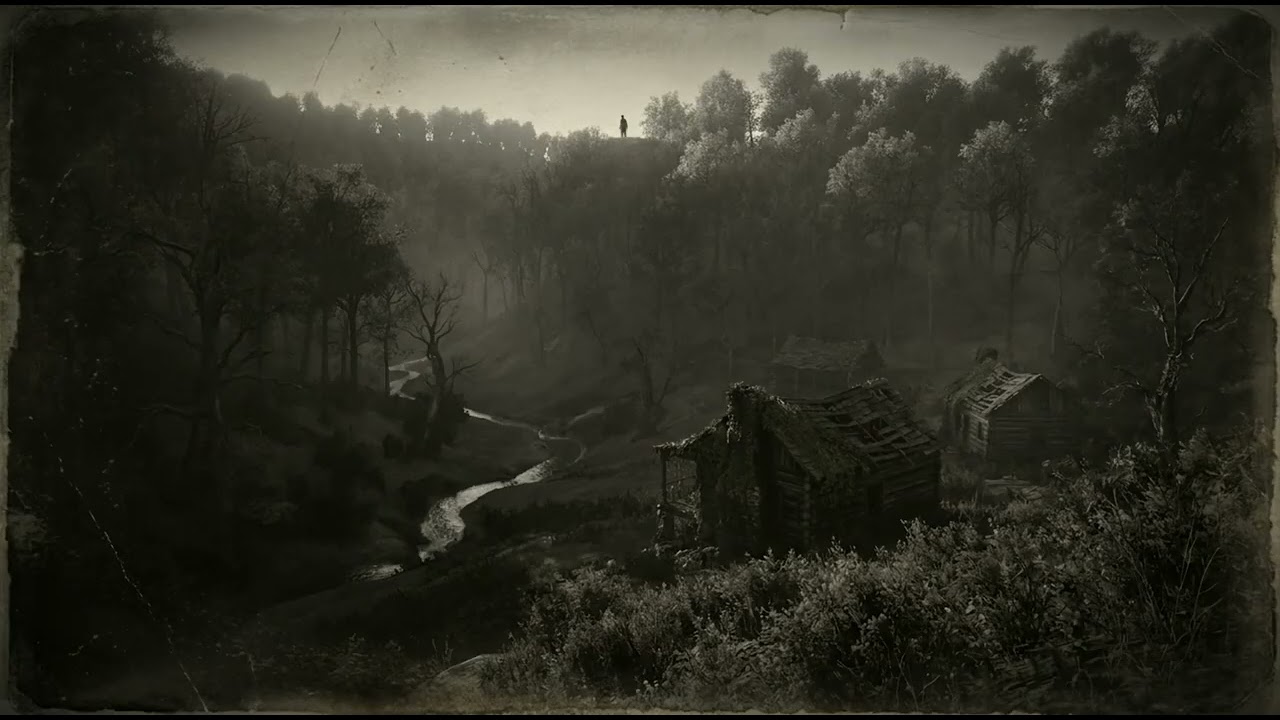
The county records of the three counties whose borders once converged near its location contain a clean and deliberate gap stretching from about 1847 to 1891. Researchers believe at least three federal agencies acted in coordination over nearly 40 years to remove Harrow Hollow from documented geography. In 1847, a federal census taker named Prescott Gale passed through the valley. He estimated between 60 and 80 permanent residents, mostly farming families who had arrived in the 1820s and 1830s.
Gale noted the valley was walled on three sides by ridgelines that made it difficult to find. He also wrote three times that the creek running through its center appeared to flow in the wrong direction. His census record for the valley was the last official document to acknowledge its existence for the next four years. Gale counted 63 residents and gave names to them all.
Most families were Scots-Irish in origin, with some German surnames and one family whose name Gale recorded phonetically and could not identify. He noted the other residents seemed careful around that family but did not explain what that meant. One resident was a 34-year-old farmer named Corvus Hallett, who had been in the valley for six years. Hallett kept meticulous records of weather, soil quality, and the behavior of the creek.
In the summer of 1847, his records began to change. It started with a smell he described as mineral and faint, with a secondary quality like something charred. There was no fire visible in the valley to account for it. He noted the smell on a Tuesday and again that Thursday, then not for ten days, then four times in a single week, always in the early morning hours between 3:00 and 5:00.
When he asked other farmers, three of them had noticed the same thing in the same hours. None had mentioned it to each other before he asked. By December, a farmer named Gideon Spart reported that his three dogs refused to enter the barn after dark, though they went in freely during the day. Hallett filed that observation and kept watching.
In January 1848, Hallett went out before dawn with a lantern and saw a shape at the edge of the tree line, roughly 40 yards away. He described it as upright, too large for a man, not moving, and not responding to light. He wrote that its proportions seemed arrived at by someone who had heard a man described but never seen one. It was there, and then it was not.
He waited three days before writing it down. By the end of January, four other residents had reported similar experiences, always at the edges of the valley, always at night or in the early morning, always gone before anyone could be certain. Hallett began compiling what he called the composite account, tracking sightings by location, time, weather, and season. In August 1848, Gideon Spart reported a shape standing in his farmyard, eight feet from his back door.
Spart said it was different from previous encounters. He was not afraid because he could not identify what he was looking at. He was afraid because he felt it knew exactly what it was looking at. The following week, Hallett felt a low vibration in his chest while working in his fields with his back to the tree line.
It lasted about 30 seconds and then stopped. He wrote that night that he did not know what he was dealing with but believed it had been in the valley longer than the people, and that it was becoming less patient. By the fall of 1848, the community was quietly afraid. People avoided going out after dark.
Farmers from the northern end of the valley found reasons to spend evenings further south. But the family whose name Gale had recorded phonetically was not afraid. They continued their routines and walked toward the northern end of the valley at night. Hallett approached the head of that family, a man he identified only as Reese, in October 1848.
Reese said they had always seen the presence. What concerned him was that the others were seeing it now. Asked what that meant, he said the presence had made a decision. He would not elaborate.
Hallett noted the rest of Reese’s family had begun looking at the others with what he could only describe as sorrow. In the spring of 1849, a federal land surveyor named Ignatius Colby passed through the valley. He arrived on a Monday and was gone by Wednesday morning, before his two days were up. He did not finish his survey.
He did not file a report. When Hallett wrote to the county land office, the reply stated no survey had been submitted and no surveyor had been assigned to that location. Hallett filed that letter and wrote beneath it that someone outside the valley was watching and already deciding what to do. By the summer of 1849, three families had quietly left.
They had not sold their land or formally abandoned their claims. They had simply stopped coming home. Hallett wrote that they thinned out like a fire that was not being fed. That July, the sound returned in a new form.
It was articulated but did not correspond to language or any animal call. Hallett described it as carrying intention, like a message in a medium no one in the valley had been taught to read. That same month, a woman named Orpha Vane brought Hallett an object she had found at the eastern boundary of her farm. Wrapped in cloth, it was a flat piece of slate with an arrangement of feathers, small bones, marked bark, and a fragment of dark stone that seemed to absorb light rather than reflect it.
Hallett kept it on a shelf above his desk. Six weeks later, he woke to find the slate on the floor. Nothing else in the room had been disturbed. Some items had been moved, and a long black feather from a species he could not identify had been placed precisely at the center.
Hallett wrote that the presence was not watching anymore. It was responding. In October 1849, Reese came to Hallett for the first time. He said his family had lived near the presence for three generations under a working arrangement: do not go into the northern part of the valley after dark, do not cut trees on the northern ridge, do not obstruct the creek, and do not document what you see.
He said the terms had now been violated. He said other people outside the valley were becoming aware of it, and the presence would not be patient about that indefinitely. By spring of 1850, fewer than 40 people remained in the valley. Two of the families who had left wrote to Hallett.
Both said they did not want to speak about their experiences and asked that he not write again. One letter contained an additional line in a different hand: destroy your records, whatever you think you are doing, stop. That June, a man arrived in the valley who claimed to be a researcher connected to a university he would not name. He asked questions about the valley’s history, the families who had left, the northern end, and the creek.
A resident named Tessily Run told Hallett the man already knew things. He was using questions to confirm information, not to discover it. After the man left, Hallett found marks in the creek bed suggesting something had been installed and taken. Between 1850 and 1855, the valley lost most of its remaining population through the same quiet thinning.
By the middle of 1855, the permanent residents were Hallett, Tessily Run, Gideon Spart, and Reese’s family. In July 1855, Reese died at the northern edge of the tree line. There was no sign of injury or struggle, and the examining doctor could not identify a cause of death. Tessily Run told Hallett that Reese had said years earlier that when his time came, he would go to the tree line.
After Reese’s death, his daughter Seraphine became the person Hallett spoke to when he needed to understand something. In August 1855, she told him that the valley and the presence in it might not be different things. The land itself might be what he was trying to describe. She said his records were not an account of something that happened in the valley.
They were part of what was happening. Hallett wrote her words down exactly. Beneath them, he wrote one sentence: I think she is right. Between 1855 and 1865, the nature of the presence changed.
In the summer of 1857, Hallett saw it in full daylight for the first time. He noted he was not afraid, and he considered that significant. The sound also changed into something more like a presence than a communication. He described sleeping near it as being in a room where someone is thinking intensely about something that does not involve you.
By 1860, Gideon Spart had died of an unrelated illness, and Tessily Run had gone to live with her sister to the north. The valley held three households: Hallett, Seraphine’s family, and a former telegraphist named Wentworth Grail, who had arrived in 1858 and simply stayed. Grail had noticed the presence within his first week and asked Hallett directly about it. Hallett said yes.
Grail said fine. In 1862, Grail told Hallett that the question of whether the presence was a natural phenomenon or something else was the wrong question. He said Hallett was asking the question in English, and the thing he was asking about did not have an English answer. In 1865, a government geologist named Prescott Ames arrived to survey mineral resources.
On his fourth day, he went into the northern end of the valley. When he came back, he told Hallett he had never been in a place like it. Hallett spent the evening and the next day showing him the composite account. Ames said he would file an honest report but was not certain how it would be received.
Before leaving, he told Hallett to keep the records and not send them anywhere until he knew who he was sending them to. No record of Ames’s report was ever filed. After his death in 1881, a folder was found in his personal papers containing one page. It said: What is there is real.
It is not going anywhere and the correct response to it is not to pretend it is not there. That is all. Hallett continued to keep the composite account through the long quiet middle of his time in the valley. He described his approach in notes from 1870, saying he had spent 20 years watching the leaves move in the wind and was now more interested in standing still within it.
In 1878, two men identifying themselves as representatives of the Department of the Interior arrived. They told Hallett, Grail, and Seraphine’s family that their land was being assessed for federal acquisition. They photographed the structures, measured the farmhouses, and left the next morning. They did not go to the northern end of the valley.
Hallett wrote that they were not there for the land but to confirm that the documentation of the place would be done only by people they controlled. Two months later, the first formal offer of purchase was made and rejected by all three households. A second, higher offer was also rejected. Grail said he had nowhere else to be.
Hallett rejected it because leaving was not an option he was willing to consider. By this time, Hallett had come to believe the valley was not a place where something had arrived. It was a place where something had always been. The presence was not an intrusion.
It was what the valley was when the human overlay of farms and roads and names was removed. The creek ran in the wrong direction because wrong was a human word, and the creek had never been asked to run in any particular direction. In 1880, the formal process of removal began. The residents were compelled to leave under a public health designation based on a report whose findings were never made public and whose author was never named.
The designation stated the land contained properties hazardous to human occupation. Hallett wrote that calling it a hazard was the most honest thing the government had said in 30 years of watching the place. But he believed they were using dangerous to mean unknown, because unknown could not be controlled. He wrote that they had the authority and they would win, and he had known for some time that this was how it ended.
By 1882, all legal residents had been notified to vacate. Grail left that spring and wrote one letter from Virginia advising Hallett to separate the records and let different pieces survive in different places. Hallett did this, distributing the composite account to personal archives, a university library in Maryland, and a sealed deposit in a county courthouse. He kept the final section for himself.
Seraphine’s family left in the autumn of 1882. On the day they left, Seraphine came to Hallett’s farmhouse and told him the presence was aware he was leaving, not upset, but aware. She said it did not need him to stay to keep existing, but she believed it had appreciated the company. Hallett spent one final winter in the valley.
He was 69 years old and had been there 36 years. He wrote about the winter light, the ice forming on the creek, and the sound, which came through that winter with a quality he described as unhurried. He saw the presence more often that winter than any previous one. He wrote on the first of February 1883 that he and it were standing together in the blue hour before sunrise, two old things in a winter valley, and the arrangement of that morning felt like acknowledgement.
He left in March 1883, escorted to the boundary by a federal marshal. He carried two bags of personal belongings and one locked case containing the final section of the composite account. At the boundary he stopped, looked back, and stood for a considerable time before walking out. In the years that followed, Hallett tried through legal channels to have the valley’s status reviewed.
He sought meetings with the Department of the Interior, attempted to submit the composite account as evidence, and contacted journalists and academics. He was treated politely and never helped. He died in 1891 at the age of 77 in a boarding house in Knoxville, Tennessee. His personal effects, including the locked case, passed through several hands before resting in a private archive, unexamined for nearly 60 years.
The sections of the composite account survived in the locations he had chosen. None was connected to the others until Aldous Mercer Fenn went looking for them in 1892. Fenn had learned about Hallett’s records from Grail, who was still living in Virginia and spoke to him on condition of anonymity. It took Fenn three years to locate all the pieces and another two to transcribe and assemble them.
He filed the assembled account with four institutions. Three returned it without comment. The fourth accepted it, then reclassified it and marked it for restricted access. Fenn died in 1903.
The assembled account sat in restricted storage for another 40 years. When the archive was consolidated into a larger one, a box was mislabeled and cataloged incorrectly. For 40 years, the composite account sat on an open shelf in a university archive in Maryland, technically available to anyone who knew to ask for it under the wrong title in the wrong category. Someone eventually found it and began the process of reconstructing what had happened in Harrow Hollow.
That reconstruction took 30 years. The results became part of the Appalachian Dossier. The valley is still there, marked on no map. The road leading to it was reclaimed by vegetation long ago.
People who have gone looking for it describe a feeling of increasing resistance, a gentle and unmistakable encouragement to turn back. Most do. Those who continue describe the feeling shifting from discouragement to recognition, as if whatever was pushing them back has accepted that they are the kind of person who continues. The valley itself is overgrown.
The farms are gone. The creek is still there, still running in the direction Gale described as wrong in 1847, a direction confirmed as wrong by every measure later visitors knew how to apply. The northern end is dense with old growth, trees considerably older than the farms were. Visitors describe the same experience: not fear or threat, but the feeling of being observed, of standing in the attention of something aware of them the way a mountain is aware of the weather moving over it.
The question that persists in the record is what Hallett would have wanted done with the information. He kept records because he believed records mattered and that if enough people understood what was actually there, the decision to erase it might be revisited. The record suggests the presence in the valley does not require human knowledge of it to persist. It was there before anyone arrived and, as far as the accounts can determine, it will be there long after the current restrictions decay.
It is patient in a way that has no human equivalent. It is there the way the mountains are there.