On June 25, 1876, the temperature in the Little Bighorn Valley climbed past 90 degrees by early afternoon. The 210 men of the United States 7th Cavalry who rode in that day, under a general who had never seriously considered the possibility that he would not ride out, were all dead within the hour. The question that 150 years of examination has never fully resolved is not what happened—the ground itself, through forensic archaeology, eventually told that story. The unresolved question is why there was no escape.
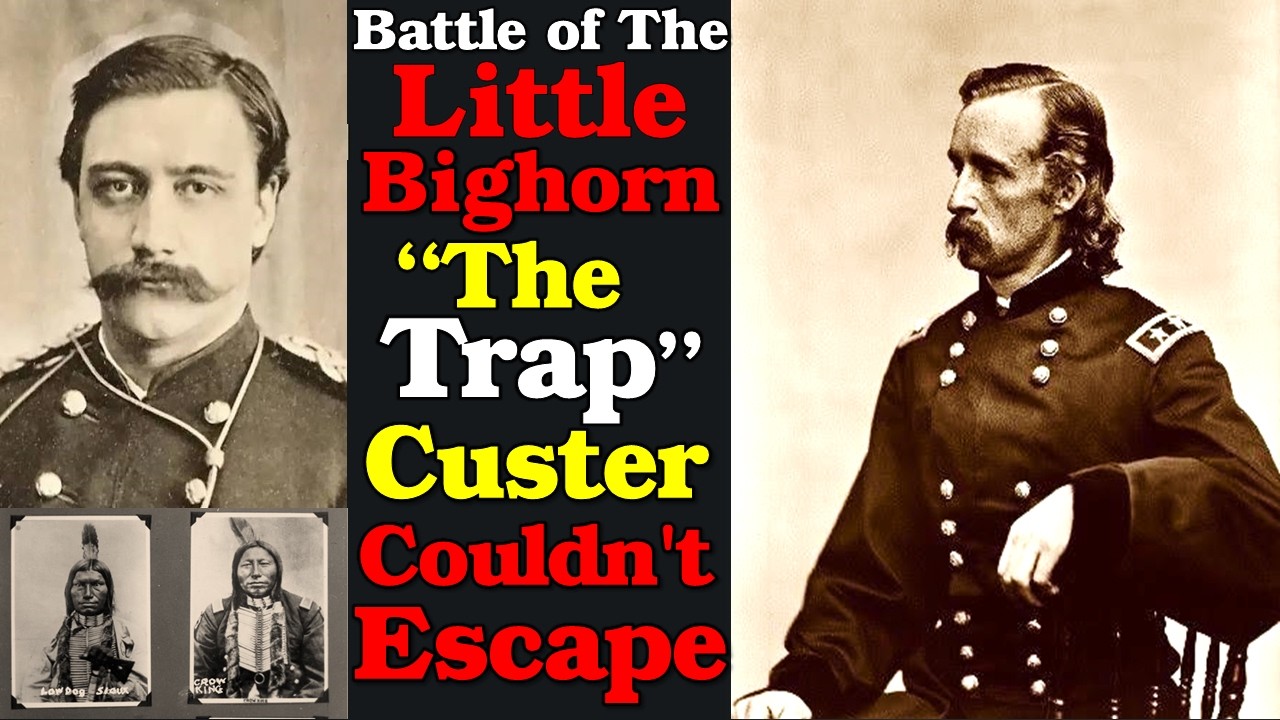
Why 210 men, spread across a half mile of Montana ridgeline, some of them experienced combat soldiers who had survived the Civil War and years of frontier campaigning, found no route out of what closed around them. The answer is not a single failure. It is a documented, interlocking sequence of decisions and conditions that closed every exit simultaneously. Custer’s plan hinged on Major Marcus Reno.
He sent Reno into the valley with three companies and roughly 190 men, believing Reno would engage the southern end of the village and fix the warriors’ attention in a defensive posture. While they were occupied, Custer would cross the river to the high bluffs, move north along the ridge, and strike the village’s center from above. It was a classic envelopment, and it had worked before. It required Reno to hold.
Reno did not hold. Nine hundred mounted warriors emerged from the camp circles before Reno’s attack achieved any meaningful penetration of the village perimeter. They did not defend—they attacked. They flanked Reno’s dismounted skirmish line with speed and volume.
Ordnance records would later establish that the warriors carried over 900 firearms of 47 different types against Reno’s three companies of Springfield trapdoor carbines and Colt revolvers. At close range, Bloody Knife, Custer’s most trusted Arikara scout, was shot through the head—an impact witnessed directly by Reno. What followed was described as a command paralysis whose specific cause has been debated ever since, and whose specific consequence is not arguable: Reno’s command became a retreat, then a route, then a desperate river crossing under fire and a scramble up the bluffs to the east. Those were the bluffs where Custer was supposed to be providing support—but he had already moved north along the eastern bank toward the position his plan required.
The southern pressure that Custer depended upon had collapsed in minutes. The warriors who had driven Reno across the river turned north toward Custer. The first door closed. Viewshed analysis conducted across the battlefield in the late 1980s produced a finding the written record had never established with comparable precision.
From Last Stand Hill—where Custer’s body was found alongside roughly 40 others, including his brother Tom, his brother Boston, his nephew Autie Reed, and his brother-in-law Calhoun—the analysis mapped every area of terrain visible and invisible to a defender on the high ground. The results were devastating. The ridgeline Custer had taken because his training told him high ground was defensible was high ground riddled with blind spots. Ravines cut into the ridge from the west; coulees dropped away from the eastern slope.
The broken Montana topography could not be observed from above, and therefore could not be covered with fire. The Lakota and Cheyenne warriors who moved through those invisible channels were not improvising. They were reading ground they knew—ground their horses knew, ground their families had camped on and hunted across for generations. They moved through terrain the soldiers could not see, closed the distance from positions the defenders could not reach, and delivered fire from angles Army tactical training had never prepared those men to address.
The cartridge case distribution recovered by the archaeological survey confirmed this with forensic precision. Indian cartridge cases concentrated in the depressions, the draws, the invisible places. Soldier cartridge cases concentrated on the exposed high ground. The spatial relationship between those two distributions is the physical record of what closed around Custer: he held the ground he could see, while the warriors moved through the ground he could not.
The second door closed. The Army came to the Little Bighorn with two weapons: the Springfield Model 1873 trapdoor carbine and the Colt single-action Army revolver. The warriors opposing them carried 47 different firearm types, with recovered cartridge cases representing more than 900 individual weapons. The Springfield had a failure mode the Army had documented before the campaign and not resolved.
Under sustained rapid fire, the brass cartridge case expanded in the hot chamber, and the extractor tore through the softened rim. The weapon required a knife or cleaning rod to clear the stuck case before it could fire again. Men were found on that ridgeline with knives in their hands—not as weapons, but as tools to manually clear jammed rifles in the middle of an engagement that was not pausing. Across the river, the warriors carried weapons the commercial firearms market had been providing to indigenous communities through trade networks and treaty annuity channels for a decade.
Winchester Model 1866 lever actions and Henry rifles cycled . 44 rimfire cartridges through 16-round tubular magazines at a rate the Springfield single-shot architecture could not approach under any condition—let alone with a hot chamber and a knife in the hand where the rifle should have been. The archaeological project recovered a sequence of . 44 caliber rimfire cartridge cases bearing the consistent tool mark signature of a single Henry or 1866 Winchester, distributed across nearly a mile of battlefield.
One weapon, one warrior, moving through invisible ground—a physical trail of the movement through terrain the soldiers above could not see or reach. The third door closed. By the final phase, 210 soldiers were spread across a half mile of ridgeline in three separate groups: Company L and Company C under Calhoun on the southern ridge, Company A under Keogh about 300 yards north, and Custer with Companies E and F at the position now designated Last Stand Hill. Each group was isolated by the terrain and by warriors moving through it.
Oral accounts gathered from Lakota and Cheyenne participants describe warriors arriving at the Custer field from multiple directions simultaneously: from the south along the ridgeline after Calhoun’s position was overwhelmed, from the west through the draws and ravines below the ridge, and from the north, where the escape route the terrain might theoretically have offered was already covered. Estimates of the warrior force engaged against Custer’s five companies in the final phase range from 1,500 to 2,000 men. The fighters who had driven Reno across the river flowed north, adding their numbers to those already pressing from below. The odds were roughly 7 to 1, possibly higher, against a force scattered in three groups too far apart to support each other.
The fourth door closed. Every account of the Little Bighorn—written, oral, and archaeological—agrees the engagement on Custer’s Ridge was fast. The best available estimate places the entire battle, from initial contact to destruction of the last group, at between 45 minutes and slightly over an hour. In 45 minutes, the options available to a military force do not include the deliberate tactical withdrawal that the word “escape” implies.
They include only the immediate, instinctive, reactive responses of individual men attempting to survive the specific seconds they are currently inside. The soldier who might have found a route down the northern slope with two hours of careful observation had 45 minutes of sustained fire from multiple directions—and a stuck cartridge case and a knife in his hand. The archaeological survey recovered physical evidence of men who moved in the final minutes, with cartridge cases in positions away from the main defensive concentrations, suggesting individuals or small groups attempting to find ground the fire was not yet reaching. The movement did not produce escape.
It produced cartridge cases in different positions, which the ground preserved. The fifth door closed. The question was never whether Custer could have survived if he had made different decisions in the days and hours before June 25. That decision chain—the Black Hills gold report, the winter ultimatum, Crook’s undisclosed withdrawal, the advance on the morning of June 25—delivered 210 men to that ridgeline.
The question here is simpler and more devastating: once they were on that ridge, under those conditions, against that force, was there a door that remained open? The ground says no. The viewshed analysis says no. The cartridge case distribution says no.
The weapons comparison says no. The numbers say no. And the time—45 minutes from contact to silence, the engagement moving faster than the options available to the men inside it—says no with the specific finality of a fact that requires no interpretation. The doors closed in sequence.
Each one closed faster than the previous because each closure accelerated the next. Reno’s collapse sent warriors north. The warriors moved through ground Custer could not see. Their weapons fired faster than his soldiers’ weapons.
The numbers arriving from every direction exceeded what three scattered groups could address simultaneously. And the time compressed everything into a specific, irreversible 45-minute window that left no gap between the closing of one door and the next. The ground held the evidence of every closed door. It holds it still, pressed into Montana soil through cartridge cases, marker positions, and the specific spatial distribution of two forces whose weapons, knowledge, numbers, and time all pointed in the same direction on the afternoon of June 25, 1876.
There was no escape. The ground always knew—it took a century to ask it the right questions.