At 5:00 in the morning on June 22, 1842, a small crew opened a gate on the Croton River, about 40 miles north of New York City, and let the river in. The water slid into a brick tunnel barely wide enough to stand in and began moving downhill toward Manhattan at just under two miles an hour. It did not stop. It crossed valleys on stone arches.
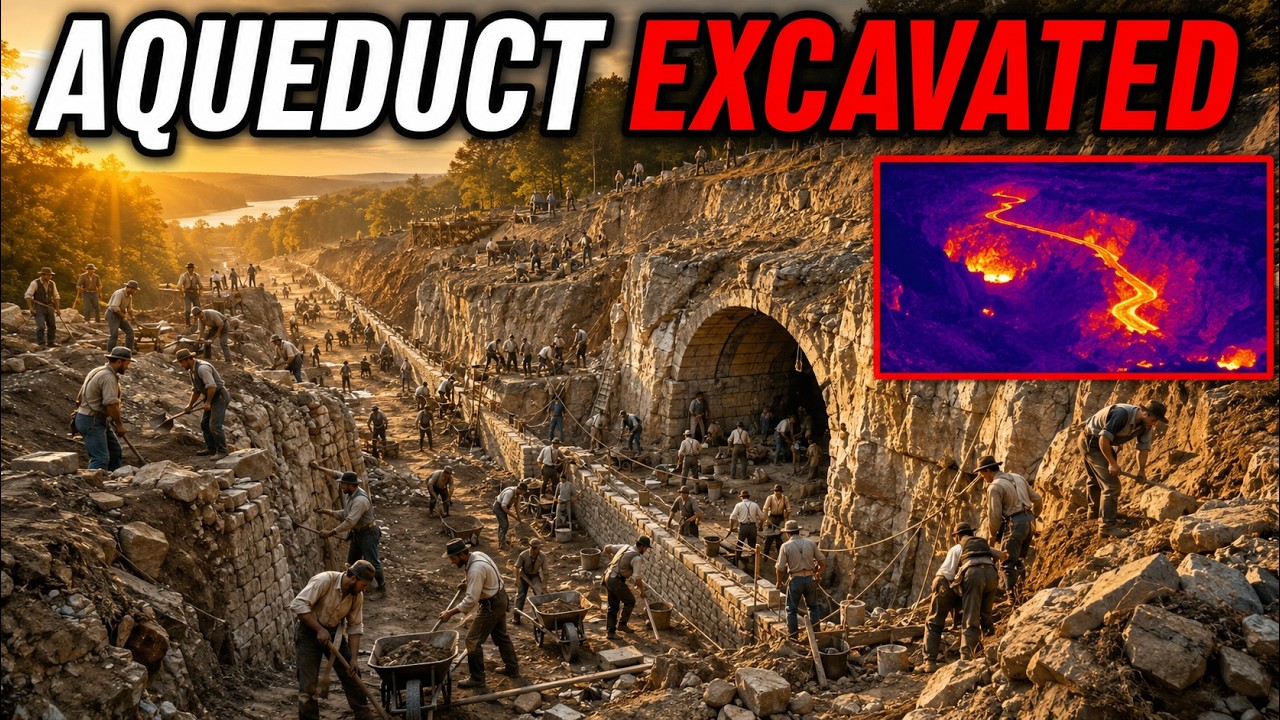
It slipped through hills that had been blasted open by hand. And 22 hours later, it reached the Harlem River at the top of Manhattan. There was no pump anywhere on the line and no engine of any kind. The entire system ran on gravity, on a drop of 13 inches for every mile—about the thickness of a single brick—and it held that grade dead steady for 41 miles.
It had all been dug by pick, shovel, and black powder, under a self-taught engineer named John B. Jervis. Jervis had learned his trade with an axe in his hands on the Erie Canal, and he set that grade himself. One of his assistant engineers, a young man named F.
Bartholomew Tower, walked the whole job and later wrote it all down in a book, so the historical record of how it was done survives in detail. The project is now known as the Old Croton Aqueduct, a hand-built masonry ditch that rescued the largest city in the country, yet remains almost unknown to most of the people who live there. To understand why grown men wept in the streets when the water finally arrived, it helps to understand what New York was drinking before it. The island of Manhattan sits in salt water, and its own groundwater was shallow, brackish, and by the 1830s foul.
The city had grown to a quarter of a million people who were still pulling their water from backyard wells and street pumps. For 40 years, the city had leaned on a single private company, the Manhattan Company, chartered in 1799 with a promise to bring in clean water. It never really did. Instead of piping fresh water down from the Bronx River, the company sank its wells into the Collect Pond, a shallow downtown pond that generations of tanneries and slaughterhouses had already fouled, because that was cheaper.
It laid only about 23 miles of wooden pipe under the streets and charged around $20 a year for the service, which put it out of reach of most working families. The wealthy paid cartmen to haul cleaner water in by the barrel, and everyone else drank what was there from wells and pumps next to privies. A city of a quarter million people was still getting its water the way a frontier village did. Then, in the summer of 1832, cholera came.
It moved through the wells, the cesspools, and the crowded wards. By the time it burned out, 3,515 New Yorkers were dead out of a population near 250,000. People who could afford to leave the city did. The ones who stayed learned the hard way that a city cannot drink its own waste and live.
If the sickness was not enough, the fire was. On the night of December 16, 1835, a blaze broke out in the warehouse district in the coldest part of a brutal winter. It was so cold that the East River had frozen and the harbor was choked with ice. When firefighters ran out their engines and opened the hydrants, the water froze in the hoses.
A reporter for the Evening Post wrote that the hoses of many of the engines were frozen and useless. With no working water, the men gave up trying to put the fire out and started blowing up buildings with gunpowder to starve it of fuel. By morning, close to 700 buildings were gone, and 17 city blocks in the heart of lower Manhattan had been leveled. The richest commercial district in America had burned down because there was nothing to throw on it.
So the city stopped arguing. Two years after the cholera, voters had already approved the idea of bringing in an outside water supply, and the target was set well to the north on the Croton River in Westchester County. The plan was almost absurd in its simplicity: dam the Croton, catch the river in a reservoir, and carry the water 41 miles south, downhill the entire way, in a covered stone channel until it reached Manhattan high enough to feed the streets. There would be no steam and no pumping works anywhere in it—only a very long and very precise slope doing all the labor.
The first engineer to survey that line was a West Point man named David Bates Douglass, who did the early fieldwork, walked the route, and drew the first plans. But Douglass was slow, and the commissioners lost patience. In 1836, they replaced him with Jervis. That decision is easy to skip past, but Jervis is the whole story.
He was born in 1795 and raised on a farm in Rome, New York, and he had almost no formal schooling in engineering because in America at that time there was almost none to be had. What there was instead was the Erie Canal. In 1817, at 22 years old, Jervis hired onto that canal as an axeman, clearing brush and trees ahead of the diggers under chief engineer Benjamin Wright. He paid attention.
He moved up to rodman, setting the levels, then resident engineer laying out the line himself. By the time the canal was done, he was running an entire division of it. Almost every American civil engineer of that generation came up the same way on that same canal, because there was no university in the country then that could teach them what a shovel and a level and a few hundred miles of ditch could. The Erie Canal was the school, and Jervis had graduated near the top of it.
When the Croton commissioners needed a man who could hold a precise grade across mile after mile of rough country with nothing but hand tools, he was one of the very few in America who had actually done it. The work began at the river up in the Westchester Hills. Crews threw a masonry dam across the Croton to pond the water back into a long reservoir, and at the head of the line they built a stone gatehouse where the water entered the aqueduct proper. From there, the whole line was broken into sections, and each section was put under a resident engineer who answered to Jervis, with the actual digging let out to contractors.
That is how a job this size got done in an age before heavy equipment. There was no single army. There were dozens of small gangs strung out along the survey line, each one grinding through its own mile or two of the Hudson Valley at the same time, all holding to the single grade that Jervis had set. If any one of them cut too deep or not deep enough, the water would either stall or run backward.
So the level had to be right in every gang’s ditch, mile after mile, or it was right nowhere. For most of its length, the aqueduct is not a pipe and not an open ditch. It is a masonry tunnel shaped like a horseshoe, 8½ feet high and 7½ feet wide, big enough for a man to walk through upright with room to spare. The bottom is an inverted arch of brick, so the floor curves up at the sides.
The sides slope outward and then close again into an arch across the top, and the whole shell is backed with stone and concrete, so the water never touches raw earth. Jervis wanted the inside smooth and permanent because the grade was so gentle that any rough patch would slow the flow, and any leak would rot the hill it ran through. Tower, the assistant who wrote the book, watched crews lay that brick by hand, ring by ring, mile after mile, and he understood he was watching something that would either last a century or fail in a season, depending on the care of the man holding the trowel. Tower is the reason the full record survives.
He was born in 1817, joined the Croton engineering staff in 1837, and stayed on it through the whole build. In 1843, a year after the water came, he published a volume he called “Illustrations of the Croton Aqueduct. ” It contained 21 plates of the work drawn from the field—the arches, the tunnels, and the gatehouses rendered in careful detail, with text to explain them. Most great works of that age come down to us as a finished monument and a pile of dry contracts.
Tower gave us the aqueduct as the men on the line actually saw it going up. When the record explains how a crossing was built or how a tunnel was cut, it is very often because one of his own engineers stopped mid-construction to draw it. Then there was the ground. The Hudson Valley is not a smooth ramp.
It is ridges, stream valleys, and outcrops of hard rock, and the aqueduct had to hold its 13-inch grade straight through all of it. Where the land rose, the crews had to cut down into it. Where it was solid rock, they had to blast. Remember what year this is.
Dynamite did not exist yet—it would not be invented until 1867, a full generation later. So every foot of rock on this line was broken with black powder, the same volatile, unpredictable gunpowder that firefighters had used to level buildings in the great fire. A man drilled the hole by hand with a hammer and a steel bar, packed the powder, lit it, and ran. Then crews came back with picks and shovels and hauled the broken rock out by basket and barrow.
Where the aqueduct ran underground, they sank shafts down to the line so the diggers could work the tunnel from inside and let the powder smoke escape. Those stone ventilators still stand along the route today, roughly one every mile—little stone chimneys in the woods, with about 21 surviving along the trail. Plenty of hikers walk right past them without ever knowing they are looking at the breathing holes of a hand-dug tunnel. Where the aqueduct met a stream valley too deep to cross on grade, Jervis threw a stone bridge across it and ran the water over the top.
The finest of these still stands in the village of Ossining and is worth seeing. It is called the Double Arch. The great upper arch that carries the water is 88 feet long and 76 feet high—a single clean span of cut stone leaping the Sing Sing Kill—and it has held its shape and its water for more than a century and a half. Everything about it was cut and set by hand.
There was no crane on that job that a modern builder would recognize; there were sheer legs, block and tackle, rope, mules, and a great deal of human muscle. The result was a bridge so sound that the village later ran a road under it, and it carries that too. The record of a great project is never a straight line of triumph, and this one nearly drowned in its own river. Everything on the line depended on the dam up at the Croton, the masonry weir that caught the river and fed the aqueduct.
Part of that first dam was built up with an earthen embankment. In the first week of January 1841, with the work years along and the end finally in sight, the weather turned. There was about a foot and a half of snow on the frozen ground. On January 5, the temperature shot up and it began to rain hard for three days.
The snow melted all at once. Every creek in Westchester filled and kept filling, and by the night of January 7, the Croton was over its banks and climbing toward the top of the dam. At around 2:00 in the morning on January 8, the water began pouring over the earthen part of the embankment. Within an hour, that earth gave way.
What came down the gorge was not a flood in the ordinary sense. It was a moving wall of water and broken ice and debris that reached, at the narrow points, a height of 50 feet. It tore out the Van Cortlandt Mills. It swept away every bridge and building on the banks of the lower Croton, carried them into the Hudson, and people died in it.
Years of work and the water supply of a city were undone in a single winter night by the very river they were trying to capture. Jervis and his engineers went back and rebuilt the dam in solid masonry, this time with a long curved face designed to break the force of the water sliding over it and a pool at the bottom to catch and calm the fall. They had learned what the river could do, and they built the second dam to take that blow and hold. Setbacks like that fed the doubters, and there were many.
This was the most expensive public work the city had ever attempted, and the bills kept climbing past every estimate anyone had put on paper. Douglass had once figured the whole line at under $5 million. It was plainly going to cost far more than that, and through the long middle years of the digging, there were respectable voices in New York calling the whole thing a folly, a bottomless ditch that would drown the city in debt before it ever delivered a drop. Jervis had no answer for them except the work itself.
He could not argue the aqueduct into existence. He could only hold the grade mile after mile and trust that running water would settle the argument once it arrived. It did, but for five years he was building on faith and other men’s money, with critics reading the ledgers over his shoulder. That left the last and largest obstacle, and it was the one everyone could see coming.
Between the aqueduct and the city lay the Harlem River, a wide tidal channel with ships moving on it. Jervis could have saved a fortune by dropping the water down into a pipe, running it across the riverbed under pressure, and letting it climb the far bank on the other side—a trick engineers call an inverted siphon. He drew that cheaper plan, but the state legislature, worried about blocking navigation on the river, ruled in the spring of 1839 that any crossing had to leave at least 100 feet of clearance for ships. So Jervis built up instead of across.
He built High Bridge. High Bridge is 1,450 feet of cut stone marching across the Harlem River Valley on 15 great arches, and it originally carried the water about 140 feet above the river. The piers went down onto bedrock and onto oak piles driven deep into the river mud, and the arches went up one shaped stone at a time. Across the top, the bridge carried the Croton water in a pair of great iron pipes about 3 feet across.
Years later, when the growing city needed still more, engineers added a third pipe more than 7 feet wide to push the volume higher. It was so slow and so expensive that the aqueduct actually opened years before the bridge was finished. In 1842, to get water into the city on time, crews ran it across the Harlem on a temporary low pipe while the great bridge was still rising beside them. The permanent High Bridge did not open until May 1848, and when it was done, it had cost the better part of a million dollars all by itself.
It was worth every stone. High Bridge is still standing today. It is the oldest bridge in New York City, older than the Brooklyn Bridge by 35 years, and you can walk across it right now. Jervis did not dig this himself.
The aqueduct was built by hand by a workforce of somewhere between 3,000 and 4,000 laborers, and the large majority of them were Irish immigrants, many of them fresh off the boat into a country that wanted their muscle and not much else. They did the drilling, the blasting, the hauling, and the brick laying in all weather along the whole open cut, for wages of about $1 a day. The record is honest about its limits here. We know the wage.
We know the count. We mostly do not know the names. The paymasters’ books track the yards of rock moved and the dollars paid out, but the individual Irishmen who broke that rock are for the most part lost to the record. The ledger kept the labor and let go of the man.
And it was dangerous work. A man drilled a hole into solid rock by hand—one holding the steel bar and another swinging the hammer onto it—then packed it with loose black powder and lit a fuse he could only hope was cut to the right length. A job done with early gunpowder and no safety equipment of any kind is a record of premature blasts, falling rock, and men crushed in the cuts. The crews lived rough alongside the work in shanties strung out through the Westchester woods, moving their families down the line as the ditch advanced.
Fever and the ordinary accidents of heavy labor took a steady toll that the paymaster never tallied the way he tallied the yardage. These were not soldiers in an army that counted its dead. They were day laborers, and the country that hired them did not think their names were worth writing down. They did not take everything quietly.
In 1840, contractors tried to cut the daily pay from $1 down to 75 cents, and the workers walked off the job in a strike. The response was not a negotiation. The authorities called out the militia to break the strike and force the men back to the line. It is a hard human detail that belongs in the story, because the clean water that saved the city was pulled out of the ground by people who were themselves treated as disposable.
Jervis, for his part, ran a tight and sober work site. He was known for his exact specifications and for discouraging liquor anywhere near the work, which on a line full of black powder was plain common sense, because drink and loose gunpowder in the same hands get men killed. This was not machine work with a few men supervising. This was thousands of human backs bending for five years, turning a survey line into a stone river.
Once the water reached Manhattan, Jervis built two great reservoirs to hold it. The first, the Receiving Reservoir, sat up on high ground at a place called York Hill, with its basin blasted down into solid rock. It was enormous—more than 1,800 feet on a side—and it could hold as much as 180 million gallons. That reservoir was later drained, filled, and turned into the great lawn in the middle of Central Park.
The families spreading blankets on that grass are sitting in the bowl of the old Croton Receiving Reservoir. From York Hill, the water ran down to the Distributing Reservoir, and this one the whole city could visit. It stood at 42nd Street and Fifth Avenue, and it did not look like a water tank at all. It looked like a temple.
Jervis and his architects faced it in massive granite walls 50 feet high and 25 feet thick, sloped like the pylons of an Egyptian tomb, holding 20 million gallons behind them on a four-acre block. On top of those walls ran a public promenade, and it became one of the fashionable places in the city to walk. Edgar Allan Poe strolled that wall. New Yorkers went up there to take the air and look out over a city that finally had water.
That reservoir is gone now, torn down at the end of the century, but its site is familiar, too: the main branch of the New York Public Library, the one with the stone lions, stands where those Egyptian walls once held the Croton water. A piece of the old foundation is still down in the library’s south court. The precision of the whole thing is worth pausing on. A drop of 13 inches over an entire mile is a fall you could not even see with your eye standing down in the channel.
The floor looks flat to a man walking it. Yet they held that invisible slope without a single laser or powered instrument of any kind, across every mile of hills, swamps, and river valleys, using a spirit level, a surveyor’s transit, measuring rods, and stakes driven into the ground by men who checked each other’s figures by hand. Too much fall in one stretch, and the water would race and undercut the masonry. Too little, and it would sit, go stagnant, and back up on itself.
They got it right the whole way, the first time, and the water walked itself down to the city on nothing but that grade. After the final inspections in June 1842, they let the river in on the 22nd, and it made its 22-hour walk to the Harlem. It filled the Receiving Reservoir up at York Hill on June 27. Then, on the 4th of July, of all days, the Croton water poured into the Distributing Reservoir on 42nd Street, and the city had its supply.
New York being New York, it waited a few months and then threw itself the biggest party it had ever seen. On October 14, 1842, the city held a parade seven miles long to celebrate the water—the biggest procession New York had ever staged. The fire companies marched. The trade societies marched.
The temperance men marched behind the plain fact that this was clean water and not liquor. President John Tyler came up for it. The members of the New York Sacred Music Society sang a specially written Croton Ode in front of a new fountain in City Hall Park. When they turned that fountain on, it threw a jet of Croton water 50 feet into the air over a crowd that had spent its whole life drinking from fouled wells.
People toasted with something they called a “Croton cocktail,” which was river water and lemonade, and they meant it as a boast, because for the first time in living memory, the proudest thing you could hand a New Yorker was a glass of plain water. Former mayor Philip Hone, who kept a famous diary, wrote that nothing was talked of or thought of in New York but Croton water. It had cost far more than anyone promised. Douglass had once estimated the whole line at under $5 million.
By the time the pipes were laid and the interest was paid, the Croton system had run to something near $12. 5 million—better than double the early guess, which is the oldest story in public works. But the city paid it and never looked back, because the alternative was another fire it could not put out and another summer of cholera, and nobody wanted to live through either of those again. The water changed the city almost overnight.
Remember the frozen hoses of 1835, the firemen with nothing to pump. Now the streets filled up with hydrants fed straight off the Croton line at a rate of about 60 a week. For the first time in its history, New York could actually throw water on a fire under real pressure. The Receiving Reservoir up at York Hill was taking in around 35 million gallons a day, and something like 134 miles of iron distribution pipe went in under the city streets to carry it to the wards.
Running water, which had been a luxury of the very rich, began to reach ordinary homes. Indoor taps spread. Bathtubs, which had been rare, started appearing in houses that had never had them, and sewers followed the fresh water in. A city that had been drinking out of a fouled pond a few years earlier was learning to live like a modern place, and all of it flowed from that shallow, unwavering grade, holding steady across the whole hand-laid line.
That hand-dug aqueduct did not just work for a year or a decade. It carried the drinking water of New York City for about 50 years, until a larger new Croton Aqueduct was tunneled deeper to take over the growing city’s thirst. And even then, the old line was not abandoned. Parts of it kept running into the middle of the 20th century.
The last stretch was not shut down until 1955, which means the pick-and-shovel tunnel that Jervis, Tower, and those unnamed Irish crews finished in 1842 was still delivering water when televisions were in living rooms and cars had tail fins. Most of the great stonework is still out there. High Bridge still leaps the Harlem, the oldest bridge in the city. In the 1860s, they even raised a stone water tower beside it and hung a walkway along it so people could stroll across the river on the aqueduct itself.
The Double Arch still carries its span over the Sing Sing Kill in Ossining, with a village street running through the lower arch beneath it. The stone ventilators still stand in the woods along the old line, those little chimneys marking the buried tunnel. Most of the route is a state historic trail now, and you can walk it for miles right down the grassy roof of the aqueduct, from the Croton Dam site down through Westchester and on toward the top of Manhattan. The old keeper houses still stand along it.
When you walk that trail, you are walking on the lid of a channel a few feet above water that engineers first turned loose more than a century and a half ago. For much of the way, there is nothing to tell you the tunnel is even there. That was the whole point of it. The Croton Aqueduct is so nearly forgotten, while the Erie Canal is remembered, perhaps because the Croton did its job too well.
When you open a tap and it runs clean, you do not think about the man with the level setting that impossible grade, or the Irishman with the drill and the black powder, or the engineer who taught himself the whole trade with an axe on another ditch 200 miles away. You just drink. HISTORICAL NOTE: This article is based on a documentary-style narrative that describes the construction of the Old Croton Aqueduct, the first reliable water supply system for New York City, completed in 1842.
The telling includes documented details of engineering, labor, financing, and public celebration, as well as a major dam failure in January 1841.