In February 1962, President John F. Kennedy was preparing to ban the import of Cuban goods. According to his press secretary Pierre Salinger, Kennedy asked for one favor first: “Get me some Cuban cigars. ” Salinger found 1,200 of them.
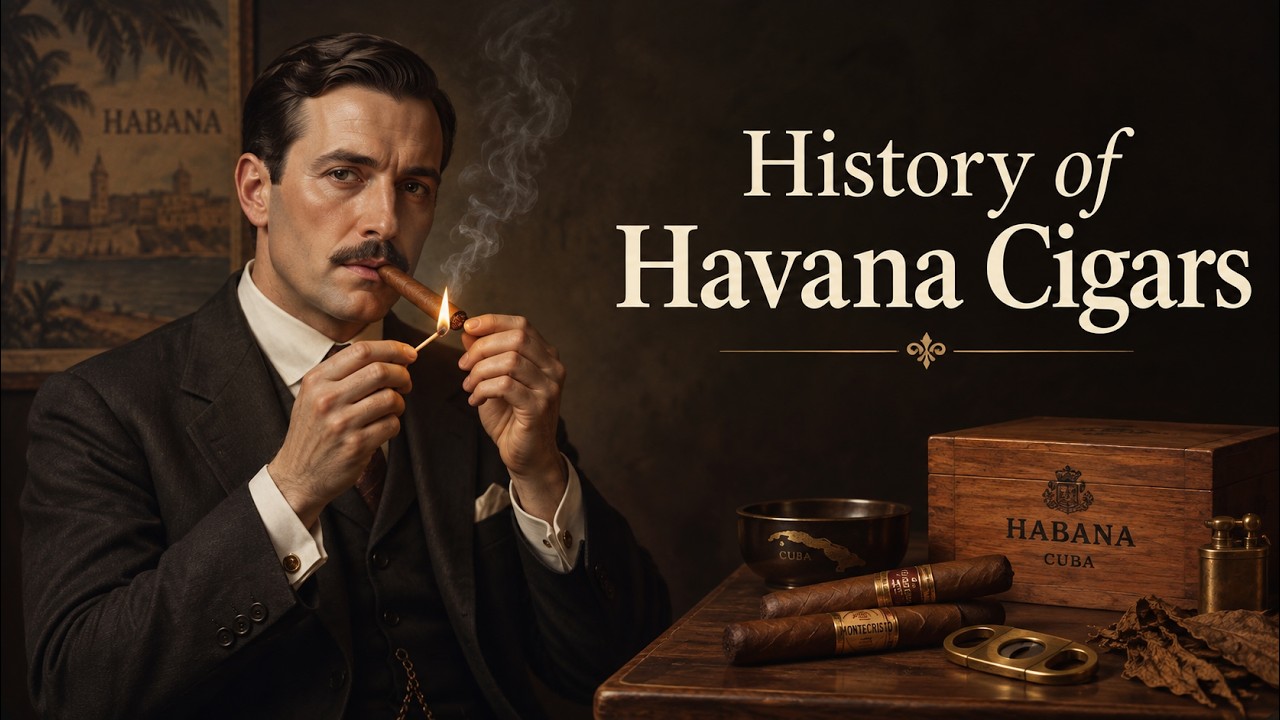
Only then did the president sign the order. The most powerful man in the world closed the door on a product he could not give up himself. But the fame of Havana cigars was born long before that embargo and outlived it. How did a tobacco leaf from a small island become a symbol of wealth, then of revolution, and after America lost access, keep its name around the world?
And how much of that fame escaped Cuba along with its skilled craftsmen? To understand the story, it helps to go back to a time when the leaf had no brand names and no presidents backing it. On November 14, 1492, two of Columbus’s sailors pushed inland across an unknown island. They were looking for gold and the palace of an eastern governor.
Instead, they found villages where people wrapped dried tobacco leaves, lit them, and inhaled the smoke. The sailors found no gold, but they saw something that would bring Spain enormous wealth over time. Europe did not accept tobacco immediately. At first it was treated as a curiosity from the New World, then as medicine.
The French ambassador Jean Nicot sent it to the royal court as a remedy for headaches, and his name would live on in the word nicotine. Then it became a habit people paid for again and again. Wherever such demand appeared, someone wanted to control it. In 1717, the Spanish crown imposed a tobacco monopoly in Cuba.
The Cuban farmer, known as a “veguero,” could still grow tobacco, but he could only sell it to the state at a state-set price. Men who woke before dawn and knew every plant in their fields no longer determined the value of their own work. The veguero refused to accept that. They protested, took up arms, and marched toward Havana.
Unrest lasted for years. In 1723, another uprising was met with soldiers and there were deaths. Tobacco leaves traveled across the ocean. Cigars were rolled in Seville at the royal factory, one of the largest industrial buildings in Europe at the time.
The island prospered, but the profits went abroad. That remained the case for a full century. In 1817, the monopoly was abolished, and Havana began filling with factories. Within a few decades, cigars turned from a local habit into one of the island’s most important exports.
In the 1840s, a German banker named Hermann Upmann settled there. Legend has it that he began sending cigars to his banking clients in London in cedar boxes. By mid-century, the word “Havana” on a box was enough to attract customers. Tobacco also grows in Virginia, Brazil, and Sumatra.
So why did the world remember this island? The answer lies in western Cuba, in the province of Pinar del Río. Work begins there long before the heat arrives. In the early morning, mist still covers the fields.
This is Vuelta Abajo, a place that means to cigar lovers what Champagne means to sparkling wine drinkers. Red soil, humid air, mild winters. Varieties were selected for this land over centuries. But if land alone determined everything, this would be a very short story.
Look at one plant. Its leaves are not equal. The upper leaves exposed to the sun are strong, while lower leaves are light. So they are not picked all at once but in stages as they ripen.
Tobacco meant for the outer wrapper is kept from the sun under white cloth canopies, so it grows thin as paper but does not tear easily. Harvested leaves go to the drying barn. For weeks they hang in semi-darkness, slowly changing from green to golden brown. Then they are stacked in piles, and the tobacco heats from within.
This is fermentation. The leaf loses its sharpness and bitterness. Then comes aging, months and sometimes years. At every step, someone must know when to stop.
One week of neglect can ruin an entire year’s crop. There is no going back. Either the leaf is right or it is not. Only then does the leaf reach the rolling table.
The expert takes several different leaves, one for strength, another for aroma, a third for how the cigar burns. He rolls them together, neither too tight or it will not draw, nor too loose or it will burn up in minutes. On top goes a perfect wrapper leaf trimmed with a curved blade. Learning this takes years.
An apprentice is trusted with simple cigars first, then premium ones later. An expert makes more than a hundred cigars in one shift, and each one must match the one before. The earth gives the leaf. The hands make the cigar.
Remember those hands. One day they would end up far from Cuba. But a buyer in London never saw that field or that table. How do you sell someone something they cannot see?
Close your eyes. A long hall. Hundreds of people cutting and rolling tobacco. Rustling.
The tap of knives. Above it all, one voice. On a raised platform, a man sits and reads aloud. Today a newspaper.
Tomorrow a novel. He is the reader. Workers pay his wages out of their own pockets, and often vote on what he reads. The tradition began in Havana in the 1860s.
For many rollers who could not read, it was their only window onto the wider world. Spanish authorities soon noticed a current slipping through that window. In the factories, workers heard about rights, freedom, independence. Officials tried to ban the readers, but they kept coming back.
Rollers also donated money. The poet José Martí, a leader of Cuba’s struggle for independence, collected funds for the war among tobacco workers in Tampa and Key West. Legend says that in 1895, an order to begin the uprising was smuggled into the island hidden inside a cigar. Work went on for hours, and a skilled reader could hold the room’s attention so completely that hundreds waited for the next chapter the way audiences wait for the next episode of a series.
The Count of Monte Cristo was among the favorites, the story of a man who lost everything and returned to reclaim what was his. In 1935, businessman Alonso Menéndez and his partner Pepe García launched a new brand. Legend says the name came from the factory readings. The cigar was called Montecristo.
Two years later, the partners bought the famous H. Upmann factory. Now Menéndez held two celebrated Havana brands. By then, the world was no longer buying tobacco alone.
It was buying an image. Lithographs on box lids, exhibition medals, paper bands on every cigar. The buyer never saw the field, the roller, or the reader. But from the box, he knew this was a Havana cigar.
By that time, cigars had become a symbol of power. Winston Churchill was rarely seen in public without one. Bankers, business tycoons, film stars. A cigar in hand revealed a man more than his business card did.
By the late 1950s, Menéndez owned factories, famous names, and buyers around the world. He would not have long to keep them. On New Year’s Eve, 1959, dictator Fulgencio Batista boarded a plane and left Cuba. By morning, Havana woke up in a different country.
Days later, bearded men in military uniform entered the city. At their head was Fidel Castro. Alonso Menéndez still went to his factory. Rollers sat at the same tables.
The reader read. Boxes were shipped for export. For cigars, it seemed nothing had changed. That lasted for about a year and a half.
A year and a half when no one knew for certain what the next day would bring. In the fall of 1960, the government nationalized major private property. Cigar factories were no exception. Buildings, warehouses, aged tobacco stocks, even the brand names themselves, everything passed to the state.
For Menéndez that meant one simple thing: H. Upmann and Montecristo, the two companies he had spent a quarter century building, were no longer his. He left Cuba with his family. You cannot take a factory with you, nor the warehouses, nor the tobacco that had spent years maturing inside its bales.
Many other cigar company owners followed him, along with some of the top rollers. You might think cigars would be the first thing to disappear. It was a plaything for bankers, the wealthy, and colonial traders, for everyone the revolutionaries had fought. But the opposite happened.
The new government needed hard currency, and Havana cigars were one of the few Cuban products the world already knew and was willing to buy. Giving them up would mean giving up money and a reputation built over more than a century. So there was Fidel Castro on a platform holding a cigar, and Che Guevara with a cigar between his teeth. The thing that once symbolized wealth was now in the hands of the men who had taken that wealth from its owners.
It became one of the most recognizable symbols of that era. On the shelves, almost nothing changed. The same H. Upmann label, the same Montecristo label, the same box, a new owner.
In 1962, the entire tobacco industry was merged into one state company, Cubatabaco. Some old brands were closed, others folded together. The most famous names survived, the ones the world already knew. So who owned the fame of those names now?
The man who created them? The rollers who stayed at their benches? The land of Vuelta Abajo? Or the state that signed the agreement?
The rollers who stayed kept working as they had the day before. Their hands did not change, only the owner of what they made. Legally, the situation changed in one day. But Menéndez took with him what no decree could seize: expertise, relationships, and knowledge of the market.
From the north, a storm was coming that would strike everyone at once. Relations between Havana and Washington collapsed within months. Nationalization reached American property on the island. Washington responded with sanctions.
Cuba moved closer to Moscow. In April 1961, CIA-backed Cuban exiles landed at the Bay of Pigs. Three days later, it was over. The invasion failed.
More than a thousand men were taken prisoner. Later they were exchanged for medicine and baby food. Cigars were not the cause of that war, but they became its victim. On February 3, 1962, John F.
Kennedy signed Presidential Proclamation 3447. From February 7, Cuban goods were barred from entering the United States, including cigars. Now the story returns to its starting point. A small stock of 1,200 H.
Upmann cigars, the last the president kept before a decision that would outlive him by decades. The blow did not hit Cuba alone. About 200 miles from Havana, in Florida, lies Tampa. The Ybor City neighborhood grew up around cigar factories in the 19th century.
Thousands of rollers worked there, many of them Cuban. They had readers too. For years, those factories made cigars from Cuban tobacco leaves. After the embargo, those leaves disappeared.
Manufacturers had to find new tobaccos, change their blends, and win back customers. Many did not succeed. Factory floors that had buzzed with noise and the voices of readers for decades gradually emptied. A city built around cigars lost its main trade.
Cuba lost its closest neighbor and one of its richest customers. Cigars went to Europe, Canada, and the socialist bloc. But a neighbor like that cannot be replaced in one year. Still, the embargo had an unexpected side effect.
In America, the Cuban cigar became forbidden fruit. A box brought in secretly from abroad became a story to tell. The legend of the original cigar took on a life of its own. One did not cancel the other.
Cigar commerce suffered heavy losses while its fame grew. In October of that same year, Soviet missiles in Cuba nearly triggered a nuclear war. After that, the cigar page closed for a long time. American companies needed new tobacco, and skilled Cuban rollers needed a new place to reproduce cigars.
Soon those two problems met. Miami, Tampa, Madrid, the Canary Islands. Cuban cigar families scattered around the world. They owned no factories, no fields, no rights to their old names.
But they kept what could not be nationalized. They knew how to grow, dry, age, and blend tobacco leaves. They knew the buyers. They knew how to train new rollers.
The Menéndez family started over in the Canary Islands. The Montecristo name was no longer theirs, so the new cigar received a similar name, Monte Cruz. Others moved closer to home, to the Dominican Republic, Honduras, and Nicaragua. Warm climates, fertile land, and their own tobacco traditions.
The exiles brought expertise and relationships, and, as farmers themselves say, Cuban tobacco seeds. It did not happen quickly. You have to find land, grow several crops, and train workers. First cigars did not match those made at home.
Cuban seeds in foreign soil produced different leaves, and blends had to be reinvented. Buyers were in no hurry. And in Nicaragua, history repeated itself harshly. In 1979, the country had its own revolution.
As families who fled Cuba tell it, their factories were hit again. People who had lost everything lost everything a second time, and started over for a third time in their lives. But year after year, a competitor grew in the region. Not a stranger, but a student from the same school.
Local farmers and Cuban exiles together built an industry that would one day compete with Havana on equal terms. When the cigar boom swept America in the 1990s, their factories were ready. The clearest result: Cuban Montecristo is sold in Europe and Asia. On American store shelves, Montecristo is made in the Dominican Republic.
One name, two countries, two stories separated by a strait and politics. Now you understand why so much time was spent looking at the hands of a roller. You cannot take the soil of Vuelta Abajo with you, but you can take your hands. Cuba kept the land and the names.
Its competitors took part of its craft. Meanwhile, in Cuba, they were making cigars not bought with money. In the mid-1960s, Fidel Castro noticed that one of his personal guards was smoking a cigar with an unusual aroma. According to Castro’s own account, he asked where it came from.
The guard answered that a roller he knew made them. The story is hard to verify, but this is how the Cohiba legend began. In 1966, in Havana, in a small factory called El Laguito, a former mansion on the edge of the city, they began making cigars with no display window, no advertising, and no customers. It was not sold.
It was made for Castro, for the top leadership, and as gifts. According to accounts, most rollers were women, rare in this industry at the time. The word “Cohiba” itself, in its most common version, comes from the language of the Taíno people, the same people Columbus’s sailors met on this island. The circle closed.
And this cigar began its journey. It was offered to ambassadors and heads of state. A box from Havana reached the negotiating table. Getting one meant you were someone important.
Before, a cigar’s value was set by land, work, and name. Now something new appeared: access. No one bought a Cohiba. It was given.
For 16 years, this cigar remained behind closed doors. And people talked about it. Almost no one had seen it. Rumors did more for the brand than any advertisement.
In 1982, Cuba released Cohiba to the world market. Now anyone willing to pay could buy a cigar once smoked in the offices of power. The payment was not only for tobacco. It was payment for the fact that this box was once not intended for them.
Cohiba quickly became one of the most expensive and famous Cuban brands. The legend of closed doors worked better than any campaign. Then, three years later, something unexpected happened. In 1985, Fidel Castro quit smoking.
The man who had become one of the symbols of the Cuban cigar gave it up for good. The cigar kept spreading without him. In 1992, for the 500th anniversary of Columbus’s voyage, Cohiba launched its 1492 line. The legend returned once more to that first encounter off the coast of Cuba.
Privileges became a commodity. But what is the buyer really paying for? What is that story worth? Somewhere in Shanghai, Madrid, or Geneva, a shopkeeper opens a glass cabinet full of cigars.
A customer picks up a box. The price he pays depends on what is inside. And it contains far more than tobacco. It carries five centuries of history.
There is a field in Vuelta Abajo, a leaf growing under a white canopy, weeks in a drying barn, months of fermentation, years of aging, and the touch of craftsmanship no machine can replace if the cigar is handmade. But that is only the start of the price. Then comes the name. H.
Upmann, the cigar Kennedy smoked. Montecristo, named after the novel workers listened to. And Cohiba, the cigar that was once never sold. Then the word Havana, a promise that took five centuries to keep.
Limited editions, aged batches, collector boxes, and the feeling of holding what presidents and revolutionaries held. How much of the price is tobacco, and how much is story? No one can say for certain. But some things are measurable.
In 2024, Habanos, which sells Cuban cigars worldwide, recorded record revenue of $827 million. Among its main markets are China and Europe. That is the revenue of one company, not its profits, not the income of all Cuba. But the meaning is clear.
A company that lost the American market more than 60 years ago set a record in other markets. Now a simple test. Take a Havana cigar and remove its band. The tobacco is the same, and so is the rolling.
But the name is gone. Gone are the president and his secret stash. Gone are the revolutionaries, the closed doors, and 500 years of history. How much of what the buyer paid can still be sensed?
Would he know Havana from taste or only from the band? There is no simple answer, but the question explains the essential thing. A Havana cigar is at once a thing and a story. And the story is worth money too.
Its fame existed long before the embargo and outlived it, thanks to the fields, the rollers, the trade, and a story that never stopped growing. Now the president’s box looks very different. By February 1962, it had a past that no signature could erase. Kennedy received 1,200 cigars and signed the order.
He could close the border to a product, but not to what lay behind it. Behind that box were centuries: smoke in Taíno villages, a hundred years of the Spanish monopoly, mist over Vuelta Abajo, the hands of rollers and the voice of a reader above the tables, a revolution that changed owners but kept the names, masters who carried their craft across the sea. None of that could be contained in a customs list. Governments changed.
Owners and buyers changed. Even the countries where Cuban rollers worked changed. And the name Havana stayed stamped on the boxes. Every time one of these cigars is lit, the cigar itself burns.
But the story, the part people paid for, remains.