Inmates digging their own graves would have been merciful compared to what West Virginia asked of its condemned men: they were forced to build the very prison that would hold them captive. The West Virginia Penitentiary in Moundsville stands as one of the most brutal correctional facilities in American history. The men who would serve time there quarried the stone, cut it by hand, and raised walls so thick that modern engineers still marvel at their construction. They built their own cage, stone by stone, and then spent decades watching the state use that same building to execute 94 men within its walls.
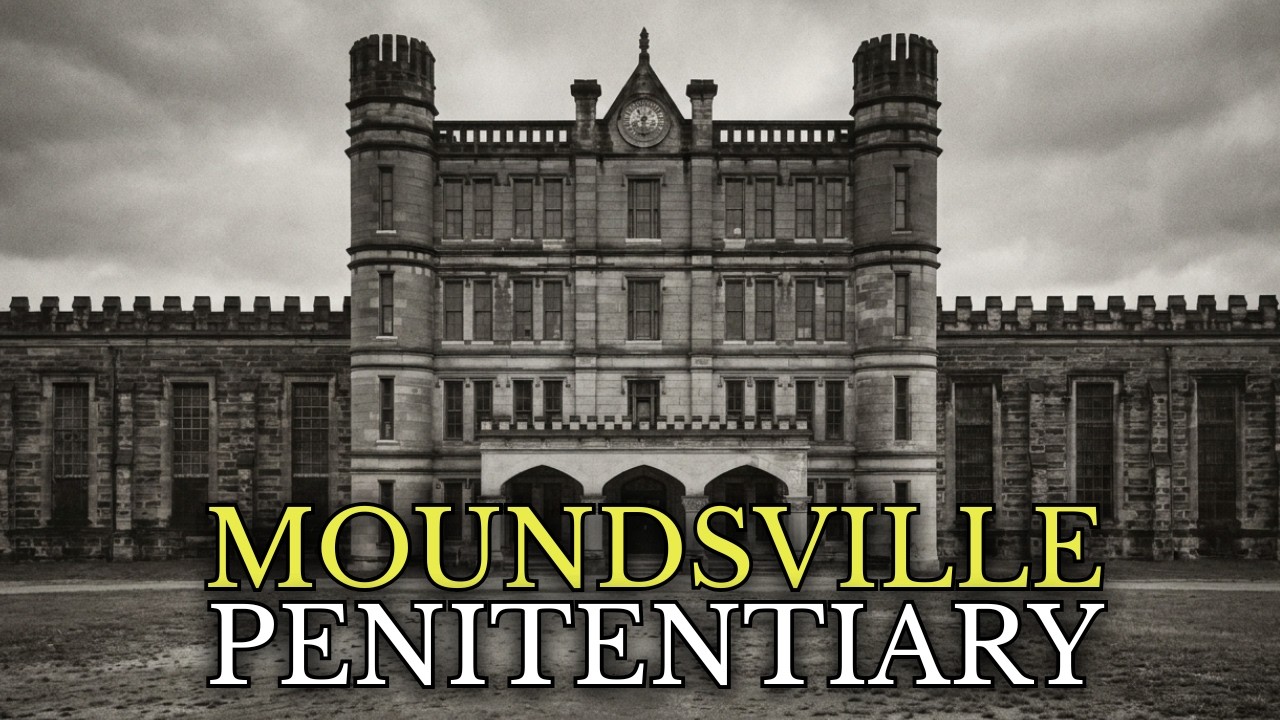
The prison rose from necessity. West Virginia, admitted to the Union in 1863 during the Civil War, had no state penitentiary for years. Convicted felons were scattered into county jails never designed to hold them. After nine inmates escaped from the overcrowded Ohio County Jail in Wheeling in 1865, public outrage finally forced the legislature to act.
On February 7, 1866, lawmakers approved the purchase of land near Moundsville, roughly 12 miles south of Wheeling, paying $3,000 for 10 acres beside the Ohio River. Architect Levi Scofield designed the facility in the Gothic Revival style, modeled after the feared Northern Illinois Penitentiary at Joliet. The design featured turrets, battlements, and a fortress-like silhouette intended to project dread. One newspaper account from the era said the architecture was meant to convey a “cheerless blank, indicative of the misery” awaiting anyone who entered.
Construction began in 1866 and took a full decade to complete. The state used inmates as the primary labor force. Prisoners cut and hauled sandstone from nearby quarries, building walls five feet thick at the base and tapering to about two feet at the top. They raised the North Wagon Gate in 1876, the South Hall in 1868, and the outer wall stretching over 800 feet along what is now Jefferson Avenue.
The total cost reached $363,061, equivalent to several million dollars today. The prison officially opened in 1876, with 224 cells in the completed south wing. Each cell measured just four feet by seven feet, barely enough space for a man to lie down with his arms at his sides. Some of the first inmates to enter had spent years laboring on the very walls now closing around them.
Overcrowding became severe almost immediately. Designed for 480 men, the population exceeded 700 within the first decade and soared past 2,000 by the 1950s. Men slept two and three to a cell, with late arrivals on the floor. Toilets sat within arm’s reach of bunks with no partition for privacy.
Communal showers offered none either. The open design of the north and south halls meant nothing inside was ever truly private or quiet. The state began carrying out executions at the prison in 1899, centralizing hangings at a single gallows inside the walls the inmates had built. For more than three decades, these executions were public spectacles.
Crowds traveled to watch condemned men die. This ended in June 1931, when the hanging of Frank Hayer, convicted of killing his wife, went catastrophically wrong in front of a gathered crowd. The details were never officially agreed upon, but the horror of the event ended public hangings in West Virginia permanently. Executions continued behind closed doors for nearly two more decades.
Then, in 1951, the state moved to electrocution and turned once again to its own inmates for the work. Paul Glenn, a trained electrician serving time for murder, was assigned to build the electric chair. He wired the device that would come to be known as Old Sparky, constructing it on top of the old gallows mechanism it replaced. Once the chair was finished, the state transferred Glenn to another facility.
The other inmates wanted him dead for building the instrument that would kill their fellow prisoners. Old Sparky claimed nine lives between 1951 and 1959. The state abolished capital punishment entirely in 1965. In total, 94 men died by execution at Moundsville across six decades: 85 by hanging and nine by electrocution.
Old Sparky still sits preserved on display near the prison’s entrance today. The prison also housed figures of national significance. Harry Powers, convicted of the “lonely hearts” murders in the 1930s, was held there until his 1932 execution. His crimes later inspired Davis Grubb’s novel “The Night of the Hunter,” which became a classic American Gothic work.
Eugene Debs, the labor organizer and five-time presidential candidate, was held briefly at the prison in 1919 under the Espionage Act. In 1983, Charles Manson wrote a letter to the warden requesting a transfer to the facility, promising not to cause trouble. The request was denied, but the letter remains on display at the site. As decades passed, conditions deteriorated dangerously.
Gang power grew, with groups like the Aryan Brotherhood and the Avengers controlling territory inside the facility. Locks failed, security loosened, and guards were permanently outnumbered by as much as 13 to one. A small uprising in March 1973 showed how fragile control had become, with inmates seizing hostages and setting fires before it ended without loss of life. The reckoning began on January 1, 1986.
Around 5:30 that evening, 20 members of the Avengers moved on the mess hall, overwhelming five guards and a kitchen worker within seconds. They used the guards’ own handcuffs to secure their hostages. The prison’s open design worked entirely in the inmates’ favor once keys were seized. The uprising expanded until 16 guards were held hostage, offices were ransacked, and damage reached an estimated $200,000.
Governor Arch Moore entered the prison personally to negotiate. Danny Lehman, president of the Avengers, became the inmates’ chief negotiator and voice. Inmate grievances centered heavily on physical conditions, chief among them a leaking sewer pipe beneath the cafeteria floor that had filled the dining hall with an unbearable stench for months. The standoff lasted two full days.
During the uprising, three inmates believed to be informants were killed by fellow prisoners. The official hostages were released largely unharmed. Governor Moore secured concessions, including plans for a new cafeteria. But 1986 became the prison’s deadliest year in over a quarter century, with six prisoners killed in total and twice as many injured in the aftermath.
While the riot captured public attention, a legal reckoning had been building for years. In 1981, inmate Robert Crane filed a petition challenging the fundamental conditions of his confinement, arguing that the prison itself violated constitutional protections. In 1986, the West Virginia Supreme Court ruled that confining inmates in cells measuring five feet by seven feet constituted cruel and unusual punishment. The court repeatedly rejected state proposals for renovation.
The building itself could not be brought into compliance. The prison’s population had already declined to around 700 by the time the ruling took full effect. In 1995, after 129 years of continuous operation, the West Virginia Penitentiary at Moundsville closed its doors for good. Remaining inmates were transferred to the new Mount Olive Correctional Complex in Fayette County.
The building found a second life after closure. The Moundsville Economic Development Council took over management and opened the site for tours. Stories of a “shadow man” and other unexplained phenomena began circulating among visitors and staff. The prison now offers guided tours, midnight explorations, and an autumn haunted house called The Dungeon of Horrors.
In 2009, a full three-dimensional digital model of the structure was completed for law enforcement training. Each spring, the mock prison riot exercise brings tactical teams from across the country to run realistic drills inside the very halls where a real riot once claimed lives. The building has also served as a filming location, appearing in the 2013 film “Out of the Furnace” and the Hulu series “Castle Rock. ”
Today, tour guides lead visitors past cramped cells, isolation wards, and the execution chamber, explaining in plain terms how bad conditions became before the courts intervened.
The walls still stand 24 feet high along Jefferson Avenue, exactly where inmates set them more than a century ago. They no longer hold anyone against their will, but they still carry the weight of every hand that was forced to help build a cage meant to hold men for life.