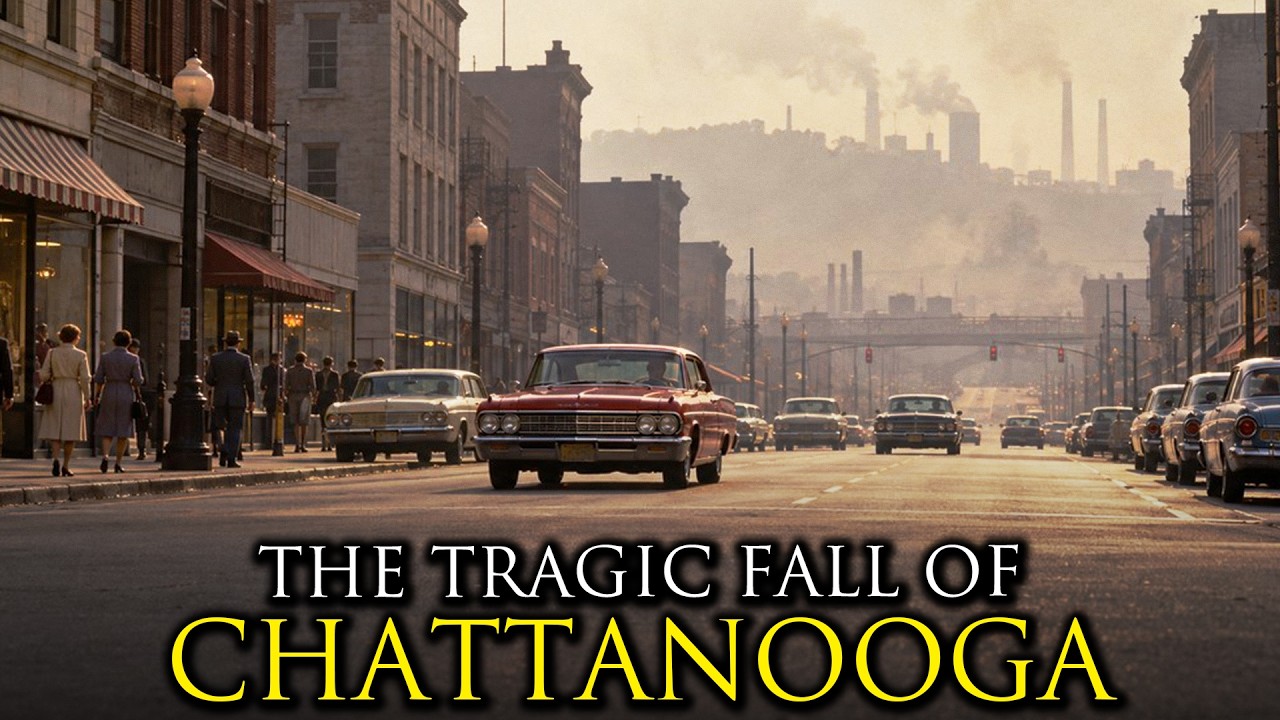
In 1969, the federal government declared Chattanooga, Tennessee, home to the filthiest air in the United States. Soot from iron foundries and chemical plants fell so thick over downtown that on some days drivers turned on their headlights at noon. Doctors reported respiratory disease at rates that alarmed federal health officials, families who could afford to leave did, and property values collapsed. The Tennessee River, the same river that made the city vital enough to fight a Civil War over, ran so foul that people would not wade into it.
What happened next in Chattanooga does not follow the usual script of American industrial decline. It was not Gary, Indiana. It was not Camden. It was not one of those cities where decline just kept declining and every recovery plan stalled.
Something different happened here. A city that had literally poisoned itself with its own prosperity managed to come back—not as a museum, and not as a suburb of somewhere else—but as a place people now actually choose. Urban planners from around the world flew in to figure out how. That story does not start in 1969.
It starts much earlier, with the river. The Tennessee River bends through a valley ringed by mountains: Lookout Mountain to the southwest, Signal Mountain to the northwest, and Missionary Ridge to the east. It is a natural bowl, one of the most dramatic settings of any city in the American South. The Cherokee had lived in this valley for centuries, and the place where the river bends was one of their most important trading posts.
The settlement at the river landing was run for years by a Cherokee chief named John Ross, a blue-eyed man of mostly Scottish descent who had become one of the most powerful leaders in the Cherokee nation. The place was called Ross’s Landing. It was busy, profitable, and strategic—exactly the kind of place that white settlers and the federal government wanted. In 1838, federal troops marched into the valley and forced the Cherokee out.
Thousands of men, women, and children were rounded up, held in makeshift camps, and driven westward on what became the Trail of Tears. Ross’s Landing was one of the primary departure points. Within a year of the removal, the settlement was incorporated under a new name: Chattanooga. The mountains and river made this spot a transportation choke point, and transportation choke points attract railroads.
By the 1850s, Chattanooga was a junction for four rail lines, turning a small trading settlement into something strategically enormous. When the Civil War came, both sides understood immediately that whoever controlled Chattanooga controlled the railroads, and whoever controlled the railroads controlled the movement of armies, supplies, and ammunition through the entire western theater. In September 1863, the armies collided just south of the city at Chickamauga Creek. The Battle of Chickamauga became one of the bloodiest engagements of the entire war, with roughly 34,000 casualties over two days.
The Union Army, badly beaten, retreated into Chattanooga and was nearly starved out. Confederate forces held the high ground on Lookout Mountain and Missionary Ridge, looking down at a trapped enemy. In November 1863, Union reinforcements arrived under Ulysses Grant. On November 24, Union troops fought their way up the slopes of Lookout Mountain through fog so thick that observers below could not see the battle—it became known as the Battle Above the Clouds.
The next day, Union soldiers charged up Missionary Ridge in what was supposed to be a limited assault on the base. But the men did not stop. They kept climbing all the way to the top, past stunned Confederate defenders. Grant, watching from below, reportedly asked who had ordered the charge.
Nobody had. The soldiers had simply decided on their own to take the ridge. Chattanooga was secured. The city itself was wrecked—buildings shelled, infrastructure destroyed, the population scattered.
But the war had proven beyond any doubt that this bend in the Tennessee River inside this ring of mountains was one of the most strategically valuable locations in the South. That lesson was not lost on the men who came next. Within two decades of Appomattox, Chattanooga had become one of the most aggressively industrialized cities below the Mason-Dixon line. Iron foundries went up first, the raw material nearby: Tennessee’s eastern ridges held iron ore, coal, and limestone, the three ingredients needed to make pig iron.
Chattanooga was not a cotton town. It was a factory city, a furnace city. Boosters called it the Dynamo of Dixie. Each operation sent plumes of thick smoke into the valley air, and the promotional literature of the era treated that smoke as a badge of honor.
Engravings from the 1880s show the city skyline punctuated by smokestacks, drawn proudly the way a later generation would draw skyscrapers. Smoke meant work, and work meant stability. The population, which had been around 6,000 before the war, surged past 12,000 by 1880 and hit nearly 30,000 by 1890. With that growth came ambition beyond function.
The 1880s and 1890s saw a building spree: commercial blocks in brick and stone, banks with marble lobbies, churches with steeples you could see from the ridge. The most telling sign of Chattanooga’s self-image was its newspaper and the young man who ran it. In 1878, a 20-year-old named Adolph Ochs took control of the Chattanooga Times. Ochs had grown up in the city, the son of German Jewish immigrants, and had been working in print shops since he was 11.
By the mid-1890s, the Chattanooga Times was one of the most respected papers in the South. Then in 1896, Ochs left. He went to New York and bought the struggling New York Times, which he would transform into the most influential newspaper in the world, with credibility and connections he had built in Chattanooga. The city produced more than ambition.
In 1894, in a small wooden cabin on Charles Street, a girl named Bessie Smith was born. Her father was a part-time Baptist preacher who died while she was an infant; her mother died before Bessie turned nine. She grew up in desperate poverty, singing on street corners for pocket change. By her early 20s, she had become the highest paid black performer in the United States—the Empress of the Blues.
Columbia Records reportedly sold nearly 10 million of her records during the 1920s and early 1930s. In 1899, something happened in Chattanooga whose consequences would ripple forward in ways nobody could have predicted. Two local lawyers, Benjamin Thomas and Joseph Whitehead, traveled to Atlanta to meet with Asa Candler, the owner of the Coca-Cola Company. Candler sold Coke as a fountain drink, syrup mixed at the counter in pharmacies and soda shops.
Thomas and Whitehead had a different idea: they wanted to bottle it. Candler thought the idea was borderline foolish. He sold them the exclusive bottling rights for nearly the entire United States for what most accounts describe as one dollar. Thomas and Whitehead took those rights back to Chattanooga and built a bottling operation that would become one of the most lucrative franchise systems in the history of American business.
Billions of dollars in revenue, decades of wealth, entire family fortunes, all flowing from a deal the seller thought was barely worth the paper it was printed on. That Coca-Cola money stayed in Chattanooga. It built mansions on Lookout Mountain, funded foundations, and created a class of local philanthropists whose wealth had nothing to do with foundries or railroads. Meanwhile, the city kept building.
In 1909, Chattanooga opened Terminal Station, a Beaux-Arts passenger rail depot designed by New York architect Donn Barber, with a soaring dome, brick and terra cotta detailing, and an interior that announced without any subtlety that Chattanooga considered itself a major American city. A dozen years later, in 1921, the Tivoli Theater opened on Broad Street, designed by the legendary firm of Rapp & Rapp, the same architects behind some of the most extravagant movie palaces in America. The interior was a fantasy of ornamental plaster work, crystal chandeliers, and a ceiling painted to resemble an open sky. It seated over 1,700 people.
The Incline Railway had been climbing Lookout Mountain since 1895, hauling passengers up a grade so steep—nearly 73 percent near the top—that first-time riders gripped the seats. From the top on a clear day, people claimed you could see seven states. By the 1920s, Chattanooga had industry, rail connections, grand architecture, a famous theater, a mountaintop tourist attraction, and a newspaperman who had already produced the publisher of the New York Times. The population was pushing past 100,000.
In 1941, Glenn Miller and his orchestra recorded “Chattanooga Choo Choo,” a swing number about a train ride from New York down to Tennessee. The recording sold over a million copies and became the first record to be certified gold by RCA Victor. Suddenly, people who had never set foot in Tennessee knew the word Chattanooga. The song created an image of the city that had almost nothing to do with the real place.
The real place by the 1940s was an industrial powerhouse in the middle of a war economy. During World War II, the city’s factories produced ammunition, textiles, and material. TNT was manufactured at the Volunteer Army Ammunition Plant east of town. The 1950s brought new chemical plants, more manufacturing, and auto parts suppliers.
DuPont had operations nearby. Combustion Engineering employed thousands. The American Lava Corporation produced industrial ceramics. A man could work at the same plant for 30 years, own a house, send his kids to public school, and retire with a pension.
But the geography that had made Chattanooga strategically vital was quietly becoming a trap. The mountains didn’t just frame the city—they enclosed it in a bowl. Into that bowl, every foundry, every chemical plant, every coke oven, every textile mill, every automobile, every furnace was pumping exhaust, particulates, sulfur dioxide, and chemical waste. In a flat city, that pollution would have dispersed.
In Chattanooga, it had nowhere to go. It settled and thickened. Thermal inversions, atmospheric conditions where warm air traps cooler air below it, were common in the valley. When they happened, the pollution just sat there, a gray-brown blanket draped over the entire downtown.
Housewives in the 1950s knew that if you hung white laundry on the clothesline in certain neighborhoods, it would be gray by afternoon. Drivers on some winter mornings could barely see the car ahead of them. Particulate levels—the tiny solid particles suspended in the air that get into your lungs—were among the highest ever recorded in an American city. Respiratory illness was climbing.
Doctors at local hospitals were seeing patterns: asthma, bronchitis, emphysema. Some physicians began pressing the county health department. The city’s leadership was caught between two fears: that the air was genuinely dangerous, and that admitting it would scare away the industry that kept people employed. There are accounts, not all easy to verify but consistent enough to take seriously, of days when the haze was so dense that Lookout Mountain disappeared entirely from downtown—a mountain nearly 2,000 feet tall, six miles away, simply erased by particulate matter.
Children in some neighborhoods reportedly developed respiratory problems at rates far above national averages. The river was its own disaster. Industrial runoff had turned stretches of the Tennessee into something closer to a chemical channel than a waterway. Industrial operations had walled the riverfront off from downtown.
The river was there technically, but the city had turned its back on it completely. The thing that made the city was the thing the city was poisoning. Then the federal government made it official. In 1969, the Department of Health, Education, and Welfare released data showing that Chattanooga had the worst particulate air pollution of any city in the United States.
The dirtiest air in America—not Los Angeles, not Pittsburgh, not Gary. The phrase “dirtiest city in America” attached itself to Chattanooga and would not come off. National media picked it up. Remarkably, Chattanooga chose to confront it.
In 1969, Hamilton County created an air pollution control bureau. Local government began enforcing emission standards. Industries that had operated for decades without controls were told to clean up or face consequences. Some cleaned up; some closed.
Every factory that installed scrubbers and filters absorbed new costs. Every factory that couldn’t afford the upgrades either relocated or shut down. The pollution cleanup began costing jobs. Working-class neighborhoods that had tolerated dirty air because dirty air came with a paycheck now faced a different kind of crisis.
The air was getting better; the employment picture was getting worse. At almost the same time, Chattanooga was being hit by the same forces devastating downtowns across America. Interstate highways made it easy to live in suburbs and drive past the old commercial core. Shopping centers and then malls pulled retail out of downtown.
The department stores on Market Street and Broad Street began to close one by one. Terminal Station saw its passenger traffic drop to nearly nothing as airlines and automobiles replaced trains. By the mid-1970s, downtown Chattanooga was beginning to look like a place abandoned by its own residents. Young people with options were leaving for Atlanta, Nashville, or Knoxville.
Chattanooga wasn’t unique in losing industry and downtown life. What made it different was the specific combination: the pollution stigma, the geography that had created the pollution, the industrial cleanup that was necessary but economically painful, the highway-driven suburban sprawl, and a downtown psychologically separated from its own river for decades. Most declining cities had two or three of those problems. Chattanooga had all of them at once.
By some estimates, downtown lost more than half its retail square footage between 1960 and 1985. Terminal Station, the front door of the Dynamo of Dixie, was in danger of being torn down. Demolition was discussed seriously. In 1973, a group of local investors stepped in and converted the station into a hotel and entertainment complex called the Chattanooga Choo Choo, after the song.
Visitors could sleep in restored rail cars parked on the old tracks. The dome was preserved. The building survived. This is the part of the story where the Coca-Cola money comes back.
The 1899 bottling deal had created enormous fortunes in Chattanooga. One of the families that benefited most was the Lupton family. John Thomas Lupton had become an early partner in the Coca-Cola bottling system, and over the decades the family accumulated staggering wealth, channeled through a philanthropic organization called the Lyndhurst Foundation. The foundation didn’t try to run the city.
It helped the city run a conversation with itself. In 1984, a community-wide planning effort called Vision 2000 was launched. The Lyndhurst Foundation provided significant funding and organizational support. Hundreds of meetings were held.
Thousands of residents, business owners, civic leaders, educators, environmentalists, developers, and ordinary citizens argued about what Chattanooga should become. A set of shared priorities emerged, centered on two things: the environment and the riverfront. The city decided its future depended on reversing the damage it had done to itself—cleaning the air the rest of the way, reclaiming the river, and turning the abandoned riverfront into the centerpiece of a new downtown. At the time, it was a gamble.
The riverfront was a mess of industrial ruins, rail yards, vacant lots, and old warehouses. Skeptics thought the money would be better spent chasing the same manufacturing economy other southern cities were competing for. But the Vision 2000 process had built broad civic buy-in. Thousands of people had participated, their ideas were in the plan, and they felt ownership.
The air, it should be said, had already improved dramatically. Between the early 1970s and the mid-1980s, Chattanooga’s air quality went from the worst in the nation to meeting federal standards. Particulate emissions dropped by more than 70 percent over roughly 15 years, one of the most successful air pollution cleanups in American urban history. The Air Pollution Control Bureau that Hamilton County created in the wake of the 1969 humiliation had actually worked.
The anchor project—the one that would either prove the skeptics right or prove them wrong—was an aquarium. Not a marine aquarium, but a freshwater aquarium, designed to sit right on the riverbank in the heart of downtown. The Tennessee Aquarium would be the largest freshwater aquarium in the world when it opened. The architect was Cambridge Seven Associates, the same group behind the New England Aquarium in Boston.
The cost was projected at around $45 million, an enormous bet for a mid-sized southern city in the late 1980s. Private donations covered a significant portion; the Lyndhurst Foundation contributed, and public funds filled the rest. The choice of a freshwater aquarium was deliberate. Chattanooga wasn’t on the coast.
What it had was a river—a river that had been poisoned, ignored, walled off, and turned into a symbol of everything the city had gotten wrong. Building the aquarium on the riverbank was a statement: the river matters again. The Tennessee Aquarium opened on May 1, 1992. More than 130,000 people came in the first week.
Within its first year, it drew over a million visitors in a city whose entire metropolitan population was around 450,000. Within five years of the aquarium’s opening, more than $725 million in new construction and renovation had been invested in the downtown core, according to figures cited by the city’s development office. New hotels opened. Parking garages went up.
A 13-mile river walk along the Tennessee River’s edge was developed in phases. Property that had sold for almost nothing in the late 1980s was suddenly worth real money. The Walnut Street Bridge was the next piece. Built in 1891, it had been a major vehicular crossing before being closed to traffic in 1978.
For years it sat rusting, an argument between preservationists and pragmatists. Vision 2000 identified it as a potential pedestrian bridge, and in 1993, after significant renovation, it reopened for foot traffic only, connecting downtown to the developing Northshore neighborhood. At over 2,300 feet, it became one of the longest pedestrian bridges in the world. Coolidge Park opened on the Northshore end, with a restored carousel and splash pads.
The Bluff View Art District took shape on the south bank. The Hunter Museum of American Art expanded with a modern addition cantilevered over the limestone cliff face. None of this happened without friction. Property values along the riverfront climbed, creating real displacement pressures in surrounding neighborhoods.
The old industrial economy had employed people without college degrees; the new tourism, hospitality, and arts economy offered different kinds of jobs at often lower wages. The people who had breathed the worst air for the longest were not always the people who benefited most when the air got clean and property values rose. Chattanooga was also still a deeply segregated city. The riverfront redevelopment was concentrated in areas more accessible to white residents and visitors.
The Martin Luther King Boulevard corridor, the historically black commercial district, saw some investment, but nothing on the scale poured into the riverfront. Bessie Smith’s legacy was honored with the Bessie Smith Performance Hall, later the Bessie Smith Cultural Center, but the broader question of whether the reinvention was reaching all communities remained very much alive. Still, the physical transformation was astonishing. Outside magazine named Chattanooga the Best Town Ever in 2011.
Urban planning conferences held it up as a case study. European delegations came to study what had happened. The phrase “Chattanooga Renaissance” stopped feeling like civic boosterism and felt earned. The Lookout Mountain attractions—Rock City, Ruby Falls, the Incline Railway—had never really gone away.
Rock City, with its dramatic rock formations and gardens, had been drawing visitors since 1932, when Garnet Carter first opened it. Carter, who also invented miniature golf on the same mountain in the late 1920s, promoted Rock City by hiring a man named Clark Byers to paint “See Rock City” on barn roofs across the rural South. At its peak, over 900 barns carried the slogan. Ruby Falls, a 145-foot underground waterfall deep inside Lookout Mountain, had been a tourist attraction since 1930, drawing visitors into caverns discovered, or at least publicly promoted, by a local cave enthusiast named Leo Lambert, who drilled a shaft into the mountain and found both the waterfall and the cave system surrounding it.
Then Chattanooga did something nobody else in the country had done. In 2010, the city’s publicly owned electric utility, the Electric Power Board of Chattanooga, or EPB, launched a citywide fiber optic network offering internet speeds of one gigabit per second to every home and business in the service area. At a time when most Americans were getting by on connections topping out at 10 or 20 megabits, Chattanooga was offering speeds 50 to 100 times faster—the first city in the Western Hemisphere to offer gigabit internet to all its residents. The decision didn’t come from Silicon Valley.
It came from a municipal utility originally created to distribute electricity from the Tennessee Valley Authority. The investment was significant, roughly $330 million for the full smart grid and fiber network. Critics, including large incumbent telecommunications providers, fought it. Lawsuits were filed.
The state legislature passed laws restricting EPB from expanding beyond its existing electric utility footprint. But within the footprint, the service launched, and it was transformational. Chattanooga became known as Gig City. In 2008, Volkswagen announced it would build a new automobile assembly plant in Chattanooga—a billion-dollar investment that opened in 2011 and employed roughly 3,500 workers.
Manufacturing again, but a different species: robotic assembly lines, German engineering standards, a global supply chain. The irony is layered. Chattanooga’s greatest infrastructure achievement of the 19th century was the rail junction. Its greatest infrastructure achievement of the 21st century is a fiber optic network, a system for moving information instead of iron.
The city even cleaned the Tennessee River enough that people paddle it now—kayakers, rowers, stand-up paddleboarders. There are waterfront restaurants with patios where people sit and look at the same bend in the Tennessee River that the Cherokee navigated, that Union soldiers fought to control, that foundries used as a dumping channel, and that planners eventually decided to reclaim. Chattanooga now draws roughly 17 to 18 million visitors per year to its metropolitan area—a figure that would have seemed clinically delusional to anyone standing in downtown in 1975, watching the storefronts close and breathing air that tasted like metal. They come for the aquarium, for Rock City, for Ruby Falls, for the Incline Railway.
They come to walk the Walnut Street Bridge at sunset. They come for a dining culture that punches well above its weight class. They come because downtown is walkable, the setting is dramatic, and the place feels like somewhere specific. Yet the old economy—the one that employed men without degrees and paid them enough to buy houses and raise families in the shadow of Lookout Mountain—has been replaced by something newer, cleaner, more educated, and in many ways less inclusive.
Tourism jobs and tech jobs are not the same as foundry jobs. The city’s poverty rate remains higher than the national average. The neighborhoods farthest from the riverfront and the innovation district still carry the marks of the decades when Chattanooga was a place people left. The reinvention is real, but so are its uneven consequences.
Walk down Broad Street today. The Tivoli Theater is still there, restored, still hosting shows under that painted sky ceiling designed over a hundred years ago. The Read House hotel is still there, with a ghost story about room 311. The Walnut Street Bridge is full of people every evening when the weather is good.
The aquarium still draws families who drive hours to watch river otters, freshwater stingrays, and the fish of the Tennessee River watershed—the same watershed that nearly killed this city. The river bends through downtown the way it always has. The Cherokee knew this spot. Grant took it.
The foundries blackened it. The planners reclaimed it. And on a warm evening, standing on the Walnut Street Bridge looking south toward Lookout Mountain, it’s possible to understand why every generation that found this place decided it was worth fighting over. The air is clean now.
You can breathe.