In the autumn of 1860, William Tecumseh Sherman was the superintendent of a military college in Alexandria, Louisiana. He had spent years living among Southerners, eating at their tables, teaching their sons, and calling many of them his closest friends. He liked the South. By every account, the South liked him back.
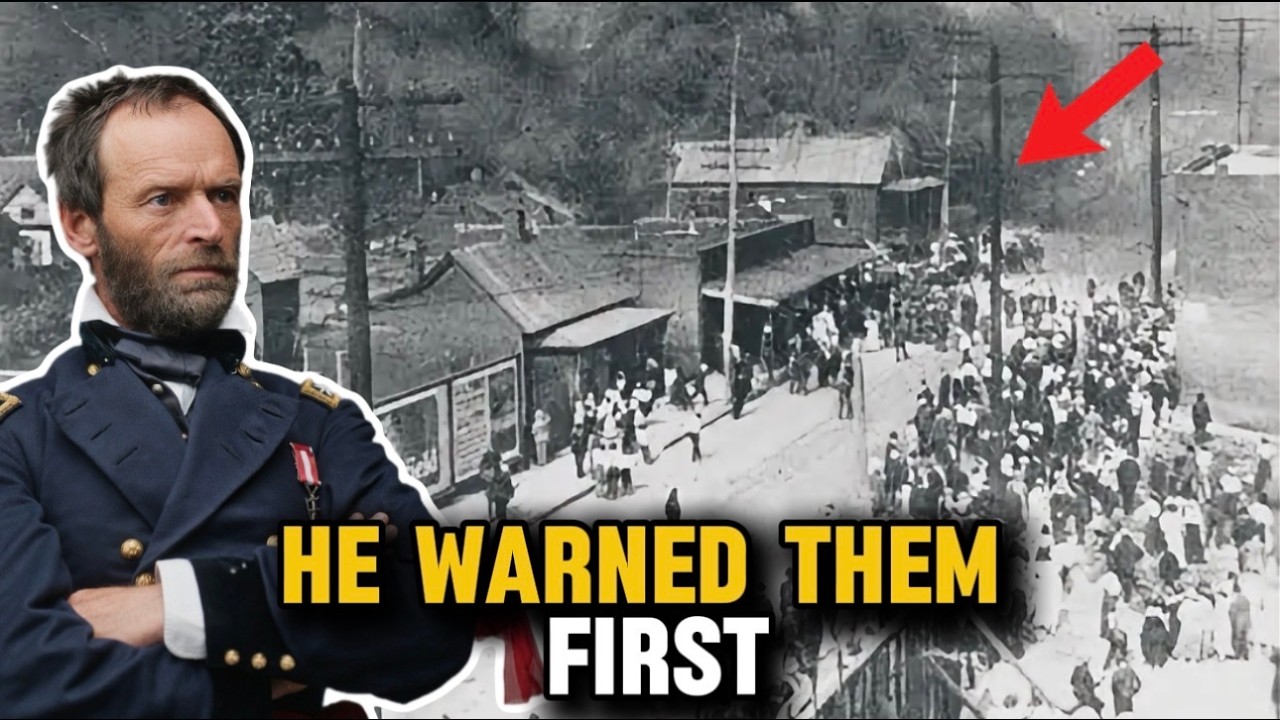
But, when the secession debate started heating up and men in parlors and courthouses began talking about what a war against the North would look like, Sherman said something that made the room go quiet. He told them it would be the worst thing they had ever seen. He told a close friend, David Boyd, that the North could make war in a way the South was not equipped to endure. He said that the population difference alone was staggering, and that Northern industry would choke Southern supply lines within two years. He said all of this before a single shot had been fired.
When he finished, the men around him smiled politely and told him he was wrong. They genuinely believed what they believed. Southern military culture had spent decades producing officers who were over-represented at West Point, who had proven themselves in Mexico, and who carried a deep confidence in their own fighting ability. They believed the Confederate soldier, fighting on his own soil for his own way of life, would simply outfight whatever the Union sent at him.
What they did not account for was Sherman. He resigned his Louisiana post in January 1861, wrote a letter to his southern friends that read almost like a farewell, and went north. When the war came, he went with it. He was at Bull Run, where the Union Army broke and ran. He was at Shiloh, where Grant's men nearly got pushed into the Tennessee River before they held.
The turning point in Sherman's thinking was not a single battle. It was an accumulation. He watched Confederate guerrillas tear up Union supply lines in Tennessee and Mississippi. He watched the Army of Tennessee rebuild itself after losses that would have destroyed a conventional force, because the Confederate countryside kept feeding it. As long as the southern economy functioned, the Confederacy could keep fighting regardless of what happened on any individual battlefield.
Sherman's conclusion was not a complicated one. It was exactly what he had told those men in Louisiana 4 years earlier. You had to make the South feel it. What Sherman proposed and what Grant approved was a military campaign aimed at the material foundation of Confederate resistance. If the Southern home front believed the war was being fought somewhere else, Sherman's job was to walk into the middle of that belief and dismantle it literally with 60,000 men.
Atlanta fell on September 2nd, 1864. Sherman spent the next several weeks reorganizing and working out the details of what came next. He wanted to cut loose from his supply line entirely. He would feed his army off the land and march it from Atlanta to the sea across the heart of Georgia, destroying everything that had military value. Grant eventually agreed. Lincoln, up for re-election and desperate for something to change the political weather, agreed.
On November 15th, 1864, what remained of Atlanta, its warehouses, its rail yards, its machine shops, everything that had made it a logistical hub for the Confederacy, went up in flames. Sherman watched it from a hillside. The army that moved out of Atlanta was a specific kind of instrument. Sherman had spent months culling it. He sent away the sick, the reluctant, and the men he did not trust to maintain discipline.
What he kept was roughly 62,000 soldiers organized into two wings, each capable of operating independently. They moved on a front 40 to 60 miles wide, which was deliberate. A narrow column could be slowed, harassed, or blocked. A force spread across 60 miles of Georgia countryside could not be stopped by anything the Confederacy had left to put in its path.
John Bell Hood had taken what remained of the Confederate Army of Tennessee and moved it north toward Nashville. The practical effect was that Sherman's march into the Georgia interior was opposed by almost nothing. A patchwork force under William Hardee, Georgia militia that included old men and boys, and Confederate cavalry under Joseph Wheeler could harass the column's edges, but could not stop it from moving.
Sherman covered roughly 15 miles a day. In 3 weeks, he had crossed 300 miles of Confederate territory. The foraging parties, Sherman called them bummers, fanned out ahead of the main columns each morning, pulling food and livestock from the farms in their path. They took what the army needed and destroyed what they could not carry. They destroyed cotton gins, because cotton gins had everything to do with sustaining the southern economy that was keeping this war alive.
The railroads got the most systematic attention. Sherman's men had developed a technique they were almost proud of. They would pull up the rails, heat them over fires of their own cross ties, and then bend them around trees, what soldiers called Sherman's neckties. A twisted rail cannot be straightened and reused without industrial equipment the Confederacy no longer had access to.

Sherman's orders explicitly prohibited the burning of private residences and the abuse of civilians. Those orders were enforced unevenly at best. Some of his officers kept tight control of their men. Others looked the other way. The March produced real suffering among Georgia's civilian population and no honest accounting of it pretends otherwise.
But Sherman's purpose was never to destroy Georgia for the satisfaction of it. Every time his men tore up a railroad, burned a depot, or drove off a herd of cattle, they were converting Confederate military infrastructure into nothing. And they were delivering a message. That message was simple. Your government cannot stop this. The Confederate Army that was supposed to protect you is somewhere else right now.
Jefferson Davis understood the danger immediately. He issued statements insisting Sherman would be crushed, that Georgia would rise up and destroy the Union column. None of it happened because the men in Richmond had no means to make it happen. George Thomas was dealing with Hood in Tennessee. Lee was pinned at Petersburg by Grant.
Savannah fell on December 21st, 1864. Sherman sent a telegram famously offering the city as a Christmas present. The march had taken 36 days. Sherman had lost fewer than 700 men killed, wounded, and missing across 300 miles of enemy territory. His army had consumed and destroyed an estimated $100 million worth of Confederate property. More importantly, it had demonstrated that the Confederate government had lost control of its own interior.
When Sherman turned north into the Carolinas in early 1865, the dynamic shifted. South Carolina was treated with considerably less restraint than Georgia had been. Columbia burned on the night of February 17th, 1865 and the argument over who started that fire has never been completely settled. What mattered strategically was that it made no difference anymore.
By the time Columbia burned, Lee had fewer than 60,000 men at Petersburg facing twice that number. Hood's Army of Tennessee had been shattered at Franklin and Nashville. The Confederacy was not losing the war. It had lost it. The question was only how much longer it would drag on.

Sherman reached North Carolina in March. Joseph Johnston had assembled whatever remained of multiple depleted Confederate forces and was trying to slow him down. Johnston managed to land a blow at Bentonville, the largest battle of Sherman's entire Carolinas campaign, but it was a holding action against an army that could not be held. Johnston retreated. Sherman pressed on.
When Lee surrendered at Appomattox on April 9th, Johnston was still in the field but had no realistic option and knew it. He asked Sherman for terms two weeks later. Sherman offered Johnston terms so generous that they were immediately repudiated by Washington. Sherman was furious and the fury was instructive. He had made the calculation that the fastest route to ending the war was to make continued resistance cost more than surrender.
The Lost Cause mythology that emerged in the decades after the war did something specific with Sherman. It transformed the march from a military operation into an atrocity. If Sherman was a monster, then what he did to Georgia was not evidence that the South had been warned and refused to listen. It was simply evidence that the North was barbaric.
But the record does not cooperate with that framing. Sherman wrote and spoke extensively about what he intended. He believed that war is not an abstraction. It exists in the cotton gin, in the railroad depot, in the storehouse full of cured pork. Until the population sustaining a war feels that war in a tangible way, the men fighting it have little incentive to quit.
He had said as much in almost those exact words to men in Louisiana who had laughed politely and told him he was wrong. They were not laughing in December of 1864. And the ones who were still waiting to be proven right ran out of time in April of 1865.
The war that the Confederate leadership had imagined clean, quick, decisive, fought by gentleman soldiers on agreed upon battlefields, was never the war they were going to get. Sherman had known that before the first shot was fired. He had said it out loud. He had committed it to paper. When the moment came to prove it, he did not hesitate.
That is the history that tends to get lost beneath the flames and the mythology. The thing underneath all of it, the fact that a man had looked at the South and told it exactly what was coming. And the South had decided he was wrong. And he spent four years proving otherwise. The warning was always on the table. Sherman just made sure they could not ignore it anymore.