On the night of September 7, 1937, a handful of servants stood in the fading light and watched Whitley Court burn. The fire pump would not start. It had not worked in years, and nobody had thought to check. By morning, one of the largest private palaces in Europe was a smoking shell.
But the story of the mansion’s death is far stranger than a simple house fire. Whitley Court had been dying for 40 years before the flames ever touched it. The real destruction began not with a spark in a basement bakery, but with a drowning off the coast of Ireland, a gambling habit, and 665 enslaved people in Jamaica. The fire was not the cause of death.
It was merely the coroner’s report, delivered after the killing had already been done, slowly and quietly, by the same economic machinery that had raised the walls in the first place. The fortune that built Whitley Court began with a man who hammered nails for a living in a workshop in Dudley. His name was Richard Foley, born around 1580 in the Black Country, the dense knot of coal seams and iron deposits in the English Midlands. The nail trade was brutal, low-margin work.
But Richard Foley was not interested in making nails forever. He was interested in how nails were made. According to a story that has come down through the centuries, likely embellished but persistent, Foley traveled to Sweden disguised as a fiddler to learn the secret of splitting iron rods using a slitting mill. Sweden had the technology.
England did not. Whether the fiddler story is true or not, Foley returned to Stourbridge and built one of England’s first slitting mills around 1627. The machine turned iron bars into thin rods at a speed no hand process could match. It made money.
Lots of it. Within a generation, the Foleys controlled a network of iron works, forges, and furnaces across Worcestershire and beyond. When the English Civil War tore the country apart in the 1640s, they supplied something far more profitable than nails and tools: cannons. Parliament needed weapons.
The Foleys were ready to provide them. By the time Charles I lost his head in 1649, the family had accumulated wealth no nail maker could have imagined. Now came the transformation every newly rich English family attempted. The Foleys needed to stop looking like ironmongers and start looking like gentlemen.
That meant land. The estate they chose was Whitley Court. When the Russell family built it around 1624, Whitley was a modest Jacobean manor of red brick, gabled roofs, and mullion windows, handsome enough, but nothing to turn heads. It sat in rolling Worcestershire countryside about ten miles northwest of Worcester.
Thomas Foley, Richard’s grandson, bought the estate in 1655 for a sum that does not survive in the records. What does survive is the logic of the purchase. Thomas was not buying a house. He was buying a disguise.
The Jacobean brick would cover the smell of the forge. The parkland would erase the memory of the workshop. Within a generation, the Foleys would be not iron makers but landowners, not manufacturers but gentlemen. This was the essential alchemy of the English class system: raw money made in smoke, fire, and war poured into soil and stone until it looked old, permanent, and respectable.
For 182 years, the family treated Whitley Court not as a home but as a project that could never be finished. Eight successive heads of the family, nearly all of them called Thomas, inherited the last generation’s work, judged it insufficient, and started again. By the early 1700s, Whitley was no longer a modest manor. The most extraordinary addition had nothing to do with the house itself.
Great Whitley Church, dedicated to St. Michael, stands just yards from the house. The Foleys rebuilt it in the 1730s and filled it with one of the most remarkable interiors in England. The ceiling paintings and painted glass windows were not made for Whitley.
They were made for the chapel at Canons, the Duke of Chandos’s extravagant mansion in Middlesex. When Canons was demolished in 1747, its contents were scattered at auction. The Foleys bought the paintings, the glass, and the gilded papier-mâché ceiling decorations and had them shipped by canal and cart to Worcestershire. A family of iron makers, barely a century removed from the forge, bought the spiritual furnishings of a duke’s private chapel and installed them in their own parish church.
By the late 1700s, the Foley fortune was under strain. The iron works were facing competition, and the second Baron Foley, who inherited in 1766, had a problem no amount of iron could solve: he gambled. His debts mounted through the 1770s and 1780s. He sold land.
He mortgaged property. The estate survived him, but it survived diminished. During this period, the family made one last grand architectural gesture. They hired John Nash, a talented but not yet famous architect.
Nash was commissioned to add a portico to Whitley Court’s south front. What he built was enormous: a full classical portico with massive columns, the largest on any private house in England. It was magnificent. It was also an act of defiance.
The family was spending money it could barely afford on a facade that proclaimed stability and power. Behind the portico, the debts quietly grew. By the 1820s, the Foley line was exhausted. The money was thin.
The direct male line was failing. The estate needed a new owner with a new fortune. And as if on cue, one appeared. He was 16 years old.
His name was William Ward, and his trustees had just agreed to spend £680,000 on a house for a boy who could not yet sign his own checks. In 1837, trustees spent a sum equivalent to nearly £100 million today on a house for a teenager who was not yet allowed to touch his own money. William Ward was born in 1817 into a fortune that made even other rich people uncomfortable. His father, the first Viscount Dudley and Ward, controlled the most productive coalfield in England.
The family’s mines around Dudley produced close to a million tons of coal per year. Annual income from the Ward estates exceeded £100,000 at a time when a skilled laborer might earn £50 in a year. But the Ward fortune was not built on coal alone. In Jamaica, the family owned plantations worked by enslaved people.
Records of the Slave Compensation Commission show that the Ward estates claimed compensation for 665 enslaved individuals when slavery was abolished in the British Empire in 1833. The family received thousands of pounds in compensation, not for the people they had enslaved, but for the loss of their property. When William’s father died in 1833, the boy was just 16. His inheritance was placed in the hands of trustees.
They looked at Whitley Court, recently on the market as the Foley line collapsed, and saw potential. The purchase price of £680,000 was staggering. The trustees were not simply buying a house. They were buying the apparatus of aristocratic life: the farms, the tenancies, the shooting rights, the village, the church.
William Ward grew up in the strange limbo of the very wealthy minor. The house was his, but he could not alter it. The money was his, but he could not spend it. While he waited, someone else moved in.
Queen Adelaide, widow of King William IV, leased Whitley Court as her country residence from 1843. For several years, a dowager queen occupied the house a teenage coal heir technically owned. When William came of age and took full possession of his fortune, he had a house a queen had lived in, an income that rivaled most dukes, and the social ambition to match. He was created Baron Ward in 1860 and eventually Earl of Dudley.
Everything was in place. All that remained was a reason to build. Then, seven months after his wedding, his wife died. Selina Ward, born Selina de Burgh, died in 1851.
She was 23. The child she carried died with her. William was 34, and by every account, the loss broke something in him. He would not remarry for another 14 years.
In the meantime, he redirected the full force of his grief, his money, and his restless energy into the only thing that could absorb it all. He rebuilt Whitley Court. The architect he chose was Samuel Daukes, a competent but not celebrated designer who had worked on churches and institutional buildings. He would build whatever his patron demanded at whatever scale his patron could afford.
And William Ward could afford anything. The transformation began in 1855 and continued until roughly 1860. It was not a renovation; it was a replacement. Daukes wrapped the entire Jacobean and Georgian house in a new skin of Bath stone, laid over the old red brick like a mask.
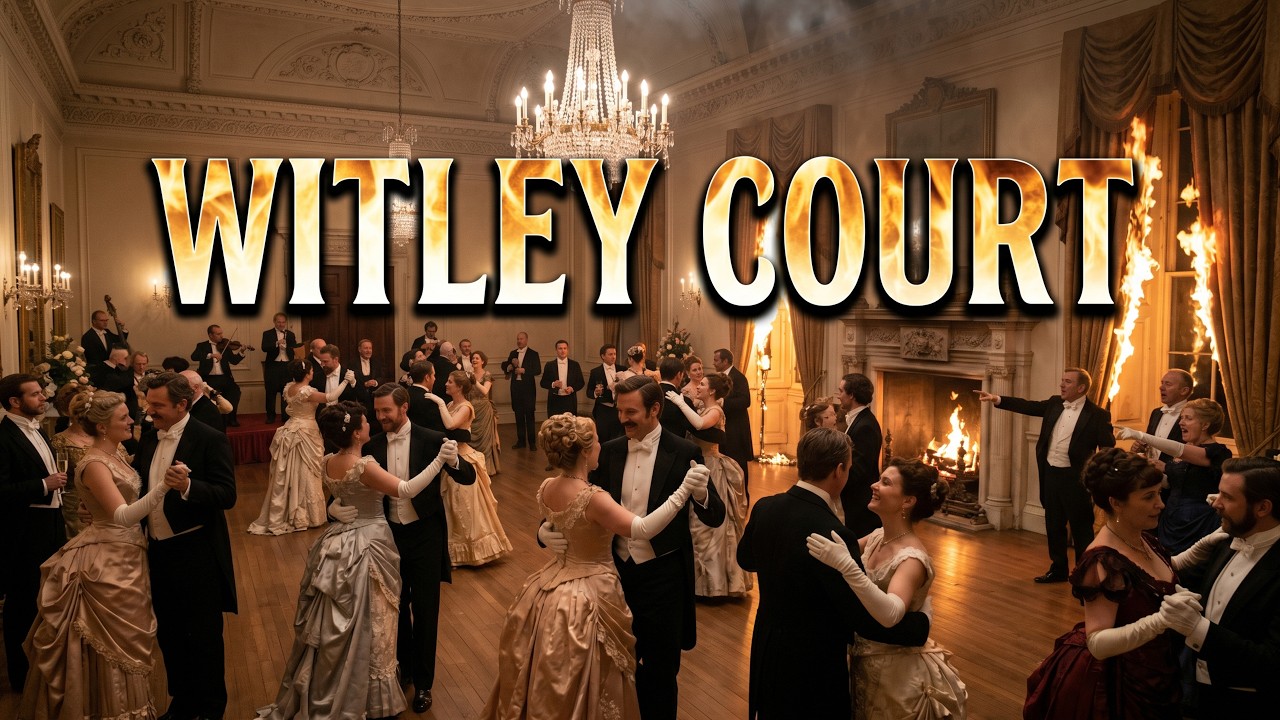
The house grew to over 100 rooms. Inside, Ward gutted the existing interiors and refurnished them in the style of Louis XV. Gilded plaster covered the ceilings. Silk lined the walls.
Marble fireplaces were imported from France and Italy. The state rooms alone consumed fortunes. The ballroom could hold 300 dancers beneath eight vast chandeliers. The dining room seated 60.
The real spectacle was outside. William Nesfield, one of the greatest garden designers of the Victorian age, was commissioned to create the grounds. His masterpiece was the Perseus and Andromeda fountain, one of the largest sculptural fountains ever built in Britain: 20 tons of Portland stone and bronze depicting Perseus rescuing Andromeda from the sea monster. When it operated at full power, the central jet reached 120 feet.
Nesfield called it his monster work. The total cost of the gardens and grounds has been estimated at £250,000, an amount that could have built a small town. The orangeries attached to the south side of the house were modeled on Joseph Paxton’s Crystal Palace. A soaring structure of glass and iron, it housed tropical plants and served as a winter garden where guests could stroll among palms while snow fell outside.
The operational scale of the rebuilt Whitley Court was industrial. Heating the house required 30 tons of coal per day during winter months. The kitchen served meals for a household of up to 100 servants. Twenty-five gamekeepers managed the shooting estates.
The house did not simply sit in the landscape. It devoured resources from it. And this was the point. Ward was not building a home.
He was building a monument to his dead wife, to his own status, to the sheer fact that he could. The second Earl of Dudley, William Humble Ward, inherited the estate in 1885 and married Rachel Gurney in 1891. Rachel was beautiful, socially ambitious, and perfectly suited to the role of hostess at one of England’s grandest houses. Together, they turned Whitley Court into a performance space for the Edwardian elite.
The Prince of Wales, the future Edward VII, visited regularly for shooting parties. The Duke and Duchess of Westminster, Lord and Lady Curzon, politicians, generals, and financiers all came. To be invited to Whitley was to confirm your place in the uppermost tier of English society. The scale of hospitality was extraordinary.
Formal dinners served 200. Outdoor lunches accommodated up to 900. Garden parties offered tea to 850. At Christmas, the great hall held a tree draped not with tinsel but with real jewelry, gifts for the guests.
Shooting parties consumed thousands of birds raised specifically to be killed. Behind all of this, invisible by design, worked the servant army that made the illusion possible. Whitley Court employed approximately 100 indoor and outdoor servants. The architecture itself was designed to keep this workforce hidden.
Service corridors ran behind the main rooms so that a maid carrying a coal scuttle would never cross the path of a guest walking to breakfast. This was the central trick of the English country house: effortless elegance, with the effort made invisible. Twice a week, gardeners replanted entire flower beds between dinner courses so that guests would see a different garden by dessert. It was simply how things were done.
The cost of a single weekend party at a house of Whitley’s scale has been estimated at the equivalent of several thousand pounds in an era when a housemaid earned perhaps £20 a year. By the time the chandeliers were blazing brightest, the coal mines that paid for them were losing money to Germany and America. British industrial supremacy peaked around 1870 and began a long, irreversible decline. Germany industrialized aggressively.
America industrialized on a continental scale. The Black Country iron works that had funded the Foley and Ward fortunes faced competition they could not overcome. The mines around Dudley did not close overnight. They simply became less profitable year by year.
The second Earl responded in the only way the system allowed. He sold things. Between the 1890s and the 1910s, the Ward family divested vast holdings. Estates in Scotland were sold.
Properties in Wales went to market. The Jamaican plantations were disposed of. Each sale bought time. Each sale shrank the foundation on which Whitley Court stood.
The income, which had exceeded £100,000 per year at its peak, began to contract. Estate expenses did not contract with it. The gap between income and expenditure narrowed, then reversed. In 1912, William and Rachel Ward separated.
Two households now operated where one had existed before. Without Rachel, the house lost its function as a social theater. It became merely expensive. Then came the war.
In August 1914, the world that had produced Whitley Court’s golden era was destroyed. The First World War killed a generation of the young men who had danced in the ballroom. The servant class that had made the house function was pulled into factories, uniforms, and graves. The Wards lost two sons in the fighting.
By the end of the war, the world that Whitley Court was built to serve no longer existed. Between 1875 and 1975, approximately 1,200 English country houses were demolished, not burned, not bombed, but deliberately torn down because their owners could no longer afford to maintain them. Whitley Court was not yet among them, but the forces that would destroy it were already at work. The second Earl continued to live at Whitley through the 1920s, but the house was increasingly a shell.
Rooms were closed. Staff were reduced. The gardens received less attention. The fountain ran less often.
It would take only one more shock to start the final collapse. That shock came on a June afternoon in 1920 off the coast of Ireland. On June 26, 1920, Rachel Ward went swimming in the sea off Connemara and never came back. She was 52 years old.
She had been living in Ireland since her separation from the Earl. The details of her death are sparse. She went into the water. The currents off the west coast of Ireland are notoriously dangerous.
Her body was recovered. The coroner’s verdict was drowning. Rachel’s death might seem like a personal tragedy unrelated to the fate of a Worcestershire mansion. It was not.
It was the trigger. The second Earl of Dudley had never recovered from the separation. Within months of her death, he made the decision to sell. The sale of Whitley Court in 1920 was not a private transaction between gentlemen.
It was a liquidation. The estate, which had once encompassed several thousand acres, was broken into hundreds of lots and auctioned. Farms, cottages, woodland, and fields were carved apart and sold. The house itself went to Sir Herbert Smith, a Kidderminster carpet manufacturer whose nickname, widely used behind his back, was “Piggy.
” He paid a fraction of what the Wards had spent on the estate. For 265 years, Whitley Court had been owned by families who understood, or at least attempted, the demands of a great estate. Smith was different. He was not buying a way of life.
He was buying a house. And the house he bought was designed for a way of life that no longer existed. Smith kept six maids and a butler in a house that had needed 100 servants to function. The building did not care about Smith’s budget.
Stone needs pointing. Lead needs inspection. Timber needs ventilation. Plumbing needs maintenance.
A building the size of Whitley Court had miles of plumbing, acres of roofing, and more windows than a small town. Smith’s solution was retreat. He and his family occupied the southwest corner of the house. The rest was closed.
Room by room, the palace shut down. Doors were locked. Dust sheets were laid over furniture. Shutters were drawn.
The grand rooms that had hosted princes fell into silence. The Perseus fountain went quiet. The parterre gardens grew rough. The orangerie began to deteriorate.
Glass cracked. Iron frames rusted. Without constant heating and attention, a glass structure of that size simply cannot survive an English winter. Smith did make some improvements.
He installed electric lighting. But the critical failure was insurance. Whitley Court was effectively uninsurable at full replacement value. Smith insured the house, but for a fraction of its true value.
The policy would cover perhaps a quarter of any major damage. And then there was the fire pump. Every large country house in England maintained its own firefighting equipment. Whitley Court had a fire pump, installed decades earlier during the Ward era when the house had engineers and maintenance staff who could keep it working.
Under Smith’s reduced household, the pump sat untested. No one checked its valves. No one primed its engine. Year after year, the pump rusted in its housing.
Year after year, Whitley Court’s timber roof dried a little more. The fire began in the basement bakery at 8:00 on a windy September evening, and there was almost no one home to fight it. September 7, 1937 was a Tuesday. Sir Herbert Smith was away.
The skeleton staff discovered the fire in the basement bakery. The exact cause was never definitively established. What matters is what happened next. They tried the fire pump.
It would not start. The pump had not been tested in years, perhaps decades. The seals had perished. The mechanism had seized.
The staff did what they could. They formed bucket chains. They closed doors to slow the spread. But a fire in a house the size of Whitley Court, fed by decades of dry timber, old fabric, and wooden floors, moves faster than a handful of people with buckets can contain.
The September wind pushed the flames through the east wing. They found the service corridors, the hidden passages that had once kept the servants invisible, and raced through them like highways. The local fire brigade was called, then brigades from neighboring towns. By the time firefighters arrived, nearly 100 firemen fought the blaze through the night.
But the building’s sheer scale defeated them. There was not enough water pressure. There were not enough hoses. By morning, the house was a shell.
The south front still stood, its Bath stone facade blackened but intact. Nash’s great portico survived. But the core of the house, the state apartments, the ballroom, the grand staircase, the gilded interiors, was gone. The fire destroyed roughly two-thirds of the interior.
Ceilings had collapsed. Floors had burned through. The roof was gone over most of the building. What remained was a stone box open to the sky.
And now the economics delivered their final verdict. Smith’s insurance covered approximately a quarter of the damage. Rebuilding was out of the question. The logic was inescapable: Whitley Court as a functioning building was finished.
Smith tried to sell, but the timing was catastrophic. Europe was sliding toward war. An auction was held in 1938. The contents that survived the fire were sold for pitiful prices.
The fire of 1937 did not kill Whitley Court. It merely confirmed a death that had been decades in the making. The fire pump that failed was the perfect emblem: not a sudden catastrophe, but the end point of a long, slow withdrawal of care, money, and purpose. The fire was not an accident.
It was an inevitability that happened to arrive on a specific date. After the fire came something worse: 40 years of people pulling Whitley Court apart piece by piece. Abandoned and unprotected, the ruin became a quarry. Anyone with a truck and a lack of scruples could drive up and take what they wanted.
Marble chimney pieces were ripped from walls. Lead was torn from the surviving sections of roof. Carved stonework was levered from facades and sold to dealers. The house was disassembled by informal consensus, its components scattered across the antiques trade and the salvage yards.
Some of the removals were more ambitious. Billy Butlin, the holiday camp entrepreneur, reportedly tried to buy the Perseus fountain and ship it to his resort at Skegness. The plan fell through, defeated by the sheer weight and complexity of moving 20 tons of stone and bronze. Bing Crosby was rumored to have inquired about shipping it to America.
That too came to nothing. What did leave the country were the ornamental entrance gates. They were eventually sold and shipped to a resort in Arizona. The gates that had welcomed the Prince of Wales to shooting weekends ended up welcoming tourists to the American desert.
Through the 1940s and 1950s, the ruin sat in its landscape like a broken tooth. Local children played in the roofless rooms. Vegetation crept through the shattered floors. Trees grew inside the house.
Then in 1967, something unexpected happened. Procol Harum, riding the success of their single “A Whiter Shade of Pale,” filmed a promotional clip at Whitley Court. The footage is haunting. Band members wander through the ruins in the diffused light of a gray English afternoon.
It captured the absolute nature of Whitley Court’s existence: a place so ruined that its only remaining function was as a backdrop for a pop song about confusion and loss. It took the British government until 1972 to decide that what was left of Whitley Court was worth saving. A building preservation order had been placed on the ruin in 1964, preventing further deliberate demolition. But a preservation order on a roofless building is like a bandage on a severed limb.
The real intervention came in 1972, when the government issued a compulsory guardianship order. The ruin was taken into state care. The work was painstaking. Walls were consolidated.
Unsafe sections were dismantled and rebuilt. The south facade with its Bath stone cladding and Nash’s colossal portico was stabilized and conserved. The Church of St. Michael, which had survived the fire untouched, was maintained as a functioning place of worship.
Its baroque ceiling, bought from a duke’s demolished chapel two centuries earlier, continued to glow above empty pews. English Heritage took over management in 1984 and began a more comprehensive program of conservation. The grounds were cleared and the garden layout restored. The most dramatic restoration was the fountain.
In 2002, the Perseus and Andromeda fountain was restored to working order. After decades of silence, water once again rose from the bronze figures. In 2003, the freehold of the Whitley Court estate was sold on eBay for £975,000. The trustees had paid £680,000 for the estate in 1837, a sum that would exceed £100 million today.
One hundred and sixty-six years later, the ruin and its grounds sold on an internet auction site for less than the price of a London flat. In 2023, English Heritage launched Whitley Court Re-Imagined, a digital initiative using projection and augmented reality to show visitors what the house looked like at its peak. Visitors could stand in the roofless ballroom and see through their phone screens the chandeliers, the gilded ceiling, the silk walls. The technology made the absence more vivid.
But something at Whitley Court has refused to die entirely. On the surviving wall of the orangeries, a camellia plant still grows. It was planted during the Ward era over a century ago. The fire did not kill it.
The frost did not kill it. The neglect did not kill it. It flowers each spring against the blackened stone, the only living thing at Whitley Court that remembers what the house was. Walk the ruins today and you will see something no visitor during the golden years ever saw.
Where the Bath stone facade has fallen away, the original Jacobean brickwork shows through: red, rough, 400 years old. Each layer of the house’s history is exposed at once. You can read the building like a geological core sample, each stratum representing a different fortune, a different ambition, a different attempt to make wealth look permanent. The Jacobean brick says someone built a modest house here and thought it would last.
The Nash portico says someone covered that house with grandeur and thought grandeur would last. The Bath stone says someone covered the grandeur with even greater grandeur and thought money itself would last. The charred timbers say none of it did. This is what makes Whitley Court more valuable as a ruin than it ever was as a palace.
When the house functioned, it told a lie. It said: this is permanent. This wealth, this power, this way of life will endure. Every room, every fountain, every replanted flower bed existed to sustain that fiction.
The ruin tells the truth. Fortunes rise and fall. Industries boom and contract. Systems that seem eternal, colonial slavery, industrial monopoly, the servant economy, aristocratic display, all have expiration dates.
Walk past the Perseus fountain on one of the days it operates and you can still feel a shadow of the original spectacle. Water rising from bronze, light catching the spray. For a moment, the illusion holds. Then the pump cycles down, the water falls, and you are standing in front of 20 tons of stone in a garden that nobody maintains for the pleasure of a prince.
The church still stands, just yards from the house. Inside, Bellucci’s ceiling paintings glow in the same amber light they have known for nearly three centuries. The church survived because it was built to serve a community, not to impress one. The house was built to impress.
An impression, unlike community, does not outlive its audience. Six hundred and sixty-five people were enslaved in Jamaica to help fund what you see here. A million tons of coal were dug from the earth each year. A hundred servants lived invisible lives so that 300 guests could dance without seeing a maid carry coal.
The fire pump rusted because no one cared enough to test it. The insurance covered a quarter of the damage. The freehold sold on eBay. These are not separate facts.
They are the same story. Whitley Court was built by a system that extracted wealth from labor, from colonies, from the earth, and converted it into stone and spectacle. When the system contracted, the spectacle collapsed. The fire did not destroy the house.
The fire simply arrived after everything else had already left. Stand in the roofless ballroom. Look up. There is no ceiling.
There are no chandeliers. There is only the Worcestershire sky. The birds nest in the walls where silk once hung. Rain falls where dancers once turned.
And the Jacobean bricks, the oldest thing here, the thing every generation tried to hide, are finally the only thing left to see.