When comedian Trevor Moore died on August 6, 2021, at the age of 41, after an accidental fall from his balcony, media outlets from Variety to The Independent honored a request he had made on Twitter roughly a month before his death. He had written that he wanted his obituary to consist of one sentence: “Local Sexpot Dies. ” As news of his death spread, headlines around the world ran with exactly that phrase. Moore was a bundle of contradictions.
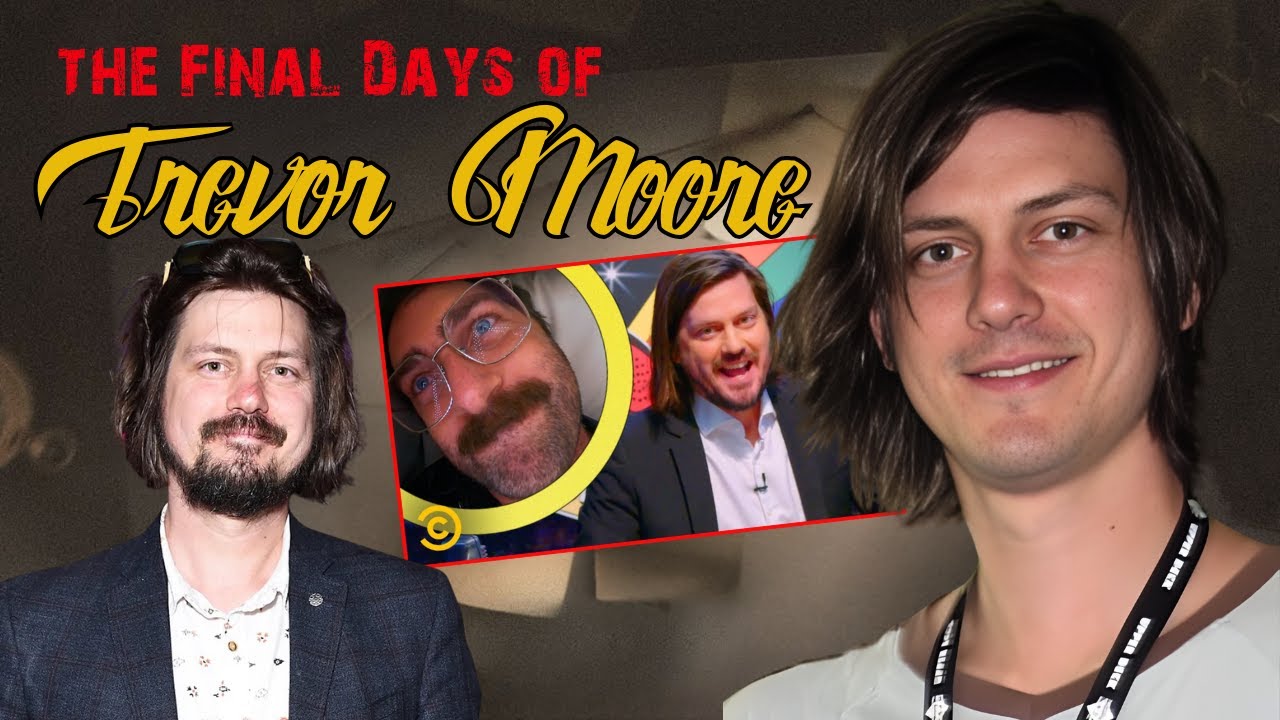
He was the comedian who famously pretended to drink a gallon of PCP on television, yet he was also the creative mind behind family programming for the Disney Channel. He was a child prodigy who became one of the youngest published cartoonists in history, and he was also a man who struggled publicly with severe obsessive-compulsive disorder. Born on April 4, 1980, in Montclair, New Jersey, Moore did not have a typical suburban childhood. His parents, Mickey and Becky Moore, were professional musicians and artists who toured relentlessly, performing Christian folk rock in churches, festivals, and cafes across the country.
They even scored a hit with a love song that reached number two on American Christian music charts. His upbringing was spent largely on the road, immersed in music and performance, with creativity treated as a family profession rather than a hobby. This lifestyle had a profound effect on him. He was constantly the new kid, moving from school to school, which honed his observational skills and made him an expert at reading social dynamics.
He absorbed the sincere faith of his parents’ world, but his naturally questioning, skeptical mind began moving in a different direction. His comedy later became a direct response to that world, dissecting institutions, dogma, and unconditional belief. His 2015 special “High in Church,” filmed in a real church, was the ultimate expression of that impulse. His creative drive was evident early.
By age five, he was creating full comic books. At twelve, while the family was settled in Virginia, he became a professionally published cartoonist with his weekly strip “The Qi” in The Charlottesville Observer. Two years later, in 1994, he compiled his work into a book called “Scraps,” making him officially one of the youngest published cartoonists in history. At sixteen, Moore moved to television, creating, writing, directing, and starring in “The Trevor Moore Show” on Charlottesville’s public access channel.
He and his friends produced bizarre, boundary-pushing sketches that presaged the style of what would later become The Whitest Kids You Know. The show was eventually canceled after a programming error aired one of his more provocative segments during a Saturday morning children’s time slot. To Moore, that cancellation was a badge of honor. He moved to New York City and enrolled at the School of Visual Arts, majoring in film and graduating with honors.
Even before graduating, he secured a prestigious internship at Saturday Night Live, where he observed the legendary production process firsthand and credited executive producer Lorne Michaels as essential to his comic education. He was later accepted into the competitive NBC Page program, where he met his future wife, Amy Carlson, in 2002. They married in 2010 and remained partners throughout his life. At SVA, Moore found his creative family.
He met Sam Brown, Zach Cregger, Timmy Williams, and Darren Trumer, kindred spirits who shared his surreal, irreverent sense of humor. In 2004, the group officially formed The Whitest Kids You Know (WKUK). They began performing live sketches in small, gritty Manhattan venues, building a cult following through word of mouth. Their comedy was raw, experimental, and fearless, blending highbrow intellect with gleeful, shocking absurdity.
Their true innovation was their intuitive understanding of the internet. In 2004 and 2005, before YouTube even launched, they were posting sketches on their own website and using platforms like MySpace to connect directly with fans. When YouTube launched in 2005, they were perfectly positioned, uploading a steady stream of high-quality, professionally crafted sketches at the very moment the world was learning what viral video meant. Their sketches became legends.
“The Gallon of PCP” featured Moore in a classroom announcing he would drink a gallon of the drug, descending into a reality-bending nightmare that broke the fourth wall repeatedly. “Hitler Rap” was a daring, sophisticated parody of celebrity worship and media’s tendency to repackage monstrous figures into consumable stories. They tackled politics, religion, history, and social conventions from a surreal, sideways angle. In 2006, their online popularity and live show buzz became impossible to ignore.
They were invited to the prestigious HBO US Comedy Arts Festival in Aspen, Colorado, where they won the award for Best Comedy Troupe. Suddenly, Hollywood executives were lining up to meet the group that had conquered the digital world, and IFC gave them their own show. “The Whitest Kids You Know” aired for five seasons from 2007 to 2011. When the show ended, Moore didn’t rest.
He had already co-written, directed, and starred in the 2009 film “Miss March” with Zach Cregger, a critical and commercial failure that earned a 5% rating on Rotten Tomatoes. The experience taught him a valuable lesson about the limits of translating their surreal sketch humor into conventional narrative. His next project, 2011’s “The Civil War on Drugs,” was a pure distillation of his style: a feature-length musical comedy depicting the Civil War as a conflict over marijuana legalization rather than slavery. He also launched a prolific solo career as a musical comedian, releasing the album “Drunk Text to Myself” in 2013 and the Comedy Central special “High in Church” in 2015.
In the special, filmed in a beautiful church in Los Angeles, he appeared as a clean-cut folk singer with an acoustic guitar, delivering sacrilegious, brilliant songs about religious hypocrisy, the absurdity of politics, and the superficial kindness of social life. In 2018, he followed with “The Story of Our Times,” a musical special targeting the absurdities of YouTube fame, reality television, and online trolling. Then came the most baffling twist in his career. From 2016 to 2018, he co-created and produced “Walk the Prank” for Disney XD, a hidden-camera prank show for kids.
From 2019 to 2021, he co-created “Just Roll With It” for the Disney Channel, a hybrid family sitcom where actors perform a scripted scene until a buzzer sounds, prompting a live studio audience to vote on absurd, unscripted events that the actors must then roll with, such as the family’s new dog turning out to be a bear or a 300-pound man in a diaper falling through the ceiling. To outsiders, this seemed a contradiction. But Moore saw it as the application of his craft. He had deep respect for the mechanics of comedy, the setup, tension, escalation, and payoff.
A prank is just a sketch with a real audience of one. “Just Roll With It” was structured chaos, using the same core principle of improvisation that defined WKUK, refined into a family-friendly formula. It was also the work of a dedicated family man, a stable job that allowed him to support his wife and son. The key to understanding Moore lies in his lifelong, private battle with severe obsessive-compulsive disorder, which was far from the pop-culture stereotype of cleanliness and organization.
It was a debilitating anxiety disorder, a relentless internal bully operating in a two-part cycle: obsessions and compulsions. Obsessions are uncontrollable, intrusive thoughts that are often violent, sexual, or, in Moore’s case, blasphemous. Compulsions are ritualistic behaviors performed to neutralize the anxiety those thoughts generate. For a child raised in a deeply religious family, the mental torment of such thoughts being directed at God, Jesus, and family was devastating.
His entire career can be seen as a form of coping. He channeled the relentless stream of disturbing thoughts into fabricated, structured comedy. The WKUK sketch “God Says,” from his 2015 special, is perhaps the most clinically precise and compassionate portrayal of OCD in popular media. Dressed in bright, friendly attire, Moore sings an upbeat Sunday-school-style tune in which God demands he touch a doorknob thirty times or his father will die of cancer, escalating to even more graphic threats against his family.
It perfectly captures what psychologists call magical thinking, the escalation of fear, and how OCD targets what you love most. Moore’s work with Disney becomes even more interesting through this lens. “Just Roll With It” was literally a game show built on his daily experience of living a normal life interrupted by sudden, chaotic, absurd intrusions from his own mind. He turned his disorder into a competition format for the Disney Channel, a feat of psychological ingenuity that is difficult to fully comprehend.
In 2020, the pandemic brought the world to a standstill. For Moore, a man whose life depended on stages and studios, this could have been devastating. Instead, he launched a YouTube quarantine show, broadcasting sketches and songs directly from his home. He also reunited with Zach Cregger for a weekly live-streamed news show called “News Boyz.
” The entire WKUK group began production on their most ambitious project yet, a feature-length animated musical film called “Mars,” funded through a massively successful crowdfunding campaign that demonstrated the enduring loyalty of their fanbase. On the night of August 6, 2021, Moore and Cregger recorded another episode of “News Boyz” from their respective homes. It was a normal Friday. Hours later, Moore died instantly from an accidental fall from the upper-story balcony of his home.
The official coroner’s report confirmed an accidental fall with a blood alcohol level of 0. 27%, more than three times the legal driving limit. There was no warning, no long decline. He was 41 years old, at the peak of his creative powers.
The news sent shockwaves through the comedy world. Friends and family expressed grief and disbelief. Zach Cregger called it a stupid, accidental tragedy. Some outsiders tried to construct a narrative of a troubled artist drinking himself to death, but those closest to him rejected that simplification.
The truth, as those who knew him insisted, is that all things can be true at once: he was a devoted husband and father, a brilliant professional, a man who struggled with severe mental illness, and a man who overindulged one night, leading to a random, fatal accident. Moore’s death was a cruel, absurd final twist for a man whose entire life was a war against chaos in his mind. He built structures, wrote songs with precise rhyme schemes, and created sketches with impeccable logic. He fought his inner demons every day and won, transforming their energy into a remarkable body of work.
In the end, it wasn’t the internal chaos he fought so masterfully that killed him, but an utterly random moment of external chaos. His legacy extends far beyond one sketch or one show. He was a genuine pioneer of internet media, one of the first groups to prove that a massive fanbase could be built entirely online and then leveraged into mainstream success. His journey from a personal website to winning the best sketch troupe award at the HBO Comedy Festival to a five-season run on IFC was a blueprint for countless digital creators who followed.
He was a true multi-hyphenate, moving seamlessly from the most controversial religious satire in “High in Church” to polished, structurally innovative family content for Disney. This wasn’t a contradiction but a sign of his almost frightening mastery of his craft. He was an engineer of comedy, understanding structure, timing, and escalation on an academic level. Perhaps his most enduring significance lies in his bold exploration of the human mind.
His willingness to take his most personal, painful struggle with OCD and turn it into art was an act of profound courage and empathy. “God Says” is more than a brilliant sketch; it’s a lifeline for millions suffering from obsessive-compulsive disorder, especially those with religious or harm-related obsessions. He gave a voice to silent, misunderstood suffering, proving that comedy could be not just an escape from pain but a means of confronting it, processing it, and ultimately controlling it. As his friend and WKUK partner Sam Brown said in his eulogy, “He was our best friend and leader.
He was our Trevor. ” When Moore tweeted that he wanted his obituary to be one sentence, “Local Sexpot Dies,” it was more than a joke. It was a comedian’s final attempt to write his own epitaph, to have the last word and control the narrative one last time. His posthumous works, including the animated film “Mars,” which was completed and released in 2024, were final gifts from a mind that never stopped generating ideas.
His tragic, accidental death remains a raw, illogical joke at the end of a life that was anything but. His legacy lies not only in the laughter he created but in the boundaries he broke down between internet and television, between adult humor and family entertainment, and between deep personal pain and brilliant public comedy. He was a rare talent, combining bold, excessive absurdity with fierce, undeniable intelligence.
He was, and remains, a unique figure and truly a local sexpot.