In March 1987, a California Air National Guard fighter jet carrying Dean Martin’s eldest son vanished from radar over the mountains east of Los Angeles. When the wreckage was found days later, there were no survivors, and the people closest to the entertainer said something in him changed permanently. The public had long seen Martin as the effortlessly charming, slightly tipsy singer who never seemed to have a serious care. Behind that image was a man who spent his life guarding his private self.
He gave few interviews, wrote no memoir, and left behind no diary, and even his wives and children often felt they could only see him through a pane of glass. Dean Martin was born Dino Paul Crocetti on June 7, 1917, in Steubenville, Ohio, where his Italian-speaking family settled among the steel mills. The story his daughter Dena later recorded was that when he entered school speaking almost no English, other children laughed at him. Decades later, he told her in a single sentence that he had learned early that if you said nothing, no one could laugh at you.
By 16, he was dealing blackjack in a local establishment known as the Rex Cigar Store. Friends and biographers would later debate how deep his ties ran in that world, but the experience left a clear mark. In a room full of dangerous men, he watched who stayed silent and who lost composure, and he understood that the safest man was the one whose face gave nothing away. He tried boxing under the name Kid Crochet, eventually earning a broken nose and a scarred lip that plastic surgery would later smooth.
Meanwhile, he was singing. After changing his name to Dean Martin, he spent the early 1940s working small clubs and nightclubs, trying to make a living as a professional singer. In 1941, he married Elizabeth Anne “Betty” Macdonald. Over the next seven years, they had four children, Craig, Claudia, Gail, and Dena, while Dean traveled constantly.
Betty largely raised the children alone, and the surviving accounts describe a man who could be physically present yet emotionally difficult to reach. She began to drink, and by the mid-1940s, the marriage was quietly falling apart. On July 25, 1946, Martin walked onto a stage at the 500 Club in Atlantic City with a 20-year-old comedian named Jerry Lewis. Neither had been drawing much of an audience alone.
What happened that night, as both men later described it, was an instant click, with Lewis interrupting Martin’s songs and Martin responding with perfect deadpan composure. Within a year, Martin and Lewis were the hottest act in America. Together, they made 16 films at Paramount, played the Copa Cabana, appeared on radio and television, and became the biggest act in the country. But behind the scenes, the partnership was eroding.
Critics increasingly treated Lewis as the genius and Martin as a pleasant accessory, and Lewis, who idolized Martin, wanted a closeness Martin could not give. On July 25, 1956, exactly 10 years after they first shared a stage, they played their last performance together. By Jerry Lewis’s account, Martin told him that he could talk to him about anything except business, and the two men did not meaningfully speak for the next 20 years. The industry assumed Martin’s career was over, but he quietly rebuilt it.
He recorded songs, took film roles, and in 1958 appeared opposite Marlon Brando and Montgomery Clift in The Young Lions. The following year, Howard Hawks cast him in Rio Bravo alongside John Wayne, where he played a real, broken drunk with startling restraint. Critics who had written him off began to reconsider. His personal life had moved on as well.
He divorced Betty in 1949, and on September 1 of that year married a young model named Jeanne Biegger. She raised his first four children, gave him three more, Dean Paul Jr. , Ricci, and Gina, and seemed to understand him without trying to break through his reserve. Jeanne later spoke of their marriage without bitterness.
Dean could share a house, children, meals, and decades of history and still seem to keep rooms inside himself he did not invite anyone to enter. In January 1960, at the Sands Hotel in Las Vegas, Frank Sinatra gathered Martin, Sammy Davis Jr. , Joey Bishop, and Peter Lawford on the Copa Room stage. The group, soon called the Rat Pack, became a phenomenon, selling out showrooms and helping define Las Vegas glamour for decades.
Martin stood at the center of it, glass in hand, tie loosened, looking like a man with no cares at all. The glass, however, was part of the performance. People who worked with him repeatedly said his stage drink was often apple juice or iced tea. The slurred, half-drunk singer was a carefully constructed act.
He knew every word of every song, rehearsed exactly where he would appear to stumble, and controlled the room by seeming to control nothing. In September 1965, NBC gave him The Dean Martin Show. It ran nine seasons and drew tens of millions of viewers weekly at its peak. He became famous for minimal rehearsal and spent his home evenings watching old westerns until he fell asleep in his chair.
Gena watched, and after a while, the distance between them became part of the marriage’s structure. In 1973, after 24 years, they divorced quietly, without drama or public statements. Jeanne remained the central woman in his life until his death. Within months, Martin married again, a woman in her mid-20s named Catherine Hawn who worked at a Beverly Hills hair salon.
The marriage lasted about three years. Dena later wrote that after her mother left, her father seemed frightened by the emptiness of the house and did not know what to do with the silence. In September 1976, Frank Sinatra engineered a reunion. During Jerry Lewis’s Labor Day telethon, Sinatra brought Martin onto the stage without warning.
The two partners, who had not spoken for 20 years, embraced on live television. Jerry, in tears, asked why they had waited so long. Martin replied with a small joke and steered the moment away from raw emotion, as he always had. Dean Paul Martin, the eldest son of Dean and Jeanne, had long occupied a special place in the family.
Known as Dino, he was open and affectionate in a way his father had never quite managed. As a teenager, he found fame in the pop trio Dino, Desi, and Billy. Later, he pursued tennis seriously, reaching qualifying rounds at Wimbledon, and then became a captain in the California Air National Guard, flying F-4 Phantom fighter jets out of March Air Force Base. On Saturday, March 21, 1987, Captain Dean Paul Martin took off on a routine training flight with his weapons systems officer, Captain Ramon Ortiz.
Winter weather had reduced visibility over the San Bernardino mountains. Within minutes, the Phantom disappeared from radar. Searchers found the wreckage on Wednesday, March 25 on a steep slope at about 5,500 feet. Both men died instantly.
For the family, the uncertainty of those days was replaced by something worse. A private military memorial was held on April 1, 1987 at the Los Angeles National Cemetery. Frank Sinatra, Sammy Davis Jr. , Jerry Lewis, and other friends attended.
Martin wore dark glasses and said little. Photographs captured a man in grief, but what the family later described was a permanent change. He became more inward and less interested in the public world. Less than a year later, Martin agreed to join Sinatra and Davis for a reunion tour called Together Again.
It opened in Oakland on March 13, 1988, to a sold-out crowd. Reviews noted flashes of the old timing, but also diminished vitality. After a Chicago performance, Martin returned to Los Angeles and entered Cedars-Sinai with a flare-up of a long-standing kidney condition. He did not return to the tour’s original lineup.
Sinatra and Davis continued, and later Liza Minnelli joined in his place. After leaving the tour, Martin’s public career narrowed sharply. He still made occasional appearances, but the expectation that performing would organize his life had ended. He settled into a quiet routine in Beverly Hills.
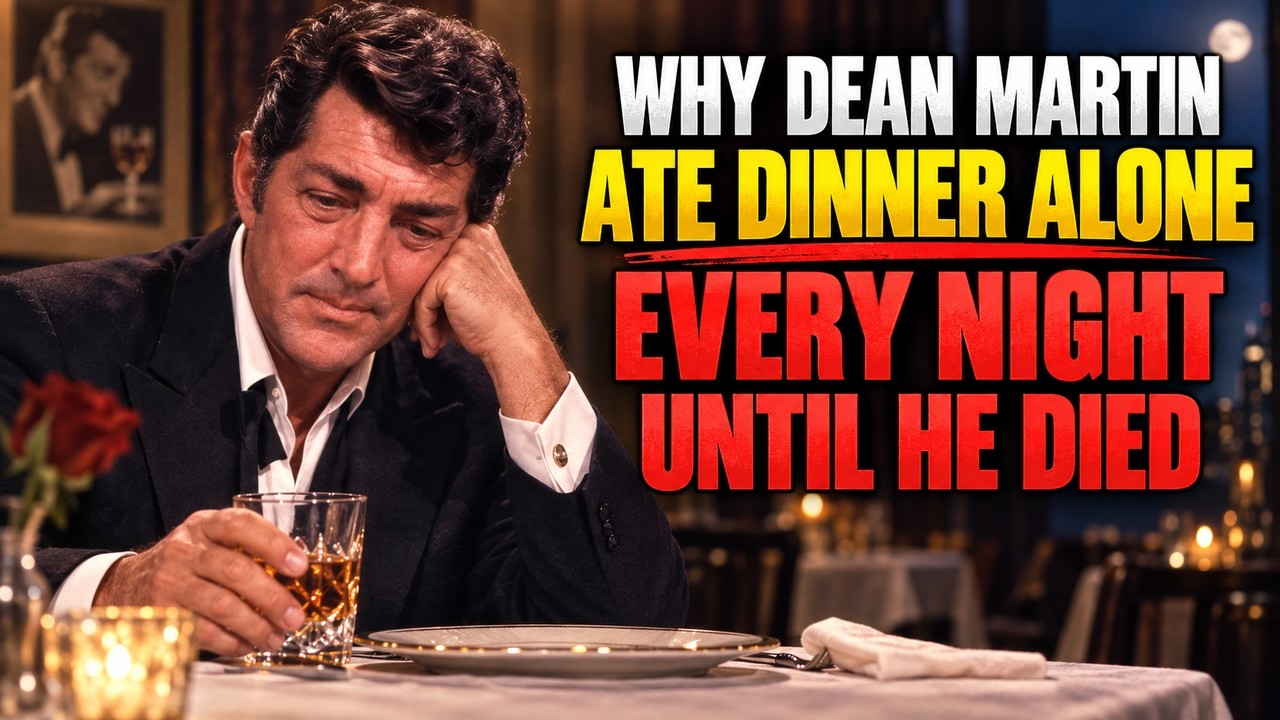
He often ate dinner alone at an Italian restaurant called La Familia, where the staff knew to leave him alone. A later story claimed he always sat with an empty chair reserved for his lost son; that specific version is romantic mythology. What is well attested is that he regularly ate those quiet dinners alone. By the end of the 1980s, the world Martin had inhabited was disappearing around him.
Sammy Davis Jr. died in May 1990, and Martin attended the funeral. Dena wrote that on the drive home, her father sat in the back of the car, looked out the window, and did not speak once. In September 1993, he was diagnosed with lung cancer.
Doctors recommended surgery. He refused it. On the morning of December 25, 1995, Dean Martin died at his home in Beverly Hills. He was 78.
The immediate cause was acute respiratory failure, complicated by the lung cancer and lung disease. Frank Sinatra released a short statement through his office, saying that Dean was his brother, not through blood but through choice. Las Vegas dimmed the marquees of several major hotels for 10 minutes in his memory. He was buried on December 28, 1995 at Westwood Village Memorial Park.
His grave bears his name, the dates of his birth and death, and one line: “Everybody loves somebody sometime. ” In accordance with his life, the marker is small and quiet. No final explanation of Dean Martin’s reserve was ever discovered. He left no diary, gave no last confession, and never handed the world the key it wanted.
What remains is the pattern his family described: warmth, generosity, humor, and a distance that could not be crossed. The pane of glass remains not as a verdict, but as a question. How much of another person can we ever really know? He loved, and he was loved.
Beyond that, the silence belongs to him.