Every autumn, the five most powerful men in Sparta—the ephors—performed a ritual that made state-sanctioned murder possible. They stood before the gods and formally declared war on their own slaves. With that single legal declaration, the Helots became an enemy in a war they never knew had begun. And young Spartan men were sent into the hills with hidden daggers to prove their worth by killing the strongest and most dangerous of them, without being caught.
The Krypteia, meaning “the hidden thing,” was the final secret trial of the Spartan state upbringing known as the agoge. Boys chosen for this trial were stripped of the red cloaks that marked them as Spartans, given a short iron blade, and sent into the wilderness. Their orders were simple: find the Helots who stood tallest, who held their gaze without flinching, who carried themselves with pride, and kill them. If they were caught, the state would deny they ever existed.
Sparta had not enslaved a scattered collection of captives. It had conquered an entire people—the Messenians—and bound them to the land they had once owned freely. The first war came in the late 8th century BC and dragged on for 19 years. The second came a lifetime later.
After two grinding defeats, the Messenians were swallowed whole and chained to their own soil. Helots could own no weapons, were beaten a set number of times each year simply to remind them of their place, and were forced to wear dogskin caps and animal hides as permanent markers of their servitude. Half of everything they grew was taken by their masters. Even their grief was commandeered: when a Spartan king died, Helots were marched to the funeral and made to wail on command.
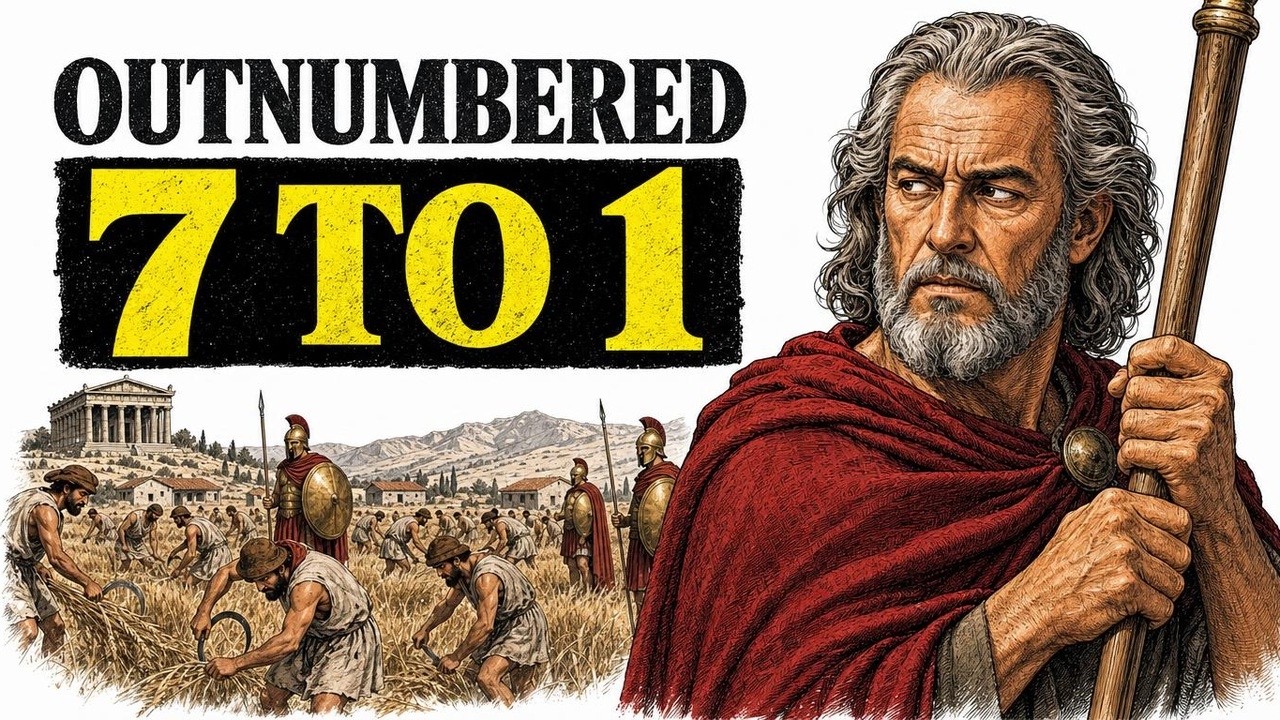
This system produced a society trembling at its own foundation. By the time of the Battle of Plataea in 479 BC, historian Herodotus recorded that 5,000 Spartan citizens marched out accompanied by 35,000 Helots—seven attendants for every single hoplite. The arithmetic was plain: Sparta was a small armed camp of masters surrounded by a captive population that hated them and vastly outnumbered them. Every law, every alliance, every campaign was weighed against one question: what happens if the Helots rise while the army is far from home?
That fear was made flesh in 464 BC, when a catastrophic earthquake tore through the Laconian Valley. Plutarch wrote that only five houses in all of Sparta were left standing. Thousands died in a single afternoon. When the survivors stumbled through the rubble, the Helots rose from the fields, seizing scythes and picks, and moved to finish what the earthquake had started.
The revolt seized Mount Ithome, the ancient spiritual heart of Messenia, and defied the greatest land army in Greece for nearly a decade. Sparta was forced to ask Athens for help, then abruptly dismissed the Athenian force out of fear that free-thinking Athenians might join the Helots. That insult broke the friendship between the two cities and helped set Greece on the path to the Peloponnesian War. The revolt was finally crushed, but it never left Sparta’s memory.
Every institution of the state was re-knotted with a single aim: never again. From that terror came the full hardening of the agoge. Spartan boys were taken from their mothers at age seven, kept perpetually hungry, and forced to steal their food. A boy caught stealing was flogged, not for the theft, but for being caught.
One boy, hiding a stolen fox beneath his cloak, supposedly stood silent while the animal tore open his belly rather than reveal himself. He died with the cloak still closed over the wound, and was held up as a model for the young. The boys slept on beds of reeds torn by hand from the riverbank, were whipped at the altar of Artemis Orthia in a rite that sometimes ended in death, and were trained to swallow pain and show nothing. The goal was not simply to make soldiers; it was to make masters.
Men capable of holding down a captive nation for a lifetime. Men who could order a Helot beaten and feel their own pulse stay level. The ephors were the true power behind this machine. Five men chosen fresh each year, they could sit in judgment over kings and steered internal security.
And it was they who chose the boys for the Krypteia. They watched for a particular turn of mind: the quiet, the watchful, the cunning. The boy who studied a kitchen for days before stealing his supper, who saw an opponent’s weakness and struck without hesitation. These were not necessarily the finest soldiers; they were recruits for Sparta’s intelligence core, its assassins.
The chosen boys were sent out alone into a countryside that, by decree, was war zone. By day they hid in caves and thickets, watching the Helots work the fields. By night they moved along the paths, waiting for their targets. The solitude and terror were part of the design.
After a decade of being trained entirely as part of a pack, the boy was reforged into something that could kill alone, trusting nothing but his own ears, reasoning, and knife. The killing was never mindless. Plutarch, drawing on a lost work by Aristotle on the Spartan constitution, wrote that the youths were to seek out the strongest and most spirited Helots. Some, he added, even worked in daylight, cutting down dangerous-looking Helots on the roads in the open.
The point was to prune the captive population of its natural leaders, to cut down the men who could one day become the spark of revolt, before they understood themselves to be leaders. The Krypteia was a slow war against hope itself. Yet the same state that trained its boys to kill in secret built its public glory on a different ideal: the phalanx, men locked shield to shield, who fought and died as one body. At Thermopylae in 480 BC, the Spartans joked in the face of death and never left the line.
But the boy who joked as Persian arrows darkened the sun had most likely once lain in a thicket with a dagger, waiting for a farmer to walk home. The honor of open battle and the terror of the hidden blade were two faces of one coin. The flawless discipline that men praised on the battlefield was bought with the pitiless work done in the dark at home. When Sparta needed to kill on a larger scale, it did so with equal coldness.
Around 424 BC, during the Peloponnesian War, an Athenian force seized Pylos and became a magnet for runaway Helots. Frightened as never before, Sparta announced that any Helot who had proven himself brave would be given his freedom. About 2,000 came forward—the boldest and best. They were crowned with garlands and led in a procession past the temples, a public celebration of their new freedom.
Then they vanished. Thucydides records that no one ever learned how each of them had been killed. Sparta believed the proudest, the ones who came forward first, would be the first to turn on their masters. The ceremony had been a trap designed to draw the dangerous ones into the open.
The message written in those 2,000 deaths was plain: there is no way out. Service will not save you. Bravery only marks you for the knife. The poison of this system ate away at Sparta’s nerve.
A state that must watch its slaves every hour cannot look outward with confidence. When the Persian threat loomed, Sparta sent Leonidas to Thermopylae with only 300 men; the main army stayed behind to guard the slaves. The finest army in Greece was chained to the ground it stood on, unable to campaign far from home without risking an uprising behind it. The poison also thinned the blood of Sparta itself.
To hold full citizenship, a man had to own a plot of land and pay a monthly share into the common mess. Men who fell into debt or lost their land were cast down among the inferiors, with no way back. Over generations, wealth pooled among a shrinking circle of families. Aristotle wrote that Sparta could have supported 1,500 cavalry and 30,000 hoplites, yet the number of full citizens had sunk below 1,000.
The machine built to breed a master race was eating its own young. Around 399 BC, a plot led by a man named Cinadon, who had been shut out of citizenship, was uncovered. He told his questioners he wished to be inferior to no man in Sparta. He planned to arm the inferiors, the Helots, and the Perioikoi.
The ephors seized him, tortured him for names, and killed him. The hatred was not only in the fields; it was inside the walls. The reckoning came on the plain of Leuctra in the summer of 371 BC. The Theban commander Epaminondas threw out the standard Greek formation.
He thinned his center and packed his best men, including the Sacred Band under Pelopidas, into a single column 50 shields deep, aimed at the heart of the Spartan line. The Spartan cavalry, which Xenophon described as poor, broke and fell back into its own infantry, throwing the ranks into confusion. The column of 50 rolled forward and smashed the Spartan phalanx apart. For the first time in living memory, Spartans broke and ran.
Of 700 Spartiates on the field, 400 died. The defeat shattered the myth of Spartan invincibility. Epaminondas then did what no invader had dared in centuries: he marched into Laconia itself. He crossed the Eurotas River and camped within sight of the unwalled city.
Then he turned west, crossed the passes of Taygetus, and entered Messenia. There he declared Messenia free, summoned home the exiled Messenians who had kept their language and grief alive for three centuries, and raised a new capital, Messene, on the slopes of Mount Ithome. The walls he built were so strong that later travelers stood amazed, and much of that stonework still stands today. That single stroke ended Sparta.
With Messenia gone, Sparta lost close to half its land and the entire slave population that had fed its economy. The warrior class forged in the agoge and tested in the Krypteia had no Helots left to hold. The training, the dominance, all of it drained away. Sparta shrank into a shell, a museum piece.
Later Roman tourists came to watch boys being flogged at the altar of Artemis Orthia, a show staged for outsiders. The power was gone, and it never came back. In the end, the slaves buried the masters. The boy on the slopes of Taygetus, gripping his blade in the dark, believed his killing was a necessary gift to his people.
He was wrong. The Krypteia was never a show of Spartan strength; it was the plainest confession of Spartan weakness ever made. A civilization built to manufacture the perfect warrior, to hold down a captive nation, was consumed by the very fear it had created. The men it hunted for three centuries—the strong, the proud, the defiant—outlived it.
Messene stood free for the rest of antiquity, its walls unbroken. Sparta became a name in a guidebook.