Julius Caesar was assassinated on the Ides of March in 44 BCE, but the details of that infamous day are far more chaotic and unsettling than the version taught in most history classes. Medical examination after his death revealed that of the 23 stab wounds he suffered, only one was actually fatal. The other 22 were shallow, panicked strikes, many barely breaking the skin, a pattern that suggests terror and frenzy rather than a calculated political execution. Caesar had dismissed his personal bodyguard in the weeks before his death, believing that a leader of Rome should not need soldiers to walk through his own city.
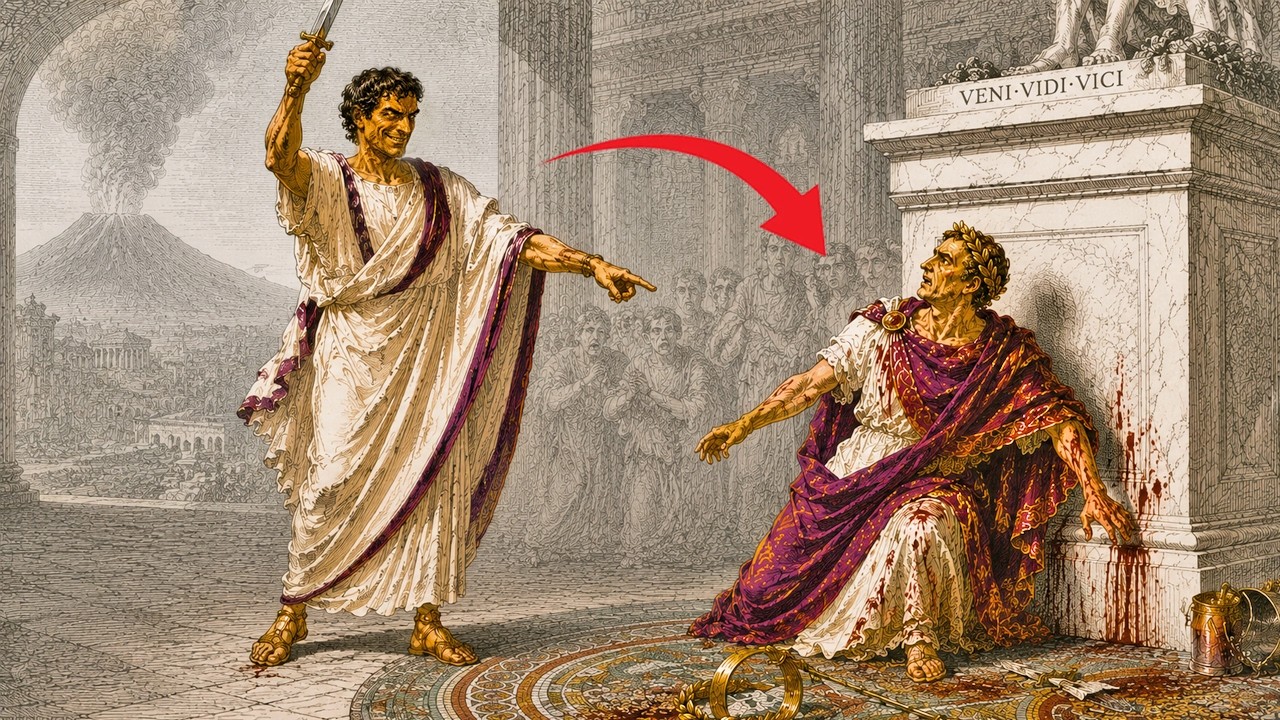
He was 55 years old, had been declared dictator for life, and was walking unarmed to a Senate meeting when a man named Artemidorus pressed a letter into his hand. The letter contained the names of every senator planning to kill him that day. Caesar never read it, tucking it away with other petitions before continuing his walk. The conspiracy involved roughly 60 men, including several whom Caesar had pardoned, promoted, or named in his will.
Among them was Decimus Junius Brutus, a trusted general and secondary heir in Caesar’s will, and Marcus Junius Brutus, whose mother Servilia had been Caesar’s lover for decades. Ancient rumors, never confirmed or disproven, suggested Caesar may have been Brutus’ biological father. In the days before the killing, the conspirators argued over whether to also kill Mark Antony, Caesar’s co-consul. Cassius pushed for it, warning that Antony would not go quietly.
Brutus objected, insisting that killing more than Caesar would make them look like butchers rather than liberators. Brutus won the argument, and Antony was spared, a decision that sealed the conspirators’ fate. On the night before the assassination, Caesar’s wife Calpurnia woke up screaming from a nightmare. Ancient sources differ on what she saw, but she begged Caesar not to attend the Senate meeting.
Caesar agreed and sent word that the session was postponed. Then Decimus Brutus arrived and talked him out of staying home, mocking the dreams and appealing to Caesar’s pride. Caesar changed his mind and left with the man who would help kill him. On the walk to the Senate, Caesar passed the soothsayer Spurina, who had warned him weeks earlier to beware the Ides of March.
Caesar smiled and noted that the Ides had come. Spurina replied that they had come but not gone. When Caesar entered the Curia Pompeia, an annex of the theater complex built by his defeated rival Pompey, he sat beneath a statue of Pompey. The conspirators surrounded him under the pretense of presenting a petition.
Tillius Cimber grabbed Caesar’s toga as the signal, and the attack began. The first blow came from Casca, who struck desperately and shallowly. Caesar grabbed his arm and shouted in protest, but the blades kept coming. According to ancient sources, Caesar initially fought back, using a stylus to jab at his attackers.
He tried to break through the crowd of men pressing around him. But the scene was chaotic. In the tight space, several conspirators wounded each other with their own blades. The killing was not a dignified execution but a panic-driven rush by men largely untrained in violence.
When Caesar saw Marcus Junius Brutus in the crowd, he stopped fighting. Some ancient sources record that he spoke in Greek, asking, “You too, child? ” The famous phrase “Et tu, Brute” was invented by Shakespeare centuries later. Caesar then pulled his toga over his head, a gesture of dignity, and fell at the foot of Pompey’s statue.
After the assassination, the conspirators marched to the Forum expecting to be hailed as liberators. Instead, they found the city empty and barricaded. The Senate later granted them amnesty but refused to declare Caesar a tyrant or to condemn his killers. Mark Antony, who had been spared at Brutus’ insistence, seized Caesar’s papers and treasury, and asked to deliver the funeral oration.
Antony used the speech to turn the crowd against the conspirators. He displayed Caesar’s bloody toga, pointed to each wound, and read from Caesar’s will, which left money to every Roman citizen. The crowd erupted, burned Caesar’s body on a makeshift pyre, and marched on the homes of the assassins. Brutus and Cassius fled the city.
Within two years, both Brutus and Cassius were dead, defeated at the Battle of Philippi. Decimus Brutus was captured and executed while fleeing. Other conspirators met similar fates. The Republic they claimed to save did not survive.
Within 13 years of Caesar’s death, his adopted heir Octavian defeated all rivals and became Augustus, the first Roman emperor. The site of the assassination is often misidentified. Caesar was not killed in the Roman Forum, but in the Curia Pompeia, located in what is now the Largo di Torre Argentina, a busy square in central Rome.
Today, the ruins where Caesar bled out are home to a cat sanctuary, where feral cats sleep on the stones where one of history’s most famous killings took place.